The Hard Reality of Our Time


John Walter recently shared an "inventory of possibilities" to Substack describing conditions, in five regions of the United States, where vulnerabilities and a convergence of failures might trigger a cascade of disaster in which existing conditions could be forced beyond their limits. The susceptible regions and concerns discussed are: Northeastern density, California's agriculture, Florida's sea level rise, the heat of the desert Southwest, and the seasonal demands of the industrial Midwest.
WORLD OCEAN RADIO
World Ocean Radio is a weekly series of five-minute audio essays available for syndicated use at no cost by college and community radio stations worldwide, providing coverage of a broad spectrum of ocean issues from science and education to advocacy and exemplary projects. Episodes of World Ocean Radio offer host Peter Neill's perspectives on global ocean issues and viable solutions, and celebrate exemplary projects. Subscribe, rate and review: every share, star, and endorsement helps to sustain World Ocean Radio.
Image: usgs.gov
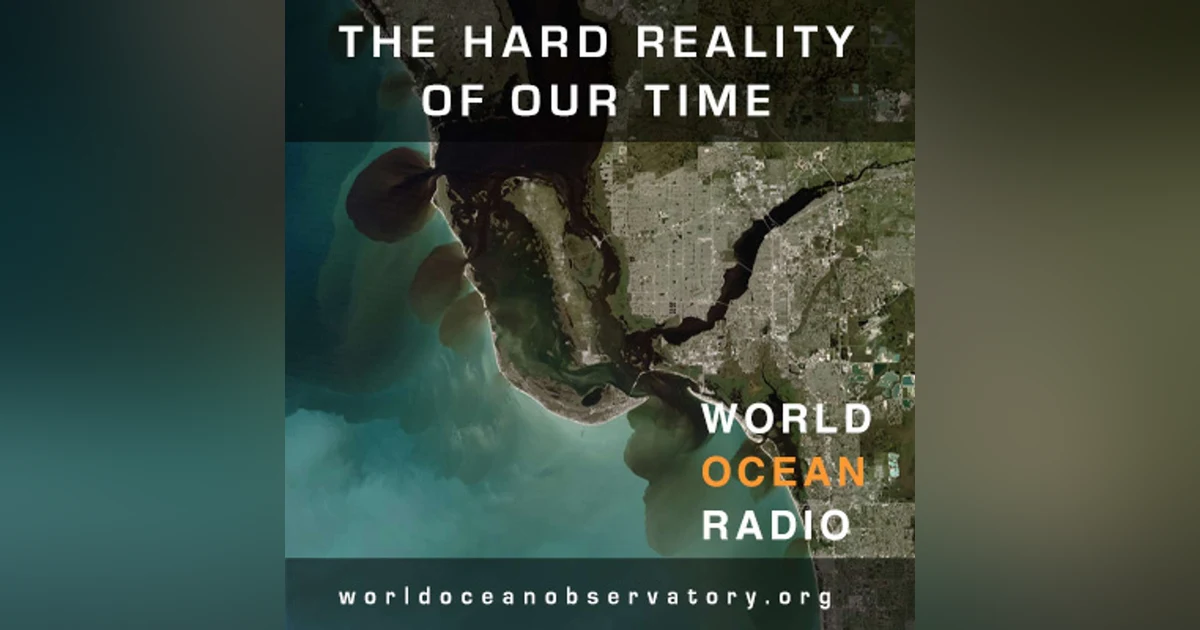
Landsat 7 Captures Hurricane Ian Aftermath Detailed Description On October 2, 2022, this gap-filled Landsat 7 image captured brownish-black sediment runoff from rivers and streams on the southwest coast of Florida. These are the first Landsat images after Hurricane Ian devastated the area on Wednesday, September 28. Water runoff can carry away debris, fertilizers, metals, and other pollutants.
[intro music, ocean and wind sounds]
Welcome to World Ocean Radio…
I’m Peter Neill, founder of the World Ocean Observatory.
Things are intensifying politically, socially, and financially seen from where I sit here on the coast of Maine. My congenital optimism is severely challenged by these circumstances, and I am compelled to say why. Last week John Walter posted to Substack describing what he called “an inventory of possibilities” where a convergence of failures might trigger a cascade of disasters in five areas of the United States where existing conditions might be forced beyond limits with devastating regional, if not national disaster. This will be a hard listen, but we had best pay attention to the hard logic of his analysis and its consequence.
Link to John Walter's substack: https://johnwalter25.substack.com/p/the-5-places-in-america-you-dont
He describes five conditions, by region, with specific vulnerabilities that pertain. First, Northeastern Density and Interdependence: the corridor between Washington and Boston, where 50 million people reside in a blended metropolis operating with an infrastructure – rail, bridges, highways, the electrical grid and energy distribution – is deemed “functionally obsolete,” at the margins of capacity that a hurricane or other sudden intervention could bring to a standstill with immediate, total disruption of social control.
A second condition is Caifornia’s Agricultural Mirage: When the Water Stops, where urban sprawl and the concentration of agricultural production that provides a vast majority of food nationwide is already showing the impact of drought, wildfire, reduction of essential water supply by rivers, dams, reservoirs, aqueducts, wells, and pumps, not to mention ongoing seismic activity – a concentration of food system production that could collapse in a single growing season should conditions continue or accelerate. The Colorado River water distribution system, exacerbated by drought and diminished mou ntain snow melt, is already challenged to extreme: again, an unpredictable additional event could trigger economic and social chaos with negative impact nationwide.
A third condition is Florida’s Sinking Peninsula: the Physics of Water and Salt where sea level rise, coastal erosion, extreme heat conditions, depleted aquifer and freshwater supply, and underground subsidence already threaten the viability of the region to an extent that insurance companies and the national government are no longer providing coverage to coastal property, for storm relief and reconstruction, emergency response, evacuation, and relocation of a vast population equally displaced as those in far west and northeast.
The fourth condition is Phoenix and the Thermodynamic Ceiling, the already evident record temperatures that amplified by consumption, air conditioning, local reservoir evaporation, and lack of rainfall has rendered the desert southwest nearly uninhabitable, putting to test the survivability of outdoor workers, young children, the elderly, and support institutions like hospitals, rescue and social services that cannot meet the survival needs of a population stressed by thermal danger.
And finally, the fifth condition, The Industrial Midwest: When the Pensions Run Dry where seasonal exigencies of extreme heat and extreme cold create conditions no longer amenable to past work patterns, infrastructure dependency, industry demands, housing, transportation, maintenance, community dislocation, financial and social stability – indeed, all the expectations for survival.
At any point, any one of these extremes, anywhere, could metastasize without warning, with unmanageable outcome locally, with obvious reverberation beyond, nationwide.
There are two underlying realities for this situation. First, they are all the result of a national failure to understand climate change and to meet its challenge at every level of government; of failed leadership through political denial, and of irresponsible indifference to the obvious even still, today, when we are all experiencing conditions that foretell a coming disaster. And second, they all involve water, the lack thereof, to sustain growth, health, finance, stability, continuity, and the lives of present and future generations. We have subverted our best interest to vested interest and worst intention, and we have placed all of us, each of us, everywhere at risk by so doing. This is the hard reality of our time. What will it take?
We will discuss these issues, and more, in future editions of World Ocean Radio.
WORLD OCEAN RADIO IS DISTRIBUTED BY THE PUBLIC RADIO EXCHANGE AND THE PACIFICA NETWORK, FOR USE BY COLLEGE AND COMMUNITY RADIO STATIONS WORLDWIDE. FIND US WHEREVER YOU LISTEN TO PODCASTS, AND AT WORLD OCEAN OBSERVATORY DOT ORG.
[outro music, ocean and wind sounds]