Blue Nitrogen: The Nutrient Story Coastal Wetlands Have Been Hiding
Every time this podcast talks about coastal wetlands, the conversation goes straight to carbon. Marshes, mangroves, and seagrasses pull carbon dioxide out of the atmosphere and lock it in soil for centuries, a service now valued at roughly $191 billion a year globally. Dr. Adam Langley, a professor of biology and global change ecologist at Villanova University and a research associate at the Smithsonian Environmental Research Center, thinks there's an equally important story hiding in that same soil: nitrogen.
The Number: 3.2 Teragrams a Year
Langley and 37 co-authors just published the first global estimate of nitrogen burial in tidal wetlands, pulling from a database of more than 8,000 soil nitrogen measurements across 255 sites worldwide, salt marshes and mangroves alike. The headline figure: coastal wetlands bury roughly 3.2 teragrams of nitrogen every year. Langley tries to make that number tangible on the show, comparing it, loosely, to the mass of 700,000 African elephants, or to the volume of fertilizer applied to cornfields across the entire United States. Put another way, tidal wetlands account for somewhere between 13 and 15 percent of all the nitrogen buried in the world's oceans, a share nobody had managed to calculate globally before this study.
Why did carbon get all the attention until now? Partly coincidence. Most of the soil samples in Langley's database were originally collected to study carbon. Since the standard lab method (an elemental analyzer) measures nitrogen and carbon in the same pass, a lot of nitrogen data was quietly sitting in raw datasets, measured but never published, because nobody had thought to add it up. Langley's team went back through decades of records and did exactly that.
Why Nitrogen Is Different From Carbon
Nitrogen is essential to life, which is exactly why humans use so much of it. The ability to pull nitrogen from the atmosphere and add it to crops helped fuel the twentieth century's agricultural green revolution. But once nitrogen runs off farmland and into waterways, that same life-sustaining property turns against local ecosystems: it fertilizes algae blooms, which die and decompose in a process that sucks oxygen out of the water, creating dead zones, and in some cases those algae release toxins that can kill fish and manatees and cause respiratory problems in people standing on the beach nearby. Andrew shares his own experience of a red tide event on the Gulf Coast, where a beach full of people started coughing with no visible warning before anyone realized what was happening.
Langley makes a striking comparison: while humans have significantly altered the global carbon cycle, the disruption to the nitrogen cycle may be even larger in relative terms, with human fertilizer production and fossil fuel combustion more than doubling the natural rate of nitrogen entering ecosystems. The key difference is scale of impact. A molecule of carbon dioxide mixes into the whole atmosphere and warms the planet everywhere at once. A unit of nitrogen dumped into one estuary does its damage right there, acutely and locally, which is part of why nitrogen pollution hasn't attracted the same global policy attention as carbon.
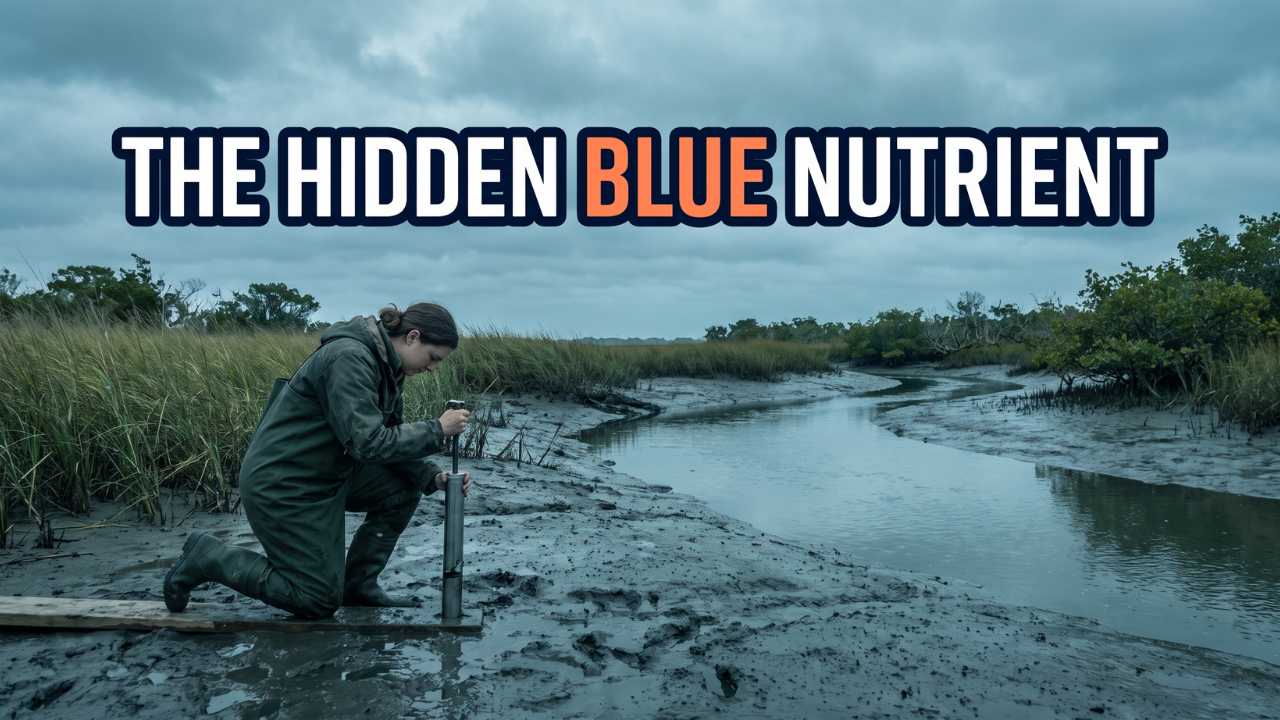
That's where coastal wetlands come in. Langley describes marshes and mangroves as nature's kidneys: water carrying nitrogen filters through the soil, plants take the nitrogen up as they grow, and when they die, their tissue gets buried in waterlogged, oxygen-starved soil where decomposition essentially stops. It's the same anoxic preservation that keeps a "bog mummy" intact for thousands of years. As long as that soil stays put, the nitrogen inside it is locked away and inert, no longer capable of fueling a bloom.
The Catch: It Only Works If the Wetland Survives
Marshes and mangroves have kept pace with sea level rise for 5,000 to 10,000 years by continuously building soil upward, through a mix of trapped sediment and accumulated organic matter. But that mechanism has limits. Langley says several independent approaches in his field, reconstructing past sea level rise events from sediment cores and running process models, have converged on a rough threshold: wetlands can generally keep up with about 8 millimeters of sea level rise a year. Beyond that, they start to drown.
The math is getting less comfortable. The global rate of sea level rise has roughly doubled over the last 75 years, and independent tracking backs that trend up, showing the rate of global sea level rise has doubled again just in the past three decades. Langley is candid that his field doesn't fully agree on what happens next: some colleagues think wetlands could migrate landward and even gain area as seas rise, but Langley's own read is that higher rates of sea level rise will mean more coastal wetland loss overall, not less.
He's already seeing it in Florida, where his lab's more recent work is centered. Wetlands along the state's Intracoastal Waterway are losing roughly a linear meter of shoreline per year, driven partly by accelerating sea level rise and partly by a factor with nothing to do with climate: more, bigger, and faster boat traffic generating wave energy these historically calm-water ecosystems were never built to withstand. Interestingly, Langley's team found that shorelines where mangroves have moved in tend to erode more slowly than marsh alone, adding a wrinkle to a broader pattern of mangroves shifting poleward worldwide, including a mangrove population documented in Georgia for the first time on record within the last couple of years, a range shift Langley attributes mainly to fewer of the hard winter freezes that have historically kept mangroves confined further south.
Putting a Price on Nitrogen
Langley's team also ran the numbers on what all this buried nitrogen might be worth economically, following the same logic that gave blue carbon its now widely cited $191 billion global valuation. Using published values for the cost of keeping a gram of nitrogen out of a waterway, and extrapolating from the study's 3.2 teragram figure, Langley's team estimates blue nitrogen could be worth as much or more than blue carbon, an estimated $70 to $339 billion a year globally. He's candid that the range is wide and the science of valuing nitrogen is more complicated than valuing carbon, since nitrogen's damage is so localized that a gram sequestered in a heavily polluted estuary is plausibly worth more than the same gram sequestered somewhere pristine. Carbon, by contrast, is more fungible: a molecule anywhere on Earth has roughly the same climate effect.
Why put a dollar figure on any of this at all? Because, as Langley puts it, that's what gets policymakers to act. Blue carbon's headline valuation has already shaped international climate policy and conservation funding. Langley hopes a comparable blue nitrogen figure does the same for nutrient pollution, an issue that, unlike carbon, is squarely a local and state-level policy problem as much as a global one.
Saving a wetland, Langley cautions, isn't as simple as fencing off a forest or patrolling a marine protected area. A fence can't stop sea level rise. Protecting what these ecosystems already do, filtering nitrogen, storing carbon, buffering coastlines, and supporting fisheries, means tackling sea level rise at the source while also managing nitrogen pollution more directly. For everyday listeners, Langley's suggestion is straightforward: calculate your own nitrogen footprint the same way you might calculate a carbon footprint, eat lower on the food chain, cut fossil fuel use where you can, and vote for policymakers who take environmental funding seriously. None of it solves the problem alone, but he argues nitrogen, like carbon, is a genuinely collective problem that doesn't respect borders, which means it takes collective action to fix.
Takeaways:
- Coastal wetlands (marshes and mangroves) bury roughly 3.2 teragrams of nitrogen every year, drawn from a global database of over 8,000 soil measurements across 255 sites, the first estimate of its kind.
- That nitrogen burial equals 13 to 15 percent of the world's marine nitrogen burial.
- Human activity has more than doubled natural nitrogen inputs to ecosystems, arguably a bigger disruption to the nitrogen cycle than to the carbon cycle, even though nitrogen's damage shows up locally rather than globally.
- Blue carbon's global value has been estimated at $191 billion a year; blue nitrogen's could be even higher, an estimated $70 to $339 billion a year.
- Wetlands can generally keep pace with roughly 8 millimeters of sea level rise per year by building soil, but the global rate has already roughly doubled since the mid-20th century.
- Mangroves are expanding poleward, including a newly documented population in Georgia, which may help some marshes build soil and resist erosion better, though Adam expects overall coastal wetland area to keep shrinking as seas rise faster.

CEO

Who Pays for Plastic? Inside the Law Quietly Shifting the Bill to Producers