The Rise of Ocean Startups, And Why They Might Save the Ocean
The next breakthrough in ocean conservation might not come from a university.
It might come from a startup.
That is not because science is unimportant. It is because startups are built to take ideas and put them into the real world. And right now, that may be one of the biggest gaps in conservation.
In this episode of How to Protect the Ocean, I explore why ocean startups are becoming more important, how they differ from traditional conservation institutions, and why their speed could make a real difference, if that speed is matched with science and accountability.
A New Player in Ocean Conservation
For decades, ocean conservation has been driven by governments, NGOs, and universities.
Those institutions are critical. They produce science, shape policy, and help define the problems we need to solve. But they are not built for speed. They are built for accuracy.
And that creates a gap.
Discovering a solution is very different from scaling one.
That is where startups come in. They take ideas and ask a different question: can this work in the real world, and can it scale?
That mindset matters because the ocean is changing quickly. Marine heatwaves, biodiversity loss, overfishing, and pollution are not slowing down while we wait for perfect systems to respond.
Coral Vita and the Business of Reef Restoration
One of the clearest examples in the episode is Coral Vita.
Traditional coral restoration happens underwater. It is slow, expensive, and often struggles to keep up with warming oceans.
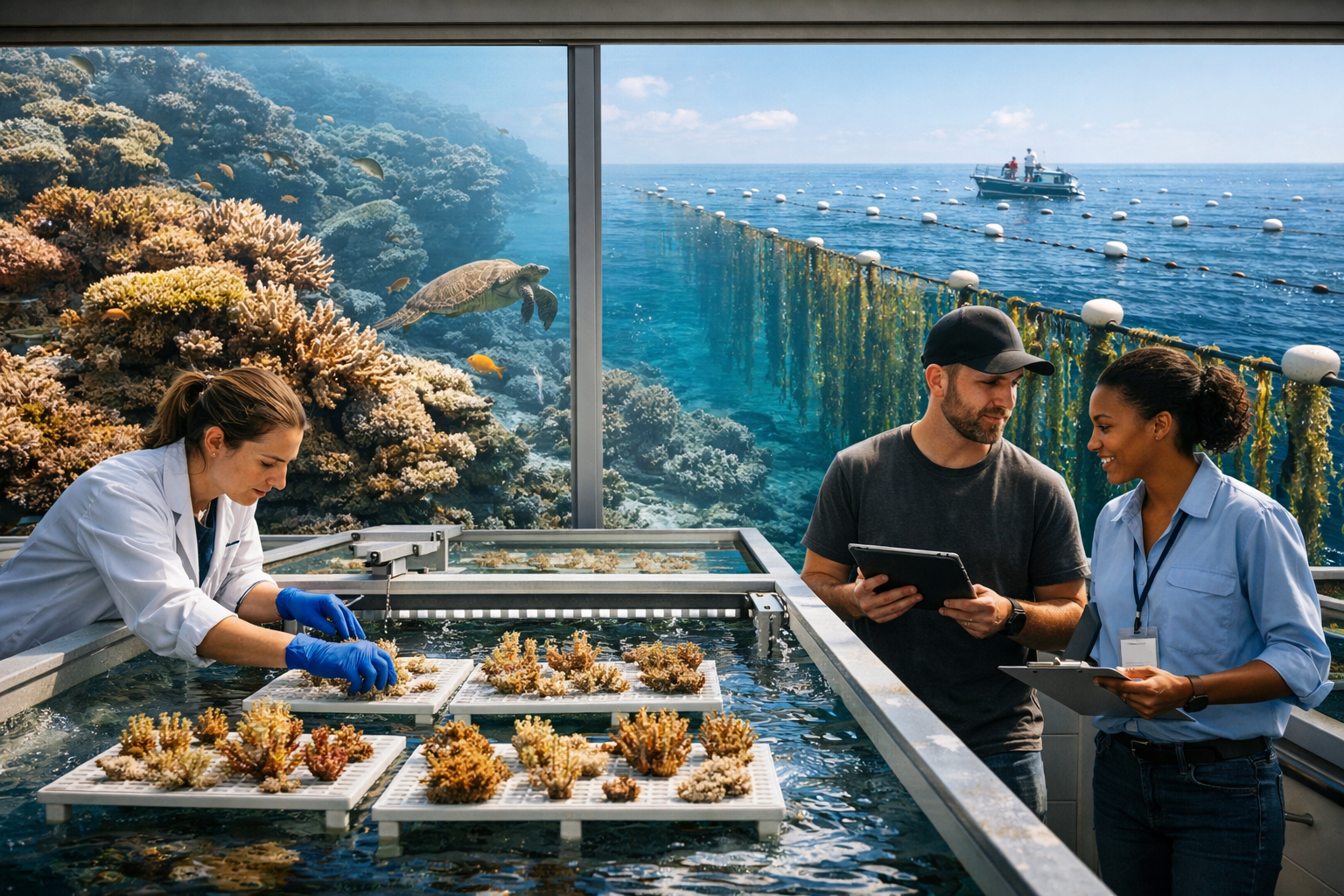
Coral Vita changed that model by growing corals on land in controlled environments. That allows them to grow corals much faster, select for heat-tolerant corals, and increase production beyond more traditional restoration methods. The corals are then transplanted back onto reefs.
But the bigger point is not just the technique. It is the business model.
Coral Vita built a company around reef restoration. They work with tourism operators that depend on healthy reefs, governments interested in coastal protection, and insurance-related interests that recognize reefs can reduce storm damage.
That changes restoration from a one-off conservation project into something that can potentially scale as a service.
That is a major shift in how restoration can be funded and delivered.
Running Tide and the Carbon Removal Debate
The episode also looks at Running Tide, a company exploring ocean-based carbon removal.
The idea is straightforward on paper. Grow kelp that absorbs carbon, then sink it deep into the ocean to lock that carbon away long term.
This falls under the broader category of ocean carbon dioxide removal. And according to the IPCC, carbon removal will likely be needed alongside emissions cuts if the world hopes to meet climate targets.
But this is where the conversation gets complicated.
The ocean is not simple. It is dynamic, interconnected, and still full of unanswered ecological questions. We do not fully understand the long-term impacts of large-scale carbon removal efforts in marine systems.
That is why this approach is controversial.
Still, companies are getting funded to test these ideas because they connect to carbon markets. And when something connects to markets, it has a chance to scale much faster than a typical academic pilot study.
That does not mean it will work. It does not even mean it will be good for the ocean.
But it does mean the idea is being tested in a way that traditional systems may not have moved on as quickly.
Why Startup Speed Matters
The strongest advantage startups bring is speed.
They test faster.
They adapt faster.
They scale faster.
They are often not waiting years for peer-reviewed publication before deciding whether to move forward. They want to know in months whether an idea has potential. If it does not, they pivot. If it does, they push ahead.
That speed matters because the ocean is changing fast.
We are seeing marine heatwaves, rapid biodiversity loss, more pressure on fisheries, and increasing pollution. Solutions need to move just as quickly as the problems.
And when startups find something that works, they can expand globally in years, not decades.
That kind of pace is hard to ignore.
The Risk of Moving Too Fast
Of course, not every startup succeeds.
Some fail.
Some overpromise.
Some create unintended consequences.
That is the risk of innovation, especially in ecosystems as complex as the ocean.
The transcript makes this point clearly with deep-sea mining. There is a major push from companies and investors, but we still do not know enough about the ecological consequences. That is exactly why science still matters, and why regulation still matters.
This is not about replacing traditional conservation.
It is about complementing it with speed, funding, and a different mindset.
But that only works if the guardrails stay in place.
Without strong science, careful monitoring, and smart governance, speed alone can become a liability.
Ocean Startups Are Worth Watching
The real message of this episode is not that startups will save the ocean by themselves.
It is that they are becoming an important part of how ocean solutions are built, funded, and delivered.
Some ideas will fail. Some may prove harmful. Some may turn into meaningful tools that help conservation move at the speed this moment demands.
Either way, ocean startups are worth watching.
Because the next big breakthrough might not come from a paper alone.
It might come from a company trying to solve a problem at scale.
Final Thoughts
Ocean conservation is entering a new phase.
It is still driven by science. It still needs policy. It still depends on public accountability.
But it is also being shaped by entrepreneurs, investors, and businesses trying to move solutions into the real world faster than we have seen before.
That should make all of us pay attention.
Not because speed is always good.
But because the ocean crisis is moving quickly, and the solutions will need to move quickly too.

CEO

Why Ocean Solutions Need Business, Not Just Science