Why Ocean Solutions Depend on Collaboration Across Industries
Ocean conservation is often framed as a scientific challenge.
But the truth is, the biggest ocean problems are rarely just scientific.
They are also economic, political, technological, and social. That means even the best research can struggle to create real change if it stays trapped inside one sector.
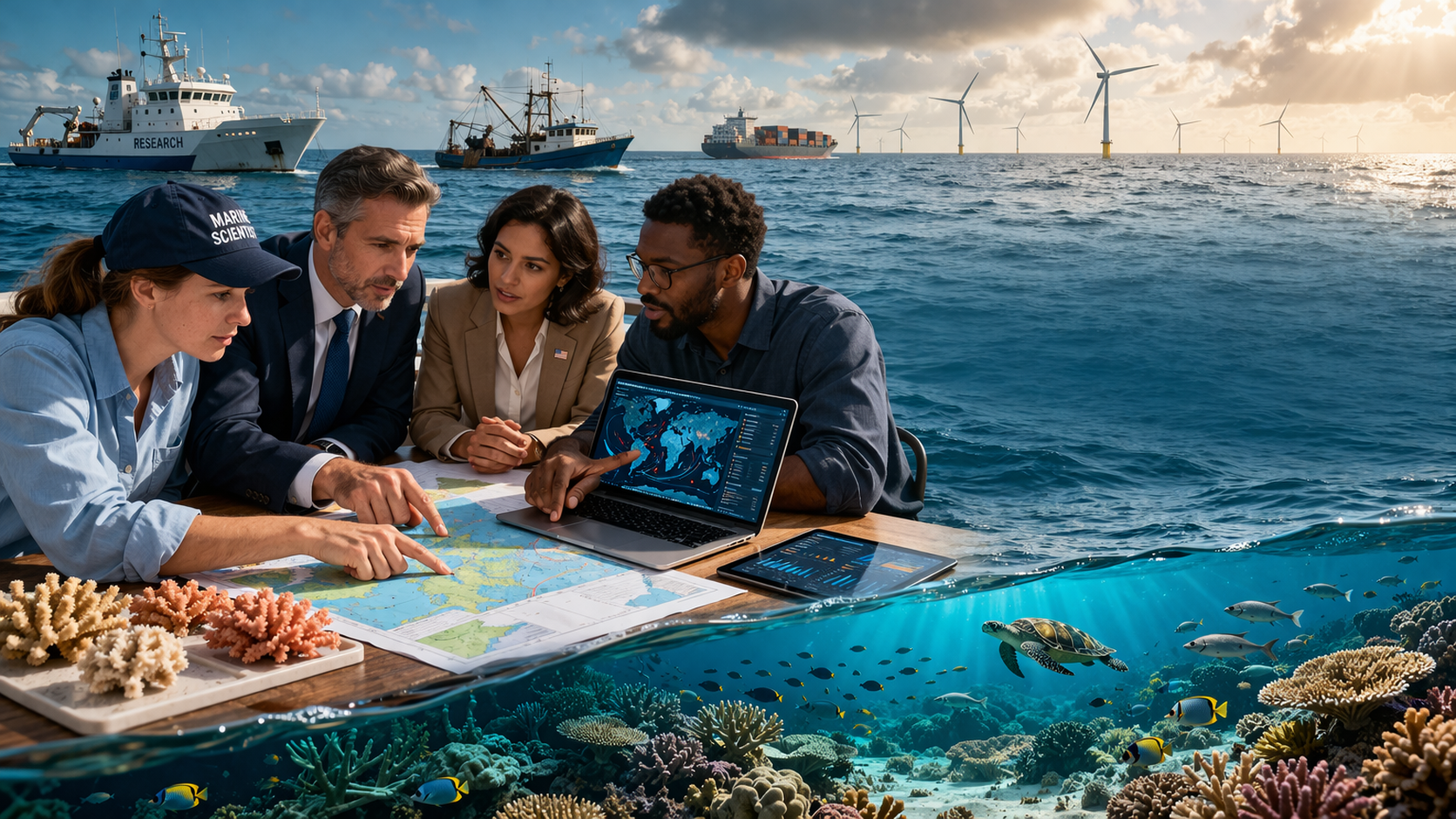
In this episode of How to Protect the Ocean, we explore why collaboration across industries is becoming one of the most important drivers of real ocean solutions. Scientists, businesses, conservation organizations, and policymakers all bring different tools to the table. When they work in isolation, progress slows. When they work together, solutions become more practical, scalable, and durable.
The problem with silos
A lot of important ocean work still happens in silos.
Scientists often speak to other scientists. Businesses focus on business priorities. Policymakers work inside political systems and regulatory structures. Each group has a piece of the puzzle, but too often they are not building the puzzle together.
This creates a major bottleneck.
A scientist might develop a breakthrough in coral restoration, fishery management, or habitat protection. But without industry investment or policy support, that research may never move beyond pilot projects.
A company might create a technology that could reduce bycatch, improve transparency, or monitor illegal fishing. But if regulators do not adopt it and industry does not trust it, the tool may never scale.
A government may announce a protected area or a new conservation target. But without science to guide implementation and technology to support enforcement, that action may remain weak on the ground or on the water.
The issue is not always a lack of solutions. Often, it is a lack of connection between the people who can make those solutions work.
A powerful example: Global Fishing Watch
One of the clearest examples of cross-industry collaboration in ocean conservation is Global Fishing Watch.
This initiative brought together very different organizations with very different strengths:
Google contributed computing power and technical expertise.
SkyTruth brought environmental monitoring experience.
Oceana brought conservation and policy advocacy.
Together, they helped build a system that uses satellite data, vessel tracking signals, and machine learning to map fishing activity across large parts of the global ocean.
That matters because illegal, unreported, and unregulated fishing has long been difficult to detect and even harder to prove. Fishing happens far from shore, often out of public view. Monitoring those waters is expensive and complicated.
By improving transparency, Global Fishing Watch changed the conversation. It gave governments, journalists, advocates, and researchers a better way to see what is happening at sea.
This is what collaboration looks like in practice. It is not just about networking or partnerships on paper. It is about combining tools and expertise to make something possible that no single group could do alone.
Why policy collaboration matters too
Collaboration is not only about science and technology.
It also matters deeply in policy.
At conferences and convenings like EarthX, one of the biggest opportunities is not just the panels or presentations. It is the space they create for people from different sectors and even different political viewpoints to meet face to face.
That kind of interaction matters more than many people realize.
Ocean solutions often fail, not because they are scientifically weak, but because they do not survive political friction. Trust is often the missing ingredient. When leaders build relationships in person, they are more likely to identify shared interests, reduce polarization, and move toward action.
For ocean conservation, that can make a major difference. Fisheries management, coastal resilience, marine protection, and climate adaptation all depend on decisions that involve multiple interests. Collaboration does not erase disagreements, but it can make progress more possible.
Why collaboration strengthens solutions
When different sectors collaborate, problems get reframed in useful ways.
A scientist may see coral bleaching as an ecological crisis.
A tourism operator may see it as a business risk.
A coastal government may see it as a threat to jobs and local economies.
Each of those perspectives is incomplete on its own. Together, they create a fuller picture of the problem and a stronger case for action.
Collaboration also improves the quality of solutions.
Science helps determine whether something actually works.
Business helps figure out whether it can scale.
Policy helps turn it into something durable and enforceable.
That combination is especially important in ocean conservation, where many problems are large, complex, and spread across jurisdictions. Strong science matters, but on its own it is rarely enough.
What this means for ocean professionals
This episode also carries a practical message for people building careers in marine science, sustainability, and conservation.
If you work in science, your impact grows when you understand how decisions get made outside academic spaces. That means learning how businesses think, how policymakers operate, and how to communicate your work clearly to people who do not share your background.
If you work in business, there is a real opportunity to be part of the solution. But that only happens when science is taken seriously and sustainability is built into decisions in a meaningful way.
If you are early in your career, this may be one of your biggest advantages. The future will belong to people who can connect worlds, not just stay inside one of them.
People who can translate.
People who can build trust.
People who can bring the right groups together around a common goal.
Ocean protection needs connectors
There is a tendency to think of collaboration as something extra, something nice to have once the real work is done.
That is the wrong way to look at it.
In ocean conservation, collaboration is part of the real work.
It is how data becomes policy.
It is how innovation becomes implementation.
It is how good ideas become real outcomes.
Protecting the ocean is not just about discovering what needs to happen. It is about building the relationships and systems that make action possible.
That is why collaboration across industries is not optional.
It is one of the clearest paths to solutions that actually last.
Listen to the episode
In this episode of How to Protect the Ocean, I break down why silos slow ocean progress, how projects like Global Fishing Watch show the power of cross-sector partnerships, and why the future of conservation depends on people who can connect science, business, and policy.
Listen to the full episode to hear how collaboration is driving ocean solutions, and why it may be one of the most important forces shaping the future of conservation.

CEO
Why Storytelling Might Be the Most Powerful Ocean Solution