Boat Wake Erosion Explained: The Coastal Threat With Nothing to Do With Climate Change
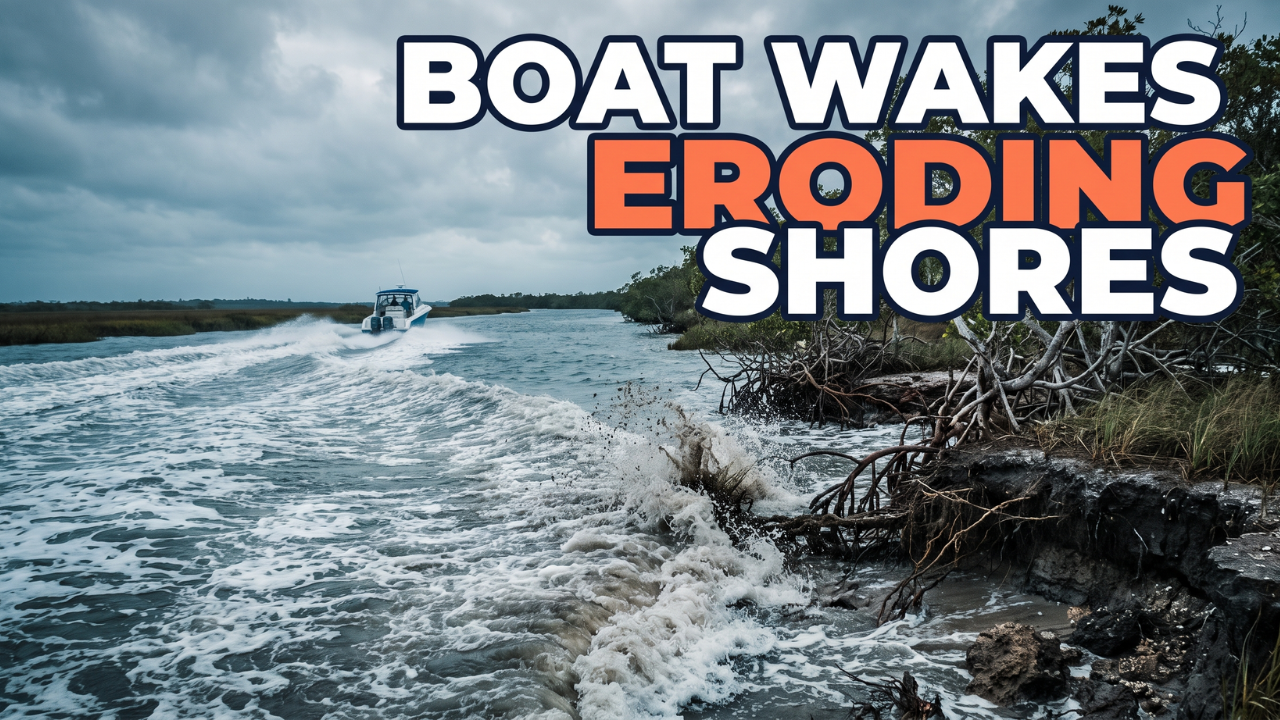
A boat's wake looks harmless right up until you watch it happen more than once. Watch one roll out from behind a passing boat and hit a marsh bank, and it looks like nothing much happened. Come back to that same bank a year later, and a chunk of it is gone. That's boat wake erosion, and unlike most of the coastal damage that makes headlines, it has nothing to do with storms, sea level rise, or a warming planet. It's mechanical, it's constant, and it's happening on calm, sunny days, every time a boat passes.
How a wake actually forms, and why "slow" makes it worse
As a boat moves through the water, its motor pushes water out of the way, and that displaced water rolls back in behind it as a wave, a wave that didn't exist a moment before the boat arrived. A NOAA study at Snow's Cut, North Carolina (Fonseca and Malhotra, 2012) measured actual wave heights along a stretch of the Atlantic Intracoastal Waterway and found that roughly half of all boat wake heights there exceeded the largest wind driven waves measured in that same stretch of water. Counterintuitively, boats moving at the slow, bow up "plowing" speed many drivers use out of courtesy near shore produced the tallest wakes of all.
These are shorelines that formed over centuries in calm, low energy water. They were never built to absorb a wave like that, repeated hundreds of times a day, from boats that have nothing to do with weather.
Habitat is a measured defense
Here's the part that changes the story: healthy coastal habitat can measurably stop this. A study by Doughty and colleagues, published in the journal PeerJ and covering the Intracoastal Waterway near St. Augustine, Florida, found that mangroves and marsh can reduce wave height by up to 90 percent. Marsh grass paired with an oyster reef cut wave energy specifically from recreational boat wakes by 67 percent compared to bare mud. That's an engineering grade number, the kind that belongs in a coastal permit application.
Once it's measurable, it's fundable
Once a coastal benefit can be measured, in wave energy or in dollars, it starts attracting real funding. Bertram and colleagues (Nature Climate Change, 2021) put the global value of blue carbon storage in mangroves, marsh, and seagrass at nearly $191 billion a year. On a smaller, more local scale, restoring a single 100 acre wetland has been shown to save nearby water treatment systems about $17,000 a year, the same figure covered earlier this week in the Nature's Kidneys episode. Different scales, same underlying idea: once you can write a number on a page, you can build a funding mechanism around it.
The Riviera Maya reef that got its own insurance policy
Mexico's Riviera Maya coastline is the clearest real world proof of what that funding mechanism can look like. Its coral reef system shields around $10 billion in annual tourism revenue for the region, a value that was known informally for years but wasn't attached to any fast, dedicated way to pay for repairs. After a storm damaged the reef, restoration was left to whichever organization could fundraise for it, and fundraising for reef restoration is difficult.
In 2018, The Nature Conservancy, the Quintana Roo state government, local hotels, and the insurer Swiss Re set up a Coastal Zone Management Trust. Hotels already paid a tax for beach usage rights in the area, and that existing tax now funds a parametric insurance policy on the reef itself, a policy that pays out automatically once wind speeds in a defined area cross a set threshold, with no lengthy damage assessment required first.
When Hurricane Delta hit in 2020, the policy triggered its first payout, $850,000, within days. Volunteer brigades that were already organized and assigned used it to stabilize over 2,150 uprooted coral colonies and reattach more than 13,500 coral fragments within three months. Neighboring towns took notice and started their own volunteer brigades, and the model is now expanding into Belize, Guatemala, and Honduras, with mangroves named as the next planned expansion of the same insurance framework.
Why insurers are the ones funding this
Insurance companies understand what protects a coastline and what reduces damage, and they have a direct financial incentive to keep that coastline healthy. It's cheaper for an insurer to help maintain mangroves, marshes, seagrasses, and reefs than to pay out a claim after they're gone. That's what makes this a durable funding source rather than a one-time grant: the same math that produced the Riviera Maya trust applies anywhere a coastline supports an economy someone is willing to insure.
What you can actually do: if you live near, or visit, an intracoastal waterway, marina, marsh, or mangrove shoreline, call your local marina, harbor authority, or town council about establishing or enforcing slow speed or no wake zones near that habitat. That's the one lever an individual can push on directly, right where boat wakes and habitat protection meet.
Takeaways:
- Boat wake erosion is mechanical, not climate driven: NOAA's Snow's Cut study found roughly half of boat wake heights exceed the largest wind driven waves, and slow "plowing" speed produces the tallest wakes of all.
- Healthy habitat is a measured defense: mangroves and marsh can reduce wave height by up to 90 percent, and marsh paired with an oyster reef cuts boat wake wave energy by 67 percent (Doughty et al., PeerJ).
- Once a coastal benefit is measurable, it becomes fundable: global blue carbon storage is valued at nearly $191 billion a year, and a single restored 100 acre wetland saves about $17,000 a year in water treatment costs.
- Mexico's Riviera Maya reef shields around $10 billion in annual tourism revenue, and a 2018 insurance partnership turned that value into a parametric policy that pays out automatically after a storm.
- When Hurricane Delta hit in 2020, that policy paid out $850,000 within days, funding the stabilization of over 2,150 coral colonies and the reattachment of more than 13,500 coral fragments within three months, and the model is now expanding to Belize, Guatemala, and Honduras.

CEO
Sea Level Rise Has a Speed Limit: Why Marshes and Mangroves Are Racing the Tide