Who Pays for Plastic? Inside the Law Quietly Shifting the Bill to Producers


 Apple Podcasts
 Spotify
 YouTube
 Amazon Music
 PocketCasts
 Overcast
 For decades, the honest answer to "who pays to deal with plastic packaging once it leaves the shelf" was taxpayers, quietly, through municipal budgets that funded garbage trucks and recycling plants running at a loss, whether or not the packaging actually got recycled. That's the system extended producer responsibility (EPR) is built to replace: a legal requirement that the companies making and selling packaging fund what happens to it after a customer buys the product, not the city that collects it afterward. Seven US states have now passed packaging EPR laws. Oregon has been charging producer fees since July 2025, Colorado's fees started in January 2026, and California, Maine, Minnesota, Maryland, and Washington are all phasing in requirements through 2030.
California's SB 54 is the biggest and most closely watched of these laws, and it's a useful case study for how the system actually works underneath the headline. Producers pay eco-modulated fees that scale with how toxic or hard-to-recycle their packaging is, which is the built-in incentive to redesign packaging in the first place. Starting in 2027, the law is expected to generate roughly $500 million a year for a decade for a plastic pollution mitigation fund, with 60% of that earmarked for the communities most directly affected by plastic pollution. Almost as soon as California finalized its rules, the law got sued from two completely opposite directions: environmental groups arguing the regulations are too weak, and a coalition of states plus a wholesaler trade group arguing the law goes too far and violates the US Constitution. Neither suit has stopped the law so far, though a nearly identical fight in Oregon just produced a real answer: a federal court upheld Oregon's law against the same kind of constitutional challenge in August 2026.
The same fight is quietly playing out here in Canada, on two tracks. Canada's federal single-use plastics ban survived a legal rollercoaster, struck down by a federal court in late 2023, kept in effect on appeal the whole time, then upheld by the Federal Court of Appeal in January 2026. But the bigger, more direct parallel to what's happening in California is provincial: British Columbia has run a producer-funded packaging program since 2014, and Ontario just completed its own full transition on January 1, 2026, a shift the province says is already saving municipalities more than $200 million. Andrew closes out the week's plastics and microfiber arc by asking the question underneath every other episode: who actually pays, and is the answer finally starting to change for the better.
Takeaways:
- Extended producer responsibility (EPR) shifts the cost of dealing with packaging waste from taxpayers and municipal budgets to the companies that make and sell the packaging, paid up front rather than absorbed quietly later.
- Seven US states have passed packaging EPR laws (Maine, Oregon, Colorado, California, Minnesota, Maryland, Washington), with Oregon and Colorado already collecting producer fees.
- California's SB 54 is being sued from two opposite directions at once: environmental groups say the final regulations are too weak, while a coalition of states and a wholesaler trade group say the law itself is unconstitutional.
- A near-identical constitutional challenge in Oregon was already resolved: a federal court upheld Oregon's EPR law in full in August 2026, a signal for how the California lawsuits might eventually land.
- Ontario completed its own full transition to producer-funded recycling on January 1, 2026, which the province says is saving municipalities more than $200 million, though whether that savings is reaching taxpayers directly is still an open question.
- Canada's federal single-use plastics ban survived a multi-year legal fight, struck down by a federal court in 2023 and upheld on appeal in January 2026, with a possible further appeal to the Supreme Court of Canada still pending.
Support Independent Podcasts: https://www.speakupforblue.com/patreon
Need help with your ocean non-profit, company, or project? Get the help you need with Pisces Oceans Inc.: https://www.piscesoceans.ca
Connect with Speak Up For Blue
Website: https://bit.ly/3fOF3Wf
Instagram: https://bit.ly/3rIaJSG
TikTok: https://www.tiktok.com/@speakupforblue
Twitter: https://bit.ly/3rHZxpc
YouTube: www.speakupforblue.com/youtube
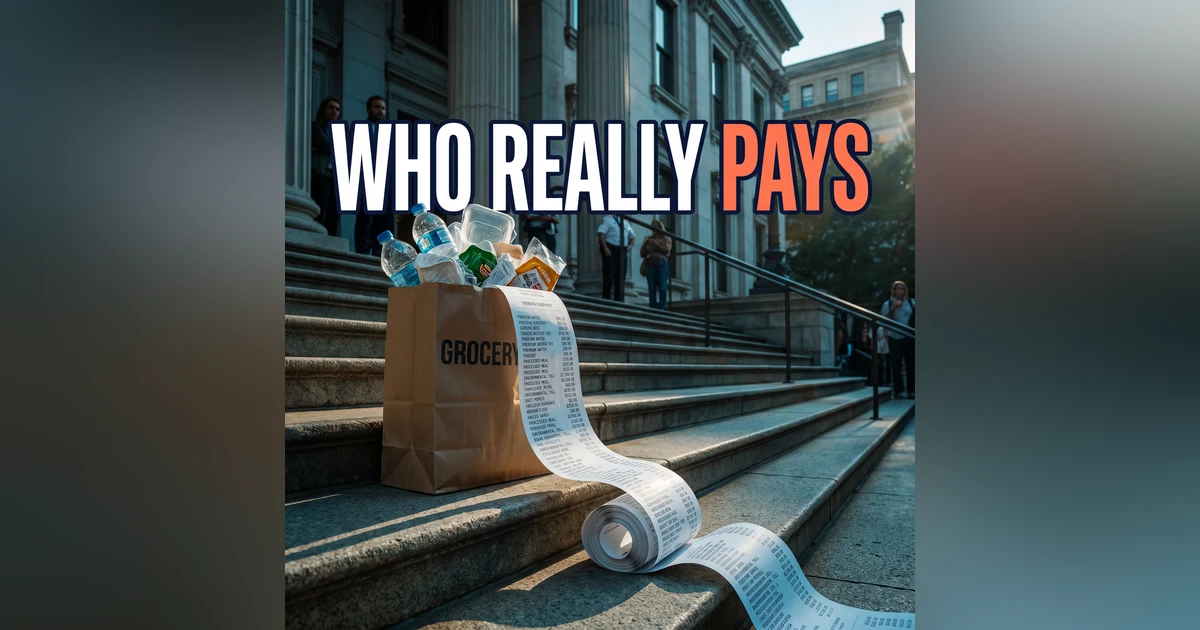
0:00 It all starts with a receipt, a grocery run, a case of water bottles, a six-pack of yogurt cups. Every one of those containers has a bill attached to it that never shows up on the receipt itself. And that bill gets paid somewhere, right? For decades it landed on cities, on garbage trucks, on recycling plants, running at a loss. And tax bills that funded those trucks and plants, whether the packaging gets recycled or not, whether we were lied to or not. Now, who actually pays to deal with the plastic once it leaves the shelf? For a long time, the honest answer was taxpayers. but that is starting to change. and the fight over that change is now sitting in front of judges in multiple states and quietly playing out at home here in Canada as well, in my home. This week started off with an interview on plastic policy and microfibers.
0:51 Tuesday through Thursday, we went deep on technology, industry pushback, and state-by-state campaigns. Today, we close the loop by following the money in the US and right here where I live in Canada. Now, this is what we're going to do on the How to Protect the Ocean podcast. If you like this kind of stuff and learning more about how you can protect the ocean and maybe some science involved in that as well in ocean science. Please follow on your favorite podcast app, share with a friend, share with the family member who would like this type of material because this isn't what I do. I love doing this kind of stuff. I've been doing it for 11 years and counting, and I just I enjoy the heck out of it. So let's talk more about what's going on and who's paying for plastic.
1:34 The United States actually recycles roughly 48% of its packaging waste. I bet you didn't think that. You thought I thought it was more. I thought it was more. Belgium, which already runs a producer funded system, recycles about 78% of its packaging. That's pretty good. The gap between those two numbers has a price tag. The country loses an estimated $7 billion a year in potential value by sending plastic that could have been recycled straight to a landfill instead. So cities absorb the rest of the cost directly. Recycling, collection, and processing gets folded into municipal budgets, competing for the same dollars As roads and police. One municipal sustainability expert put it plainly: nobody wants to pay for recycling, so it usually loses that competition.
2:18 This is a system as it has worked for decades, right? Plastic producers design and sell packaging. Cities and taxpayers cover what happens after. I bet you you didn't even think that when you had a Starbucks or you had for in Canada, you had a Tim Horton stuff cup, or my kids have Starbucks. And you're probably thinking. I'll just, you know, put that in a recycling banner. I'll it up, but it doesn't get recycled, right? Because it can't. Just the way it's built, it just doesn't get recycled. Right. And and all of a sudden, who pays for that? You don't think you pay for it because you're just paying for the cup, but you eventually pay for it, whether it's through taxes or whether it's through your dollar at the counter. And so now we're starting to like look at this and how this is going to change, So there's a different idea that's starting to spread, So extended producer responsibility in the legal framework that requires the companies making and selling packaging to fund what happens to it after a customer buys the product.
3:13 So seven US states have now passed extended producer responsibility laws covering packaging. So Oregon has been charging produce producer fees since July 2025, and Colorado started charging fees in January 2026. California, Maine, Minnesota, Maryland and Washington are all in the pipeline, phasing in fees and requirements between now and 2030. New Jersey, Illinois, Massachusetts are pursuing their own versions. New York's bill has failed twice, but most recently in June 2026. So they're trying to get this stuff going, The cost of packaging waste starts moving from the tax bill into the price tag.
3:55 And we're going to start seeing it as consumers. We're paying for it anyway, but it's going to start to move because the companies have to start paying for it. Now, California Senate Bill 54 is the largest and most closely watched of these laws. So it becomes the case study for how the system actually works underneath the headline. And you think California, yes, this would be a perfect place for this to start. A producer under this law is a company with more than $1 million in gross sales of covered products. Packaging or plastic food serviceware. So producers register with the state's recycling agency and either join a nonprofit called the Circular Action Alliance or apply to run their own compliance plan independently.
4:37 Producers pay eco-modulated fees, meaning the fee scales with how toxic or how hard the to recycle the packaging is. So now we're starting to we're going to start to see companies be like, I don't want to pay too much of this. I'm gonna start to use better packaging. Patching packaging designed to be reused or easily recycled costs less. Packaging that is neither costs more. that is the built-in incentive to redesign packaging in the first place. So it's not the fact that, hey, this is an excuse for companies to put up their prices if they have to have packaging. This is an excuse for companies to pay less and use better packaging so that they can pay less so that you don't have to feel it in your wallets. Now you'll probably see an increase.
5:17 There's no doubt we're going to see an increase. but this is how this is how it's gonna work until we can start getting to better packaging and more recyclable packaging, A 10% cut in a single-use plastic packaging in 2027. There's gonna be a 20% in 2030, a 25% in 2032, and at least 10% of all the final cut coming specifically from reuse and refill systems rather than just lighter packaging. By 2032. 65% of covered packaging has to be recyclable or compostable. One material already got caught by this bar. Expanded polystyrene food serviceware, the foam clamshells and cups needed to hit a 25% recycling rate to stay legal for sale in California. That rate has not been met.
6:04 So as of now, expanded polystyrene food serviceware is prohibited from sale in the state. Starting in 2027, this system is expected to generate roughly $500 million a year for a decade flowing into a plastic pollution mitigation fund. 60% of this fund is earmarked for communities most directly affected by plastic pollution, with three quarters of that share targeted at low income residents specifically. The rest goes to ecosystem restoration network. So now sit on that number for a second. $500 million a year paid by the companies that make the packaging into a fund for the communities living closest to the pollution it creates.
6:44 Just think about that, Think about what this does now. It's making the companies responsible. We are seeing unprecedented studies where we're getting information where we have plastic pollution in our lungs, we have microplastics in our lungs, in our blood. In in our air, in our water, in our oceans from the very, very depths. If you listen to Ocean Decoded Live, I talked about a recent deep sea expedition off of Trinidad and Tobago. And what they found there was they still found in the deepest part of that area, they still found plastic pollution or even just marine debris. We are touching every part of this planet, including our own bodies.
7:28 And this is the time where companies are now gonna have to respond. and I think this is kind of interesting because this is something that wasn't really expected, right? Because, you know, almost as soon as California finalized its rules, the law got sued from two completely opposite directions at once. So on the one side, environmental groups filed suit filed suit, arguing the regulations were too weak. And their case says that the the The rules improperly open the door to chemical recycling technologies that lead that let producers claim credit without actually turning plastic back into a usable material. In other words, they would just heat it up and burn it. And that the definitions used to judge whether a recycling market is real and viable are too loose to hold up. Now, on the other side, a coalition of 17 state attorneys general, ~ For states, including Texas, Florida, and Alabama, join with a national trade group representing wholesalers and distributors to sue, arguing the law goes too far.
8:23 Their case is built on the United States Constitution, that the law discriminates against interstate commerce, that requiring companies to itemize the fee as a separate line on a customer's receipt violates their free speech rights, and that the state handed too much authority to the Circular Action Alliance. So the circular action alliance without ev without enough legislation guardrails on how the authority gets used. Now, as of now, none of these lawsuits have stopped law. So no court in California or Colorado has issued an injunction. Every deadline and every fee stays in effect while these cases work through the system. Oregon's version of the fight has already produced a partial result.
9:06 A judge a preliminary injunction there. But it only applies to members of the wholesaler distributor trade group that's sued, not to the law as a whole. So that's the picture right now. one side says the law lets producers off too easy. The other side says that the law shouldn't exist in its current form at all. Both are suing the same regulation for opposite reasons. And that tension is exactly what makes this fight worth watching, to be honest. Now, what these laws change is that extended producer responsibility does not make the cost of dealing with plastic packaging disappear. It changes who pays first. So under the old system, a city collects trash, a recycling plant loses money processing it.
9:49 Taxes cover the gap months or years later, quietly without a receipt. And under the new system, the producer pays the fee up front based on how much packaging they put into the world and how hard it is to deal with. So that fee gets built into whatever the product costs before it even ever reaches the shelf. Now, here there is an open question here of what happens next, right? Does the upfront cost push companies to generally redesign packaging and cut plastic the way the built-in fee structure is designed to reward? Or is it just becoming another line item passed straight to the customer, changing nothing about how much plastic gets made? I alluded that to earlier in this in this episode.
10:32 And I think this is where it really comes down to how people are going to respond to the companies. We're kind of beholden to products that we buy anyway. And cut and government should make custom make these companies pay this upfront in the incentive. So you're not actually passing the buck to the customer. Cause that won't be fair. Cause we will pay the the up the increased fee, but we can't afford it. That not like the things are already inflated as they are, And so I think it'll be interesting to see what happens here and how it moves forward in the US and of course in in Canada as well. Because that question is not gonna get answered by the law itself. It gets answered by what the companies do once the fees start landing and how these lawsuits get resolved over the next few years.
11:14 Now, the same fight that we have is playing back here in Canada. It's the exact same, but it has a like it's a version of its own version running here, right? On two tracks at once. The federal track centers on Canada's single use plastics ban, covering things like checkout bags, stir sticks, six pack rings, certain utensils, and of course straws. A federal court struck down the government's underlying order in December 2023, ruling that the plastics items didn't qualify as a regulatable substance and that Ottawa has overstepped his authority. That ruling was ~ stayed pending appeal. So the ban stayed in effect the entire time. In January 2026, the Federal Court of Appeal reversed that decision, ruling that plastic items can qualify as a substance and that government can act as a precautionary principle instead of waiting for proven harm.
12:05 The ban survives through a superior court appeal that is still possible, So so here's the thing. The ban stayed in in play the whole time. The government basically came out and said, all plastic is toxic. The plastic makers were like, you can't do that. And it banned like six specific single use plastics. The press plastic producers, the chemical companies, the fossil fuel companies and all that came out and said, hey, you can't do that. You can't just say that they're all toxic. Like we understand that some are toxic, but not all of them. Because we know what's going to happen. Even though the law, like the six ~ six single use plastics didn't really affect them. They didn't want anything coming down because they knew something's coming down in the future, where we're going to start to see the responsibility that's going to be put down to the makers of this type of plastic, right? And so I think it's kind of cool.
12:50 So alongside the band, Canada runs a federal plastics registry. This was one of the things that came out, requiring companies to report how much plastic packaging, electronics, and single-use plastics they put on the Canadian market. The first phase is already active, which is great. Later phases that would have added more detailed reporting. Just got delayed after industry pushback about the pace and the data burden, which is kind of BS in my opinion, with new requirements expected later in 2026. Now the bigger shift is the provincial governments, and is the direct Canadian equivalent of what California is fighting over right now. So British Columbia has run a producer-funded packaging program since 2014. Ontario just completed its own transition on January 1st, 2026. Full extended producer ~ responsibility for packaging and paper.
13:36 Producers now fund the entire blue box system directly. Municipalities and taxpayers no longer pay for it. The province says that this saves Ontario municipalities more than $200 million. And it also standardized what gets accepted for recycling across the whole province for the first time. In Quebec, they're moving to full extended producer responsibility on a similar timeline. And it goes even further by covering industrial, commercial And institutional waste generators, not just households. So it's kind of interesting, right? California just built a producer pay system and got sued for the two up from two opposite directions. Ontario finished the same kind of transition on January 1st with no comparable lawsuit making headlines.
14:18 And municipalities are also already banking on the savings, which is great, right? So this is not just hypothetical talk, right? This is not just a policy debate happening somewhere else. It already happened here in Ontario where I live. And the question that that is really worth the ask is is it working the way that it's supposed to? Right. And is that $200 million in savings actually reaching taxpayers or disappearing into other budget lines? That's really where it comes, or I couldn't find out what was happening, but because it would kind of be, it'd be kind of cool to take that $200 million and put it more towards environmental aspects for ~ green spaces in municipalities, to clean up waste in municipalities, for handling plastic pollution in general that comes through river systems and so forth.
15:01 But look, this has been an interesting week in talking about microfibers, plastic pollution, how things are being dealt with. In Monday's interview, we opened up the door with what was happening with plastic policy right now and what needs to happen on the not safe for wash type of campaign that Ocean Conservancy was going to do with when we had Dr. Anya Brandon on the podcast. Tuesday looked at whether technology can actually eat plastic waste. Wednesday followed a single load of laundry through the water system. Thursday, we talked about the campaign trying to force the appliance industry to do more. And today closes the loop of it asking the most basic question underneath every one of those. Who pays? Who pays for this plastic? And for most of modern history, the answer was the public, quietly, through taxpayers, and never really mentioned the plastics by name.
15:45 And we kept buying plastic and plastic and plastic containers. You know, that's changing now. We see it's changing in Canada, we see it's changing in the US. And I think that's really great. So I think it's it's kind of cool. Whichever way these US courts fights lands or or what happens in Canada, it will likely become a template for other states to copy it. And for Canadian listeners, the system is no longer theoretical. We're actually seeing this put in place. and is the building that produces directly right now in your own municipality. I think that's kind of a cool thing to do when you when we look at this plastic, we shouldn't have to pay for it. Producers should pay for it. We used to have better ways of doing plastic. It used to be about the less packaging was the better. And we're going back to that hopefully.
16:26 And hopefully, we're just not just being charged a lot more for that. I'll try and look into that a little bit more of how we are being charged if producers are putting it onto the customer. And if so, that's not cool. That's not cool one bit. ~ anyway, that's it for the episode for today. I want to thank you so much for joining us this week, joining us each and every episode. Don't forget to follow. and if you want to contact me, you can do so. If you're on Spotify, leave me a comment. I'll get back to you as soon as I can. And if you if you're on social media, just DM me. my social links are in the show notes. ~ thank you so much for joining me on today's episode of the How to Protect the Ocean podcast. I'm your host, Andrew Lewin. Have a great day. We'll talk to you next time and happy conservation.


