People and Sustainability: The Human Cost Big Business Keeps Ignoring
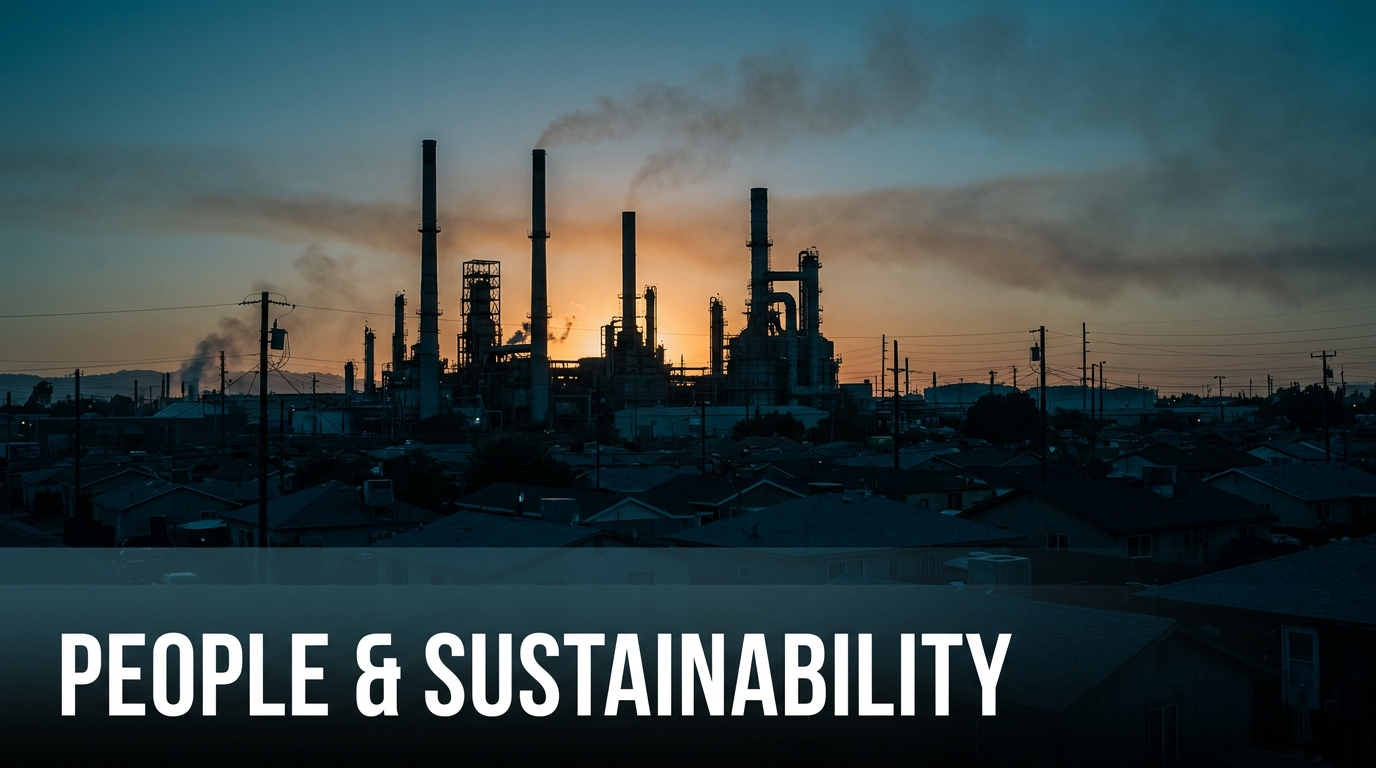
For a long time, the health of people hasn't been at the center of how businesses think about sustainability. Some of the industries that run our economy, particularly fossil fuel companies in both Canada and the US, have put people at the lowest end of consideration, and communities have paid for it with their health.
What's happening
Communities living next to industrial facilities carry a disproportionate pollution burden. In Philadelphia, a former refinery released the second-highest benzene emissions of any US refinery in 2020 and 2021, even after being shut down, with roughly 117,000 people living within one mile, most of them low-income residents of color. Fenceline communities like this one consistently show higher poverty rates, higher percentages of residents of color, and higher cancer and respiratory hazard risk than the surrounding city or county.
Why it's happening
More people now live near oil and gas development because of expanding extraction techniques and new industrial animal operations, both linked to increased pollutant exposure. Refineries and industrial sites tend to be sited in poverty-stricken areas because residents can't afford to move and few buyers want a home next to a refinery. In many cases, those facilities were built after communities had already settled the land, without consultation and without a say in the decision.
The consequences
Wildfires make these gaps even more visible. Last year's Santa Ana wind fires in Pasadena devastated affluent communities, but those households generally had the means to evacuate and rebuild. Compare that to remote communities in Northern Ontario and the Arctic, where limited road infrastructure, in some cases a single road in and a single road out, meant residents had to be evacuated by plane or helicopter, sometimes over multiple trips. Wildfire smoke carries its own toxic load of methane and metals, and downwind communities absorb higher air toxicity and worse water quality regardless of how far they are from the fire itself. Toronto had the worst air quality in the world at one point a few weeks ago, and that was still a lighter burden than what communities lose when homes, pets, and lives are gone.
There's an ocean tie-in here too. The Philadelphia refinery example includes a shipping port among its compounding pollution sources, a direct link between industrial waterfront activity and community health. New York's Hudson River tells a similar story in reverse. Through the 1950s, 60s, and 70s, the harbor was a disaster, and the city lost its oysters, its whales, and its menhaden. Decades of expensive restoration work brought all three back, proof that recovery is possible once the underlying pollution is addressed.
The politics
As federal environmental justice efforts recede in 2026, states are stepping into the gap. Minnesota is advancing cumulative impact rules, Illinois created an EPA Office of Environmental Justice, and Massachusetts adopted new siting regulations for energy infrastructure. Federal courts have also found that the EPA unlawfully terminated environmental justice grant funding, a case still being litigated on appeal. Nonprofits and NGOs with legal divisions are taking these fights to court and winning. On the ocean side, the current administration has succeeded in opening marine monuments to industrial and artisanal fishing without putting monitoring programs in place to track the benefits those protected areas built up over the past ten to sixteen years.
What you can do
Protecting the environment and protecting people are often the same fight. Sustainable business practices tend to save companies money, strengthen local economies, and protect the health of the people who live and work near industrial sites. Understanding that connection, and supporting the states, nonprofits, and advocates pushing back on rollbacks, is one of the more direct ways listeners can support environmental justice work right now.
Takeaways
- Communities near industrial facilities carry a disproportionate pollution burden, often without their consent
- Fenceline communities show higher poverty rates, higher percentages of residents of color, and elevated cancer and respiratory risk
- Wildfire evacuation capacity varies sharply by community resources and infrastructure
- The Hudson River's recovery shows environmental restoration is possible after decades of industrial damage
- States are advancing environmental justice policy as federal efforts recede in 2026
- Courts have blocked some federal rollbacks of environmental justice funding
- Protecting the environment and protecting public health are frequently the same fight

CEO


