The Blob Hit California's Kelp. Protected Kelp Came Back Faster.
California finished building its statewide network of marine protected areas in 2012. Two years later, the Pacific handed it the hardest test it could. A marine heatwave known as The Blob moved in along the coast in 2014 and, combined with El Niño conditions, stayed through 2016. Kelp forests declined statewide, the exact habitat the original law was written to prioritize.
Sea stars had it worse. Sea star wasting disease tore through populations while the water was warm, and many scientists thought sea stars would never be the same. Nobody could stop the heatwave. The only real question left was whether the kelp could come back, and whether the network made any difference.
Checking the Work
That question landed in California's first MPA Decadal Management Review, released by the California Department of Fish and Wildlife in January 2023 in partnership with the Ocean Protection Council. It drew on long-term monitoring from universities, agencies, and research institutions across kelp forests, rocky intertidal zones, mid-depth rocky reefs, sandy beaches and surf zones, and estuaries, along with the human side of commercial and charter fishing.
The results came out as seven technical reports plus a synthesis report. The synthesis was led by an outside group, the National Center for Ecological Analysis and Synthesis at UC Santa Barbara, so the state wasn't only reviewing its own data.
What the Satellites Saw
In 2025, a UCLA-led team published a peer-reviewed study in the Journal of Applied Ecology that used satellite imagery from 1984 to 2022 to compare kelp canopy inside 54 MPAs against similar unprotected stretches of coast. Kelp inside the MPAs recovered better after the 2014 to 2016 heatwave, with the clearest benefit in Southern California. The authors also noted that not every MPA outperformed its reference site, so protection is one factor among several.
A separate Stanford-led study in Global Change Biology in 2024 found the same pattern in Southern California and no measurable benefit in Central California, where sea otters are already protected statewide and sunflower sea stars were largely wiped out.
Why Predators Matter
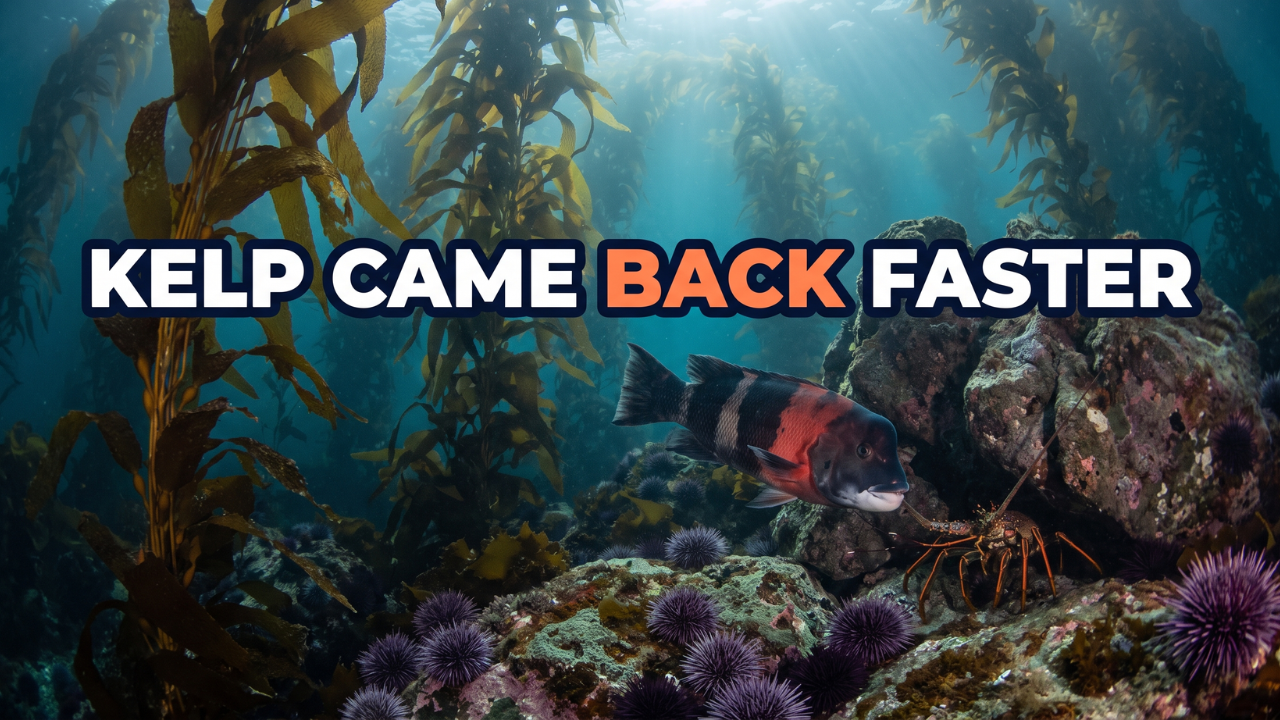
The mechanism is a classic trophic cascade. MPAs protect California sheephead and California spiny lobster from fishing, and both eat sea urchins. With those predators intact, urchin populations don't explode into the barrens that can strip a recovering kelp bed to bare rock. Outside the MPAs, those predators had been fished down, and with sea stars gone from the wasting disease, urchins had fewer checks.
Andrew's hope is that over the next ten to twenty years, sheephead and lobster populations inside MPAs spill over into surrounding waters and help kelp outside the boundaries too.
From Review to 30x30
CDFW followed the review with prioritized recommendations organized around three areas: MPA governance, the state's MPA management program, and overall network performance. The Ocean Protection Council is now folding those recommendations into California's 30x30 commitment to protect 30% of the state's lands and coastal waters by 2030, treating the existing network, which covers 16% of state waters across 124 MPAs, as a foundation to build on.
That opens real options: expanding some MPAs, adding new ones, and prioritizing areas that may hold up better as the climate changes.
Why This Kind of Review Matters
The next decadal review is due in about ten years. Andrew would prefer a check every five years at minimum, in smaller chunks. Either way, these assessments exist to show what happened after something like The Blob and whether protection helped. In this case, the data makes a case for more protection, because the kelp inside the MPAs is what came back.
We rarely hear about what works. This is one of those times.
Takeaways:
- The 2014 to 2016 marine heatwave (The Blob) and El Niño hit two years after California completed its MPA network, collapsing kelp forests statewide.
- California's first MPA Decadal Management Review, released by CDFW in January 2023 with the Ocean Protection Council, drew on long-term monitoring across multiple habitats.
- The review produced seven technical reports and one synthesis report, with the synthesis led by an outside group, NCEAS.
- A UCLA-led study in the Journal of Applied Ecology found kelp inside MPAs recovered better after the heatwave than matched unprotected sites, most clearly in Southern California.
- Protected sheephead and spiny lobster keep urchins in check, which is the likely reason protected kelp rebounded.
- CDFW's recommendations cover MPA governance, the management program, and network performance, and OPC is folding them into California's 30x30 goal.
- Regular assessments show where protection is working and make the case for expanding it.

CEO

300 People, 50 Tribes, One Meeting: How California Built Its Marine Protected Areas