The Blob Hit California's Kelp. Protected Kelp Came Back Faster.

 Apple Podcasts
 Spotify
 YouTube
 Amazon Music
 PocketCasts
 Overcast
 In 2014, just two years after California finished its statewide network of marine protected areas, a marine heatwave known as The Blob settled over the Pacific coast and stayed for two years. Kelp forests collapsed up and down the state, and sea star wasting disease wiped out sea stars on a scale few scientists had seen. For a network built partly to protect kelp habitat, it was the worst possible first test.
Andrew Lewin walks through what the state learned when it checked. California's first Decadal Management Review pulled together long-term monitoring across kelp forests, rocky reefs, the intertidal, sandy beaches, and more, producing seven technical reports plus an independent synthesis from the National Center for Ecological Analysis and Synthesis so the state wasn't grading its own work. A UCLA-led study in the Journal of Applied Ecology then used nearly four decades of satellite imagery to show that kelp inside MPAs recovered better after the heatwave than similar unprotected coastline, most clearly in Southern California.
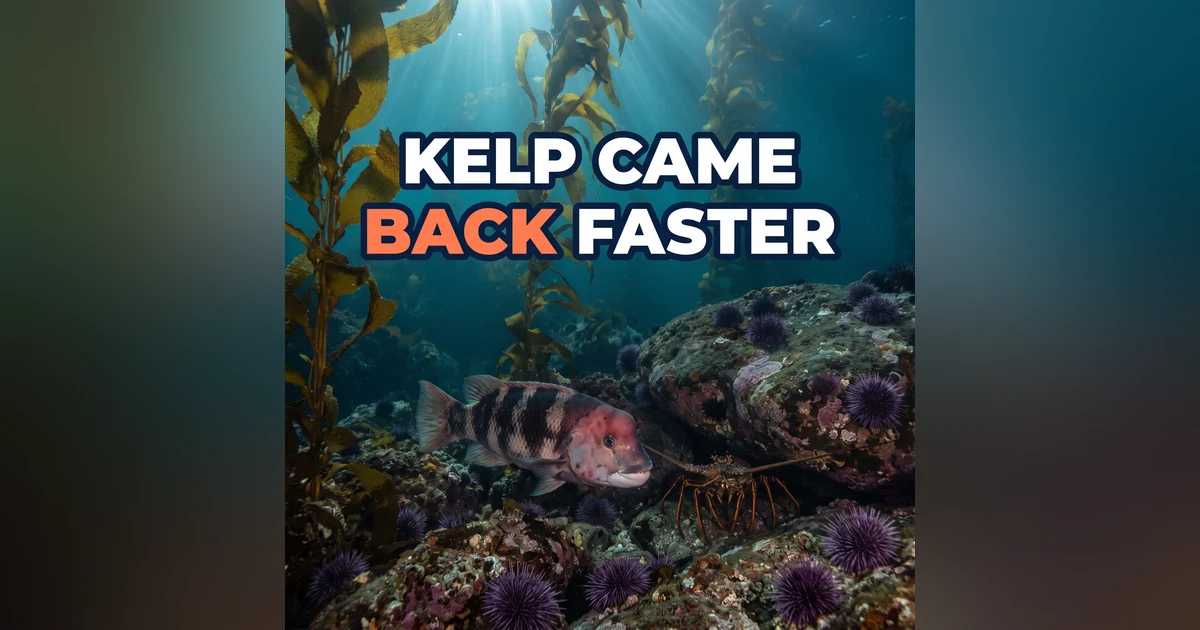
The reason comes down to predators. Inside MPAs, California sheephead and spiny lobster were protected from fishing and kept urchins in check, so recovering kelp beds weren't mowed down into urchin barrens. Andrew covers the 2023 recommendations that came out of the review, how the Ocean Protection Council is folding them into California's 30x30 commitment, and why he'd like to see these assessments happen every five years instead of every ten. Thursday, the series turns to who gets heard in what happens next.
Takeaways:
- The 2014 to 2016 marine heatwave (The Blob) and El Niño hit two years after California completed its MPA network, collapsing kelp forests statewide.
- California's first MPA Decadal Management Review, released by CDFW in January 2023 with the Ocean Protection Council, drew on long-term monitoring across multiple habitats.
- The review produced seven technical reports and one synthesis report, with the synthesis led by an outside group, NCEAS, for independent perspective.
- A UCLA-led study in the Journal of Applied Ecology used satellite imagery from 1984 to 2022 and found kelp inside MPAs recovered better after the heatwave than matched unprotected sites, most clearly in Southern California.
- The likely mechanism is a trophic cascade: protected sheephead and spiny lobster keep urchin populations from exploding into kelp-eating barrens.
- CDFW's recommendations are organized around MPA governance, the MPA management program, and overall network performance.
- The network covers 16% of state waters across 124 MPAs, and the Ocean Protection Council is treating it as a foundation for California's 30x30 goal.
- Regular, checkable assessments show where protection is working and make the case for expanding it.
Support Independent Podcasts: https://www.speakupforblue.com/patreon
Need help with your ocean non-profit, company, or project? Get the help you need with Pisces Oceans Inc.: https://www.piscesoceans.ca
Connect with Speak Up For Blue
Website: https://bit.ly/3fOF3Wf
Instagram: https://bit.ly/3rIaJSG
TikTok: https://www.tiktok.com/@speakupforblue
Twitter: https://bit.ly/3rHZxpc
YouTube: www.speakupforblue.com/youtube
00:00:00,049 --> 00:00:04,849
In 2014, two years after California
finished building its statewide network of
2
00:00:04,849 --> 00:00:09,009
marine protected areas, the Pacific Ocean
did something almost nobody expected.
3
00:00:09,269 --> 00:00:15,959
A marine heatwave named The Blob hit the
coast, and it didn't let go for two years.
4
00:00:16,329 --> 00:00:19,399
Kelp forests up and down the
state started collapsing.
5
00:00:19,909 --> 00:00:23,749
So the real test is how do these kelp
forests in this new marine protected
6
00:00:23,749 --> 00:00:26,180
area recover after the heat wave?
7
00:00:26,590 --> 00:00:28,999
This is what we're gonna be
discussing on this episode of the
8
00:00:28,999 --> 00:00:30,189
How to Protect the Ocean podcast.
9
00:00:30,210 --> 00:00:33,400
I'm your host, Andrew Lewin, and
I'm a marine biologist and ocean
10
00:00:33,400 --> 00:00:36,649
communications manager for a,
company called Pisces Oceans.
11
00:00:36,890 --> 00:00:40,780
It's a consulting firm that helps
ocean projects succeed and have
12
00:00:40,780 --> 00:00:43,119
a greater impact on the ocean.
13
00:00:43,594 --> 00:00:47,568
Today we're gonna be talking about what
happened after the California Marine
14
00:00:47,568 --> 00:00:49,378
Protected Area Network went into place.
15
00:00:49,598 --> 00:00:52,698
Yesterday's episode was all about the
history of how it came into place.
16
00:00:53,048 --> 00:00:55,698
Then we're gonna talk about something
major that happened was the fact that
17
00:00:55,737 --> 00:01:01,128
a heat wave hit two years after it was
designated and all hell broke loose.
18
00:01:01,158 --> 00:01:04,817
And we're looking at how a network of
marine protected areas could recover
19
00:01:04,817 --> 00:01:08,557
after a heat wave or was it just the
fact that these were paper parks and
20
00:01:08,557 --> 00:01:09,648
nobody was actually managing them?
21
00:01:09,648 --> 00:01:13,098
So we're gonna talk about that and
what happened 'cause, uh, the thing
22
00:01:13,098 --> 00:01:16,067
is, like after one of these heat
waves hit, like the blob, one of
23
00:01:16,068 --> 00:01:19,277
the major heat waves that happened
during an El Niño and so many things
24
00:01:19,287 --> 00:01:22,037
happened that were bad, can it recover?
25
00:01:22,208 --> 00:01:23,077
Is that the idea?
26
00:01:23,077 --> 00:01:25,238
I mean, that's what a
marine protected area does.
27
00:01:25,238 --> 00:01:29,287
It takes away the human aspect of it,
the human disturbance, all the extractive
28
00:01:29,288 --> 00:01:33,577
processes that can happen, fishing,
mining, even some places where you can't
29
00:01:33,577 --> 00:01:37,008
do any kind of recreational activities
in these marine protected areas to make
30
00:01:37,008 --> 00:01:41,208
sure that these areas were gonna be fine
so that it could recover faster when
31
00:01:41,208 --> 00:01:42,908
these things happen with climate change.
32
00:01:43,178 --> 00:01:46,238
So we're gonna dive into
actually what happened.
33
00:01:46,947 --> 00:01:52,637
So two years after this marine protected
area was put together, this network, 2012.
34
00:01:52,637 --> 00:01:58,947
Two years later, between 2014 and 2016,
a marine heatwave and compounding El
35
00:01:58,947 --> 00:02:03,257
Niño conditions hit two years after
the network finished, and kelp forests
36
00:02:03,267 --> 00:02:08,907
statewide went into a large-scale
decline, the exact habitat that the
37
00:02:08,907 --> 00:02:11,817
original law was supposed to prioritize.
38
00:02:12,037 --> 00:02:16,297
Not only did that happen, but we saw sea
stars go through probably the one of the
39
00:02:16,307 --> 00:02:19,947
worst cases of, death in that we've seen.
40
00:02:19,957 --> 00:02:22,027
Like, just the decrease
that happened was unreal.
41
00:02:22,027 --> 00:02:25,527
They had sea star wasting disease,
which was like a disease that came on
42
00:02:25,527 --> 00:02:29,437
because of the heatwave, and we just
saw sea stars disintegrate right in
43
00:02:29,437 --> 00:02:33,247
front of us, and there was nothing we
could do about it until that bacteria or
44
00:02:33,247 --> 00:02:35,757
whatever it was that caused it went away.
45
00:02:35,867 --> 00:02:39,277
And now sea stars are a little on the
recovery, but still, it went through,
46
00:02:39,277 --> 00:02:40,697
like, something that was pretty dire.
47
00:02:40,897 --> 00:02:44,317
A lot of us thought that sea stars
would never be the same again.
48
00:02:44,497 --> 00:02:45,597
And the same thing with kelp.
49
00:02:45,597 --> 00:02:49,767
When we saw the heatwave happen, kelp
can't handle that much heat in that type
50
00:02:49,767 --> 00:02:51,977
of range, and so they started dying off.
51
00:02:52,217 --> 00:02:54,587
So the big thing is, is like
we couldn't do anything about
52
00:02:54,587 --> 00:02:55,687
the heatwave at that time.
53
00:02:55,687 --> 00:02:58,467
We can't just stop it in the
middle of what was happening.
54
00:02:58,467 --> 00:03:02,897
So we said, "Hey, how do we recover from
this? How do we make sure that these
55
00:03:02,897 --> 00:03:06,837
kelp forests continue to thrive after
this? Can they rebuild after this?" The
56
00:03:06,837 --> 00:03:11,277
problem really comes down to the question
of can the kelp habitats that produce
57
00:03:11,307 --> 00:03:17,447
and house a huge biodiverse, uh, system,
can they recover after the heat wave?
58
00:03:17,647 --> 00:03:22,507
And the only way to know that is really
to go into how management was done
59
00:03:22,537 --> 00:03:27,407
and how they looked at science data
to ensure that, you know, the kelp was
60
00:03:27,407 --> 00:03:31,327
actually recovering and not just hope
for the best after a 10-year review.
61
00:03:31,869 --> 00:03:36,743
So that check happened, for the first
time as a decadal management review,
62
00:03:36,903 --> 00:03:40,503
and it was led by the Department of Fish
and Wildlife for the Ocean Protection
63
00:03:40,503 --> 00:03:45,173
Council, drawing on long-term monitoring
across multiple habitat types, so kelp
64
00:03:45,173 --> 00:03:51,213
forests, rocky reefs, mid-depth rocky
reefs, sandy beaches and surf zone, deep
65
00:03:51,213 --> 00:03:53,613
habitats, and rocky intertidal zones.
66
00:03:53,963 --> 00:03:58,203
Twenty-four universities,
agencies, and research institutions
67
00:03:58,443 --> 00:04:00,903
contributed data to this program.
68
00:04:01,173 --> 00:04:05,373
The results came out as seven
separate technical reports, plus
69
00:04:05,373 --> 00:04:08,683
a synthesis report from an outside
research group, the National Center
70
00:04:08,683 --> 00:04:10,553
of Ecological Analysis and Synthesis,
71
00:04:10,913 --> 00:04:14,143
Specifically so the state wasn't
just grading its own work.
72
00:04:14,333 --> 00:04:16,943
So it wasn't as if the state went out
and collected all the data, did the
73
00:04:16,943 --> 00:04:18,173
reports, and everything like that.
74
00:04:18,363 --> 00:04:20,933
It was like they had a third party
look it over to make sure that
75
00:04:20,973 --> 00:04:23,583
the assessment was done properly.
76
00:04:24,106 --> 00:04:27,963
So after the heat wave happened,
looking at these types of reports
77
00:04:27,963 --> 00:04:32,003
and looking at this data was gonna be
really important to make sure that the
78
00:04:32,033 --> 00:04:35,623
kelp could recover or that we could
analyze whether the kelp recovered.
79
00:04:35,943 --> 00:04:39,193
Now, a peer review study out of UCLA
published in the Journal of Applied
80
00:04:39,193 --> 00:04:44,853
Ecology used nearly forty years of
satellite imagery from 1984 to 2022
81
00:04:45,103 --> 00:04:49,173
to compare kelp recovery inside
protected areas against similar
82
00:04:49,213 --> 00:04:51,293
unprotected stretches of coastline.
83
00:04:51,919 --> 00:04:54,829
The findings of that study found
that the kelp forests inside the
84
00:04:54,829 --> 00:04:59,659
MPAs recovered measurably faster
after the 2014 and 2016 heat wave
85
00:04:59,879 --> 00:05:03,489
than kelp outside of the protected
areas, with the clearest benefits
86
00:05:03,489 --> 00:05:05,249
showing up in Southern California.
87
00:05:05,699 --> 00:05:08,169
The proposed mechanism is
pretty straightforward.
88
00:05:08,639 --> 00:05:13,839
MPAs protect species like California spiny
lobster, sheephead, and other predators
89
00:05:13,840 --> 00:05:17,109
that kept kelp-eating urchins in check.
90
00:05:17,359 --> 00:05:20,609
With those predators intact, urchin
populations don't explode into the
91
00:05:20,609 --> 00:05:23,653
barren-forming outbreaks that can
wipe out a recovering kelp bed.
92
00:05:24,143 --> 00:05:25,003
That was the data.
93
00:05:25,003 --> 00:05:27,793
That's what they found, was the fact
that the predators like the sheephead,
94
00:05:28,033 --> 00:05:32,013
spiny lobster, were able to stay there,
even though the sea stars that were
95
00:05:32,023 --> 00:05:35,183
wiped out from the sea star wasting
disease during the heat wave were
96
00:05:35,183 --> 00:05:39,113
not there to account for a lot of the
predatory acts against sea urchins.
97
00:05:39,323 --> 00:05:43,693
So the kelp forests had the ability to
recover, whereas in outside the marine
98
00:05:43,693 --> 00:05:47,373
protected areas, those predators were gone
'cause they were able to be fished out,
99
00:05:47,563 --> 00:05:49,583
and so the population wasn't as strong.
100
00:05:49,583 --> 00:05:53,683
Now, hopefully in twenty years from
now or another ten years from now, we
101
00:05:53,683 --> 00:05:57,353
start seeing a spillover effect of the
predators inside the marine protected
102
00:05:57,353 --> 00:06:01,883
areas like sheephead, fish, as well as
the spiny lobster, to go outside of those
103
00:06:01,883 --> 00:06:06,743
boundaries and protect those areas and
start feasting on those sea urchins.
104
00:06:07,043 --> 00:06:11,483
So that is a big study to show what we
needed to know, was the fact that inside
105
00:06:11,483 --> 00:06:15,593
a marine protected area, the predators
of these sea urchins are protected
106
00:06:15,613 --> 00:06:19,793
and that will grow back and recover
to make sure that any kinda thing that
107
00:06:19,793 --> 00:06:23,553
happens to the kelp, like a marine
heat wave, the recovery will be a lot
108
00:06:23,553 --> 00:06:27,453
faster if those sea urchin predators
aren't there or they're kept in check.
109
00:06:27,683 --> 00:06:28,883
And that's just nature for you.
110
00:06:28,893 --> 00:06:32,213
If we allow nature to be nature, a
lot of the times they will recover,
111
00:06:32,393 --> 00:06:35,123
with, of course, some limitations.
112
00:06:35,123 --> 00:06:38,793
But this is what happens when you
do the right thing and you are in an
113
00:06:38,793 --> 00:06:41,113
MPA that is really great to do that.
114
00:06:41,628 --> 00:06:46,250
So following that review The California
Department of Fish and Wildlife
115
00:06:46,280 --> 00:06:51,180
released a formal set of prioritized
recommendations in 2023, organized
116
00:06:51,180 --> 00:06:56,560
around three areas: MPA governance, the
state's MPA management program itself,
117
00:06:56,670 --> 00:06:58,570
and the overall network performance.
118
00:06:58,840 --> 00:07:02,600
The Ocean Protection Council is now
folding those recommendations directly
119
00:07:02,600 --> 00:07:06,920
into California's broader 30 by 30
biodiversity commitment, which is
120
00:07:06,930 --> 00:07:11,550
protecting 30% of the state's lands
and waters by 2030, which we've talked
121
00:07:11,560 --> 00:07:15,370
a lot about on this podcast, and
treating the existing MPA network,
122
00:07:15,380 --> 00:07:20,040
already 16% of state waters, as a
foundation to strengthen rather than
123
00:07:20,040 --> 00:07:22,130
just a finished project to leave alone.
124
00:07:22,430 --> 00:07:26,130
Like I talked to you, uh, yesterday and
the day before with Anupa, how the fact
125
00:07:26,130 --> 00:07:30,460
that a lot of this reporting didn't come
out as new assessments for this area.
126
00:07:30,460 --> 00:07:32,120
So this must have been an older report.
127
00:07:32,120 --> 00:07:35,070
So but there have been scientific
reports that were released.
128
00:07:35,310 --> 00:07:37,450
I just wish they were released
for a lot of the people that we
129
00:07:37,450 --> 00:07:40,770
talked about on Monday, but just
it doesn't seem to happen that way.
130
00:07:41,130 --> 00:07:44,650
So the fact is that we know that the
ten years of monitoring, seven technical
131
00:07:44,650 --> 00:07:49,400
reports, one synthesis report, nearly
four decades of satellite data in the UCLA
132
00:07:49,400 --> 00:07:52,700
study that I talked about, sixteen percent
of state waters are currently protected.
133
00:07:52,700 --> 00:07:57,170
We know that this is working, and this
is a great foundation to build on and
134
00:07:57,170 --> 00:08:02,550
maybe expand some MPAs, maybe look at
areas where climate change can't have
135
00:08:02,560 --> 00:08:06,660
that much of an effect, and we can start
prioritizing those areas to be protected.
136
00:08:06,860 --> 00:08:11,250
And this is a chance to look at the
effectiveness of the MPAs and see where
137
00:08:11,250 --> 00:08:15,050
we can put either more or expand some
just to make sure that we're protecting
138
00:08:15,050 --> 00:08:18,650
more of the state waters because
that's an important aspect, right?
139
00:08:19,090 --> 00:08:22,260
The same review process is gonna
happen in another ten years.
140
00:08:22,270 --> 00:08:25,150
Hopefully, they start doing it in smaller
chunks because I think that's really
141
00:08:25,150 --> 00:08:27,120
important to do it in smaller chunks.
142
00:08:27,340 --> 00:08:30,020
But the fact is that this is
the way the system is set up.
143
00:08:30,080 --> 00:08:34,790
I would prefer, every five years at
minimum to do this type of study, uh,
144
00:08:34,790 --> 00:08:36,660
and I think that's important to have.
145
00:08:36,750 --> 00:08:41,110
But the thing is, is that this
MPA system, this network, produces
146
00:08:41,130 --> 00:08:44,890
those checkable, assessments to make
sure that things are going well.
147
00:08:44,890 --> 00:08:47,890
This is not to say that California
failed or passed or anything.
148
00:08:48,090 --> 00:08:49,290
These assessments are not for that.
149
00:08:49,470 --> 00:08:51,820
These are assessments to make sure
that if anything has changed, like a
150
00:08:51,820 --> 00:08:55,310
marine heatwave, we can see how things
are recovering and how they work.
151
00:08:55,320 --> 00:08:58,500
In fact, it's a way to say, "Hey,
you know what? This works so well
152
00:08:58,700 --> 00:09:03,200
that kelp recovered inside the MPAs
instead of outside the MPAs, so we
153
00:09:03,200 --> 00:09:06,490
should start expanding more." It's
a case to have more because we need
154
00:09:06,490 --> 00:09:08,160
more kelp forests to be protected.
155
00:09:08,540 --> 00:09:09,460
That's the show for today.
156
00:09:09,460 --> 00:09:11,140
it's pretty quick and easy, show.
157
00:09:11,140 --> 00:09:12,529
It's what we, It's what we do here.
158
00:09:12,529 --> 00:09:15,469
We kind of bring you the information
because I don't want people to think,
159
00:09:15,789 --> 00:09:19,290
"Oh, here's a marine protected area.
It's not effective." You know, because we
160
00:09:19,290 --> 00:09:24,090
don't really hear about what works when
we hear in the press, and this works.
161
00:09:24,130 --> 00:09:27,590
So I want you guys to hear it
here first before you go off and
162
00:09:27,590 --> 00:09:28,459
be like, "Hey, you know what?
163
00:09:28,460 --> 00:09:30,420
Like I don't think this is
actually working." If you know
164
00:09:30,420 --> 00:09:33,628
it works that becomes a big
benefit for us, in the future.
165
00:09:33,968 --> 00:09:37,948
Now, uh, Thursday's episode, uh,
we're gonna shift, uh, from, hey,
166
00:09:37,948 --> 00:09:41,498
does this work, does this MPA work,
to how do people get heard about
167
00:09:41,508 --> 00:09:43,538
what is happening next, right?
168
00:09:43,538 --> 00:09:44,658
Or what happens next.
169
00:09:44,898 --> 00:09:48,538
And so that's really a callback
to, you know, the Monday's episode
170
00:09:48,538 --> 00:09:53,168
with Anupa, where we looked at, how
this process didn't really allow
171
00:09:53,168 --> 00:09:56,817
everybody to be heard, and I think
that's really important, to discuss.
172
00:09:56,998 --> 00:09:59,957
and that's a good thing because we
need to make sure that that process
173
00:09:59,998 --> 00:10:01,638
is better, when we go forward.
174
00:10:01,638 --> 00:10:04,347
So this is something that's
really important to me.
175
00:10:04,348 --> 00:10:05,618
I hope it's important to you.
176
00:10:05,818 --> 00:10:09,368
That's the episode for today, so thank you
so much for joining me on today's episode
177
00:10:09,408 --> 00:10:11,048
of the How to Protect the Ocean podcast.
178
00:10:11,268 --> 00:10:12,398
I am your host, Andrew Lewin.
179
00:10:12,408 --> 00:10:13,038
Have a great day.
180
00:10:13,038 --> 00:10:15,388
We'll talk to you next time,
and happy conservation.

