Bottom Trawling on Seamounts: The Damage Nobody Sees
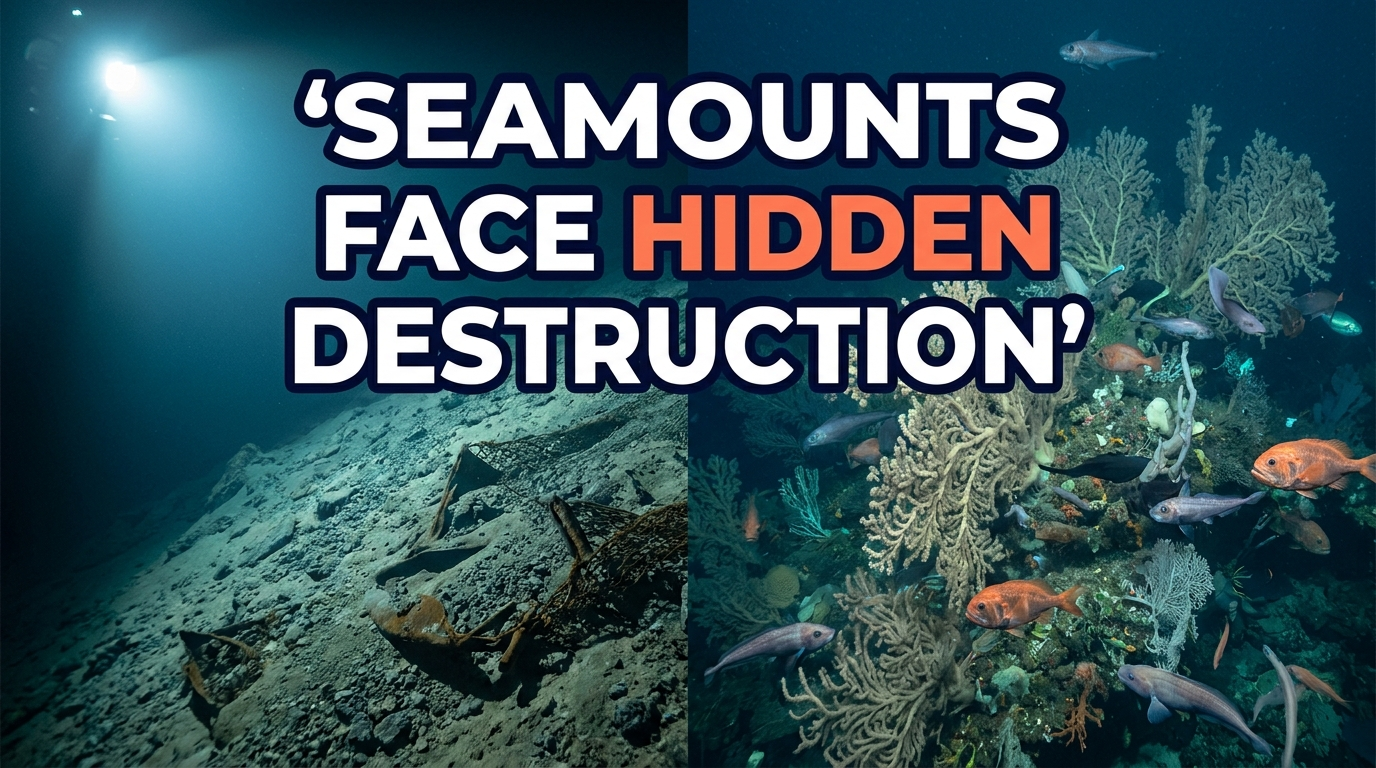
Seamounts are underwater mountains, most of them volcanic, that rise at least 1,000 meters above the surrounding seafloor without breaking the surface. They disrupt ocean currents through a process called topographic upwelling, in which cold, nutrient-rich water gets pulled up a seamount's slopes toward the surface. That upwelling fuels blooms of phytoplankton, which feed the rest of the food web, small fish, bigger fish, sharks, tuna, seabirds, and marine mammals that gather to feed around the structure.
Seamounts' rocky surfaces also give slow-growing, stationary animals like corals and sponges a rare hard substrate to attach to in an otherwise soft-sediment deep sea. On average, roughly one in five species found on seamounts are endemic: they exist nowhere else on Earth. Some marine scientists describe seamounts as oases in the deep sea, concentrated pockets of life in an otherwise cold, dark, and largely empty environment.
Humans interact with seamounts mainly through fishing. Commercial fishing around seamounts, including for species like orange roughy, has historically supported coastal communities and fed people worldwide. But the same industry can also cause damage that outlasts the benefit by decades, when practiced certain ways. Bottom trawling, dragging heavy nets and gear along the seafloor to catch fish, drags directly across coral and sponge habitat on seamount slopes that took centuries or longer to grow.
Unlike damage on land, which people can usually see directly, damage on the deep seafloor is invisible from the deck of a boat. These seamounts sit around 1,000 meters down, far beyond any recreational diving range and any sunlight. A trawler can drag its nets across the same seamount hundreds or thousands of times over the years, and from the surface, nothing looks different. Without a dedicated scientific survey, there's no way to know what's been lost, or whether anything was lost at all.
That's precisely the gap a set of Australian studies set out to close. In 1997, researchers led by Tony Koslow and Karen Gowlett-Holmes of CSIRO Marine Research in Hobart surveyed a group of small seamounts south of Tasmania using dredges and cameras. Their goal was to assess the impact of trawling for orange roughy and to test whether a proposed marine reserve would actually protect the area. They surveyed 14 seamounts, deliberately choosing sites ranging from completely unfished to heavily fished, giving them a rare opportunity to compare seamounts that had experienced years of trawling against ones left essentially alone.
The diversity itself was a discovery. That single 1997 survey turned up 262 invertebrate species and 37 fish species, compared to only 598 invertebrate species reported from every seamount study conducted worldwide up to that point . On the untrawled and lightly fished seamounts, the reef structure was dense, diverse, and alive. On the heavily trawled seamounts, reef aggregate was stripped from the slopes or reduced to rubble. Published figures from the study show benthic biomass on unfished seamounts was 106% greater than on heavily fished ones, and species richness per sample was 46% greater on unfished seamounts .
A 2009 follow-up study by Althaus and colleagues went further, analyzing more than 64,000 video frames across 25 seamounts and more than 700 high-resolution images across seven seamounts. It found trawling had reduced coral cover by roughly two orders of magnitude, close to a hundredfold, and caused threefold declines in richness, diversity, and density across the rest of the seafloor community. Perhaps the most sobering finding: on seamounts where trawling had stopped five years earlier, there was no clear sign of recovery. The damage wasn't just severe, it appeared effectively permanent on any timescale that matters to human life.
That's because deep-sea corals and sponges grow under completely different conditions than their shallow-water counterparts. Without sunlight, without the symbiotic relationships that let shallow corals grow quickly, these animals grow slowly, over centuries, and can be destroyed within moments of a trawl pass. Seamounts also carry relatively high levels of endemism, meaning some of what's destroyed may be species that existed only on that seamount and were never documented at all. Researchers have pointed out that some species may be going extinct on trawled seamounts before science even discovers they exist.
This research is part of what pushed Matthew Gianni, once a deep-sea trawl fisherman himself, to help found the Deep Sea Conservation Coalition and work with bodies including the UN General Assembly and the FAO to push for international protections against high seas bottom trawling. It's a reminder that what happens 1,000 meters down doesn't stay invisible forever, it just takes the right survey, and the right person willing to look, to bring it to the surface.
Takeaways:
- Seamounts are volcanic underwater mountains that drive nutrient upwelling and concentrate deep-sea biodiversity, including many endemic species.
- Bottom trawling for orange roughy and similar species can strip centuries-old coral and sponge habitat from seamount slopes in a single pass.
- A 1997 CSIRO-led study south of Tasmania documented dramatically lower biomass and species richness on heavily trawled seamounts versus untouched ones.
- A 2009 follow-up study found roughly a hundredfold decline in coral cover on trawled seamounts and no clear recovery five years after trawling stopped.
- Because this damage is invisible from the surface, it often goes undocumented without a dedicated scientific survey.
- This research helped drive the creation of the Deep Sea Conservation Coalition and international efforts to restrict high seas bottom trawling.
FAQ
What is deep-sea bottom trawling?
Bottom trawling is a fishing method that uses towed nets to catch fish and other marine species living on or close to the seabed. Large weighted nets are dragged across the ocean floor, clear-cutting a swath of habitat in their wake, and the practice can currently reach more than 800 meters in depth.
How is it different from ordinary or midwater trawling?
Bottom trawling involves towing a net along the seafloor, while midwater or pelagic trawling tows the net higher in the water column. Trawling can also be done just above the bottom, known as semi-pelagic trawling, so the category isn't strictly binary between surface and seabed.
Which countries banned bottom trawling?
Greece became the first country in Europe to ban bottom trawling in all of its marine protected areas, and Sweden went further by banning the practice in all of its territorial waters. The UK has pledged to ban bottom trawling in 41 marine protected areas, covering more than 30,000 square kilometres, though most of these bans apply to protected zones rather than a country's waters entirely.
Which countries do deep sea trawling?
Ten countries, including China, Vietnam, and Indonesia, are responsible for roughly 64 percent of the global bottom trawling catch. The top 20 nations by trawled catch also include the USA, UK, Russia, Norway, and New Zealand.
Why do fishing vessels target seamounts?
Seamounts attract commercially valuable deep-sea species that gather there in predictable numbers. Orange roughy spawns in dense aggregations around seamounts and other topographic features, as well as along the continental slope, which makes those locations efficient places for trawlers to concentrate their effort.
What species are caught there?
New Zealand fishing companies mostly target orange roughy and oreo around seamounts, and orange roughy is one of the oldest commercially exploited fish species, reaching more than 100 years of age. Other bottom trawl catches more broadly include whitefish like cod, haddock, hoki and hake, and flatfish such as halibut and sole, along with prawns, shrimp and squid.
Does the gear physically touch or penetrate the seabed?
Yes. Bottom trawl gear uses towed boards or a metal beam to hold the net open, and these devices often make contact with the seabed. Bottom trawling puts fine sediments back into suspension, altering the physical, morphological and chemical properties of the seabed.

CEO
The Pollution That Breeds: How the Great Lakes Stopped Invaders