Corals Nearly as Old as the Pyramids, and the Fight to Save Them
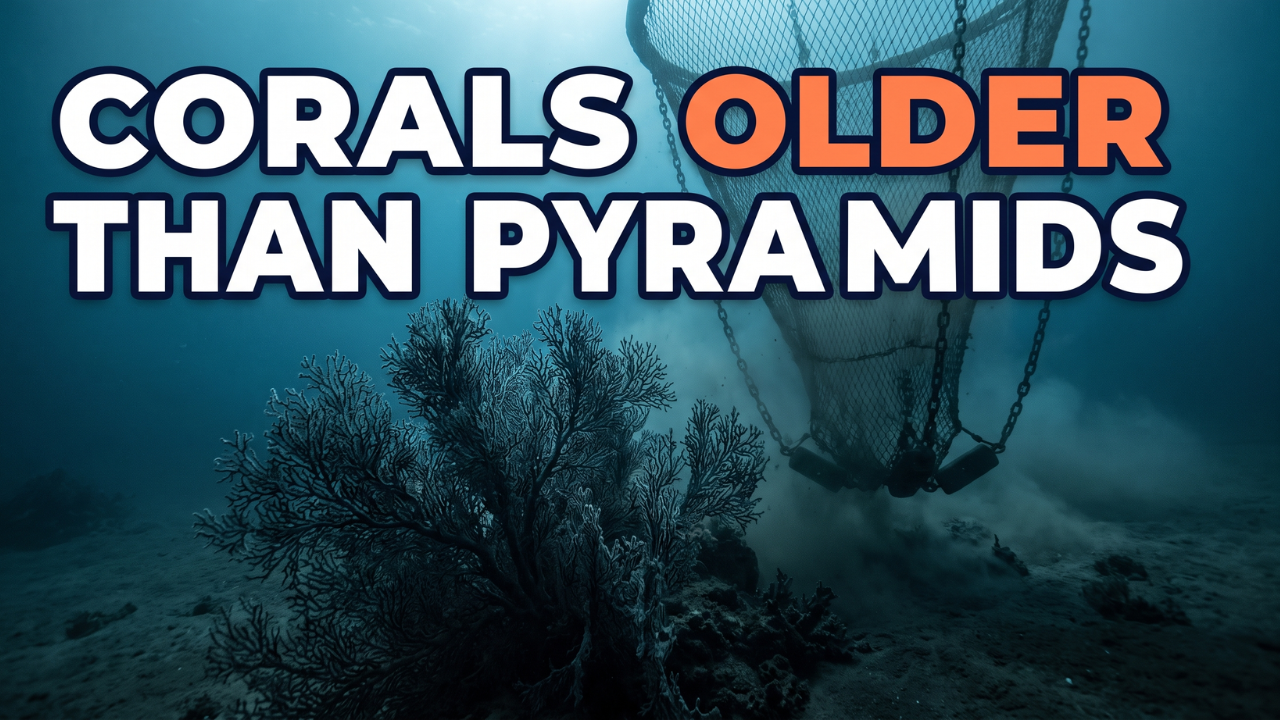
Somewhere on the ocean floor right now, there's a coral colony that has already outlived most of recorded human history. Off the coast of Hawaii, Lawrence Livermore National Laboratory researchers dated a deep-water black coral, Leiopathes sp., at 4,270 years old, making it one of the oldest living skeleton-building marine organisms known to science. For comparison, the Great Pyramid of Giza is roughly 4,500 years old, so this coral is close, though a little younger. A single pass of a bottom trawl net can destroy structures like it in seconds.
That same Lawrence Livermore research named commercial bottom trawling as a direct threat to these corals, alongside harvesting for jewelry. And that's the core problem with bottom trawling as a fishing method: the damage rarely stops at the fish being caught. A trawl net dragged across the seafloor scrapes away the coral and sponge habitat that fish rely on to hide from predators, feed, and reproduce. Once that habitat is gone, it doesn't come back on any timeline that matters to a fishery. These are structures that took centuries, sometimes millennia, to form.
That's why fisheries management has increasingly treated seafloor habitat protection as its own policy priority, separate from managing fish population numbers directly. Protect the habitat, and the fish that depend on it have somewhere to survive. Lose the habitat, and the fish eventually go somewhere else or don't come back at all.
Getting the world's fishing nations to agree on that, though, has never been simple. In November 2004, the UN General Assembly rejected an outright moratorium on high seas bottom trawling. The Deep Sea Conservation Coalition (DSCC), an advocacy group, led the campaign for the temporary ban; opposition led by Iceland and the EU defeated it, and responsibility for high seas bottom fishing was left to individual nations and regional bodies. Two years later, in 2006, a compromise did pass: UN General Assembly Resolution 61/105. It wasn't a ban. It required impact assessments and area closures in places where vulnerable marine ecosystems, like seamounts, hydrothermal vents, and cold-water corals, are known or likely to occur.
The story didn't end there. The UN has reviewed implementation on a rolling basis ever since: a 2009 resolution sharpened the impact-assessment requirements, a 2011 resolution required those assessments to be made public, and a 2016 resolution tied them to Food and Agriculture Organization guidelines, with a further resolution following in 2022. Each round made the framework a little stronger. That pattern, an imperfect first agreement getting built on over time rather than a single decisive fix, shows up across a lot of international ocean policy, including Canada's own experience with fish habitat protection: habitat provisions in the federal Fisheries Act were narrowed in 2012 and later restored through a 2019 amendment.
This fight is not a closed chapter. A preparatory UN workshop on bottom fishing's impact on vulnerable marine ecosystems was held July 13 to 14, 2026, at UN headquarters in New York, feeding into a full General Assembly review later this year. The DSCC is publicly pushing for a firm, time-bound resolution to end bottom trawling on seamounts in the high seas by the end of 2027, tying it to the Kunming-Montreal Global Biodiversity Framework and the High Seas Treaty. (Note: DSCC is an advocacy organization; its policy positions are attributed here as advocacy, not neutral fact.)
The bigger lesson is one that applies well beyond bottom trawling: strong international ocean policy is rarely won in one clean vote. It's usually the imperfect deal that keeps every country at the table, built on and strengthened over years of follow-up review. Waiting for a perfect first agreement means waiting indefinitely. Getting something workable in place, then improving it, is how protections for the ocean floor have actually moved forward.
Takeaways:
- Some deep-sea corals have been alive for thousands of years, and a single trawl pass can destroy that habitat in seconds.
- Bottom trawling's real damage usually lands on the seafloor habitat fish depend on, not the fish stock itself.
- The landmark 2006 UN resolution on bottom trawling (Resolution 61/105) was a hard-fought compromise reached after an outright ban failed in 2004.
- International ocean policy almost never arrives finished. It gets built in stages and strengthened through repeated review cycles.
- A new UN review is underway in 2026, with advocates pushing for a firm end to seamount bottom trawling by 2027.

CEO
The Biggest Mouthful: How Blue Whales Eat and Why Krill Matters