How Did Humpback Whales End Up in New York Harbor?
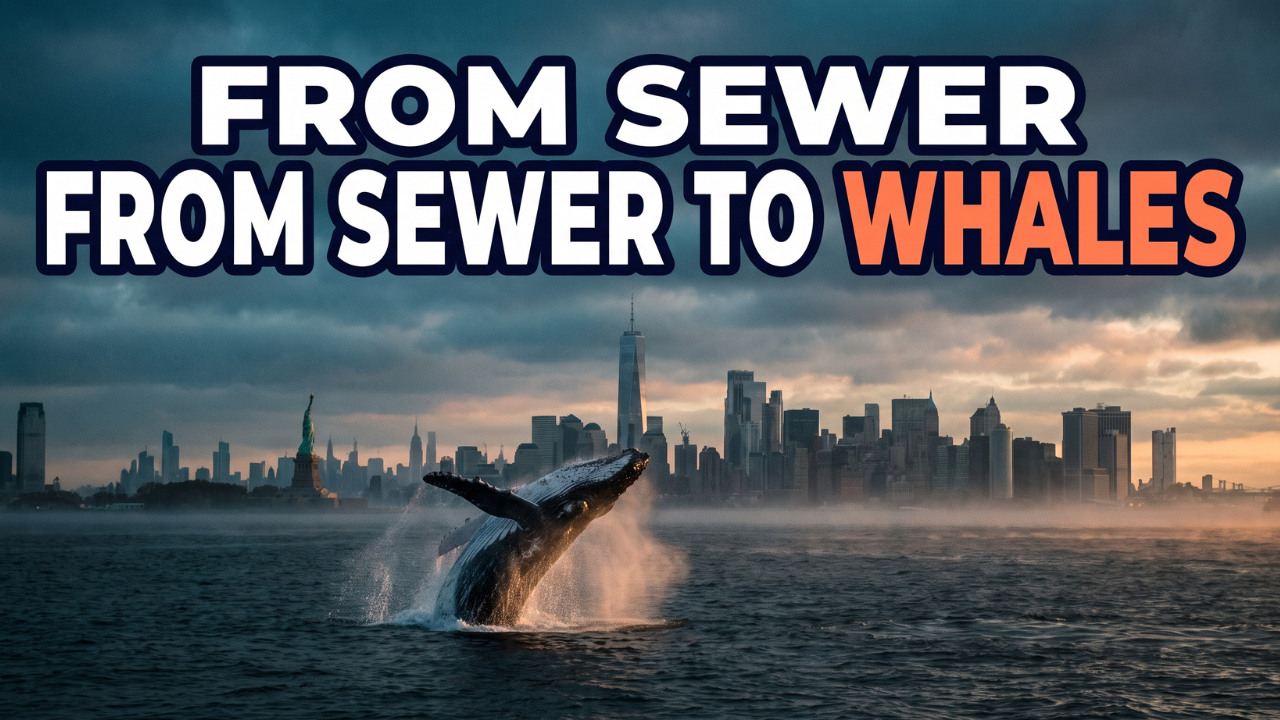
This summer, people are boarding whale watching boats around New York and seeing humpback whales feeding in sight of the Manhattan skyline. Gotham Whale, a Staten Island citizen science nonprofit, has now identified 500 individual humpbacks in New York waters, with 80 to 100 new whales showing up every year.
Ten years ago, that would have sounded impossible. Between 2011 and 2013, researchers logged a single humpback sighting in the harbor estuary. Between 2014 and 2016, they logged 45.
So how did the whales get here? The short answer is cleaner water and more food. The full answer goes back more than a century, to a time when this harbor was one of the most polluted bodies of water in North America.
The Harbor Whales Couldn't Use
New York grew faster than anyone had planned for. Its sewers were built to flush waste straight into the Hudson, the East River, and the harbor, on the theory that moving water would dilute it and carry it out to sea.
By the early 1900s, roughly 590 million gallons of raw sewage a day were pouring into the harbor. As early as 1886, the city installed floating screens at Coney Island to keep sewage away from swimmers. By the early 20th century, according to the city's own environmental agency, the harbor had lost the ability to support wildlife and recreation.
Sewage is loaded with organic matter. Bacteria feeding on it use up the oxygen in the water, and fish either suffocate or leave. When the small fish leave, so does everything that eats them, whales included.
Treatment plants started going up in the 1930s, but the West Side of Manhattan didn't get one. Into the 1970s and 1980s, every flush from Bank Street to Inwood went into the Hudson untreated. The riverfront smelled so bad that nobody walked there.
The People Who Started the Turnaround
Public pressure came early. In 1909, the city began testing harbor water in response to public outcry over pollution. That survey still runs today.
The real turning point came from people who fished the river. In 1966, a group of Hudson River fishermen met in an American Legion hall in Crotonville, New York. They dug up the Refuse Act of 1899, a forgotten federal law that paid a bounty to anyone who reported a polluter, and started using it against the factories and other sources dumping into the river. They won. That group became Riverkeeper, the model for the Waterkeeper movement, which now includes more than 300 organizations worldwide.
Six years later, in 1972, Congress passed the Clean Water Act. It required real sewage treatment and sent federal money to build it.
Fifty Years to Stop the Sewage
The North River treatment plant on Manhattan's West Side was first proposed in 1938. It opened in March 1986, nearly 50 years later. The city's records describe that moment as the first time in New York's history that daily raw sewage stopped flowing into the Hudson. Until then, Manhattan was still discharging roughly 200 million gallons of untreated sewage a day.
The work kept going after 1986. New York now runs 14 treatment plants. It has spent more than $4 billion on sewer overflow control and another $1.2 billion on nitrogen removal since 2002. The share of combined sewer overflow captured for treatment rose from about 30% in 1980 to over 80%.
That progress came with a cost that one community carried. The North River plant ended up in West Harlem after wealthier neighbourhoods blocked an earlier site farther south. Residents dealt with odours for years. In 1988, seven protesters known as the Sewage Seven were arrested blocking the West Side Highway, and that fight led to the founding of WE ACT for Environmental Justice. Riverbank State Park was later built on top of the plant. Who carries the burden of a cleanup matters, and New York's environmental movement learned that here.
Clean Enough Water for Life to Return
The results show up in the city's own data. Since 1992, bacteria levels in New York Harbor have stayed well below the standard for swimming in dry weather. Dissolved oxygen hit record highs in the city's 2017 harbor report. The Hudson riverfront that nobody wanted became a walkway people use every day.
With oxygen back in the water, the food web could rebuild from the bottom up.
Then the Food Came Back
Humpbacks follow food, and in New York that food is mostly Atlantic menhaden, a small, oily fish that travels in huge schools. For decades menhaden were fished with no coastwide limit. In 2012, regulators set the first coastwide catch limits, and the population rebounded.
Researchers who studied the harbor's humpbacks found the whales appear to be moving into the estuary to feed on menhaden. Cleaner water made the harbor livable for those fish, and catch limits let their numbers grow. Put those two decisions together and a humpback migrating along the Atlantic coast now has a good reason to stop in New York.
That's how the whales ended up in the harbor. It also created something new for the city: whale watching trips that let New Yorkers see humpbacks without leaving town.
What's Still Unfinished
New York isn't done. Most of the city still runs on old combined pipes that carry sewage and stormwater together. In heavy rain, those pipes overflow through about 700 outfalls, releasing around 20 billion gallons a year by one advocacy group's estimate. That's why the harbor still isn't open for regular swimming.
The cleanup so far worked because sewage came out of pipes. You could point to the pipe, measure what came out of it, build a plant, and monitor the result. Later this week on How to Protect the Ocean, we'll look at pollution that doesn't come from a pipe at all.
What You Can Do
The whales are in New York Harbor because people watched their water and spoke up, starting with a handful of fishermen in 1966. You can do the same thing today. Go to waterkeeper.org, use the map to find the Waterkeeper group nearest you, and sign up for their updates, including water quality alerts where your local group offers them.
A humpback surfacing in front of the Manhattan skyline, in water that was an open sewer within living memory, is proof that polluted water can come back when enough people push for it. It took decades and billions of dollars, and it worked.
If you're a New Yorker, or your family has history there, Andrew wants to hear what the harbor was like for you.
Takeaways:
- Gotham Whale has identified 500 individual humpbacks in New York waters, with 80 to 100 new whales each year.
- Humpback sightings in the harbor estuary rose from 1 (2011 to 2013) to 45 (2014 to 2016).
- By the early 1900s, roughly 590 million gallons of raw sewage a day entered the harbor, stripping oxygen from the water.
- Public outcry launched the city's Harbor Survey in 1909, and it still runs today.
- In 1966, Hudson River fishermen used an 1899 bounty law against polluters and founded what became Riverkeeper.
- The 1972 Clean Water Act required and funded real sewage treatment.
- The North River plant took nearly 50 years from proposal to opening in 1986.
- The plant's siting in West Harlem sparked the founding of WE ACT for Environmental Justice.
- Harbor bacteria have stayed below dry-weather swimming standards since 1992, and oxygen hit record highs in 2017.
- 2012 menhaden catch limits let the whales' main food source rebound.
- Combined sewer overflows in heavy rain are still being fixed.
- Find your local Waterkeeper at waterkeeper.org and follow your own water.
Frequently Asked Questions About Pollution in New York Harbour
How polluted was New York Harbour in the past?
By the early 1900s, hundreds of millions of gallons of untreated sewage were entering the harbour each day. Sewage, industrial waste and other pollutants made parts of the waterfront foul-smelling, unsafe for recreation and unable to support healthy aquatic life.
How did New York Harbour get cleaned up?
The recovery resulted from decades of public pressure, stronger environmental laws and major investments in sewage treatment. The 1972 Clean Water Act imposed tighter pollution controls and provided funding for wastewater infrastructure. New York City gradually expanded its treatment system, which now includes 14 wastewater treatment plants.
Who helped start the cleanup movement?
Commercial and recreational fishers played an important role. In 1966, Hudson River fishers organized to identify and take legal action against polluters. Their campaign eventually developed into Riverkeeper and inspired the wider Waterkeeper movement. Residents and environmental-justice advocates also pushed the city to improve its sewage facilities and address their effects on surrounding communities.
When did untreated sewage stop flowing from Manhattan into the Hudson River every day?
The North River Wastewater Treatment Plant opened on Manhattan’s West Side in 1986. Its opening ended the routine discharge of untreated sewage from that part of Manhattan, although combined sewer overflows can still release polluted water during wet weather.
Is New York Harbour completely clean now?
No. Water quality has improved enormously, but the harbour has not been restored to a pristine condition. Pollution from stormwater, contaminated sediment, plastics, chemicals and combined sewer overflows remains a problem. Conditions can vary considerably between waterways and from one day to another.
Why does sewage still enter New York waterways when it rains?
Much of New York City uses a combined sewer system that carries household sewage and stormwater through the same pipes. Heavy rain can overwhelm that system, causing a mixture of stormwater and untreated sewage to discharge through overflow outlets. The city is using storage projects and green infrastructure to reduce these events, but combined sewer overflows remain a major source of harbour pollution. Learn how NYC’s combined sewer system works.
Is it safe to swim in New York Harbour or the Hudson River?
Safety depends on the location, weather and current water-quality readings. Conditions are generally worse during and after heavy rainfall because of sewer overflows and runoff. People should use designated swimming areas, check official beach advisories and avoid entering the water when warnings are active. Check New York’s current coastal beach conditions.
Why have whales returned to waters near New York City?
Cleaner water has helped aquatic food webs recover, while protections and catch limits have supported the return of Atlantic menhaden—the small schooling fish on which humpback whales feed. Whales following these fish are now seen more frequently around the harbour entrance and nearby coastal waters. Their return is encouraging, although it does not mean every pollution problem has been solved.
What animals have returned as water quality improved?
The recovering ecosystem supports growing numbers of menhaden as well as whales, dolphins, seals, birds and other wildlife. Improved dissolved-oxygen levels and reduced sewage pollution have made the harbour more hospitable to aquatic life.
What still needs to be done?
New York must continue reducing sewer overflows, upgrading ageing infrastructure, controlling stormwater runoff and monitoring contaminants. Residents can help by following water-quality alerts, reporting suspected pollution, reducing litter and supporting local organizations working to protect the harbour.

CEO
Plastic Is Still the Ocean's #1 Villain