She Chose an Internship Over a Term Paper. It Became a 30-Year Ocean Policy Career.
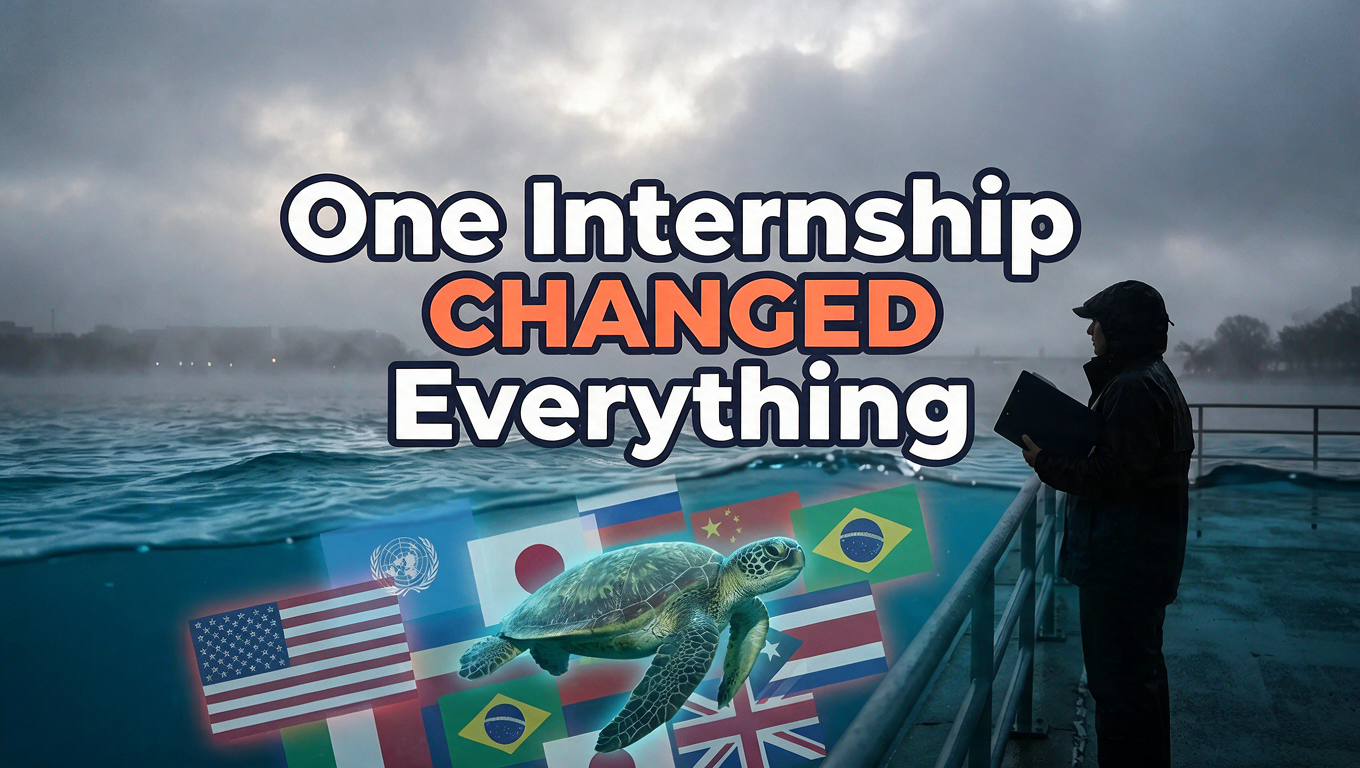
A grad student is handed a choice: write another term paper, or take a summer internship. She takes the internship. She gets assigned to sea turtles. Thirty years later, she is in rooms with delegates from more than 150 countries, negotiating the agreements that decide how the world manages its oceans.
That is the career this episode traces, one decision at a time.
She grew up in Michigan, went to school in Ohio and Indiana, and came to the work with an anthropology degree rather than a marine science one. In grad school, she added public policy coursework, an unusual pairing on paper but a natural one in practice: anthropology looks at how humans affect their environment, and public policy is the discipline for managing that impact. When the choice came between writing a term paper and taking an internship, she chose the internship, a decision Andrew calls out directly as good advice for anyone facing the same fork: if you can choose real experience over a paper, take the experience.
That internship placed her with an NGO in Washington, D.C., then called the Center for Marine Conservation. Her assignment there was sea turtles, and the detail that hooked her into a career in ocean policy was simple: sea turtles do not read maps. They hatch, reach the ocean, and go everywhere, crossing exclusive economic zones and national borders without any regard for who claims which stretch of water. Andrew backs this up with a real example from the transcript: the late Dr. Wallace J. Nichols tagged a loggerhead turtle off Baja California, Mexico, and it was later found in Japan, a documented transpacific migration. [VERIFIED] That specific story checks out against Nichols's own published research.
Once she understood that the animals she cared about ignored every border humans had drawn, the question that shaped the rest of her career became obvious: how do you manage and protect a species that no single country can fully protect on its own? Her answer, and the throughline of everything that follows, was international cooperation. That internship put her in rooms with State Department staff, and her career took off quickly from there. She moved into the State Department's Office of Marine Conservation, spent years on international tuna negotiations through 2012, and in 2014 moved to the International Sustainable Seafood Foundation, ISSF, bringing her total time in ocean policy to nearly thirty years.
Along the way, her work expanded well past sea turtles: negotiating at the UN General Assembly on deep sea trawling and its impact on centuries-old coral habitats, international fisheries negotiations, seafood sustainability policy, and a seat in the room when the High Seas Treaty was finally gaveled through after roughly twenty years of negotiation. Andrew describes the emotion in that room, a moment shaped by two decades of what he calls "blood, sweat, and tears."
He also uses this episode to make a broader point about careers, one he says comes up constantly when people ask him how their kids can become marine biologists: don't pigeonhole yourself into one narrow track before you've had the chance to discover what you actually love. Andrew draws a direct parallel to his own path, from wanting to do turtle and fish research as a marine biologist to becoming an ocean communications manager, a shift he says came from noticing that the biggest gap in ocean conservation wasn't more research, it was that the public simply wasn't hearing about the ocean often enough. That realization is what eventually led him to start this podcast.
This episode is the first of five. Tuesday looks at deep-sea corals nearly as old as the pyramids and the fight to protect them. Wednesday covers the High Seas Treaty in full. Thursday breaks down seafood policy and what retailers need to know about what their customers actually want. Friday brings the full interview with the person whose career this episode has been tracing all along.
Takeaways:
- A single decision, choosing an internship over a term paper, can reshape an entire career; three decades later, that internship led to a seat at major international ocean policy negotiations.
- Species that cross national borders, like migratory sea turtles, are the practical reason international cooperation and treaty-based ocean management exist.
- Green sea turtle populations are showing measurable improvement, genuine good news inside a story that's mostly about policy and negotiation.
- Careers in ocean conservation are rarely linear. Staying open to adjacent paths, research to policy, policy to communications, is often what lets someone have the most impact over time.

CEO
The Biggest Mouthful: How Blue Whales Eat and Why Krill Matters