The Pollution That Breeds: How the Great Lakes Stopped Invaders
In 1988, someone found a small striped mussel in Lake St. Clair, the little lake between Lake Huron and Lake Erie. It was about the size of a fingernail, and nobody had seen one in North America before.
Within a few years there were billions of them, coating pipes, boats, and the bottom of the Great Lakes. Fish populations dropped. The lakes changed. For anyone who grew up in Ontario in the 1990s, zebra mussels were the textbook example of an invasion you can't undo.
Then the Great Lakes pulled off something no other large freshwater system has documented. Here's how.
The Pollutant That Multiplies
This week on the show has been all about marine pollution. Sewage in New York Harbor. Pharmaceuticals in our water. Plastic in Canada. Every one of those pollutants needs us to keep adding it, and when we stop, the system starts to recover.
Invasive species break that rule. A chemical spill gets diluted over time. An invasive population grows, because it reproduces. That's why some scientists call invasive species biological pollution: living things in the wrong place, changing the system around them.
A Free Ride in Ballast Water
Big cargo ships carry water in their hulls to keep them stable. It's called ballast. A ship takes on water in one port, crosses the ocean, and pumps it out in another, along with whatever was living in it: larvae, tiny crustaceans, fish eggs, and plankton. For decades, a ballast tank was a free ride across the planet.
Zebra mussels are native to the region around the Black and Caspian Seas. They almost certainly arrived in the Great Lakes in ballast water, and they spread fast. At the Monroe Power Plant in Michigan, densities jumped from fewer than 50 mussels per square metre in the fall of 1988 to more than 700,000 per square metre a year later. They clog pipes, jam valves, and damage cooling systems. Estimates of the cost to North America run from hundreds of millions to billions of dollars.
They also changed the lakes. A single adult can filter up to about a litre of water a day. Multiply that by billions and the water turns clear. That clarity is a warning sign. It means the plankton at the base of the food web has been stripped out, and the young fish that depend on it pay the price. And every year, the mussels reproduced and the problem grew.
A Beautiful, Hungry Invader
Lionfish are stunning, with red and white stripes, long fan-like fins, and a crown of venomous spines. They're native to the reefs of the Indo-Pacific and were popular in home aquariums for years.
In 1985, lionfish turned up off South Florida. The most likely explanation is aquarium releases: people who no longer wanted their fish let them go in the ocean. Since then, lionfish have spread through the Caribbean, the Gulf of Mexico, and up the US coast to North Carolina.
They had every advantage. A mature female can release about two million eggs a year. Their venomous spines mean almost nothing in the Atlantic wants to eat them, and native fish had never seen a predator like this, so they didn't know to flee. Lionfish eat dozens of native fish species.
In 2008, Oregon State University scientists Mark Albins and Mark Hixon measured the damage on small experimental reefs in the Bahamas. Over just five weeks, reefs with lionfish saw about 79% fewer young native fish settling in. Young fish are a reef's future. After a bleaching event or marine heat wave, a reef needs layers of fish, including grazers that clear algae so young corals can settle. Lionfish eat into that recovery.
Closing the Big Door
From 1959, when the St. Lawrence Seaway opened, to the mid-2000s, the Great Lakes picked up a new non-native species roughly every six to seven months. Nearly 190 non-native species are now established in the basin, and about 65% of those arriving since 1959 came in ballast water.
So Canada and the United States went after the ballast. Starting in 1993, ships entering the Great Lakes from the ocean had to exchange their ballast water at sea, swapping fresh or brackish water for full-strength salt water. Freshwater hitchhikers from European ports usually can't survive that.
The early rules had a gap. Ships that declared "no ballast on board" often still carried leftover water and sludge in their tanks, and invasions kept coming. Canada closed that gap in 2006 and the US followed in 2008, requiring ships to flush even those "empty" tanks with salt water. Ships heading into the St. Lawrence Seaway now have their tanks checked.
In 2022, Anthony Ricciardi of McGill University and Hugh MacIsaac of the University of Windsor looked at what happened next. They compared three 13-year periods. From 1981 to 1993, 19 new non-native species were detected. From 1994 to 2006, 26. From 2007 to 2019, after the tougher rules, just four. That's an 85% drop, and the invasion rate is now the lowest recorded in two centuries.
Ricciardi put it this way: "I'm aware of no other documented case in which the invasion rate of a large aquatic system has been suppressed through a management intervention."
It's the same lesson as New York Harbor. Find the door the problem comes through, and close it. In 2017, an international treaty on ballast water management came into force, so ships around the world now have to manage their ballast too.
Keeping Lionfish Low
Closing the door works for new arrivals. Lionfish were already spread across thousands of kilometres of reef, and you can't flush an ocean. Most people assumed nothing could be done, since no one will ever catch every lionfish in the Caribbean.
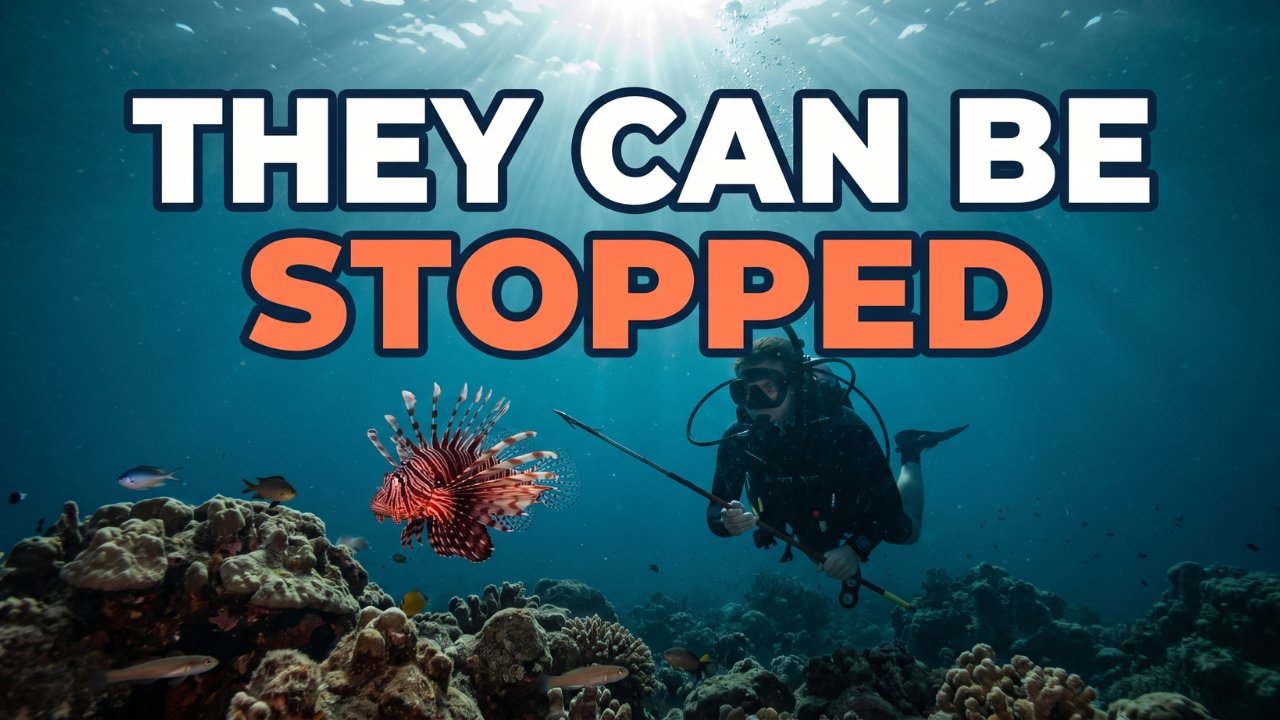
A team led by Stephanie Green, working with Isabelle Côté at Simon Fraser University, asked a different question: what if you don't have to? They worked on 24 coral reefs near Eleuthera in the Bahamas. On some reefs, divers regularly speared lionfish, removing 75 to 95% of them, enough to keep numbers below the level where they wipe out native fish. Other reefs were left alone.
The results came out in 2014. Where lionfish were kept low, native prey fish increased by 50 to 70%. Species that matter to local fishers, like Nassau grouper and yellowtail snapper, benefited too. In Green's words, "by creating safe havens, small pockets of reef where lionfish numbers are kept low, we can help native species recover." You don't have to catch every lionfish to make a difference.
The idea caught on. Florida runs an annual Lionfish Challenge, and in 2024, 285 divers removed 31,773 lionfish, the highest total since it started in 2016. One diver speared 915 on his own. Lionfish now show up on restaurant menus, and NOAA has promoted eating them as a way to keep numbers down. They're meaty and delicious, and overfishing an invasive species is one kind of overfishing worth encouraging.
The Doors Still Open
Ballast rules close one big door. Others remain open: recreational boats moving between lakes, aquarium and pet releases, bait buckets, and invasive carp moving north through US rivers. Zebra and quagga mussels aren't leaving the Great Lakes, and lionfish aren't leaving the Caribbean. The win is keeping them from reaching new lakes, keeping new species out, and managing what's here reef by reef, which depends on local authorities having the resources to do it.
Clean, Drain, Dry
This is where you come in. If you move a boat, canoe, kayak, or paddleboard from one lake or river to another, clean, drain, and dry it every time. A few larvae on a paddleboard can start an invasion in a new lake.
Clean off plants, mud, and anything stuck to the hull or trailer. Drain all the water, including the bilge and live wells. Let everything dry before you launch somewhere new.
In Ontario, it's the law. Since January 1, 2022, you must drain water and remove aquatic plants, animals, and algae from your boat and trailer before moving it overland. Conservation officers can issue fines up to $350.
Zebra mussels spread from the Great Lakes to inland lakes largely on boats and trailers. Ballast rules closed the big door. Clean, drain, and dry closes the small ones, and you're the one holding them shut.
The Pattern
This week covered four kinds of pollution: sewage in New York, drugs in our water, plastic in Canada, and invasives in the Great Lakes. Every time, the pattern holds. Find where the problem comes from, act on it, and give nature time. It responds faster than most people expect, as long as policies get put in place and enforced.
Pollution can breed, spread, and hide. We've shown again and again that we can stop it.
Takeaways:
- Invasive species are biological pollution: they reproduce and grow over time.
- Zebra mussels were found in Lake St. Clair in 1988 and almost certainly arrived in ballast water.
- At one Michigan power plant, densities topped 700,000 mussels per square metre within a year.
- Mussels filter out plankton, the base of the food web that young fish depend on.
- Lionfish likely reached Florida through aquarium releases in the 1980s.
- On test reefs in the Bahamas, lionfish cut young native fish settlement by about 79% in five weeks.
- Ballast exchange began in 1993, and flushing rules for "empty" tanks followed in 2006 and 2008.
- New Great Lakes invasions fell from 26 to 4 per 13-year period, an 85% drop.
- Removing 75 to 95% of lionfish on targeted reefs let native prey fish rebound by 50 to 70%.
- Florida divers removed a record 31,773 lionfish in 2024.
- Clean, drain, and dry every watercraft between waterways; in Ontario it's the law.

CEO
How Beach Cleanup Data Helped Canada Ban Plastic