You Left a Public Comment. Now What?
This week on How to Protect the Ocean, we followed California's marine protected area review from the history of the network to how public process builds support. Along the way, the call to action was simple: submit a public comment, or show up to a Fish and Game Commission meeting.
That leaves a practical question. Once the meeting ends and the news coverage stops, how do you find out if anything actually changed? Organizations ask people to give their time for the ocean all the time, and they don't always report back. Maybe you're not on their email list or following them on social media. Here are four questions, and where to find the answers.
1. What's actually allowed at a specific MPA?
California's network includes 124 marine protected areas. The California Department of Fish and Wildlife maintains the authoritative, current maps and regulations for every one of them on its MPA program pages. That's where you can read the line-by-line rules for the specific spot you care about.
It's also the only source guaranteed to be current once a rule change formally takes effect. Updates won't always post the day a decision is made, so check back regularly. You can even set up a simple automated check, including an AI tool, to watch the page and let you know when it changes.
2. What changes after the Commission votes?
The Fish and Game Commission meets October 15 and 16 in Sacramento to discuss and potentially act on MPA petitions, the ones Anupa Asokan walked us through on Monday. A vote in favor is an important step, and it's still only one step.
Approved changes to MPA boundaries or rules go through California's formal rulemaking process before they're legally in effect: public notice, hearings, adoption, and review by the state's Office of Administrative Law. The updated regulations get published once that's complete. That can mean a gap of months between "the Commission approved this" and "this is now an enforceable rule."
That time matters. Every change has to fit within existing law, line by line. Canada went through a similar exercise at a national scale with the High Seas Treaty, adopted in 2023 and ratified by Canada on September 24, 2026. Ratification took time because the treaty's commitments had to be built into Canadian law so the country can be held accountable for them. The same principle applies to a state MPA rule.
3. How is any of this enforced?
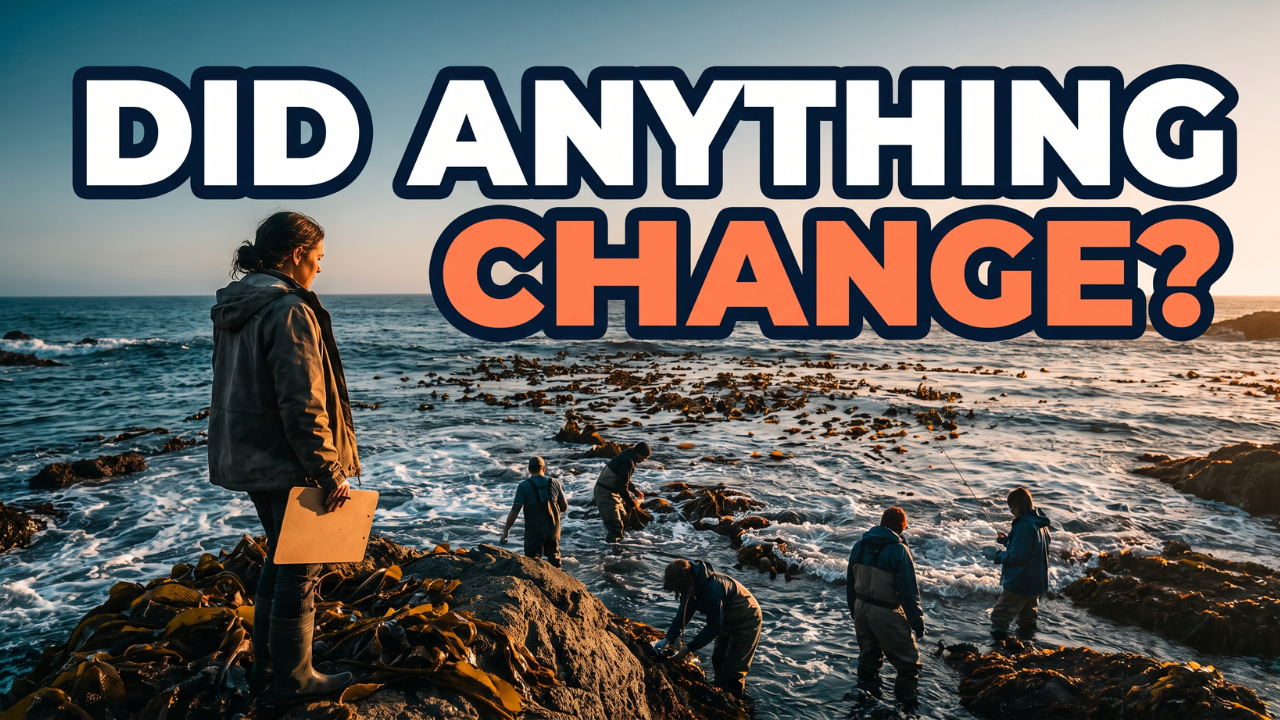
This is where you can get involved directly. MPA Watch is a statewide community science network that trains volunteers to walk set stretches of coastline and record human activity in and around MPAs. Volunteers survey inside the protected boundaries and outside them for comparison, using a standardized statewide data sheet.
The California Ocean Science Trust works with MPA Watch to make the data more useful, and the California Department of Fish and Wildlife uses it alongside other management, enforcement, and research partners. By 2019, the program had engaged about 2,000 volunteers and collected more than 23,000 surveys.
That monitoring shows enforcement isn't invisible or theoretical. It shows how people actually use MPAs, where rules are being followed, and where more enforcement may be needed. That's the social science side of MPA management, and it feeds back into how the network is designed.
4. What happens to a petition that doesn't get adopted?
Plenty of petitions don't make it through a given cycle. The Commission may decide the timing isn't right, or may not support a particular proposal. That doesn't end it.
Adaptive management is written into the Marine Life Protection Act as a recurring process, and California reviews its MPA network every 10 years. A proposal that doesn't move forward this cycle can be revisited in a future one as new science, new monitoring data, and new community priorities develop. Petitioners can add information, strengthen the case, and try again. Commission membership changes too. Conservation often comes down to science, persistence, and timing.
For that to work, petitioners need to feel safe to speak. On Monday's episode, Anupa described past meetings where that didn't happen. The hope is that October is different.
More Than Natural Science
Everything this week points to the same idea. MPA design is science-based, and the science includes more than biology. Are rockfish larvae drifting from one MPA down the coast to settle in another area that should be protected too? Are kelp forests doing well inside MPAs and struggling outside them? Those are ecological questions. Who is proposing an MPA, why it matters to them, and how people feel about it are social science questions, and they carry just as much weight.
People's livelihoods are tied to these decisions, so emotions run high. That makes it even more important that every group, no matter what they look like or where they're from, gets a say. They're all part of the same network, and it affects all of them.
What You Can Do
If you're in California, join MPA Watch through the program nearest you. It's an existing, practical way to take part in monitoring and enforcement, and it gets you out on parts of the coast you might never have visited.
You can also just show up to a Commission meeting and observe. You don't have to speak. See how it works, and if you find a way to help, great.
This is your coastline and your state. The process is open, the timeline is real, the data is public, and anything that doesn't pass this time has another chance. Andrew wants to hear from California listeners: have you taken part in MPA Watch, or would you?
Takeaways:
- Check CDFW's MPA pages for the current, authoritative rules at any of California's 124 MPAs.
- A Commission vote starts formal rulemaking; changes only become enforceable once that process is finished.
- The gap between approval and enforcement can take months.
- MPA Watch volunteers record human activity inside and outside MPAs, and CDFW and partners use the data.
- About 2,000 volunteers had joined MPA Watch by 2019.
- California reviews its MPA network every 10 years, so petitions that don't pass can return.
- MPA design combines natural science, social science, and community input.
- Everyone who uses the coast deserves to feel safe speaking in the process.

CEO

Does Your Public Comment Count? Two Ocean Wins Show How