A New PBS Documentary Wants You to Care About Coral. Meet the Man Behind It.
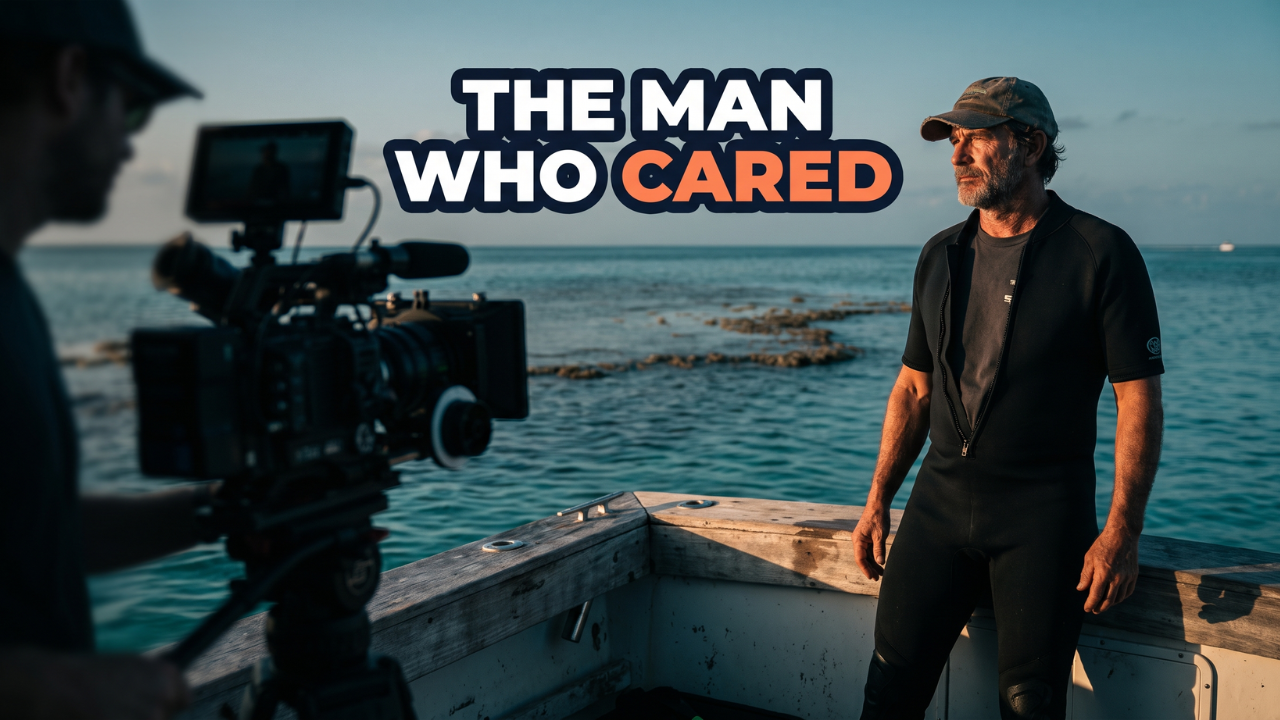
A new documentary called Descent – Into the Blue starts airing on public television stations nationwide on September 1, 2026. It's narrated by Peter Coyote, directed by Rory Fielding, and built, in Fielding's own words, like a five-movement symphony: Majesty, Exploration, Problem, Battle, Hope. One of the film's central voices in Florida is Mike Goldberg, co-founder of the Islamorada, Florida coral restoration nonprofit I.CARE (Islamorada Conservation and Restoration Education) and owner of Key Dives, a dive shop in the Florida Keys.
This is the full interview behind the week Andrew has spent building up to it, and it covers more ground than any single episode could.
From a Tank Fill to a Movie Premiere
Mike has logged more than 10,000 dives and spent over three decades running a dive shop in the Florida Keys, long enough to remember the reefs at their pristine, wall-to-wall best. He watched that decline in real time: a 2008 bleaching event in the Eastern Caribbean that he calls the first time he understood coral bleaching was real, and roughly a decade later, Stony Coral Tissue Loss Disease, a still not-fully-explained outbreak first identified off Virginia Key near Miami in 2014 that has killed living coral tissue outright across more than 20 of Florida's roughly 45 stony coral species. At one point, his own wife told him directly that the product wasn't what it used to be and he should get out of the business before there was nothing left to sell.
Instead, around 2017 into 2018, a young woman walked into his shop just to fill a couple of scuba tanks. She turned out to be Dr. Kylie Smith, then a PhD student studying parrotfish and coral outplants nearby. Mike asked her a dozen questions before she left, and kept asking more every time she came back. About a year later, after Mike talked her out of a safer government job, I.CARE was born. The first coral went into the water in January 2021. Today the nonprofit propagates its own coral, runs its own onshore nursery, and partners with Mote Marine Laboratory, Reef Renewal USA, the Florida Aquarium, and the Reef Institute.
How the Movie Actually Happened
Mike credits a chance connection for the film. Frazier Nivens, an underwater cinematographer and a friend of Mike's, was already working with director Rory Fielding and suggested Mike and I.CARE as a fit for what Fielding was trying to make. The two eventually sat down for lunch, and Mike says they quickly realized they shared the same goal: reaching people who have no reason to think about coral reefs day to day, people, in Mike's words, who "live in St. Louis." He compares the goal to how the public eventually came to understand the stakes of rainforest loss, and hopes viewers who watch Descent – Into the Blue come away with the same kind of instinct, whether that means looking up a local restoration group on a future Keys trip or introducing a kid to a possible career in marine science.
One image from the film's opening stuck with Mike enough that he brings it up unprompted: an animated girl throwing stranded sea stars back into the ocean, confronted by someone telling her it's pointless given how many are stranded. Her answer, "well, not for that one sea star it's not," is Mike's own explanation for why coral restoration works at all. Restoring an entire reef system is an impossible goal to hold in your head at once. Restoring one coral cluster, and watching it fuse, grow, and eventually spawn, isn't.
A Word of Caution on One of Mike's Own Claims
Mike also makes a striking observation on air: he says this year's water temperatures, if you laid them over 1995 conditions, would have triggered a mass bleaching event, and that isn't happening. His interpretation is that the corals I.CARE has been propagating for five and a half years are measurably more heat-resistant than their ancestors. It's worth being precise about what this claim actually is. Mike says so himself: it's anecdotal, based on what he and his team see in the water, not a peer-reviewed study. It's a genuinely interesting hypothesis from someone with an unusually long, direct view of these same reefs, but it hasn't been independently tested, and readers or listeners shouldn't mistake it for an established scientific finding.
The Business of Saving a Reef
The back half of the conversation is where Mike, a self-described non-scientist with a marketing and business background, is most in his element. He's candid that he never knows who he's talking to, whether it's a customer, a podcast listener, or a future donor, and treats every interaction as a potential source of support, calling it "not the pretty side" of the work. Andrew pushes back on that framing directly: getting people to fund reef restoration isn't the unglamorous part of conservation. It's arguably the actual work, since coral restoration, in Mike's own view, needs business-minded problem solvers as much as it needs scientists.
That funding model, when Mike lays it out, is deliberately made of small pieces rather than one large ask. Every $100 dive across Key Dives and two other participating Keys shops carries a $2 restoration fee. Mike personally donates 2 percent of his own dive revenue on top of that, a meaningful chunk of his own retirement savings by his own account. Local divers who take part in outplant work pay an additional fee. None of it is large enough on its own to draw a complaint, and Mike frames the whole structure as a fiduciary responsibility: whether someone gives $2 or a five-figure donation, I.CARE owes them the same honest accounting of what happened to the coral their money helped plant. That's also why I.CARE monitors 100 percent of what it plants, rather than a sample, producing a 47 percent one-year survival rate across all 17 species it works with, a number it has reported honestly every year, including through the 2023 global bleaching event.
It's landing at a genuinely uncertain moment for Florida's coral restoration funding at the state level, tied in Mike's own account to an upcoming change in state administration; that specific political framing is Mike's own read rather than something independently confirmed, though the underlying funding gap for Florida's reef restoration program is real and already documented. It's exactly why a visitor-funded, transparency-first model matters more right now than it would in a calmer funding environment.
An Award That Ties Straight Back to Conservation
Key Dives, Mike's own dive shop in Islamorada, won first place in all four categories judged for the United States and Canada region in Scuba Diving Magazine's 2026 Readers Choice Awards: Best Overall, Best Quality of Staff, Best Quality of Dive Boats, and Best Attention to Safety, adding to a run that's made Key Dives a repeat first-place winner across multiple years. Mike's own explanation for the recognition ties directly back to the mission: the more people who dive with him, the more he gets to donate.
Descent – Into the Blue starts airing on public television stations nationwide September 1, 2026; check local listings for the exact date and time in your area. Until then, this full conversation with Mike Goldberg is the closest thing to hearing directly from the man the film is partly built around: what got him into this work, what he's learned, and what he still doesn't know about where any of it ends up.
Takeaways:
- Descent – Into the Blue, a new documentary narrated by Peter Coyote, starts airing on public television stations nationwide September 1, 2026, and Mike Goldberg appears in it as one of its central voices.
- Mike's own read that this year's heat would have caused mass bleaching by 1995 standards but hasn't is his personal, anecdotal observation, not a peer-reviewed finding, a distinction he makes himself on air.
- I.CARE's funding model is built from small, mandatory, layered fees (a $2 dive add-on, Mike's personal 2 percent donation, an additional local-diver fee), not one large ask, and Mike frames all of it as a fiduciary responsibility to every participant.
- I.CARE monitors 100 percent of what it plants rather than a sample, producing a 47 percent one-year survival rate across 17 species that it has reported every year, including through the 2023 bleaching event.
- Florida's state coral restoration funding is genuinely uncertain right now, which is exactly why a visitor-funded, radically transparent model matters more today than it would in a more stable funding environment.

CEO


