Ghost Nets: What They Are, Why They Keep Happening, and What's Actually Working
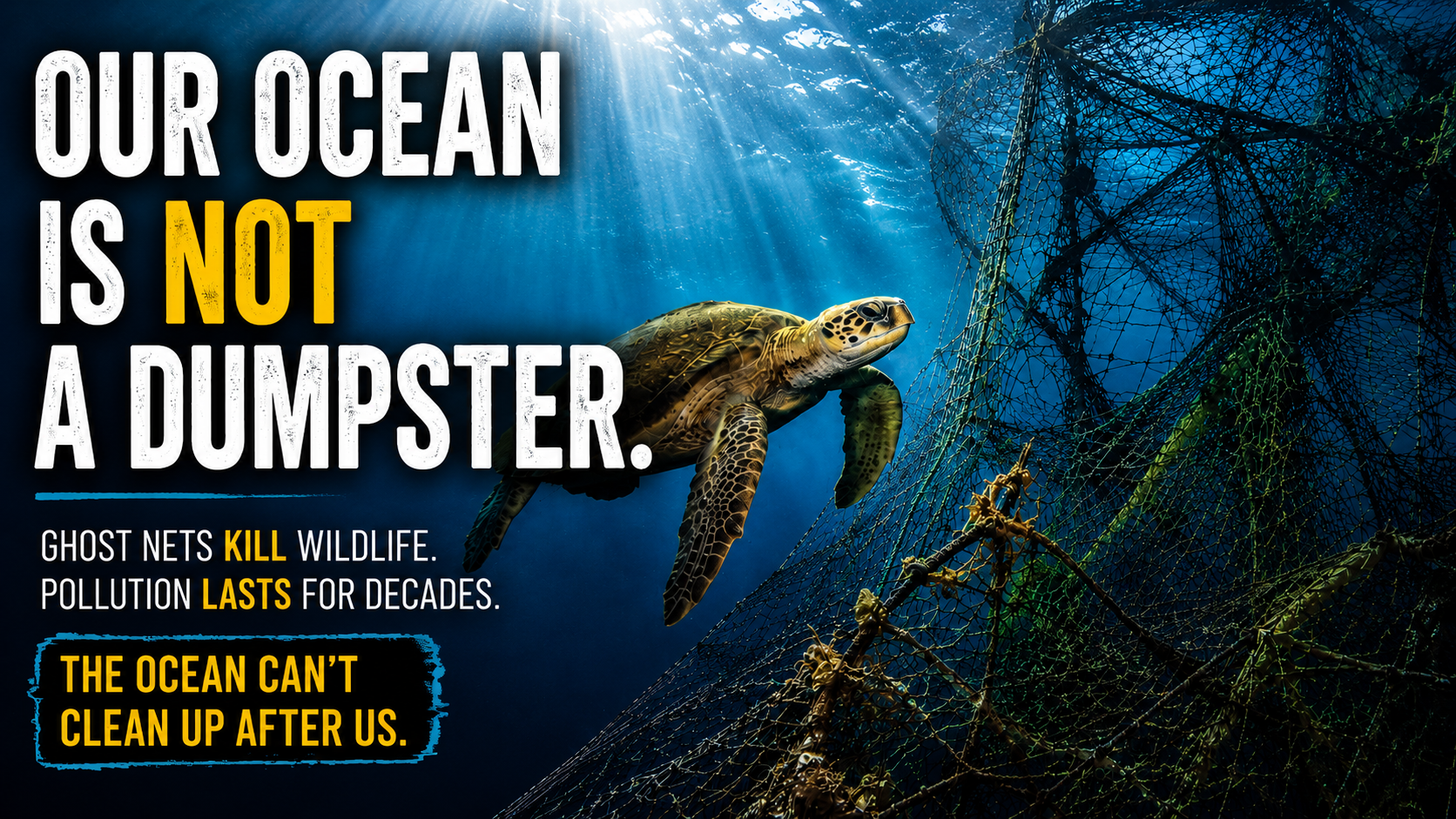
A viral TikTok about fish aggregation devices drifting into marine protected areas was the spark for this episode. It got our host, Andrew, thinking about a topic he hadn't covered in a while but that never really goes away: ghost nets.
What is a ghost net?
Ghost nets are fishing nets, lines, and traps that have been lost at sea, sometimes swept away in bad weather, sometimes discarded overboard. Once lost, they don't stop working. They continue to catch fish, marine mammals, sea turtles, and sharks, with nobody there to check or retrieve them. That ongoing, unmanaged catch is called ghost fishing. The scientific term for the gear itself is ALDFG, abandoned, lost, or otherwise discarded fishing gear.
The research shows this is a deep sea problem, not just a coastal one
A 2023 deep sea survey around the Azores used 351 dives and 15 years of seafloor footage (2006 to 2020) and found an average of roughly 597 items of ALDFG per square kilometer of seafloor. That's a striking number for a problem people often picture as a surface or coastal issue.
Who it affects
A study using social media records from 2012 to 2023 documented 144 individual animals across 35 species, 13 of them endangered or vulnerable, entangled in derelict gear across Indian coastal and freshwater systems. North Atlantic right whales are entangled regularly, with lines catching on their pectoral fins and cutting in as the animal continues to swim, leading to infection and sometimes death. Seals and sea lions get nets caught around their necks, which can cause asphyxiation or strangulation. A 2025 field study also linked sea turtle hatchling mortality directly to derelict nets and synthetic rope entanglement, with over 200 dead hatchlings recorded.
Ghost nets reach coral reefs too. Researchers have found ALDFG entangled in cold water coral colonies across the Northwestern Mediterranean, the Ligurian Sea, England's Atlantic coast, and the Azores, a consistent pattern rather than an isolated finding. One related study even examined how abandoned gear becomes physically incorporated into the structural growth of the coral species Dendrophyllia ramea along Portugal's Atlantic coast.
Andrew shared a personal story from a dive off Big Cayman, where he watched a fellow diver cut ghost net gear off a loggerhead sea turtle mid-dive, only for the turtle to swim up and appear to acknowledge them before heading back toward the surface.
Why the problem persists
There's a real economic cost tied to gear loss itself. A 2023 study modeling the English Channel static gear fishery found meaningful economic costs tied to ghost fishing, and found that current biodegradable gear designs still need improvement before they meaningfully reduce those costs.
One proposed fix is ropeless, or lineless, fishing gear, an idea that came out of a hackathon at the International Marine Conservation Congress in Malaysia roughly a decade ago. The concept uses a buoy or balloon system that only surfaces when a fisher presses a button to retrieve their gear, meaning there's no vertical line in the water column for whales to become entangled in. Early trials were expensive and inconsistent, but the technology has improved, and fisheries on Canada's east coast are now actively experimenting with it as costs come down.
Biodegradable gear is progressing too, but it isn't a simple fix yet. A 2025 laboratory comparison tested degradation rates of biodegradable co-polyester monofilaments against traditional polyamide monofilaments under accelerated aging, part of an active effort to find materials that break down fast enough to stop ghost fishing but hold up long enough to still catch fish. Economic feasibility research cited in 2025 found biodegradable gear runs roughly 30 to 50% more expensive than conventional gear, a major barrier for small-scale fishing operations on tight margins. A 2025 experimental study of Norwegian fishers found that willingness to adopt biodegradable gear is highly conditional. Fishers are more likely to switch once catch efficiency matches conventional gear, and adoption becomes contingent on whether other fishers adopt it too, meaning individual incentives alone likely won't drive the shift.
Enforcement gaps matter as well. A 2026 study of small-scale marine fisheries in Cameroon used local ecological knowledge from fishers and state officials and found that weak enforcement of gear registration and marking policies means fishers face little to no consequence for failing to report lost gear.
Where progress is actually happening
A 2026 systematic literature review following PRISMA methodology synthesized 17 peer-reviewed studies from 2015 to 2025 across marine ecology, materials engineering, and circular economy research, evaluating the ecological impacts of ghost nets alongside the technical feasibility of recycling recovered fishing gear polymers into new products, using Hawaii as a case model. Researchers studying the Salish Sea in British Columbia have also documented active derelict net removal programs specifically designed to safeguard habitat and reduce mortality across multiple species. And ongoing degradation testing on newer polymers is aimed at gear that ghost fishes for months instead of the centuries-old nylon nets that can persist.
Takeaways from this episode:
- Ghost nets are a measurable, quantifiable problem from the sea surface to the deep seafloor, not a fringe or occasional issue.
- The species affected range from whales and seals to sea turtles and reef corals.
- Ropeless gear and biodegradable materials are both improving, but cost and fisher adoption remain the core barriers to scaling them.
- Enforcement of gear registration and reporting is a bigger gap than most people realize.
- The realistic path forward is more research funding, cheaper technology, and stronger policy, not eliminating fishing.

CEO


