He Called It a Desert. Scientists Found 5,000 Species.
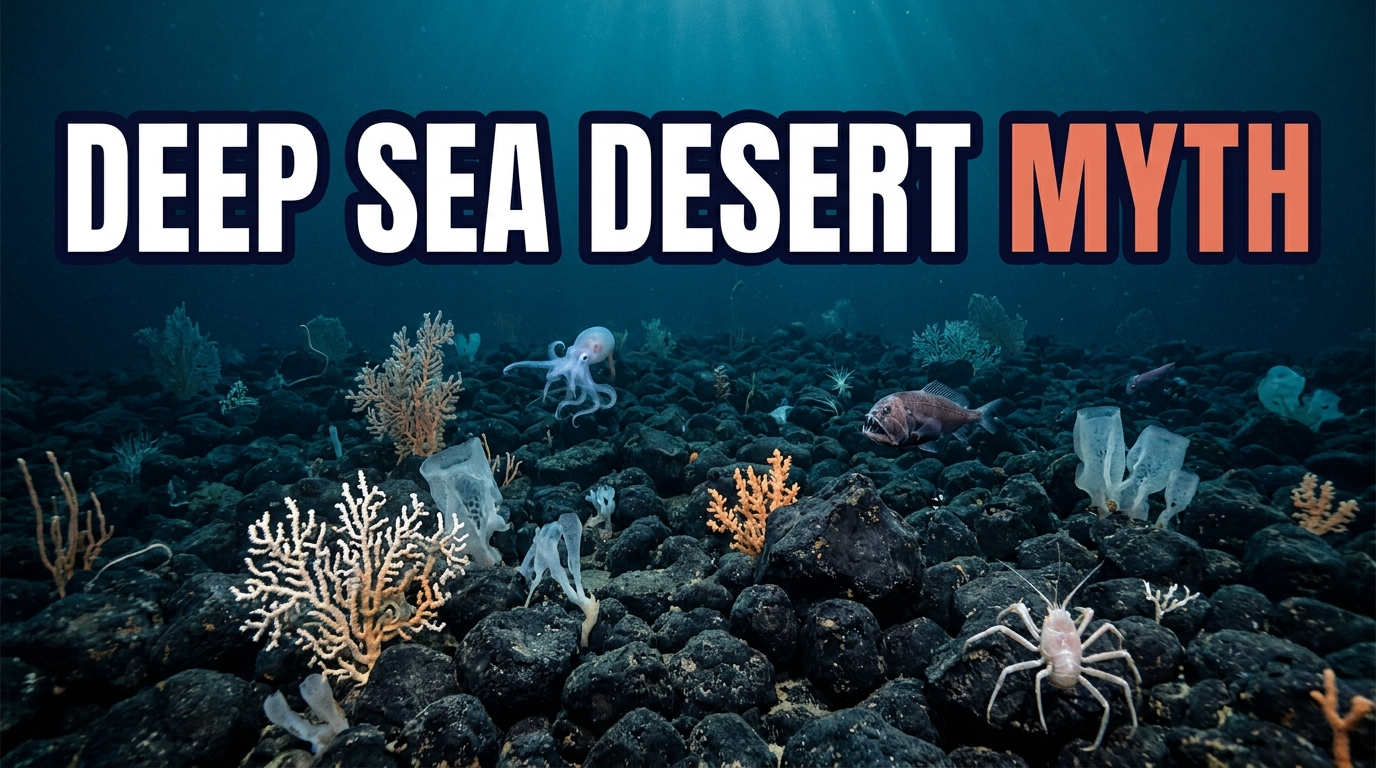
In September 2021, Time magazine profiled Gerard Barron, CEO of The Metals Company (TMC), and his company's plan to mine the Clarion Clipperton Zone, a stretch of international seabed between Hawaii and Mexico that holds one of the world's largest known deposits of polymetallic nodules. In that profile, Barron made a claim that has been repeated ever since to justify deep sea mining: "If we started mining over again, knowing what we know now, surely we would carry out extractive industries in parts of the planet where there was least life. We wouldn't go to the rain forest. We would go to the deserts. That's what we have here in the CCZ: the most desert-like place on the planet. It just happens to be covered by 4,000 meters of water."
It's a persuasive line. The deep sea is dark, cold, and far from anything most people have seen firsthand, so "desert" sounds reasonable if nobody checks it. But a growing body of direct, on-site research says otherwise.
A 2016 survey of the CCZ measured real abundance rather than estimating it, using image counts and physical samples taken on site. It found meaningful densities of both larger seafloor animals (megafauna) and much higher densities of smaller sediment-dwelling animals (macrofauna), the worms, crabs, shrimp, and related invertebrates that live in and on the seafloor sediment. Those numbers are lower than a coral reef or a rainforest, and they still describe an ecosystem with real, measurable life across the seafloor.
The clearest picture came in 2023, when researchers at the UK's Natural History Museum, funded by the Pew Charitable Trusts, published the first comprehensive species inventory of the CCZ. They documented more than 5,000 species, including sea cucumbers, corals, glass sponges, and numerous worm species. Somewhere between 88 and 92 percent of those species had never been recorded anywhere else, meaning they were new to science. Species descriptions haven't stopped since. In 2026, researchers described two dozen new amphipod species from the zone, including one representing an entirely new taxonomic superfamily. Roughly 90 percent of all species found in the CCZ remain formally unnamed, simply because taxonomists haven't had time to catch up.
The deeper issue is what the nodules themselves do. The CCZ seafloor is mostly soft sediment, and most deep sea animals can't attach to mud. The polymetallic nodules that TMC wants to extract provide something rare down there: a hard surface to grow on. A 2016 study led by Dr. Diva Amon, published in Scientific Reports, found that more than half of the megafaunal species living in these nodule fields depend directly on the nodules as a substrate to attach to and survive. The same study found more than half of the species collected during the survey were entirely new to science. A separate line of research measured raw abundance and found that nodule-dwelling animals can make up a majority of the total number of individual creatures present in nodule fields. A follow-up food web modeling study estimated that removing the nodules could cause the loss of a meaningful share of all species present in the CCZ. Removing the nodules doesn't just disturb the area. It removes the habitat itself for the species that depend on it.
A 2025 study examined an actual industrial deep sea mining trial conducted in the CCZ and found that the disturbed seafloor had significantly lower animal abundance and lower species richness compared to nearby untouched seafloor, months after the trial, a documented before-and-after rather than a projection.
TMC appears to be pursuing a pathway through the Trump administration rather than the International Seabed Authority (ISA), the UN body responsible for regulating mining in international waters like the CCZ. Notably, the ISA itself has launched an initiative, the "One Thousand Reasons" campaign, aiming to formally describe a thousand new deep sea species by 2030, precisely because so much of what lives in areas like the CCZ remains undocumented. That's the same body responsible for regulating mining in this zone acknowledging how little is known about it.
Meanwhile, a mining lease near the Northern Mariana Islands and the Mariana Trench marine protected area is moving forward. More than 60,000 public comments were submitted opposing it, and local government and communities say they haven't been meaningfully consulted on how they would benefit, or on how they'll bear the consequences if things go wrong.
None of this means every claim about the deep sea's biological richness is settled science. Researchers are still working out exactly how dense these ecosystems are compared to shallow-water habitats, and some of the specific figures cited around the CCZ deserve a closer look before they're treated as final numbers. What is clear from the available research is that "desert" undersells what's actually down there.
Takeaways:
- Gerard Barron, CEO of The Metals Company, told Time magazine in 2021 that the Clarion Clipperton Zone is "the most desert-like place on the planet."
- A 2023 Natural History Museum / Pew-funded inventory found more than 5,000 species in the CCZ, with the large majority new to science.
- A 2016 survey found measurable abundance of both megafauna and macrofauna across CCZ sites, based on direct image counts and physical samples.
- More than half of the megafaunal species in CCZ nodule fields depend directly on the polymetallic nodules as a hard surface to grow on.
- A 2025 study of an actual industrial mining trial found lower animal abundance and species richness at the disturbed site compared to untouched seafloor.
- TMC is pursuing a mining pathway through the Trump administration rather than the International Seabed Authority.
- A proposed lease near the Northern Mariana Islands has moved forward despite more than 60,000 public comments opposing it.

CEO
The Pollution That Breeds: How the Great Lakes Stopped Invaders