The 90 Percent Fix Hiding in Your Laundry Room
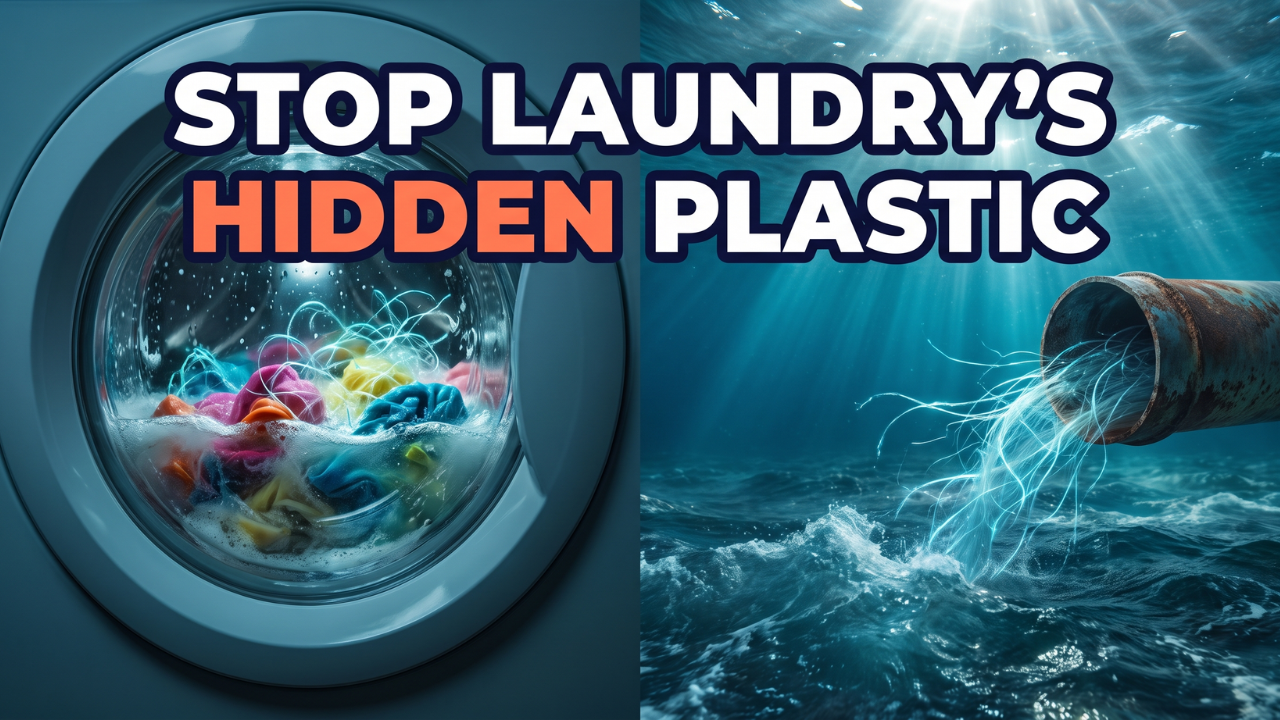
Every time synthetic clothing is made, worn, or washed, it sheds tiny plastic fibers called microfibers. Nylon, polyester, and rayon are all forms of plastic, and today's clothing is made from more synthetic material than ever before. Depending on the study, a single load of laundry can release anywhere from a few hundred thousand to millions of microfibers, a range that's wide mostly because researchers are still working toward standardized test methods for measuring them, not because the problem itself is small. Once those fibers leave a washing machine, they travel through wastewater, and a large share end up trapped in biosolids, the solid residue left over from wastewater treatment, which is frequently applied to farmland as a fertilizer replacement. That means a lot of the plastic isn't being removed from the environment so much as moved from water to soil.
This episode is a conversation with Dr. Anja Brandon, Director of Plastics Policy at Ocean Conservancy, about a type of plastic pollution that gets a lot less attention than straws or plastic bags despite the scale of it.
From an Aquarium to a PhD to Capitol Hill
Anja's path into ocean policy didn't start with policy at all. She volunteered at an aquarium as a student, where she was first introduced to plastic pollution, and followed that interest through a PhD in environmental engineering at Stanford, where her research focused on plastic-degrading bacteria. It's exactly the kind of research that periodically goes viral online with headlines suggesting scientists have found bacteria that "eat" plastic. Her honest assessment, as someone who actually did that research: it's genuinely promising as a complement to recycling or as a way to help treat plastic-contaminated water, but it is not close to being a meaningful solution at scale, and she's not holding her breath for it to arrive in the next few years. She raises a sharper version of the question too: are we chasing a futuristic technology to solve a problem that simpler choices, like using fewer single-use plastics in the first place, could address today?
Partway through her PhD, Anja started asking a different question: how do you create change at a scale big enough to matter? That question led her to a AAAS/AGU Congressional Science Fellowship, a program that places scientists inside congressional offices for a year to help translate research into policy. She spent hers in Senator Jeff Merkley's office. Her biggest takeaway wasn't a specific policy win, it was learning that science is only one input among many in how legislation actually gets made, and that scientists have to do the work of translating their findings into something usable, whether that's a one-pager, a blog post, or a plain-English explanation stripped of the jargon and acronyms that are second nature inside a lab but meaningless to almost everyone else. After the fellowship, she joined Ocean Conservancy to help build out its plastics policy program, drawn to a mission built around combining people, policy, and science to tackle plastic pollution at its source.
What Happens to a Microfiber Once It's Shed
Some washing machines already include filters that catch shed fibers the same way a dryer's lint trap catches lint, but they're still uncommon, especially in the United States. Without one, fibers flow out with the wastewater to a treatment plant. Depending on the plant, a portion get captured there, but the majority end up in biosolids, and because biosolids are nutrient-rich, they're commonly spread on agricultural land as fertilizer. The fibers that do make it past treatment continue on into rivers, lakes, and eventually the ocean.
Once in the environment, microplastic fibers carry synthetic chemicals that aren't chemically bonded to the plastic itself, which means exposure to UV light, physical wear, or an animal's digestive system can release those chemicals, making them available for ingestion by wildlife. Research has linked microplastic ingestion in marine animals to reduced food consumption, reduced energy for growth, and altered gene expression. On human health, Anja was careful to say the research is still developing, but what's known so far is enough to be concerning: microplastics and the chemicals they carry have been shown to cause cell death and toxic effects, and can act as vectors carrying bacteria and other contaminants. Fibers specifically, because of their long, needle-like shape, appear to be unusually effective at lodging into tissue once ingested, which is part of why they show up disproportionately in studies looking for microplastics in seafood and in the human body.
The Fix That Already Exists
Here's the part of the episode built for hope rather than dread: filtration technology that can capture up to 90% of the microfibers a wash cycle would otherwise release already exists today. It's just not required. Ocean Conservancy's "Not Safe for Wash," or NSFW, campaign is built around exactly that gap, building public awareness that this is happening and pushing for a legal requirement that new washing machines ship with a microfiber filter, phased in over time the same way seatbelt requirements were phased into new cars decades ago. Ocean Conservancy's own polling found that roughly 8 in 10 Americans support requiring these filters, but no state currently mandates them, though several have introduced legislation, and Anja said a similar bill has been introduced federally.
For anyone who doesn't want to wait on policy, there are options today. Retrofit external filters exist for washing machines that don't have one built in, working essentially like an external lint trap that gets emptied periodically, with some brands even offering a mail-back program for the collection canister. Lower-cost, lower-effort options include the Cora Ball, a device designed to catch fibers as they shed during the wash cycle, and fine mesh laundry bags, especially useful for fleece and other high-shedding synthetic fabrics. Andrew and Anja also discuss simpler habit changes: washing full loads instead of small ones, using lower water temperatures, and using less soap, all of which reduce the physical agitation that causes fibers to shed in the first place.
Why This Needs Policy, Not Just Good Habits
Anja is direct that individual habit changes matter but aren't sufficient on their own. That's where California's SB 54 comes into the conversation as a model, not because it specifically regulates washing machine filters, but because of the policy mechanism behind it: extended producer responsibility, or EPR. Under an EPR model, the companies that create plastic packaging and products become financially responsible for managing that packaging at the end of its life, which changes the incentives. A company that uses excessive or non-recyclable packaging pays more; a company that switches to reusable or recyclable packaging pays less. Seven U.S. states have now passed similar packaging EPR laws, and Anja sees the washing machine filter push as needing the same kind of policy backbone, framed not as a burden on any one household but as a shared cost every producer in that supply chain, from washing machine manufacturers to textile makers, should help absorb.
Andrew closes the conversation with a challenge that's about as low-effort as ocean advocacy gets: if a filter on a washing machine can cut a household's microfiber pollution by up to 90%, it's one of the simplest, least disruptive changes available, right up there with a dryer's lint trap. For anyone who wants to get more involved, Ocean Conservancy's Not Safe for Wash campaign, at oceanconservancy.org/nsfw, has tools for contacting elected representatives, joining live events, and learning more, all of which work regardless of what country you live in, not just the United States.
Takeaways:
- Synthetic clothing sheds microfibers every time it's made, worn, and washed, and depending on the study, a single load of laundry can release anywhere from a few hundred thousand to millions of them.
- Shed microfibers mostly end up caught in wastewater treatment biosolids, which are frequently applied to farmland as fertilizer, meaning they get moved around rather than actually removed from the environment.
- A retrofit or built-in washing machine filter can capture up to 90% of the microfibers a wash cycle would otherwise release, and Ocean Conservancy's own polling found roughly 8 in 10 Americans support requiring them.
- No U.S. state currently requires washing machine microfiber filters, though several have introduced legislation and a similar bill has been introduced federally.
- California's SB 54 uses an extended producer responsibility (EPR) model, making the companies that create plastic packaging financially responsible for its end-of-life costs rather than leaving that bill with taxpayers and consumers.
- Lower-cost individual options exist too: full loads over small ones, lower wash temperatures, less soap, a Cora Ball, or a fine mesh laundry bag for synthetic fabrics.

CEO


