The Biggest Mouthful: How Blue Whales Eat and Why Krill Matters
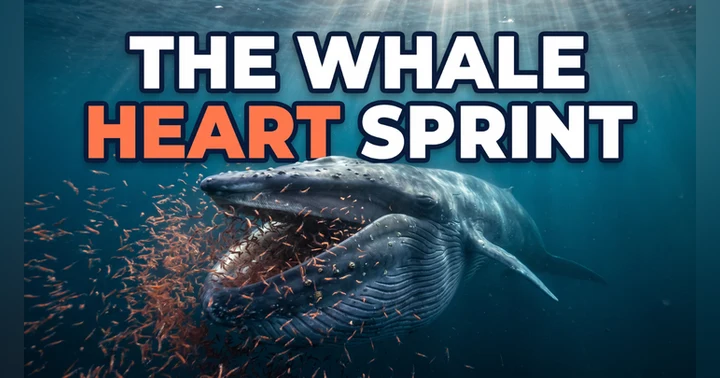
Picture a blue whale, 30 metres long and 200 metres down, closing in on a swarm of krill so thick it looks like a cloud. The whale beats its tail, picks up speed, and opens its mouth. In about the time it takes you to read a text message, it swallows a volume of water bigger than its own body.
That move only pays off when the krill is thick. And krill is something people are catching more of every year.
Many of us grew up believing whales were "saved" in the 1980s, when commercial whaling was paused. Then come the headlines about ship strikes, entanglements and climate change, and it's fair to wonder whether the comeback is real. The best place to start is the most basic question about a giant whale: how does it eat enough to stay alive? Once you see the answer, the pressure points and the good news both come into focus.
How lunge feeding works
Blue whales, fin whales and humpbacks belong to a group called rorquals, a name often traced to an Old Norse term for "furrow whale." The furrows are long grooves running down the throat and belly, and they are the secret to how these whales eat.
The skin and blubber on a rorqual's underside is pleated like an accordion and runs about half to 60 percent of the whale's body length. When the whale opens its mouth at speed, water rushes in and those pleats stretch like a balloon filling with water. The whale then closes its mouth and pushes the water back out through its baleen, the fringed plates hanging from its upper jaw. The water leaves, the krill stays, and the whale swallows.
Why dense krill is everything
Each lunge is expensive. Researchers who modelled the energy of a blue whale lunge found that one gulp costs the whale roughly 3,000 to 8,000 kilojoules. In a thin patch of krill, the whale gets back about six times what it spent. In a thick, dense swarm, it gets back more than 200 times.
Same whale, same lunge. The only variable is how tightly the food is packed. A giant whale survives by finding the densest swarms and hitting them hard. When it's feeding, a blue whale in the eastern North Pacific can eat around 16 tonnes of krill a day.
The season that ended early
Antarctic krill are small, shrimp-like animals that gather in swarms dense enough to tint the water. They feed penguins, seals, fish, seabirds and the biggest whales on Earth. They also feed an industry. Fishing vessels in the Southern Ocean catch krill for omega-3 supplements, salmon farm feed and pet food.
The fishery is managed by the Commission for the Conservation of Antarctic Marine Living Resources (CCAMLR), which set a precautionary ceiling called the trigger level in 1991: 620,000 tonnes a year. For more than three decades, the fishery never reached it. In 2025, it did. The fleet hit the limit by early August, and the season closed months ahead of schedule for the first time ever.
Where the catch happened matters too. A rule that spread fishing across different areas lapsed the year before, and catches in waters off the Antarctic Peninsula passed 355,000 tonnes, more than double the old limit for that area. Those are the same waters where humpbacks and other whales feed. Antarctic ecosystem scientist Philip Trathan has pointed out that the commission has no mechanism in place to monitor baleen whales, even though whales likely eat more krill in that area than anything else.
A fishing fleet goes where krill is densest, and so does a lunge feeder. They are working the same swarms. The industry says the early closure shows the system working as designed, and both things can be true. The limit held, and it was set before anyone knew how much whales actually eat.
[VERIFY before publishing: reports indicate the fishery closed early again in 2026. Confirm date and catch, then add one line here if desired.]
The krill paradox
Industrial whaling killed somewhere between two and three million whales in the 20th century. With most of the krill eaters gone, people expected the Southern Ocean to fill up with krill. Krill numbers seemed to fall instead.
A 2021 study published in Nature helped explain why. Scientists tagged 321 whales and measured how much they really eat, finding that baleen whales eat about three times more than older estimates. When whales eat, they also poop near the surface, and whale poop is rich in iron, the nutrient that limits plankton growth across much of the Southern Ocean. Before whaling, the team estimated Southern Ocean whales recycled about 12,000 tonnes of iron a year. Today it's around 1,200 tonnes.
More iron means more plankton. More plankton means more krill. More krill means more food for whales. Whales help farm their own food. Smithsonian scientist Nicholas Pyenson, part of the study team, put it this way: "If we restore whale populations to pre-whaling levels, we'll restore a huge amount of lost function to ocean."
The island the blue whales came back to
South Georgia is a remote island in the South Atlantic, east of the Falkland Islands. In the early 1900s its waters were full of blue whales, and whaling stations were built on its shores. Between 1904 and 1971, whalers killed 42,698 blue whales there, most of them before the mid-1930s. From 1998 to 2018, surveys recorded exactly one blue whale sighting.
Scientists treated South Georgia as a textbook case. Lead author Susannah Calderan called it "an iconic example of a population that was locally exploited beyond recovery."
Then, in February 2020, a research team went back. In three weeks they recorded 58 blue whale sightings and heard blue whale calls again and again on underwater microphones. Photos of 41 blue whales seen around South Georgia over the previous decade were compared with a catalogue of 517 known Antarctic blue whales. None matched. These were new whales, finding their way back to feeding grounds their species had used for thousands of years.
The return took about 50 years. Large whales have slow life histories: calves take years to reach maturity, and females give birth to one calf at a time. Recovery is slow, and it happens when whales have food and space.
What's left to fix
Antarctic blue whales remain a small fraction of their historic numbers. The krill fishery is legal and regulated, and the open question is whether the rules keep pace with what scientists now know about how much whales eat and how they help grow krill. Krill also face warming seas and shrinking sea ice, which young krill rely on. Whales can't afford to share a shrinking pantry.
What you can do today
Skip the krill oil. If you take an omega-3 supplement, choose one made from algae. Fish get their omega-3s by eating algae in the first place, so algae-based supplements go straight to the source.
Every capsule of krill oil starts as a krill swarm, the same dense patch a blue whale needs to make its lunge pay off. Most of the krill catch goes to farmed fish feed, which is harder for one person to change. The supplement aisle is the piece you control directly.
The biggest animal that ever lived only needs two things to come back: room to swim, and a swarm worth opening its mouth for.
Takeaways
- Lunge feeding lets rorqual whales engulf enormous volumes of water and prey in seconds.
- Each lunge costs roughly 3,000 to 8,000 kilojoules, so whales depend on dense krill swarms to make it pay off.
- The Antarctic krill fishery reached its 620,000 tonne trigger level for the first time in 2025, with heavy catches off the Antarctic Peninsula.
- Baleen whales eat about three times more than older estimates, and their iron-rich poop helps fuel the plankton krill eat.
- Blue whales are returning to South Georgia, with 58 sightings in three weeks in 2020 after one sighting in twenty years.
- Choosing an algae-based omega-3 over krill oil is a simple way to leave more krill for whales.

CEO
Whales Are Sprinters: What a Blue Whale's Heart Does When It Lunge Feeds