What Happens to Fish When Our Pills Reach the Water?
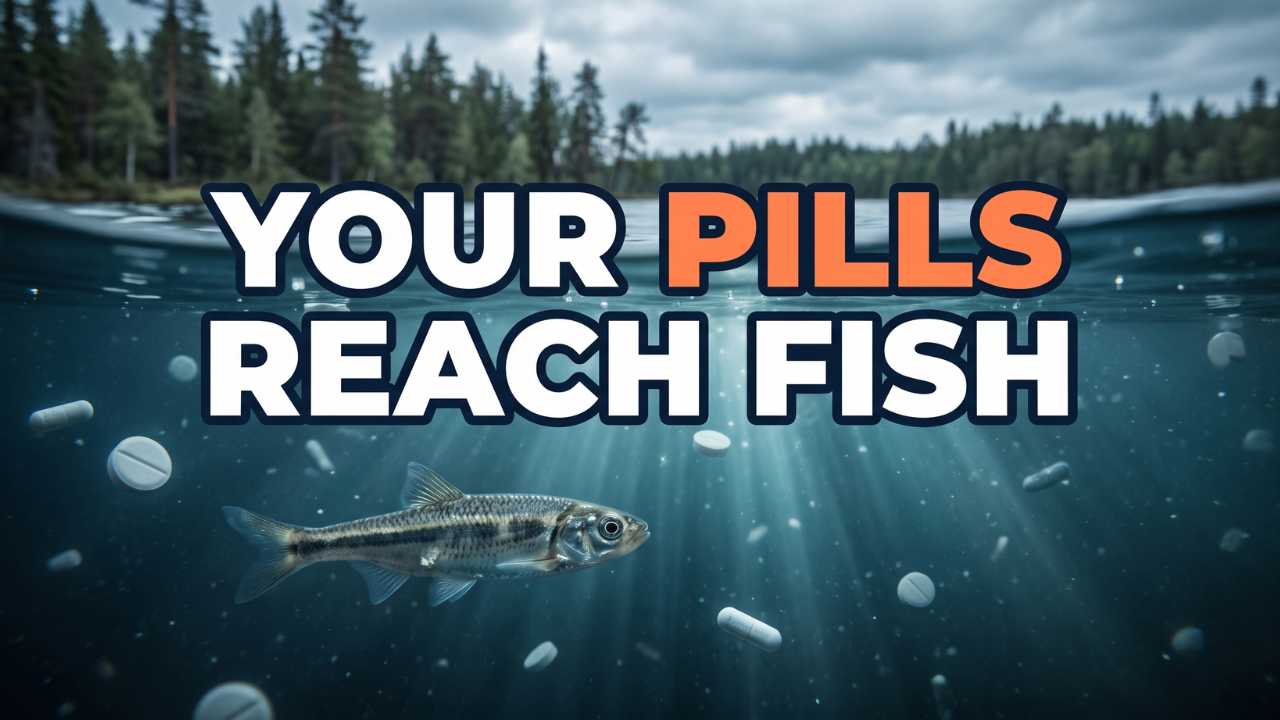
Picture a quiet lake in a boreal forest in northwestern Ontario. No cottages on the shore, no factories upstream. In 2001, a team of government scientists started adding a tiny amount of the synthetic estrogen used in birth control pills to that lake. After two summers, some of the male fish had eggs growing in their testes.
That same hormone is already in rivers downstream of our cities.
How Medications Get Into the Water
When you take a pill, your body uses part of it and breaks down some of the rest. Whatever is left leaves your body in urine, goes down the toilet, into the sewer, and through a treatment plant.
Treatment plants were built to handle human waste and the bacteria that feed on it. They remove solids and bacteria well. They were never designed to catch the drug compounds that come out of us along with that waste, so many of those compounds pass straight through and flow into rivers, lakes, and eventually the coast.
One person's share is tiny. Multiply it by every household in every city, every day, and it adds up in the same water.
The Lake That Got the Pill
The Experimental Lakes Area in northwestern Ontario is a set of small lakes the Canadian government set aside so scientists could run experiments on entire ecosystems, the kind you can't do in a lab.
In 2001, a team led by Karen Kidd, then with Fisheries and Oceans Canada, chose Lake 260 and began adding ethynylestradiol, the synthetic estrogen in birth control pills, at about 5 to 6 nanograms per litre. In an Olympic-sized swimming pool, that works out to about 14 milligrams, less than the weight of a grain of rice. They chose that dose on purpose, because it sat within the range already measured in wastewater flowing out of cities. They were recreating life as a fish downstream of us.
They dosed the lake every summer from 2001 to 2003 and watched the fathead minnow, a small fish that feeds many of the bigger fish in the lake.
Within seven weeks, the males were making vitellogenin, the egg-yolk protein that normally only females produce, at levels about 1,000 times higher than normal. After two summers of dosing, some males had early-stage eggs inside their testes.
In the fall of 2002, the young fish stopped showing up. The minnows weren't reproducing, and the population collapsed to about 1% of what it had been. Lake trout that eat those minnows declined too. All of that from a hormone at concentrations you would struggle to measure.
Fish on Anxiety Medication
Hormones change how fish breed. Other drugs change how they act.
In 2013, researchers at Umeå University in Sweden published a study in Science on oxazepam, a common anti-anxiety medication that was turning up in Swedish rivers. They exposed European perch in the lab until the fish carried about the same amount of the drug in their muscle as wild perch in those rivers.
The perch changed. Normally a young perch holds back in cover before heading out to feed. The exposed fish left cover faster, ate faster, and drifted away from their school.
In a river, each of those changes costs something. A fish that leaves cover faster is easier for a predator to find. A fish that leaves its school loses safety in numbers. A fish that eats plankton faster can shift how much plankton is left, and that ripples through the food web. The drug was doing exactly what it was designed to do, calming anxiety, and for a small fish, caution is what keeps it alive.
We've Been Here Before
After the Second World War, DDT was sprayed almost everywhere to kill insects. It worked, and it didn't break down. It washed into rivers and lakes, built up in fish, and built up even further in the birds that ate those fish. That process is called bioaccumulation.
In bald eagles, DDT thinned eggshells until they cracked under the weight of a parent sitting on the nest. By 1963, only 417 nesting pairs were left in the lower 48 states.
Rachel Carson published Silent Spring in 1962, and public pressure built. The United States banned DDT in 1972, and Canada phased it out through the 1970s and 1980s. Year by year, eggshells thickened and more chicks hatched. The bald eagle came off the US endangered species list in 2007, and the US Fish and Wildlife Service now estimates about 316,700 bald eagles in the lower 48, with more than 71,400 breeding pairs.
What Happened to Lake 260
After the third summer, the scientists stopped adding the hormone and kept watching. For a while the minnows still struggled. Then the hormone faded from the water and the changes in the males reversed.
Within three years, the fathead minnow population was back to where it had been before the experiment. Karen Kidd put it this way: "The same thing happened in the recovery, only in reverse of what we saw during the EDC additions." And: "We were all surprised and pleased to see such a dramatic and complete recovery of the fish population."
A lake pushed to 1% of its minnows came back once the exposure stopped. That works best when nothing else is holding recovery back, which is why controlling the other pressures on an ecosystem matters so much.
Building Better Treatment Plants
We've upgraded treatment plants before. When nitrogen and phosphorus were feeding algae blooms, many plants added a tertiary treatment stage to pull them out.
Switzerland is doing the same thing for drugs. In 2016, it changed its water protection law so that about 120 of its wastewater treatment plants must add a new stage aimed at micropollutants, including drug residues, pesticides, and chemicals from personal care products. The target is to remove more than 80% of them.
The tools are familiar. Ozone breaks those compounds apart. Activated carbon, the same basic material in a countertop water filter, traps them. Every Swiss resident pays 9 Swiss francs a year into a national fund, the federal government covers up to 75% of each upgrade, and once your local plant is upgraded, you stop paying the fee.
The Schönau plant was described by its engineers as the first in the world to dose powdered activated carbon directly at large scale for this job. It beat the legal removal target and used less carbon than pilot tests predicted.
The technology exists. Putting it in place is the next step.
What You Can Do Today
Keep taking what your doctor prescribes. That's the right call.
What you can control is the leftovers: old prescriptions, expired painkillers, the half-finished bottle from last year. Don't flush them or toss them in the garbage. This week, clean out your medicine cabinet and take them back to a pharmacy.
In Ontario, the free Medications Return Program runs through more than 4,500 pharmacies and collected more than 330,000 kilograms of medications in 2024. In the US, look up a local drug take-back site or watch for National Prescription Drug Take Back Day.
The minnows came back. The eagles came back. Stop the flow, and the water recovers.
Takeaways:
- Drug compounds leave our bodies in urine and pass through treatment plants that weren't built to remove them.
- At Lake 260, synthetic estrogen at about 5 to 6 nanograms per litre caused male fish to make egg-yolk protein within seven weeks.
- After two summers of dosing, some males had eggs in their testes, and the fathead minnow population collapsed to about 1%.
- Lake trout declined when their minnow prey disappeared.
- Oxazepam made European perch bolder, faster feeders, and loners, all traits that raise predation risk.
- Bald eagles recovered from 417 nesting pairs in 1963 to more than 71,400 breeding pairs after DDT was banned.
- Lake 260's minnows returned to pre-experiment levels within three years of stopping the hormone.
- Switzerland is upgrading about 120 treatment plants with ozone or activated carbon to remove more than 80% of micropollutants.
- Ontario's free pharmacy return program collected more than 330,000 kg of medications in 2024.
- Take leftover and expired medications back to a pharmacy.
Frequently Asked Questions About Pharmaceuticals and the Aquatic Environment
How do pharmaceuticals enter rivers, lakes, and oceans?
After people take medications, their bodies excrete some of the active ingredients and their metabolites. These compounds enter wastewater systems, where conventional treatment may not fully remove them before the treated water is discharged into rivers, lakes, and coastal waters.
Does flushing unused medication contribute to water pollution?
Yes, flushing unused medication sends concentrated pharmaceutical ingredients directly into the wastewater system. However, pharmaceuticals taken as prescribed and subsequently excreted are also an important and continuous source.
Why don’t wastewater treatment plants remove all pharmaceuticals?
Most conventional wastewater plants were designed to remove solids, organic waste, nutrients, and disease-causing microorganisms—not thousands of biologically active chemical compounds. Removal varies by drug, so some pharmaceuticals are broken down while others pass through treatment or are transformed into new compounds.
Can very small concentrations of pharmaceuticals harm fish?
Yes, some pharmaceuticals can affect fish at concentrations measured in parts per trillion because the drugs were designed to alter biological processes. Fish may also experience continuous exposure throughout their lives, making long-term effects possible even when concentrations are low.
Can hormones from birth-control pills affect fish?
Synthetic estrogen used in birth-control pills can disrupt fish reproduction and sexual development. In a whole-lake experiment in Ontario, environmentally relevant exposure caused male fathead minnows to produce female-associated proteins, develop early-stage eggs in their testes, and experience a severe population decline.
Do antidepressants and anti-anxiety medications change fish behavior?
Some psychiatric medications can affect the same or similar signalling systems in fish that they target in humans. Experiments with the anti-anxiety drug oxazepam found that exposed perch became bolder, fed faster, and spent more time away from their schools.
Why do changes in fish behavior matter?
Behaviors such as schooling, hiding, feeding, and avoiding predators help fish survive. A drug-induced change may make an individual fish easier to catch, alter competition for food, or change predator-prey relationships throughout the ecosystem.
Can pharmaceutical pollution affect an entire aquatic food web?
Yes, effects on one species can spread through the food web. If a pharmaceutical reduces the reproduction or survival of small forage fish, predators may lose an important food source, while altered feeding behavior can also change populations of plankton and other prey.
Do pharmaceuticals accumulate inside fish?
Some pharmaceuticals can be absorbed through the gills or digestive system and detected in fish tissues. Whether they accumulate depends on the drug, the species, the exposure period, and whether contamination is continuously replenished by wastewater.
Are all pharmaceuticals equally harmful to aquatic life?
No, pharmaceuticals differ in their persistence, biological activity, concentration, and effects on different species. Hormones may disrupt reproduction, psychiatric drugs may alter behavior, and antibiotics may affect microbial communities or encourage antimicrobial resistance.
What happens when aquatic organisms encounter mixtures of pharmaceuticals?
Wild organisms are usually exposed to mixtures rather than a single medication. Scientists are still investigating whether compounds in these mixtures act independently, add their effects together, or interact in ways that cannot be predicted from studying one drug at a time.
Can pharmaceutical pollution contribute to antibiotic resistance?
Antibiotic residues can create conditions that favour resistant bacteria and resistance genes in wastewater and aquatic environments. This makes pharmaceutical pollution part of the broader One Health challenge connecting environmental, animal, and human health.
Can upgraded wastewater treatment remove pharmaceuticals?
Advanced processes such as ozonation and activated carbon can remove a much larger share of pharmaceutical residues and other micropollutants. Switzerland, for example, has required selected wastewater plants to add advanced treatment designed to remove more than 80 percent of targeted micropollutants.
Can aquatic ecosystems recover if pharmaceutical exposure is reduced?
Recovery is possible when the source of contamination is stopped or substantially reduced. After scientists stopped adding synthetic estrogen to the Ontario experimental lake, hormone concentrations declined, reproductive effects reversed, and the affected minnow population eventually recovered.
What can individuals do to reduce pharmaceutical pollution?
People should continue taking medications as prescribed but return unused or expired drugs to a pharmacy or authorized take-back program whenever possible. Keeping leftover medication out of toilets, sinks, and household garbage prevents avoidable pharmaceutical releases into the environment.

CEO

How Did Humpback Whales End Up in New York Harbor?