84 Percent: Inside the Worst Coral Bleaching Event Ever Recorded
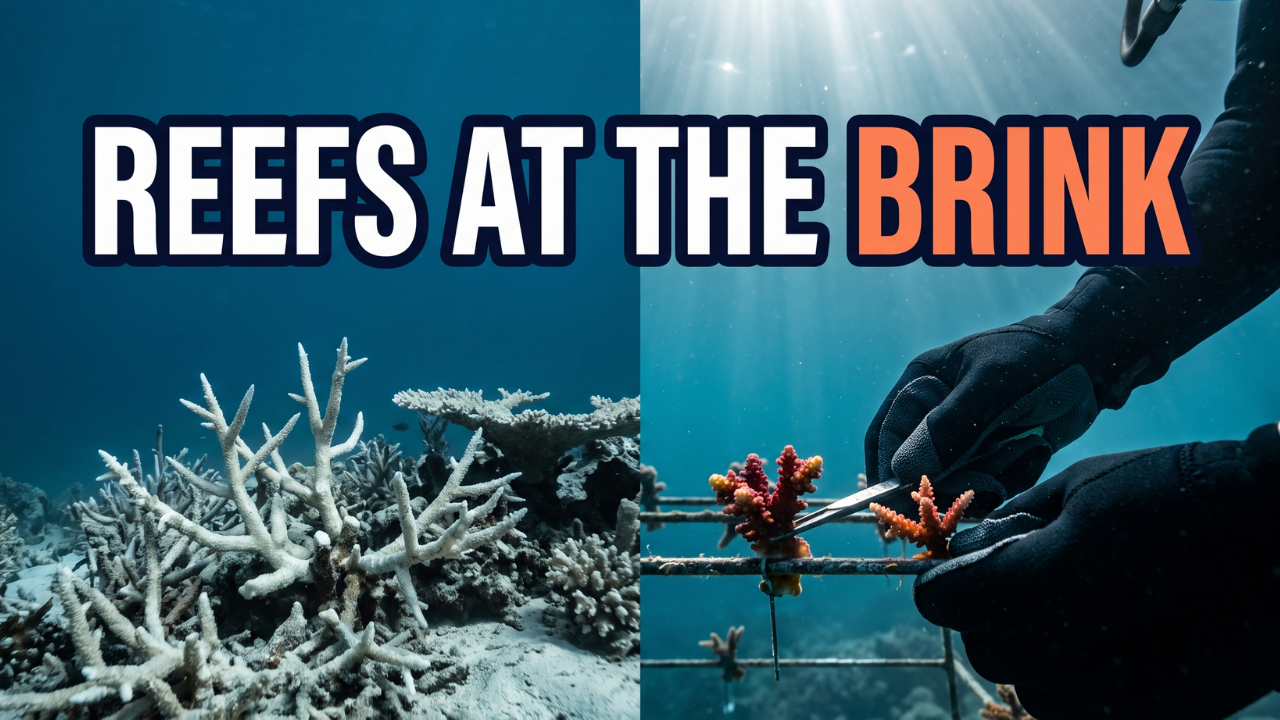
This year, most of the coral on the planet went through heat stress severe enough to bleach it. According to NOAA and the International Coral Reef Initiative, 84 percent of the world's coral reef area, spanning the Pacific, Atlantic, and Indian Oceans, was hit with bleaching-level heat stress during the fourth global mass coral bleaching event on record, running from January 2023 to roughly mid-2025. Damage was reported across 82 of 83 surveyed countries and territories. It's the most severe global bleaching event ever documented, and it fits a clear, escalating pattern: the first global event, in 1998, affected 21 percent of reefs. The second, in 2010, hit 37 percent. The third, from 2014 to 2017, hit 68 percent. Every global bleaching event on record has been worse than the one before it, and every one has coincided with a strong El Niño.
A Scale So Bad NOAA Had to Redesign Its Alert System
The severity of this event forced NOAA to add three entirely new levels to its Coral Reef Watch Bleaching Alert Scale, because the existing scale had no category for what was happening. The new top tier, Level 5, flags a risk of more than 80 percent coral mortality on an affected reef. Derek Manzello, NOAA's Coral Reef Watch coordinator, has summed up the shift bluntly: "We are now in the era where reefs will bleach on a near-annual basis." That's a significant change from a field where bleaching used to be an occasional, if serious, event. Context helps explain why: 2024 was the hottest year on record and the first calendar year to cross 1.5°C above pre-industrial levels, with triple the previous global record for marine heatwaves.
Zoom out past this one event, and the multi-decade picture is just as stark. A peer-reviewed 2021 study out of the University of British Columbia (Eddy et al., published in One Earth) found the world lost roughly half its coral cover between 1957 and 2007, with reef biodiversity falling 63 percent and reef fish abundance falling 60 percent over that same window.
What's Actually at Stake
The reason any of this matters beyond the reefs themselves: roughly one billion people worldwide depend directly or indirectly on coral reefs, and about 25 percent of all marine species live in or around them, the same biodiversity density people associate with rainforests. Healthy reefs also absorb up to 97 percent of incoming wave energy from storms, making them coastlines' first line of defense against erosion and flooding. In the U.S. alone, reefs generate an estimated $3.4 billion a year in economic value, including $1.8 billion a year in averted flood damage, on top of the tourism dollars divers, snorkelers, and recreational fishers bring in.
How a "Global Bleaching Event" Actually Gets Declared, and How We Know One Has Ended
A global bleaching event isn't a casual label. NOAA Coral Reef Watch uses a specific operational threshold, built after the 2014-2017 event: a global event is declared only when all three tropical ocean basins, Pacific, Atlantic, and Indian, independently cross the same bar, at least 10 percent of a basin's reef-containing locations experiencing heat stress of four or more degree heating weeks, a satellite-tracked measure linked to significant bleaching and coral mortality. If only two of the three basins cross that line, NOAA issues a "global bleaching warning" instead, a step below a full event declaration.
Ending works more conservatively than starting. NOAA doesn't call an event over the moment heat stress drops. Widespread bleaching has to stop occurring simultaneously across all three basins, and NOAA then monitors sea surface temperatures and bleaching reports for several more months, roughly six, before confirming the event is finished, since Southern Hemisphere bleaching often runs on the opposite seasonal clock from the Northern Hemisphere. Did the fourth global event actually end? Yes, but the exact story matters: NOAA first called it "likely" ending in 2025, with bleaching in Western Australia in early 2025 marking roughly its last widespread signal. Final confirmation waited until NOAA verified no widespread bleaching occurred anywhere during the following austral summer, December 2025 through February 2026, with that confirmation landing in the first half of 2026.
Here's the part that matters most for anyone hoping for reassurance: "ended" doesn't mean "over" in any comforting sense. NOAA has already flagged elevated bleaching risk for the North Pacific, Florida, and the Caribbean tied to an anticipated new El Niño, even as this event was being formally closed out.
Is Restoring Coral Just Decoration on a Dying Patient?
Here's the number that makes coral restoration a genuinely uncomfortable question: the IPCC's own 1.5°C Special Report projects coral reefs will decline 70 to 90 percent even if the world holds warming to 1.5°C, and more than 99 percent would be lost at 2°C. So if you're planting coral fragments onto a reef that's statistically likely to bleach again, is that meaningful work, or is it decoration?
The honest answer has three parts. First, every fragment of a surviving or restored reef is still doing real work while it's alive: buffering a coastline, feeding fish, supporting a local tourism economy. Restoration isn't a substitute for cutting emissions, it's what keeps reefs functioning long enough for the emissions fight to catch up. Second, the only realistic way to approach a problem this size is to narrow it down, one coral cluster, one reef, one community, at a time, rather than trying to solve the whole ocean at once. Third, restoration may also be building genuine resilience, not just buying time: field observations from this week's guest, Mike Goldberg of ICARE, suggest this year's water temperatures would have caused a mass bleaching event in 1995, and it isn't happening the same way today, because the coral being propagated now descends from stock that's already survived earlier bleaching and disease events. That's his own anecdotal read from the field, not a peer-reviewed finding, but it's a genuinely interesting hypothesis about assisted natural selection.
Beyond Fragments: The Full Coral Restoration Toolkit
Fragment-based coral gardening, breaking a coral colony into fragments, growing them in a nursery, then outplanting them onto a reef, is the most visible restoration method (and it's what ICARE, this week's featured organization, does). But it's one tool among several:
Larval propagation, or "coral IVF," collects coral eggs and sperm during natural mass spawning events, cultures the larvae, and releases or settles them directly onto degraded reefs, without ever handling adult coral. Selective breeding for heat tolerance is being tested by researchers at the Coralassist Lab and the Palau International Coral Reef Center, who ran a seven-year program cross-breeding heat-tolerant parent corals; results published in Nature Communications in 2024 showed heat tolerance can be meaningfully enhanced within a single generation, though the study's authors explicitly caution that selective breeding cannot replace urgent climate action, since projected heatwave intensity is rising faster than one generation of breeding can currently keep pace with.
Cryopreservation and coral biobanking, led by the Smithsonian's Reef Recovery Initiative and the International Coral Biobank Alliance, freeze coral sperm and larvae in liquid nitrogen as genetic insurance; the Smithsonian has already produced 600 genetically diverse elkhorn coral individuals this way, a meaningful boost given only around 150 wild elkhorn colonies remain in Florida. Coral probiotics apply the same logic as human or animal gut health to coral tissue, testing whether introducing beneficial microorganisms can increase a coral's resistance to bleaching. And engineered substrates take two forms: biorock, which runs a low-voltage current through submerged metal frames to accrete minerals coral can bond to, and 3D-printed ceramic reef tiles, tested in a 2025 peer-reviewed study in Hong Kong's Hoi Ha Wan Marine Park that found 88 percent coral survival after four years, alongside seven times more fish and roughly 60 percent more invertebrates than an unrestored site.
Marine protected areas and local stressor reduction, protecting herbivorous fish like parrotfish that graze down algae, and cutting overfishing, sedimentation, and nutrient pollution, round out the toolkit. It's worth noting honestly that this is an area of real scientific debate: a widely cited 2019 peer-reviewed review in the Annual Review of Marine Science challenges the assumption that MPAs and herbivore protection reliably build climate resilience, arguing that ocean warming routinely overwhelms local protections. Other research finds real benefits. None of the above changes the fact that global emissions reduction is the one lever that determines whether any restoration method holds up long-term. Every technique here is a Band-Aid, buying time and building local resilience, not a substitute for cutting emissions.
Does Restoration Actually Work? Here's the Evidence
A 2025 meta-analysis in Nature Communications, covering 764 marine restoration interventions across habitat types, found an average success rate around 64 percent using a 50 percent survival threshold. Coral reefs were among the better-performing habitats, at 67 to 74 percent success. Local case studies back that up: the Mars Coral Reef Restoration Program in South Sulawesi, Indonesia (published in Current Biology, 2024) found a restored reef's net carbonate budget, essentially whether a reef is growing or eroding, tripled within four years and matched healthy control reefs. A 15-year, community-based elkhorn coral restoration project in Vega Baja, Puerto Rico (published in Sustainability, 2024) saw outplanted colonies grow from an average diameter of 17.9 centimeters to 243.3 centimeters, with restored plots holding 2.4 times more fish species than unrestored control plots.
The honest counterweight: a recent peer-reviewed paper in Nature Ecology and Evolution, reviewing 220 restoration projects worldwide, found restoration reliably works at local scale, roughly 200 square meters to two hectares, over months to years, but isn't currently a viable fix at global scale. About 11,700 square kilometers of reef were degraded globally between 2009 and 2018; total global restoration investment over the past decade was only about $258 million, while restoring even 10 percent of degraded reef would cost a minimum of $1 billion. Local success is real. It isn't yet the same claim as global success.
How the Practice Itself Has Evolved
Coral restoration has moved fast. It started in the early 1980s, when a young researcher named Peter Harrison discovered mass synchronized coral spawning on the Great Barrier Reef, the foundational discovery behind larval-based restoration. Through the 1970s and 1980s, restoration was mostly hand-transplanting fragments and building artificial structures for coral to grow on. From 2000 to 2010, it matured into an actual discipline, with coral nurseries and practitioners starting to address root causes like invasive species and dive-tourism overcrowding, not just symptoms.
The biggest breakthrough came from an accident: in 2012, Dr. David Vaughan at Mote Marine Laboratory in the Florida Keys accidentally broke a coral fragment against the side of a tank. Instead of dying, it healed and grew explosively. He turned that accident into a deliberate experiment, and by 2015 confirmed "microfragmentation," cutting slow-growing stony coral into small pieces to trigger 25 to 40 times faster growth than the same coral achieves in the wild. In 2013, the first successful "coral IVF" reef trial happened in the Philippines, building on Harrison's spawning discovery; the technique now produces tens of millions of larvae per spawning event and has scaled across the Great Barrier Reef. Since 2016, restoration has become a full-scale, diversified practice, combining all of the above with genuine partnerships between government, business, tourism operators, and volunteer divers, which is exactly the model this week's featured organization, ICARE, represents.
Takeaways:
- Coral reefs just came through the most severe global bleaching event ever recorded: 84 percent of the world's reef area affected between 2023 and 2025, and NOAA only confirms an event over after months of monitoring show it's genuinely done, not just cooling off temporarily.
- Even the IPCC's best-case warming scenario still projects most reefs lost, which is the strongest argument for restoring reefs now, not a reason to skip it.
- Fragment-based coral gardening is just one tool. The field also includes selective breeding for heat tolerance, cryopreservation and biobanking, probiotics, engineered substrates like biorock and 3D-printed tiles, and protecting the herbivorous fish and water quality reefs depend on.
- It's genuinely working at the local scale: peer-reviewed studies show restored reefs regaining their coastal-protection function within four years and fish populations rebounding two to three times over fifteen years.
- It is not, on current evidence, a global-scale fix on its own. Restoration investment so far covers a tiny fraction of what's been lost, which is exactly why a "one coral cluster at a time" mindset matters.
- The practice itself has moved fast: hand-transplanting coral in the 1970s, a lab accident in 2012 that unlocked dramatically faster growth, and today's diversified, partnership-driven restoration models.
Coral Reef Health FAQ
Current condition
Is this reef healthy?
A healthy reef typically has living coral, diverse fish and invertebrates, low disease levels, and enough young coral to replace older colonies. Scientists examine several indicators together because coral cover alone does not reveal how well the whole ecosystem is functioning.
Is coral cover increasing or declining?
Researchers answer this by repeatedly surveying the same reef and measuring how much of the seafloor is covered by living coral. Short-term changes should be interpreted carefully because storms, bleaching, disease, and seasonal conditions can cause rapid fluctuations.
How does this reef compare with previous years?
Long-term monitoring can reveal whether the reef is stable, recovering, or deteriorating. Comparisons are most reliable when surveys use consistent locations, timing, and measurement methods.
Coral bleaching
Why are the corals turning white?
Corals turn white when stress causes them to lose the microscopic algae that provide much of their food and colour. Unusually warm water is the leading cause of widespread bleaching, although pollution, extreme cold, freshwater, or intense sunlight can also contribute.
How severe is the bleaching?
Severity depends on how many colonies are affected, how much of each colony is bleached, and which species are involved. Scientists also track the duration of heat exposure because prolonged stress raises the risk of coral death.
Can bleached coral recover?
Yes, bleached coral can recover if stressful conditions end soon enough and its tissues remain alive. Recovery may take weeks or months, and repeated bleaching can reduce growth, reproduction, and resistance to disease.
How much coral has died?
Scientists distinguish recently dead coral from coral that is bleached but still alive. They conduct follow-up surveys after a bleaching event because some mortality does not become visible until weeks or months later.
Climate and heat
Is ocean warming responsible?
Rising ocean temperatures are the main driver of increasingly frequent and severe mass-bleaching events. Local pressures such as pollution and overfishing can make reefs less capable of surviving and recovering from heat stress.
When will heat stress peak?
Heat stress generally peaks during the warmest part of the local season, but currents, cloud cover, wind, and storms can change its timing. Satellite products and local temperature sensors help scientists monitor accumulated heat and estimate bleaching risk.
Which reefs are most vulnerable to the next marine heatwave?
Reefs already affected by disease, pollution, overfishing, or recent bleaching are often especially vulnerable. Risk also depends on coral species, depth, water movement, prior heat exposure, and the intensity and duration of the heatwave.
Disease and other threats
Is this bleaching or disease?
Bleaching usually causes coral tissue to become pale or transparent while remaining intact, whereas disease may produce lesions, bands, spots, or areas of tissue loss. Laboratory analysis is sometimes needed because different conditions can look similar underwater.
What is killing the coral?
Coral mortality can result from heat stress, disease, storms, pollution, sediment, predators, or physical damage. Investigators examine the pattern of damage and surrounding environmental conditions before assigning a cause.
How important are pollution, sediment, storms, fishing, and crown-of-thorns starfish?
Their importance varies by location and can change over time. These pressures can act together—for example, poor water quality may weaken coral recovery after a storm or bleaching event.
Wildlife and ecosystem function
Are fish abundance and diversity declining?
Fish surveys can show whether the number, variety, and size of reef fish are changing. Declines may reflect habitat loss, fishing pressure, pollution, or disruption of the reef’s food web.
Is algae replacing coral?
Algae can spread when coral dies, nutrient pollution increases, or grazing fish and sea urchins become scarce. Heavy algal growth can prevent young corals from settling and make reef recovery more difficult.
Does the reef still provide habitat and coastal protection?
A reef can continue providing benefits after some coral loss, but those benefits weaken as its three-dimensional structure erodes. Structurally complex reefs support more wildlife and absorb more wave energy than flattened, degraded reefs.
Recovery and resilience
Which coral species survive heat best?
Heat tolerance varies among coral species, colonies, and their symbiotic algae. Some corals tolerate high temperatures better, although repeated or extreme heat can overwhelm even resilient populations.
How quickly can a reef recover?
Recovery can take years or decades, depending on the damage, coral growth rates, reproduction, water quality, and frequency of new disturbances. A reef may not fully recover if severe bleaching, storms, or disease recur too often.
Why do some reefs recover while nearby reefs do not?
Nearby reefs can differ in currents, depth, temperature, pollution, fishing pressure, coral composition, and supply of coral larvae. These local differences influence both how badly a reef is damaged and how readily it recovers.
Restoration and management
Does coral planting work?
Coral planting can rebuild small areas, preserve threatened species, and test more heat-tolerant coral strains. It cannot compensate for unchecked climate change or poor water quality and works best as part of a broader conservation strategy.
Should managers prioritize nurseries, water quality, fishing controls, or protected areas?
The right combination depends on the reef’s principal threats and the needs of nearby communities. Effective plans usually address immediate local pressures while also protecting resilient areas and supporting long-term climate action.
Which interventions produce measurable results?
Results are strongest when projects define clear goals and measure conditions before and after intervention. Useful outcomes may include improved coral survival, greater fish biomass, reduced disease, successful coral recruitment, or stronger coastal and community benefits.
Measurement and public participation
How is reef health measured?
Scientists measure indicators such as live coral and algae cover, coral growth and recruitment, disease and bleaching, fish abundance, biodiversity, and reef structure. Water temperature, nutrients, clarity, and other environmental conditions provide additional context.
Can satellite images or AI detect bleaching?
Satellites are particularly useful for detecting the heat stress that creates bleaching risk, while drones and underwater imagery can document visible reef changes. AI can accelerate image analysis, but field observations remain important for confirming coral condition and mortality.
Can tourists, divers, and citizen scientists report observations reliably?
Yes, particularly when participants receive clear training and follow a standardized reporting method. Photographs, precise locations, dates, and reports of both affected and unaffected reefs make observations more valuable to researchers.

CEO


