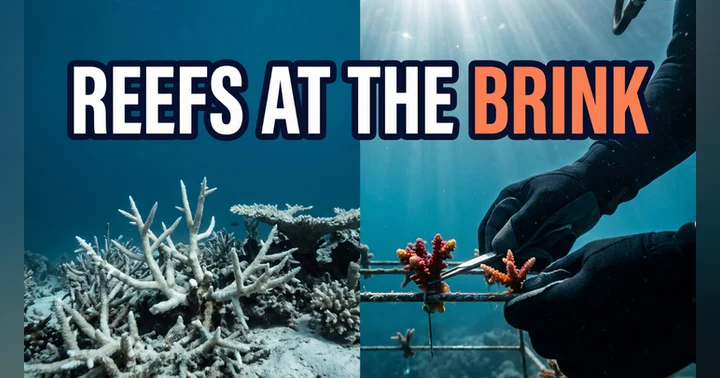
84 Percent: Inside the Worst Coral Bleaching Event Ever Recorded


 Apple Podcasts
 Spotify
 YouTube
 Amazon Music
 PocketCasts
 Overcast
 This year, most of the coral on the planet went through heat stress severe enough to bleach it. That's not a rounding error: 84 percent of the world's reef area, across the Pacific, Atlantic, and Indian Oceans, and NOAA had to add three brand-new alert levels to its Coral Reef Watch scale because the existing one had no category for what was happening. In this episode, Andrew breaks down exactly where global coral reefs stand right now: how the fourth global mass bleaching event on record got declared, why NOAA waited until 2026 to confirm it had actually ended, and why every global bleaching event on record has been worse than the one before it.
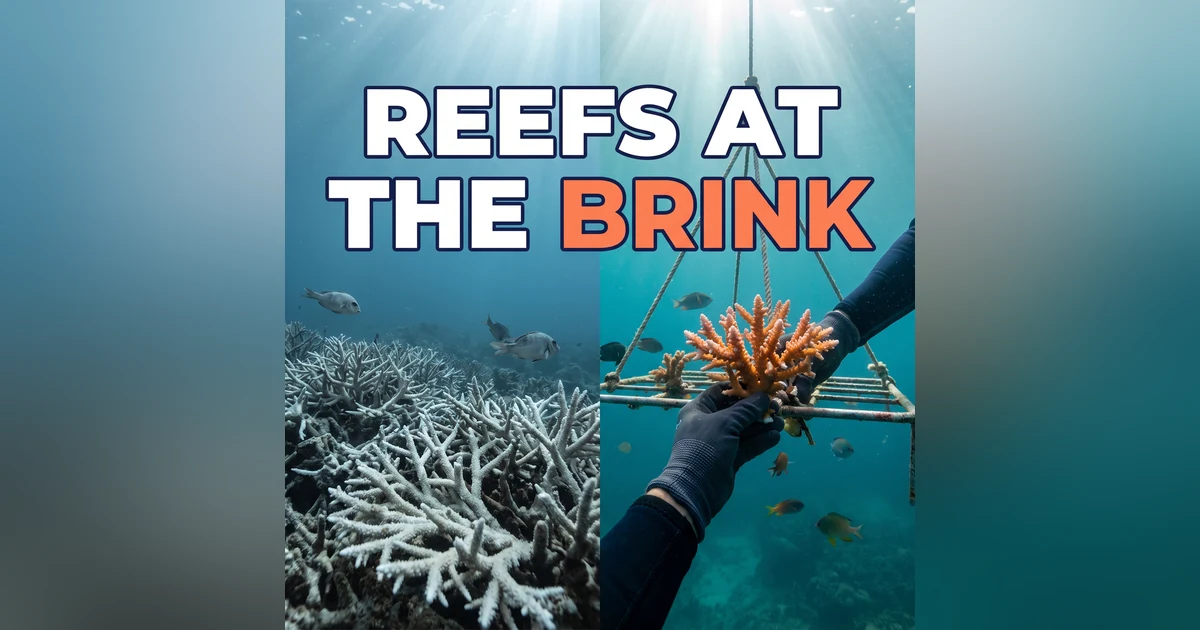
From there, Andrew tackles the harder question: if the IPCC's own projections show most reefs disappearing even in a best-case warming scenario, is coral restoration just decoration on a dying patient? He walks through the honest case for restoring reefs anyway, then surveys the full toolkit practitioners actually use beyond planting fragments, including larval propagation ("coral IVF"), selective breeding for heat tolerance, cryopreservation and biobanking, coral probiotics, and engineered substrates like biorock and 3D-printed reef tiles. He digs into the peer-reviewed evidence for whether any of it works (short answer: yes, locally, and not yet at global scale), and closes with a fast history of how restoration itself evolved, from 1970s hand-transplanting to a 2012 lab accident that unlocked 25-to-40-times faster coral growth.
This is episode one of a four-part week built around Andrew's interview with Mike Goldberg, co-founder of ICARE, a coral restoration group in the Florida Keys. The rest of the week digs into specific pieces of Mike's own story before his full interview airs Friday.
Takeaways:
- Coral reefs just came through the most severe global bleaching event ever recorded: 84 percent of the world's reef area affected between 2023 and 2025, and NOAA only confirms an event over after months of monitoring show it's genuinely done, not just cooling off temporarily.
- Even the IPCC's best-case warming scenario still projects most reefs lost, which is the strongest argument for restoring reefs now, not a reason to skip it.
- Fragment-based coral gardening is just one tool. The field also includes selective breeding for heat tolerance, cryopreservation and biobanking, probiotics, engineered substrates like biorock and 3D-printed tiles, and protecting the herbivorous fish and water quality reefs depend on.
- It's genuinely working at the local scale: peer-reviewed studies show restored reefs regaining their coastal-protection function within four years and fish populations rebounding two to three times over fifteen years.
- It is not, on current evidence, a global-scale fix on its own. Restoration investment so far covers a tiny fraction of what's been lost, which is exactly why a "one coral cluster at a time" mindset matters.
- The practice itself has moved fast: hand-transplanting coral in the 1970s, a lab accident in 2012 that unlocked dramatically faster growth, and today's diversified, partnership-driven restoration models.
Support Independent Podcasts: https://www.speakupforblue.com/patreon
Need help with your ocean non-profit, company, or project? Get the help you need with Pisces Oceans Inc.: https://www.piscesoceans.ca
Connect with Speak Up For Blue
Website: https://bit.ly/3fOF3Wf
Instagram: https://bit.ly/3rIaJSG
TikTok: https://www.tiktok.com/@speakupforblue
Twitter: https://bit.ly/3rHZxpc
YouTube: www.speakupforblue.com/youtube
0:00 This year, a lot of the coral on the planet went through some sort of bleaching event because of a heat stress, some of them severe enough where we had a good amount of bleaching. Not necessarily a mass bleaching event, 'cause apparently we're at the end of one. But about 84% of the world's reefs area across the Pacific, Atlantic, and Indian Oceans had some sort of heat stress severe enough to bleach it. And now I know a lot of the times we see reports, you know, bleaching events happen. We see global bleaching. We see corals are in trouble. We're worried about the corals. I often wonder, I'm like, "Where are corals from a global standpoint? Are we losing them all?" Do we know when they're gonna be lost? Is it something that we need to be worried about, or is this just, like, headlines just trying to get clicks?
0:41 Scientists have been studying, and they continue to study coral reefs all the time, and they're looking at it. And when you speak to a coral reef scientist, you ask them, you're like, "Is there really that much hope?" And they're kinda back and forth. I think we have to ensure that these reefs can persist, whatever that's gonna look like. The reefs we know today or that we knew back in the '50s and '60s and '70s are different today, and they're gonna be different in another 40 or 50 years. It all depends on which corals can actually survive the heat stress that we're undergoing, and if we can't change that heat increase, then that stress is gonna continue to happen, and we are going to see more and more changes, maybe to the point that we just see less coral reefs, and that's obviously something that we don't wanna do.
1:22 So what I thought I would do today, because this week is all gonna be about coral restoration. On Friday, I have an interview with Michael Goldberg, who runs ICare, which is I Care About Corals, which is an organization in the Florida Keys that is based on coral restoration, and he has a dive shop, and he has a whole thing we're gonna talk about on Friday. It's amazing. But I wanted to kinda cover today's episode as, like, what's the global health of coral reefs. And then how do we know, like, when we're in a coral bleaching, a global bleaching event for corals? How do we know when it's ended? Is there a point in restoring coral reefs? And what does that look like just beyond planting coral fragments? Does any of it actually work? How is the practice itself changing, and how has it changed over the years?
2:06 So this is, like, episode one of four this week, or really five this week, four solo episodes, all built around that conversation I had with Mike Goldberg, a co-founder of ICare, a coral restoration group in the Florida Keys. But this is the How to Protect the Ocean podcast, where you get all your ocean news updates and conservation news each and every week, Monday to Friday. If you like this type of information, hit that follow button right now because not only it helps you and get more and more information on the oceans, but it also helps other people discover us because we gain on charts and if you wanna pass it to a friend like you would a good book, please do so. If somebody's asking me, like, "Hey, what are the coral reefs like?" Well, do so. There's a lot of scientists in this audience.
2:47 If people are asking you, you can pass this episode, 'cause I'm hoping that this will be sort of like an update on global health of corals in general, and then why we do restoration to help that. All right. So NOAA, the National Oceanographic and Atmospheric Administration, and the International Coral Reef Initiative confirmed a fourth global mass coral bleaching event, running from January 2023 to roughly March 2025. So not that long ago. So that, looking at how much were affected, 84% of the world's coral reefs hit with a bleaching-level heat stress. The damage reported in 82 of the 83 countries and territories across all three ocean basins, which was the Atlantic, the Pacific, and the Indian Oceans.
3:28 Now, compare that to some of, like, the three prior global bleaching events and a pattern that we're seeing is escalating. It's not just a one-off. In 1998, we hit 21% of reefs. In 2010, we hit 37% of reefs. In 2014 to 2017, it was, hit a 68% of reefs. In 2023 to 2025, it hit 84% of reefs. So you can see that escalation happening. It's scaling, not in a good way, meaning that bleaching is occurring more and more, and these bleaching events are huge. These bleaching events are big, and we're gonna talk, gonna talk about that in a second. Now, every global event on record has been worse than the one before it, and each has coincided with strong El Niño.
4:11 Now, we have just finished an El Niño and a coral bleaching event in 2025. We are about to enter another El Niño year. It was confirmed this summer, and this might be what people like scientists consider a super El Niño, which is gonna make it even worse and, heat and storms and everything a lot worse. Now, 2024 was the hottest year on record and the first calendar year to cross the 1.5 degree Celsius above pre-industrial levels with triple the previous global record for marine heatwaves. So not looking good. Now, NOAA had to add three brand new alert levels to its bleaching alert scale because the existing scale had no category for what was happening.
4:54 The new top level, level five, flags risks over 80% of coral mortality of an affected reef. So essentially what happens when you get those heat stresses, and they last for a long enough period, NOAA will send out their Coral Reef Watch, will send out these alert systems and says, "Hey, we are at level three. We're at level four. We're at level five. We're at 80% of coral mortality could be affected." That's the risk that we're at. Now Derek Manzello, who's the NOAA's Coral Reef Watch coordinator, has been quoted as saying, "We are now in the era where reefs will bleach on a near annual basis." It used to just be like sometimes they bleach, sometimes they don't. Now it just seems like it's part of the new norm. That's not normal for marine science and the ocean. Now, a peer-reviewed study in 2021, like the study that came out from the University of British Columbia, which is by Eddie et al., published in One Earth, found the world lost roughly half of its coral cover between 1957 and 2007.
5:47 Just as it kinda overlapped the 1998 and before the 2010 mass bleaching event, we lost roughly, like, half, like 50% of the coral cover worldwide between 1957 and 2007. And with some nations losing up to 6.8% of their reefs over the past decade. Reef biodiversity fell 63%, and reef fish abundance fell 60% over that 50 some odd years. That's incredible. That's awful. Now, what's actually riding on that decline is roughly one billion people worldwide depend directly or indirectly on coral reefs. About 25% of all marine species live in and around reefs. Reefs are like a biodiversity haven.
6:28 It's the same biodiversity density people associate with rainforests. So, you know, it's funny, like I covered deep sea mining a couple weeks ago. And when we covered that,, Gerard Barron, who's like the head of TMC, which is one of the mining companies, said that, " Right now we're mining in a rainforest, so we know we don't wanna destroy things in a rainforest," plus all the human rights violations. But there's also the biodiversity. Let's just go down to the deep where there's not much biodiversity. It just so happens that there was more biodiversity than we expect in the deep sea, but there's a lot in the rainforest that people recognize. So having that decrease about 25%, that's a big hit. And, you know, healthy reefs absorb about 97% of incoming wave energy from tsunamis or any kind of storms, meaning there are coastlines, first line of defense against storms and erosion.
7:11 So in the US alone, reefs generate an estimated $3.4 billion a year in economic value, including $1.8 billion a year in averted flood damage. That's a lot of money saved and a lot bringing in just from the economic value of reefs. Like it's not only for protection, but it brings in business: divers, snorkelers, kayakers, fishers, like recreational fishing, all that kind of stuff. Now, the interview we did on Friday, we talked about, like with Mike, we talked about shifting baselines. How that's a problem that he described. He was a diver who back in like in the '90s, '80s and '90s, he was like, "Oh, wow, it's like everything is covered wall to wall. There's no patches on the reef where you just see bare rock." Now, you know, he looks today and he's like, "It's sparse.
7:55 This is like a patchy reef." Now, if somebody went, started diving today and went to a reef in the Keys, and you went there and you saw, like, just patchy reef, you'd just be like, "Oh, this is what the reef looks like." You didn't know, you weren't aware what was happening back then because it's not really well shared. But if you talk to a diver who's been diving for, like, 40 years, 30 years, they'll tell you that there's been a huge decline, especially in the last 10 years within the Keys, and we talk about that on Friday. Because, like, going back to the shifting baseline, people just haven't seen the wall-to-wall coral that we used to see. So the baseline for quote-unquote "normal" keeps resetting downward. It keeps getting, like, worse and worse. So now, like, I wanna talk just going back to the bleaching event. You know, when we talk about global bleaching events.
8:35 I wanna talk about how that's declared, because when somebody says there's a global bleaching event, I'm thinking like 90% of the corals are feeling it, but that's not the case. You know, I looked it up. I did a little bit of research to find out what it actually is. So there are categories. It's not just a casual label. Like, there's a specific category that's saying obviously they have levels to this. But NOAA's Coral Reef Watch uses specific operational threshold built after 2014 and 2017 event. So the global bleaching event is declared only when all three tropical ocean basins, so Pacific, Atlantic, and the Indian Oceans, independently cross the same bar. At least 10% of the basin's reef-containing locations experience heat stress of four or more degree heating weeks.
9:16 So that means, you know, there's an increase in the heating stress and there are four or more degree heating weeks, so where , it's at there, then they start to look. And a satellite track measure linked to significant bleaching or some coral mortality. So they get reports in from the different places, the different locations. They're gonna look at satellite data, they're gonna look at a lot of different things. Now, NOAA tracks this within an eight-month detection window because, you know, obviously all the basins, summer's different in Australia than it is in the US or in the West. So it's a lot different that way. Now, if only two of those three basins cross that line, cross the 10% threshold, NOAA issues a global bleaching warning instead of a full-on event. So it's a step below a full grade global event declaration.
9:59 So NOAA doesn't call an event over the moment the heat stress drops. So it doesn't say there's an end to this event. Like we know how it starts, now how it ends. You know, widespread bleaching has to stop occurring simultaneously across all three basins. And then NOAA monitors sea surface temperatures and bleaching reports for several more months, roughly about six more months, before confirming that the event is even finished. Since the Southern Hemisphere bleaching often runs on the opposite seasonal clock from the Northern Hemisphere. So we know that that's a little different. So like Christmas time for Australia is summertime. So it's always the beginning of summer there. So now let's talk about the question I had was like, did the fourth event that we had in 2025 that was supposed to end in 2025, did it end?
10:43 And it did. So NOAA first called it likely, quote unquote, "likely ending in 2025," with bleaching in Western Australia in early 2025, marking roughly its last widespread signal. So like, as I said before, Australia summer starts in December, so in early 2025 we still had bleaching events because that was their summertime, which is the hottest time of year. And then so they waited a little bit, before they declared it ending. So final confirmation waited until NOAA had verified no widespread, bleaching occurred anywhere during the following, austral summer, so December 2025 through February 2026. With that confirmation landing in first half of 2026. The event's active window is dated early 2023 to mid-2025.
11:27 That's essentially when the last, the fourth bleaching event occurred since we started recording bleaching events. Now, ended doesn't necessarily mean it's over in a reassuring sense. Like NOAA has already flagged elevated bleaching risk for the North Pacific, Florida, and the Caribbean tied to an anticipated new El Niño that's coming, even as this event is being formally closed out. So even though we're at the end of this event, we're still seeing bleaching events happen. Just it's not on a wide scale, as wide a scale. But then there's an El Niño coming in, potentially a super El Niño, which we don't even know what that's gonna mean yet for what these like corals are going through. But we know that during El Niño events, we tend to have the worst actual global bleaching events. So now Manzello, the program director for the NOAA's Coral Reef Watch, his own framing is that reefs have entered a new era of near annual bleaching, which I mentioned earlier.
12:15 So we have the declaration. We know the different levels. They've increased to having a level five 80% of the coral's bleach, which was the last event that we saw. We know that that's increasing. We know we're about to go into an El Niño, and we know we're about to maybe go into a super El Niño. And reefs are still undergoing bleaching since the last bleaching event ended, quote, unquote, "ended." So how do we manage reefs? There's a case for restoration. Local restoration, there's a case. But we're in still dire need because, the climate change isn't getting any better at this point. We are seeing events that are happening like wildfires, droughts, storms, and things that are making things worse, releasing more carbon through wildfires and all that kind of stuff.
13:01 And the IPCC's own 1.5 degree Celsius special report projects coral reefs will decline 70 to 90% even if the world holds to this 1.5 degree Celsius. And more than 99% would be lost at two degrees Celsius, which we're not that far off of. The question is, like, if we plant coral, is it just decoration that's about to die? Like, are we doing it for the right reasons? Is it just something that's loss of hope? Some people don't believe that. Some people will believe. I remember when I first heard of coral restoration, I'm like, it's really difficult 'cause restoration in general for any ocean or water body is very expensive. Even if you want a poor habitat. Like, I remember working in the Great Lakes pouring rocks into the Great Lakes, into like Lake St. Clair or anything like that.
13:43 Even just planning that, the costs were like half a million dollars just to put rocks in, like fish habitat. And so it's expensive to restore any kind of habitat, to do fragmenting, and to pay the people to go out and to do all that. It costs money to set up the infrastructure and everything like that. It costs money. So how do we justify the money if we think that they're going to die? That's the question here. Is it really worth it? So we're gonna talk a little bit about what's been going on, and what we can do. 'Cause every fragment of surviving a restored reef is still doing, like, real work while it's alive. It's buffering a coastline, feeding fish, supporting a local tourism economy.
14:24 And restoration isn't necessarily a substitute for cutting emissions. We still have to, do the work. It's what keeps reefs functioning long enough like emissions fight to catch up. I wanna kind of put it in context, if I can make this analogy on the run here, like in my head. I'm watching my weight. I'm always trying to watch my weight, and I've been working out for a long time. And working out does a certain amount for you. It increases cardiovascular health, builds muscle, and it's good for you as long as you do it properly and do it where you risk injury. Obviously, there's always a risk, but you know what I mean. Now, I started CrossFit when I, you know, back in 2013, I was doing it, and I even see people now, they're like, "Oh man, yeah, I remember when you were really into CrossFit," because I'm not as much into it now just because of injuries and lifestyle situations and things like that.
15:07 It's been a hard few years after COVID. But I was in good shape. Like, I had good shape. But I never really, like, lost a lot of weight. I'd go up and down, but, like, I would work out. The workout kind of restored my body. But the actual work to have long-lasting effects on my health had to come from eating. If I wanted to lose more weight, even if I worked out, if I wanted to lose more weight, I had to eat less, or I had to change the way I was eating. I was an impulse eater for quite some time. Still am sometimes. You have to do the work to go through that, and that's the tough work. That's always the difficult work because if you really get into, like, what eating and impulse eating, a lot of times it's like a mental thing. It's like a habit-building thing and sometimes there's underlying things going on, especially in my case.
15:51 So if I use the analogy that trying to get climate change reduced is like trying to reduce weight on a regular basis by changing your habits, your eating habits, and your nutrition habits. But the workout part is like the restoration of a reef, where it's like you work out, you're gonna be okay for a little bit. You can be a little bit more resilient. But the real work here is getting that nutrition in, psychologically not going after the foods that are really bad for you, so if you wanna have a long, sustaining life or do whatever you can to have that long, sustaining life, from a health perspective. That's where it's at. The nutrition part is the climate change reduction. The restoration part is like the working out.
16:32 It kinda gives you a little bit more resilient. So that's what we're talking about when we look at this type of work. Now, the way to approach a global problem, the only real way, of this size, is to narrow down to, like, one coral cluster. It's like to niche down in business. One small reef, one community at a time. Trying to solve the whole ocean, the problem, it's not gonna work. 'Cause, like, all at once is how, like, people give up from when, like, even before they even start, because it's such a huge problem. So restoration may also be building resilience, not just buying time. Because, like, even from our guests on Friday, Mike's own field observations, like, this year's water temperatures would have caused a mass bleaching event in 1995, and this isn't happening the same way today according to his anecdotal o- observations from the work that he's doing in front of him in the Keys.
17:23 Because the coral being propagated now descends from stock that have already survived earlier bleaching events and disease events. which is nice because we don't know how these reefs are changing in terms of their tolerance. The strongest will survive. Natural selection will happen. It's evolution. So the species that don't handle the change in temperature swings well, they are going to die off. The other ones are going to stay. So we might already have seen a switch in the species makeup of these reefs. But the future reefs, the ones that are being fragged, have already survived this level, this baseline level that has increased over that time. You know, it's almost like, if you listen to earbuds, you have earbuds in, you listen to music really, really loud.
18:06 when you stop playing that music and you take them off, your hearing threshold has gone down because you can't hear as much, but you become a little bit more resilient to it inch by inch, even though it's bad for you. So I just wanted to let you know, like, we're seeing some resilience for some of these corals. And, like, I covered this on Ocean Decoded Live on my YouTube channel. There's some swings in the Great Barrier Reef, like from really hot marine heat waves to lower, like, days or summers or part of the summers that's better, and it's actually helping coral cover when the swings go towards cooler. They're resilient. They come back. So I think that's an interesting way to view the problem, is let's look at it locale by locale and see how we can do this. So when we're looking at restoration, we're looking at reducing emissions. That's a long-term goal.
18:46 The restoration's the short-term goal. Build the resilience that they need to handle the world in which we live in now, so that when we do reduce the climate change problem, then we're gonna be able to help those corals. They'll bounce back even quicker. So I think that's good. Now, I wanna talk a little bit about restoration and looking at coral conservation and restoration. So fragment-based coral gardening, which, basically you take a coral, which is a colony of corals, and you start chipping off these little fragments. And then what you do is you go into this, like, incubator in your lab or something, and you start to regrow them, and you start to make sure that they're growing well. And then you replant them into the ocean where you took them from, and then they grow from there.
19:29 So that's the beauty about corals. They can just kinda grow. It builds their resilience. But at least when they're younger or they're smaller, they have a chance to get a little bigger before you replant them. So that's sort of, like, what ICARE does, which we're gonna talk about on Friday, and we're gonna talk about probably later on this week. It's the most viable restoration method, but it's one tool in the toolbox amongst several tools. So I wanna talk, before we go totally into restoration, talk about, like, the different types of restoration that we have. It's not just fragging. There's other things. So larval propagation, which is coral IVF, essentially. So this is, you know, what we're gonna cover soon, is like, it basically collects coral eggs and sperm during natural mass spawning, culture the larvae, and release or settle them directly onto degraded reefs.
20:14 It doesn't require handling of adult coral at all, which is kinda good, which is nice. Now, there's selective breeding, assisted evolution for heat tolerance. So researchers at the Coral Assist Lab and the Palau International Coral Reef Center ran a seven-year selective breeding program, cross-breeding heat-tolerant parent corals and testing offspring after three to four years. So the results published in "Nature Communications" 2024, the heat tolerance could be enhanced by roughly one degree Celsius a week within a single generation, with the genetic basis for the trait hetirability around about 0.2 and 0.3. So it, I guess, passes on to the next generations. One thing to, note, though, the projected heat wave intensity is rising by about three degree Celsius a week, so per decade.
20:58 So that's obviously increasing a lot faster than what this breeding is doing. The study explicitly states, like, selective breeding cannot replace urgent climate action. In many of these restoration efforts, climate action, urgent climate action is where we're at. Now, there's also cryopreservation and coral biobanking. So the Smithsonian's Reef Recovery Initiative and the International Coral Biobank Analysis, which has over 200 coral species now held in human care, freeze coral sperm and larval in liquid nitrogen and are developing methods to freeze whole coral fragments. This is genetic insurance essentially. So letting scientists combine genetic material from parent corals that would never naturally meet. So in practice, the idea is the Smithsonian has already produced 600 genetically diverse elkhorn corals, which is like a acropora, like a branching coral.
21:44 Individuals using cryopreserved sperm, a meaningful boost given only around 150 wild e- elkhorn colonies remain in Florida. So there's definitely reasons for this. Another method of restoration is coral probiotics or microbiome manipulation. So it's a body of research, notably around 2018, 2019 study, in the ISME Journal, is testing whether introducing beneficial micro, organisms for coral, so BMCs, into a coral's microbiome can increase its resistance to bleaching. The same underlying idea as probiotics in human or animal health applied to coral tissue. So essentially, you know how you say have your probiotics pills in the morning, or you eat yogurt 'cause it has probiotics in it? That's the idea is it helps you be more resilient towards change.
22:28 Engineered substrates, two different approaches here for that. So biorock or mineral accretion. So running a low voltage electrical current through submerged metal frames caused dissolved minerals to accrete onto the structure, giving coral a surface to bond. So that helps as well. And then, of course, deployed for decades in Bali is the, Pemuteran's Karang Lasanteri Project of 50 plus structures. And of course it's elsewhere too, not only in Bali. The technology's own promoters cite dramatic survival and growth multipliers, flagged above as needing independent verification. So a 2025 peer-reviewed study in the Journal of Marine Science and Engineering tested custom ceramic tiles in Hong Kong's Hoi Ha Wan Marine Park.
23:10 It was seeded with 378 coral fragments. The results after four years, 88% coral survival, and compared it to an unrestored site, seven times more fish and almost 60% more invertebrates by visual survey. So environmental DNA sampling found an increase in biodiversity by 23.5% than the unrestored area, and even 13.3% higher than the natural reference reef, which is great. And then, of course, there's marine protected areas and local stressor reduction. So protecting herbivorous fish like, parrotfish, which graze down the algae that would otherwise smother corals, and cutting local stressors like overfishing, sedimentation, and nutrient pollution from coastal development. It's pretty intuitive, the way we talk about marine protected areas on here and then other things that we talked about in terms of development and sort of sedimentation due to development and nutrient pollution like reductions.
23:59 It needs to be said, like there's not enough coastal marine protected areas in there. Sometimes it gets caught up in the 30 by 30 because a lot of these coastal MPAs will be smaller, and they may not contribute enough percentage to actually fit the 30 by 30. But they're just as important, if not more important, ' cause these habitats like coral reef, seagrass areas, mangroves, are crucial to the next generation of fish. That's where a lot of these larval and juvenile animals are spending time before they go off to be adults in other areas. So that's a huge thing. Now, obviously, like there was a widely studied 2019 peer review, in the annual review of marine science directly challenges the assumption that MPAs and herbivore protection reliably build climate resilience, arguing that oceans warming affects corals, routinely overwhelms local protections.
24:41 Obviously, the boundary is not a physical boundary, and water heats up, and the MPAs can't really help it. But they can take the pressure off of, like, the external. Even pollution sometimes help, but you're taking away any kind of extractive activities, whether it's like diving, whether if people are diving 'cause they can hurt it, or extractive activities like fishing, mining, all that kind of stuff. So this is a interesting debate within the MPA system and just scientists and conservations. But MPAs do provide protection for coral reefs. It's just a different type of protection. It's more fisheries and biodiversity-based, which biodiversity provides stability, so that's always good. Now, of course, you know, one thing to note that none of the above changes the fact that global emissions reduction is the one lever that determines whether any of this holds long term, any of this restoration.
25:24 It is the Band-Aid. All of these methods above are the Band-Aid. Restoration is the Band-Aid until the problem is solved. Every method here is about buying time and building local resilience, not a substitute for it. So I wanna make that clear, 'cause it may not work all the time because you never know what's gonna hit. We're heading into El Niño. You don't know how that's gonna change everything. So now let's talk about, like, does restoration actually work? Can it work in the long term? And is it worth it even if it doesn't work all the time. But let's talk about some of the evidence. So let's look at sort of the big picture. So 2025 meta-analysis in Nature Communications covering 764 marine restoration interventions across habitat types found an average success rate around 64%.
26:10 And that's using a 50% survival threshold. So coral reefs were among the better performing habitats at 67% to 74% success. So similar to salt marshes and ahead of seagrasses, that were at 56%. So about 9% of the interventions were complete failures, but a lot of them had success. So there was, like one of the local case studies for reef restoration looked at reef function that recovers fast. So the Mars Coral Reef Restoration Program in South Sulawesi, Indonesia, restored reef damage decades ago by blast fishing using coral transplants plus steel structures to stabilize loose rubble. So now this was published in Current Biology, one of the journals of 2024.
26:52 The coral reef's net carbonate budget, essentially measure like whether a reef is growing or eroding, tripled within four years and matched healthy control reefs. Now, that's a direct measurable signal that a restored reef can rebuild its coastal protection function on a real timeline. So now, something to know though is the restored reefs skew toward fast-growing branching corals, which kinda like tells you like, depending on the coral, how things will rebuild and how composition will look and diversity will look. Now another case study, it was a 15-year track record, a community-based elkhorn coral Acropora palmata, restoration in Vega Baja, Puerto Rico. So it ran from 2008 to 2023, published in Sustainability in 2024, the journal.
27:35 Outplanted coral colonies grew from an average diameter of 17.9 centimeters to 243.3 centimeters. So the restored plots had 2.4 times more fish species and 2.6 more total fish than restored control plots. And with herbivorous fish increasing up to sixfold, which is great ' cause it's exactly the grazing community that is needed to help out. So there are a lot of case studies that go into this, and I can read all the stuff, but it shows that we are seeing success rates. But like local success doesn't necessarily claim that it's a global success. Remember we talked about let's keep it local. Like a 2005 peer-reviewed paper in Nature Ecology and Evolution reviewed 220 restoration projects worldwide, found restoration reliability works at a local scale, roughly 200 square meters to two hectares over the months to years.
28:21 But it's not currently a viable fix for global scale, like it's good for local areas. So the numbers behind that, about 11,700 square kilometers of reef were degraded globally between 2009 and 2018. So total global restoration investment over the past decade was about $258 million, while restoring even 10% of degraded reef would cost a minimum of $1 billion. And under current climate trajectories, an estimated 99.6% of restored reefs are still projected to face mass bleaching by 2100 without emissions cuts. So if we don't do anything from now on, that's what's gonna happen. This is essentially why we want to do local areas to help local people, local communities.
29:04 Now, there's a way to measure these different types of restorations. NOAA and the Coral Restoration Consortium jointly publish a coral reef restoration monitoring guide, so different projects and regions can be compared on the same terms, which is always great. This is what science does. And it splits metrics into universal metrics every project should track. So coral survival and condition, growth and size, genetic diversity of restored population, water temperature, and so forth. And it's a goal-based metrics tied to what a specific project is actually trying to achieve. So could be ecological recovery, community and economic benefit, disaster response, climate adaptation, or research. So it's evaluated at multiple scales, from individual colony up to population and landscape.
29:44 There's a lot that goes into this document. And across an actual published studies above, like the metrics that keep showing up are like the percent survival at fixed time intervals. So the single most common metric in the field, like live coral cover, reef carbonate budget or net growth, fish abundance and species richness, structural complexity, genetic diversity of outplanted stock, and an increasingly environmental DNA sampling, which is to catch biodiversity shifts and a visual survey can't alone track. So it's kinda cool. Now, we're gonna talk about the monitoring that Mike Goldberg's organization, who we're gonna talk to on Friday, ICARE goes through. We're gonna talk about that on Thursday. Looking at being transparent with the data and the survival and how well that's going.
30:26 Now, the evolution has changed for restoring reefs. In the early 1980s, the discovery that made everything really possible is Peter Harrison. Like then a young researcher discovered mass synchronized coral spawning on the Great Barrier Reef. Corals releasing eggs and sperm in the water column on the same night once a year. That discovery was the foundation for larval-based restoration decades later. And the first wave, like 1970s and 1980s, like restoration starts as scientific curiosity and salvage work, made possible as scuba diving became more widely accessible and early environmental protections appeared. The hand transplanting live coral fragments and building artificial structures, it's just to grow on. Like, that's what's really coming. I remember when I was getting into the marine aquarium phase of my life, I looked at corals.
31:09 There was a site dedicated to help people create fragments and how to frag properly, and it was like a whole open database kind of thing. It was really, really great. And then from 2000 to 2010, restoration matures into an actual discipline. So coral nurseries appear, growing fragments in a controlled setting before outplanting them. That's important. Practitioners start addressing causes, not just symptoms. So they remove algae, invasive lionfish, and crown-of-thorns starfish in Australia, and then managing overcrowding at popular tourism dive sites, especially across the Caribbean. Now, the actual breakthrough though is like in 2012, Dr. David Vaughan at Mote Marine Laboratory in Florida Keys accidentally breaks a coral fragment against the side of a tank during a routine handling. Everyone's like, "Uh-oh." Instead of dying, it heals and grows at an explosive rate.
31:53 He turned that accident into a deliberate experiment, and by 2015 confirms microfragmentation. Cutting slow-growing stony coral into small pieces to trigger 25 to 40 times faster growth than the same coral would achieve in the wild. Now, one of the field's biggest breakthroughs, and it started with just a mistake because somebody, broke a coral. In 2013, larval restoration goes live, building on Harrison's 1980 spawning discovery. The first successful coral IVF reef trial happens in the Philippines. Collecting coral eggs and sperm during a natural mass spawning event. culturing larvae. We're gonna have somebody on later on this year, talking about that because that's a technique that's huge. It now produces tens of millions of larvae per spawning event, and has scaled across the Great Barrier Reef with expansion underway in the Maldives, Caribbean, and Southeast Asia.
32:40 I think we're gonna be talking about the Maldives project. Now in 2016, it was like, kind of like a third wave. The restoration becomes a full-scale diversified practice. So microfragmentation and larval propagation running alongside assisted evolution, biobanking, probiotics, and engineered substrates, combined with something new. Built-in partnerships between government, business, tourism operators, and volunteer divers, rather than just science running on its own. Rather than just, it's just scientists trying to figure out what the next thing is, but they couldn't implement it. We need the implementation. And I care that we're gonna speak to Mike, the co-founder, is really the modern-day example. We'll talk more about that, but now he's gonna have pop-up nurseries, going in in October. They're gonna be able to, basically restore a lot more areas, than they were able to do before.
33:22 I know this is a longer episode, but even though coral reefs just came through, like, one of the most severe global bleaching events ever recorded, where 84% of the reefs area were affected. It added a fifth level onto the global event watch kind of levels of risk, you know, between 2023 and 2025. And NOAA only confirms an event over after months of monitoring shows it's generally done, not just cooling off, off temporarily. We know we're going into something worse. El Niño, super El Niño. We might see the fifth event that happens two years after the fourth event. But we know restoration is here to help us is to provide that resilience that we need. It's that quick resilience in tough times. and there's so many different ways of doing it, and everybody's, like, science and practitioners are actually working to implement these ways and monitor them and be transparent about them in order to share what they've been able to find and where we can bring our practice over.
34:15 And in the next three days, the next three episodes, we're gonna be talking about some of the things that Mike Goldberg went through and sort of his evolution before we talk to him and you hear it in his own words. And I think that's… it's gonna be really interesting to see over this week where Coral Reef is and how it's affecting that, you know, just one person in the US to say, "Hey, I'm gonna make a difference," and starts an organization to make that difference. And then five and a half years later, they're already expanding, and it's great to see. So that's it for today's episode. I know it's been a long episode. My gosh, one of my longer episodes that's solo episodes. But I think it's an important aspect to figure out, and it's something that we need to build on. We need to look at from a global perspective. This is global reefs, and how do we build resilience in global reefs?
34:58 It's local restoration for now, but it doesn't ignore the fact that we need climate resiliency. We need reduction in climate change right now, yesterday, the day before, last decade. It is imperative, and we can't ignore that. Global coral reefs are the canary in the coal mine. They are the indicator of how well we're doing, and we're not doing well, and we need help. So ways that you can help are gonna come this week. Hit that follow button to make sure that you don't miss any of the other episodes that are coming out this week. I wanna thank you so much for joining me on today's episode of the How to Protect the Ocean podcast. I am your host, Andrew Lewin. Have a great day. We'll talk to you next time, and happy conservation.