He Almost Quit the Dive Business. Then a Coral Reef PhD Student Walked In.
Mike Goldberg has logged over 10,000 dives and spent decades running a dive shop in the Florida Keys, long enough to remember the reefs at their pristine, wall-to-wall best. He's also watched them decline in real time. His first widespread coral bleaching event hit around 2008, a shock significant enough that, in his own words, he didn't even know what coral bleaching was before it happened. Then, roughly a decade before his interview with Andrew, a second, different crisis arrived: Stony Coral Tissue Loss Disease.
The Disease That Almost Ended a 30-Year Business
Stony Coral Tissue Loss Disease (SCTLD) isn't like bleaching. Bleaching is a stress response a coral can sometimes recover from once water temperatures drop. SCTLD kills living coral tissue outright, in lesions that can spread 5 to 40 square centimeters a day, often killing an entire colony within weeks to months. First identified off Virginia Key near Miami in the fall of 2014, its cause is still not fully confirmed, though antibiotic treatment slows its progression, pointing to a bacterial involvement. It affects more than 20 of Florida's roughly 45 stony coral species, including major reef-building species like brain and pillar corals, with mortality on the most vulnerable species running as high as 66 to 100 percent. Since 2014 it's spread across an estimated 90 percent of the Florida Reef Tract, more than 109,700 acres, and reached reefs in at least 18 countries and territories across the wider Caribbean.
For Mike, a self-described non-scientist, it was genuinely depressing. His wife told him directly: the reef isn't what it used to be, and it's not getting better. Get out of the business before there's nothing left to sell. He didn't know what to do about it. He's not, in his own words, someone who just gives up, but for the first time in three decades of running a dive business, he didn't have an answer.
A Tank Fill Changes Everything
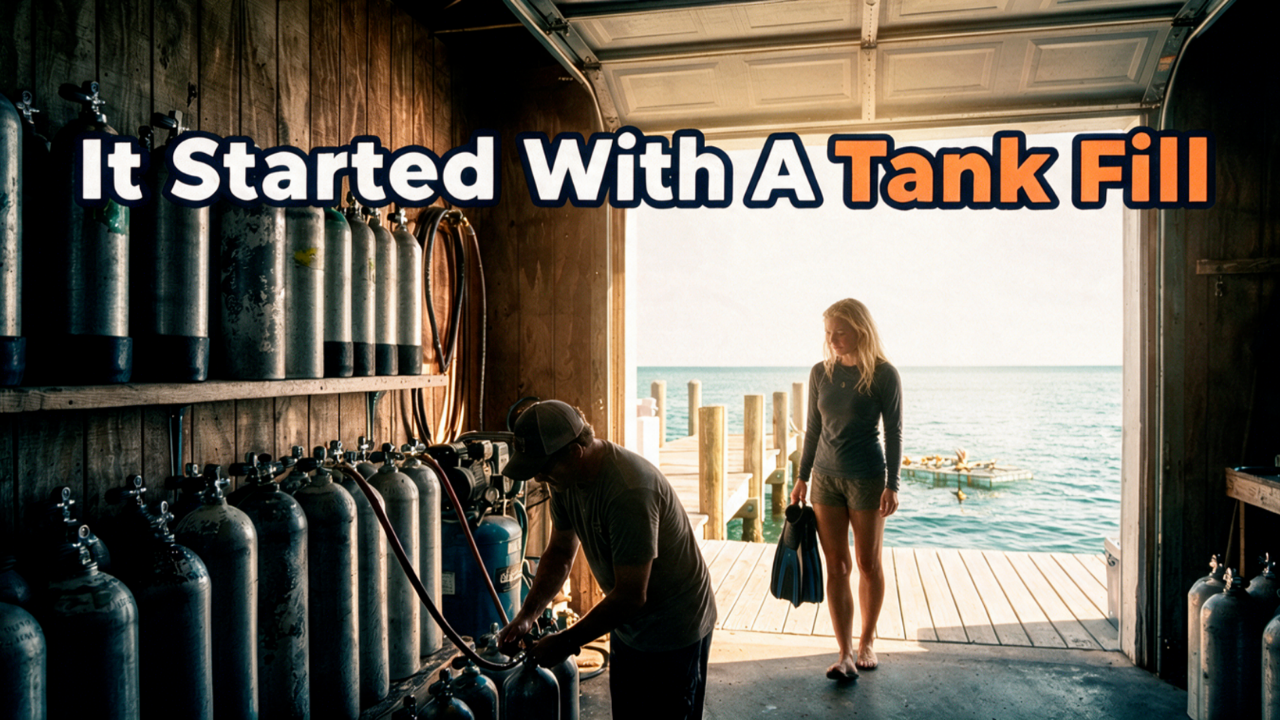
Around 2017 into 2018, a young woman walked into Mike's shop just to fill a couple of scuba tanks for her own field work. She turned out to be Dr. Kylie Smith, then a PhD student studying the relationship between parrotfish populations and coral outplants nearby. By the time she was ready to leave, Mike had asked her a dozen questions about the reef and what was actually happening to it. She came back two to three weeks later, and couldn't get out the door without another round of questions.
Mike calls this his own "period of discovery," a stretch of time where, for the first time, he had direct access to a scientist who could tell him what was actually going on with the reef he'd built his life around. It's a different instinct than most business owners default to. A lot of owners in his position ask how to keep the money coming in. Mike asked what was happening to the reef, and whether there was anything that could be done about it.
Talking a PhD Student Out of the Safe Path
It took roughly a year to figure out a direction. Part of that year was Mike convincing Kylie not to take a government job and instead run her own nonprofit alongside him, a path her own family considered risky. It's an understandable read: in 2018, freshly minted PhDs were already competing for a limited pool of government and academic environmental jobs, and that pool was especially tight at the time. Kylie had real, safer alternatives in front of her. Mike made the case anyway. His own pitch, in his telling, amounted to: trust me, we're going to make this work.
What made the partnership work wasn't just persistence. It was that Kylie's scientific credibility and Mike's three decades of relationships in the Florida Keys dive industry filled in each other's gaps. Neither piece alone gets you a functioning coral restoration nonprofit. Together, they built one.
From One Fragment to a Working Organization
The nonprofit that resulted is I.CARE (Islamorada Conservation and Restoration Education). Its partnership with Mote Marine Laboratory, an internationally recognized name in coral research, gave it credibility and scientific backing from the start. The first coral went into the water in January 2021.
Since then, I.CARE has grown into an organization that propagates its own coral, runs its own onshore nursery, and was, as of this recording, preparing to install nine offshore coral and sponge nurseries. It's built additional partnerships with Reef Renewal USA, the Florida Aquarium, and the Reef Institute. All of this happened while Mike also kept his original dive business running through the COVID-19 pandemic, a period that hit Florida Keys tourism hard and made simultaneously growing a donor-dependent nonprofit a genuinely difficult balancing act.
An Origin Story Separate From the Science
I.CARE didn't start with a grant application or a five-year strategic plan. It started with two people having conversations at a dive shop, one of them frustrated and looking for answers, the other one a scientist who happened to walk in for a tank fill. That's worth sitting with on its own terms, separate from the disease science or the restoration methods: watching your own livelihood decline, and choosing to act instead of walking away, is its own kind of resilience.
This is episode two of a four-part week built around Andrew's full interview with Mike Goldberg, airing Friday. The rest of the week digs into how I.CARE actually funds and monitors its restoration work.
Takeaways:
- I.CARE didn't start with a grant or a strategic plan. It started with a dive shop owner's frustration and one chance conversation with a grad student who walked in to fill some tanks.
- The disease that pushed Mike to act, Stony Coral Tissue Loss Disease, isn't like bleaching. It's an unresolved, contagious, tissue-killing outbreak that's been spreading through Florida and the wider Caribbean for over a decade with no confirmed cause.
- The partnership worked because it paired two kinds of expertise that don't usually sit in the same room: a scientist's research and a small business owner's community connections and hustle.
- Mike spent part of a year talking Kylie out of a safer path (a government job) and into co-founding a nonprofit instead, a real risk her own family flagged at the time.
- Watching your own livelihood visibly decline, and choosing to act instead of walking away, is its own kind of origin story, separate from the science.

CEO


