Show Me the Receipts: Why I.CARE Monitors Every Coral It Plants
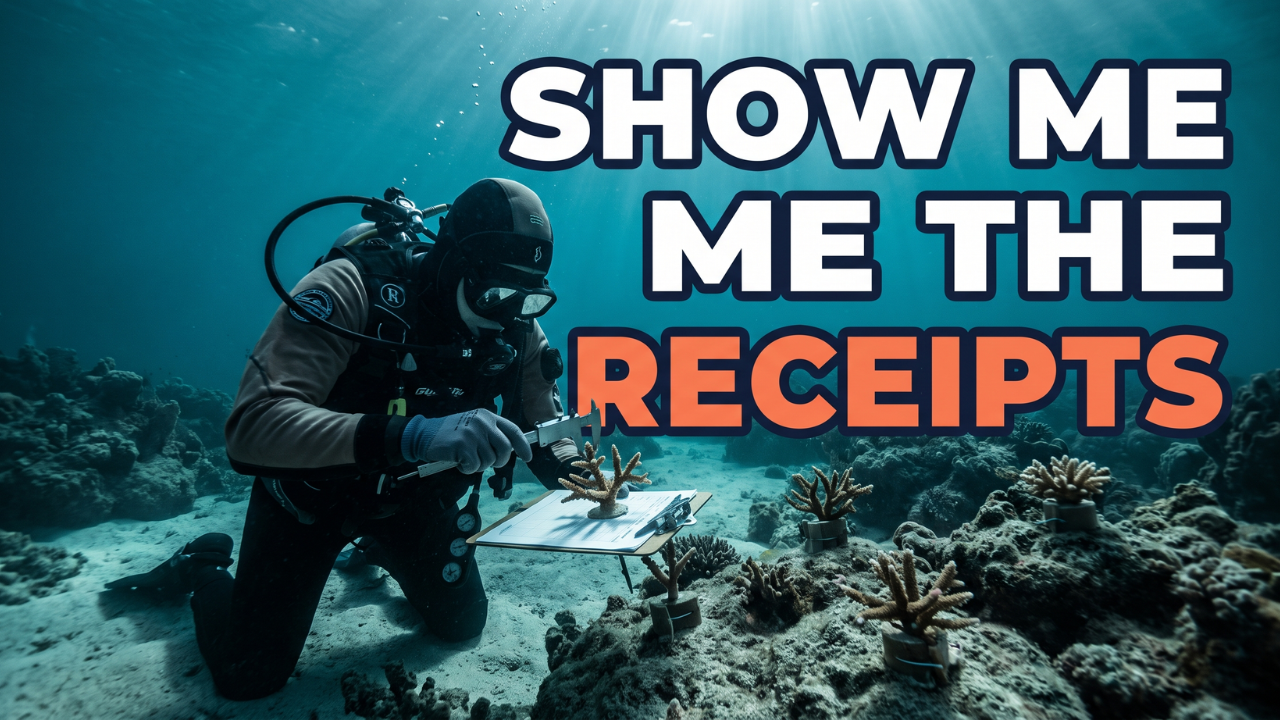
Most coral restoration groups check on a sample of what they've planted, often somewhere around 20 to 30 percent, and report that sample as if it represents everything they put in the water. I.CARE, the Islamorada, Florida coral restoration nonprofit co-founded by Mike Goldberg and Dr. Kylie Smith, checks on all of it. Every single coral outplant gets monitored at fixed intervals: one week, one month, 90 days, then one, two, and three years, with no substitute and nothing left unaccounted for.
That rule was built in before I.CARE ever planted its first coral, and it's shaped everything else about how the organization runs since.
Why 100 Percent, When the Field Norm Is a Sample
Mike has been explicit about why he rejected the sampling approach he saw used around him in the field. A spot check of a fifth of what's actually in the water can't tell you the truth about the other four-fifths, and presenting that spot check as if it can misrepresents the real outcome to the people funding the work.
That framing matters because, in Mike's telling, the real hero of this story was never the reef. It was the funders. He describes a mission to make sure they know what actually happened to the coral they paid to have restored, whether the news is good or not. That's not incidental generosity. Mike frames full monitoring as a matter of fiduciary duty, the same obligation he'd expect from anyone handling someone else's money, whether that's a $2 add-on on a $100 Key Dives trip or a large donation. If donors and dive customers are funding actual coral survival, not just the act of planting coral, the group owes them the real number rather than a flattering estimate.
It's worth being direct about what that number actually is: a 47 percent one-year survival rate, tracked across all 17 coral species I.CARE works with. Mike considers that figure strong, and notes that few practitioners in the field can even produce a comparable one, since it depends on tracking everything rather than a sample. Restoration is never going to be 100 percent successful. Coral living on a real reef faces storms, disease, and heat stress regardless of how carefully it was planted, on top of the disease outbreaks and warming events already covered earlier this week. Some loss is simply the honest cost of doing this work in the ocean rather than a lab. The real test of whether I.CARE's transparency is genuine came during the 2023 global bleaching event: I.CARE kept publishing its survival numbers straight through it, rather than pausing reporting or going quiet until conditions improved.
Why a Sample Can Lie to You
The reason full monitoring matters so much comes down to a basic issue with sampling: where you check determines what you find. If a group samples 25 out of 100 outplants but only surveys one area of a reef, and that area happens to be doing well, the group can honestly report a 75 percent success rate that has nothing to do with what's happening everywhere else. A funder who happens to dive a different, struggling section of the same reef will see dying fragments and reasonably ask why the numbers don't match what they're looking at.
Checking everything, across the entire study area, is what actually removes that bias. It's also, frankly, a less flattering number to report. A 47 percent survival rate sounds lower than a cherry-picked 75 or 90 percent. But it's the real one, and it comes with context: which conditions, which locations, and which factors (more nutrient runoff or algae in some spots, for instance) explain the difference. That's a fundamentally different kind of reporting than picking the good news and calling it representative.
A Real-World Example of What the Field Is Supposed to Do
This is exactly the kind of standardized, universal metric tracking that NOAA and the Coral Restoration Consortium's own monitoring guide recommends as the field standard, a scalable, scientific approach meant to let practitioners compare progress across projects, programs, and regions. I.CARE was doing it before it was a standard.
That's not a small distinction, because the research on the rest of the field is not encouraging. The most comprehensive look at this is a 2020 systematic review in the peer-reviewed, open-access journal PLOS ONE, which analyzed coral restoration projects worldwide. Roughly 60 percent of the projects reviewed were monitored for less than 18 months total, and the median monitoring period was just 12 months, nowhere near I.CARE's built-in three-year check-in. About 45 percent of projects with stated ecological objectives didn't measure any metric relevant to that objective, meaning a large share of the field can't clearly show whether it achieved what it set out to do. How survival itself gets measured and reported also varies so much from project to project that outcomes are often not meaningfully comparable across the field, and cost reporting is almost entirely absent industry-wide, so funders usually have no independent way to judge value for money. In the review's own language, it found "little or no scientific input or detailed monitoring" common enough across surveyed projects to describe it as a pattern, not an exception.
A second, more pointed paper is worth citing here too: Allgeier and Griffith, published in Conservation Letters in September 2025. It focuses on artificial reefs and coral restoration specifically, and argues that funding for marine restoration is currently outpacing the underlying science, producing a wave of hastily planned projects that risk accelerating harm to the very reefs they're meant to help. The paper frames this directly as a greenwashing risk: projects that read as conservation success stories without the monitoring behind them to actually support that claim. It calls for real oversight and accountability standards in the field, rather than good intentions alone.
None of this is about naming or blaming any specific organization. It's field-wide, peer-reviewed research describing a structural problem. Planting coral and photographing it is easy. Checking in on it for years afterward and reporting the losses honestly, alongside the wins, is hard. That's exactly the gap I.CARE chose to close from day one, and the same gap both of these papers say most of the field still hasn't closed. Standardized, comparable metrics aren't about ranking one restoration site against another. They're about learning what's actually working, since no two reef sites face identical conditions, and sharing that knowledge widely enough to raise success rates across the field.
Why This Matters More Right Now
Full, honest monitoring costs real money and time, and it's landing at a genuinely uncertain moment for restoration funding in Florida. Mike describes an uncertain funding environment at both the federal and state level, tied in his own account to an upcoming change in state administration; that specific causal read is his own political take rather than something independently confirmed, but the underlying funding gap is real and well documented. Florida's 2023 executive order promised to restore 25 percent of the state's roughly 350-mile reef tract by 2050. The state allocated about $28.5 million for the program's initial phase, running 2023 to 2026, with an original plan for roughly $25 million a year in follow-on funding. As of the 2026–2027 budget cycle, neither the Florida House's nor the Senate's budget proposal included continued funding for the program's second phase, leaving more than a dozen research organizations, universities, aquariums, and nonprofits needing to shuffle funding or risk losing staff.
That's exactly why I.CARE's mostly visitor-funded model, covered in Wednesday's episode, and its radical transparency about results matter more than they would in a world of stable government funding. A funding source Mike doesn't control just got less certain. A funding source built on trust and receipts is the one he's spent years building on purpose, and $2 on a $100 dive, repeated across a steady stream of Keys visitors, is a source he does control.
This is episode four of a four-part week built around Andrew's full interview with Mike Goldberg, airing Friday.
Takeaways:
- Checking on 100 percent of what's planted, instead of a sample, is unusual in this field, and it's the specific practice Mike credits with earning donor trust.
- I.CARE didn't stop reporting its numbers during a bad year (the 2023 bleaching event). That's arguably the real test of whether transparency is a genuine practice or just a marketing line.
- Field-wide, peer-reviewed research backs up how unusual this actually is: most coral restoration projects worldwide get monitored for a year or less, and close to half don't even measure the goals they originally set out to hit, a gap recent research frames as a real greenwashing risk for the field.
- A spot check of a fraction of what's actually in the water can't tell you the truth about the rest of it, and representing it as if it can misrepresents the real outcome to the people funding the work.
- State and federal funding for Florida's own coral restoration effort is genuinely uncertain right now, documented independently of Mike's interview, which is exactly the kind of risk a visitor-funded, trust-based model is built to survive.

CEO


