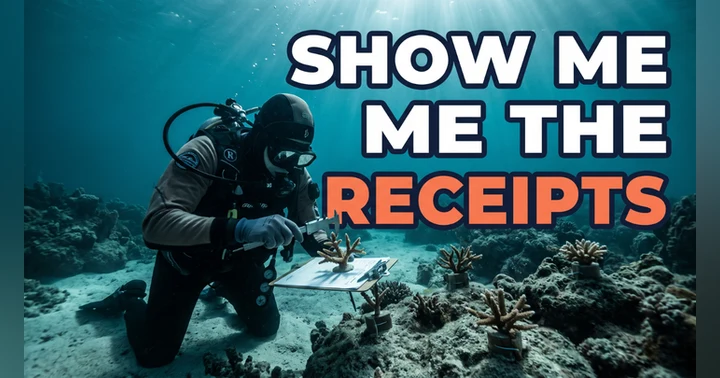
Show Me the Receipts: Why I.CARE Monitors Every Coral It Plants


 Apple Podcasts
 Spotify
 YouTube
 Amazon Music
 PocketCasts
 Overcast
 Most coral restoration groups check on a sample of what they've planted, often around 20 to 30 percent, and report that sample as if it represents everything in the water. I.CARE checks on all of it. Every single coral outplant gets monitored at one week, one month, 90 days, then one, two, and three years, with no substitute and nothing left unaccounted for. That rule was built in by co-founders Mike Goldberg and Dr. Kylie Smith before I.CARE ever planted its first coral, and Mike frames it as a matter of fiduciary duty, the same obligation he'd expect from anyone handling someone else's money, whether that's a $2 add-on on a Key Dives trip or a large donation.
The number that discipline actually produces is a 47 percent one-year survival rate, tracked across all 17 coral species I.CARE works with. Mike considers it strong, and few practitioners in the field can even produce a comparable number, since it depends on tracking everything rather than a flattering sample. I.CARE didn't pause that reporting during the 2023 global bleaching event either; it kept publishing survival numbers straight through it. That matters because coral restoration, as a field, mostly doesn't do this. A 2020 peer-reviewed systematic review in PLOS ONE found that roughly 60 percent of restoration projects worldwide were monitored for less than 18 months, and that 45 percent of projects didn't even measure the ecological goals they'd originally set out to hit. A second peer-reviewed paper, published in Conservation Letters in September 2025, goes further, arguing that funding for marine restoration is currently outpacing the underlying science and framing under-monitored projects as a real greenwashing risk to the field.
None of this is about naming or shaming any specific organization; both papers describe a structural, field-wide problem. It also lands at a genuinely uncertain moment for funding: Florida's 2023 executive order promised to restore a quarter of the state's reef tract by 2050, but as of the 2026–2027 budget cycle, neither the state House nor Senate proposal funded the program's second phase, leaving over a dozen research groups and nonprofits needing to shuffle funding. That's exactly why I.CARE's visitor-funded model and its radical transparency about outcomes, good and bad, matter more right now than they would in a world of stable government funding. This is episode four of a four-part week built around Andrew's interview with Mike Goldberg, co-founder of I.CARE, airing Friday.
Takeaways:
- Checking on 100 percent of what's planted, instead of a sample, is unusual in this field, and it's the specific practice Mike credits with earning donor trust.
- I.CARE didn't stop reporting its numbers during a bad year (the 2023 bleaching event). That's arguably the real test of whether transparency is a genuine practice or just a marketing line.
- Field-wide, peer-reviewed research backs up how unusual this actually is: most coral restoration projects worldwide get monitored for a year or less, and close to half don't even measure the goals they originally set out to hit, a gap recent research frames as a real greenwashing risk for the field.
- A spot check of a fraction of what's actually in the water can't tell you the truth about the rest of it, and representing it as if it can misrepresents the real outcome to the people funding the work.
- State and federal funding for Florida's own coral restoration effort is genuinely uncertain right now, documented independently of Mike's interview, which is exactly the kind of risk a visitor-funded, trust-based model is built to survive.
website: https://icareaboutcoral.org/
0:00 We've been talking a lot about coral restoration this week. If you haven't listened to the other episodes before you wanna listen to this one, you might wanna go listen to the other ones. We talked specifically about an organization called ICARE, ICAREaboutcoral.org is the website. Now, this is a coral restoration organization that's takes fragments of a coral and rebuilds them in a nursery and then puts them out into the ocean. We talked a lot about their method yesterday in yesterday's episode, but today we're gonna be talking about why they monitor 100% of their specimens that they put out into the ocean. That's not normal. Most coral restoration groups check on a sample of what they planted, maybe 20%. But ICARE checks on all of it, like 100%.
0:40 That single decision made before ICARE, was planted its first coral, and is the reason why people keep giving money. It matters more right now than ever because the funding ICARE and groups like that depend on is generally at risk. So we're gonna talk about that on today's episode of the How to Protect the Ocean podcast. We're getting into why monitoring 100% is a good case scenario for people who fund this type of stuff. Now, as we said yesterday, the funding model for ICARE mainly is about divers who go at the dive shop at Key Dive, and they spend an extra two bucks for every $100 dive that they do. And so that funds the coral restoration efforts, or part of the coral restoration efforts that ICARE does. So Mike and Dr. Kylie Smith, who is the co-founder.
1:23 They're both are the co-founders. But from the very beginning, before ICARE ever put its first coral in the water, Mike and Kylie built in a rule that shaped everything else about how the organization will run. Every single coral outplant that gets checked at fixed intervals, one week, one month, 90 days, then one, two, and three years, with no substitute and no coral left unaccounted for. This wasn't necessarily like the standard practice elsewhere in the industry, at least not in the Keys at that time. So like others were like doing 20%, maybe 30%. And that's, like to be honest, from a scientific perspective, you wanna look at a portion of it. To do all of them, if you're planting like, thousands of oak plants, well then maybe you're not gonna be able to do it.
2:06 But they decided to do 100%, which I think is admirable. I think is really, really admirable. ' Cause the alternative approach, you know, checking a random sample of oak plants and reporting that sample as if they're representative of everything else planted, was like the norm Mike said he saw around him in the field. He rejected it on the grounds that a spot check of a fifth of what's actually in the water can't tell you the truth about what's happening in the other four-fifths. And representing it as if it could misrepresent the real outcome of the people funding the work. So his hero of the story wasn't the reef. His hero of the story was the people who were funding the work. It's the funders. He had this mission to ensure that they knew what was happening and they knew the restoration of the coral, whether it was good or not.
2:52 Whether it worked out or not. 'Cause let's be honest, when you're restoring something, it's not always going to be 100%. You're not always going to be 100% successful. You are working in coral reefs that have already seen damage. They've seen disease, they've seen climate change impacts like increasing heat of the surface of the sea and even the bottom of the sea, like everywhere. Everything is bad. Ocean acidification happening. We're seeing more fresh water in the water in general, sea level rise, all that kind of stuff. It is crazy. It is nuts to see what happens. So you're never gonna get a full 100% success rate, especially with fragging corals. It's not gonna happen. But monitoring that mattered. It mattered enough to build an entire organization around it. Like Mike frames full monitoring as a matter of fiduciary duty, the same obligation he'd expect from anyone handling someone else's money.
3:35 Whether it's $2 dive add-on or a large donation. If donors and dive customers are funding actual coral survival, not just the act of planting the coral, but the group owes them the real number rather than the flattering estimate. If I'm paying $2, I don't wanna just know that you're doing the work. I wanna know if it's successful. Because there's nothing worse than saying, "Yeah, I gave two bucks. I kinda had to when I did the dive. It was for the fragments." And somebody's like, "Well, does it work?" I don't know. I mean, I see reefs out there, but it's not like… It's just, it's not perfect. It's not wall-to-wall as it wouldn't be because these are coral fragments. So like, you wanna know. It's like, "Oh, actually, yeah. They send me a report. I've spent two bucks, they send me a report like every month or every year, whatever they do, and I get to see how successful their work is, and I've only paid two bucks." But it makes me want to pay more because I know they've invested in it because they share the data.
4:23 They survey, they monitor 100% of the corals that are planted. Like, that's crazy. So for Mike, like skipping full monitoring would have let, like, ICARE quietly avoid ever reporting a bad outcome. There's biases in sampling. We know this as science. We have to remove the bias. So when you technically say you have 100 corals, and you're like, "I'm gonna take a representation of 25. I'm gonna monitor 25 of those corals." And it could be across species or it could be like, for each species. So say you have one species and you're gonna do 25 of them out of 100. Now, you're not gonna do it in all the same area, 'cause if you do it all in the same area and that's a successful area, you're gonna say, " We know we've had 75% success rate." But if I go diving and I'm a funder and I go diving and I don't go in that area, I go in the other area, I'm like, "Well, hold on a second.
5:06 I see, like, these corals, they're dying. Like, these are little frags and they're dying. Why? Like, 'cause they just look like pieces of rock that are cemented on with epoxy. Like, that's you guys are doing this, but you told me that there was, like, a 75% success rate." Well, that's because this one area that we surveyed, that was the rate. Now, normally what you would do is you take the 25, but you would go all over the place, like your entire study area, so that you can see how they're all doing in your entire envelope of your study site. So you can do that from a 25% rule, right? 25 of 100. But if you did all 100 and you started to look at it and you said, "Hey, yeah, you know what? We actually have a 47% survival rate." That's what they're producing 47%. The tracked across, like, 17 coral species ICARE works with.
5:48 You know, a figure Mike considers is strong, and one he notes few practitioners in the field can even produce, since it depends on tracking everything rather than a sample. So what he's basically alluding to is that some organizations will say, "We have a higher success rate," but they're not looking at everything. So they're kinda hiding some of the failure. And look, it's science. You have failure. This is why having somebody like Dr. Kylie Smith as the co-founder and the scientist on the board, they kinda look at that and say, "Look, we gotta take the bias out." It's not just a matter of, like, we're taking funding in. We have a duty to that funder to say, "Yes, this is working," or, "Hey, we haven't had, like, the success that other people have, but we're monitoring everything." We're not taking sub-samples. And you can even say, if I took a sub-sample over on the left side here, I can say that 90% of the coral survived.
6:31 But if I look over on the right side and I just take those, I can say that, like, 25% survived, just in the way that they were doing it, and we're looking at why that is. But if I said, "Okay, 47% survived," it'd be like, "Oh, that's kinda low." But then, like, when you look across, we looked at everything, and here are some of the reasons. The conditions over on the right side had maybe a little more nutrient runoff or more algae or something like that, and then the ones on the left side didn't. But we're seeing an overall 47% success rate, which is great. And so I think that's what's missing from a lot of these reports. A lot of these, Like, I was at our liquor store, LCBO. And they will ask for donations. Like, you pay for your booze, and then they say, "Oh, hey, do you wanna add $2 onto the SickKids Hospital?" Well, yeah, sure.
7:11 No problem. It's two bucks. I can do it. Now, I have no idea how this money is being used. I can probably go on a site, they can probably give it to me, and I can see how it's being used. But right from then and there, I don't know how it's being used. But if I go to a dive shop for ICARE, like, Key Dive, which is one of ICARE's dive shops that funds it, and I say, "Hey, I'm giving you this two bucks. I don't mind giving it to you, 'cause it's part of the dive package, but what's it going to? Can you show me?" Like, Oh, you're doing coral restoration. That's kinda cool. Like, can you take me through it?" And, like, Mike will take you through it. His staff will take you through it, and they'll talk about it, and they'll talk about the monitoring and everything like that. That is powerful. That is transparency at its core. That is science. That's conservation. And I guess like the real test of whether the transparency was genuine came during a 2023 global bleaching event which we covered in Monday's episode.
7:56 ICARE kept publishing its survival numbers straight through it rather than pausing reporting or going quiet until the conditions improve. So not every outplant survives, and ICARE doesn't treat it as a failure to explain away. Coral living on a real reef faces storms, disease, and heat regardless of how carefully it was planted. So some loss is simply like, to be honest, it's the honest cost of doing the work in the ocean rather than a lab. Now the more restoration that's done, the more frags are out there, probably the more survival that will happen, the more resilient it can get, the connection will be better, and that's great. But the payoff in Mike's own framing, so full transparency about outcomes good and bad, is what gives the donors and dive customers a reason to trust ICARE with more support over time because they can see their specific coral's actual fate rather than just like some marketing summary.
8:44 And I think again, that helps when you have a co-founder who is a scientist, a coral scientist. Now this is a real world example of exactly the kind of standardized universal metric tracking. That's what we need. That NOAA and the Coral Restoration Consortium's own monitoring guide recommends as the field standard. Except ICARE was doing it way before it was even a standard. Like this isn't just ICARE being unusually diligent for its own sake. Independent field-wide research shows monitoring like ICARE's is the exception, not the norm. So across coral restoration generally. The most comprehensive look at this is a 2020 systematic review in a open source journal called PLOS ONE. Which it analyzed coral restoration projects worldwide, and roughly 60% of the projects reviewed were monitored for less than 18 months total, and the median monitoring period across all of them was just 12 months.
9:34 Like nowhere near ICARE's built-in three-year check-in that they have. About 45% of the projects measured different metrics than the ecological goals that they had actually set going in, meaning like a large share of the field can't clearly show whether it achieved what it set out to do, and this could be just in project planning. Not to say that the people who are in charge of this did so 'cause it skewed the results. All I'm saying is it's good to have a plan and stick to it. Like how survival itself gets measured and reported varies so much from project to project that outcomes are often not meaningfully compared across the field, and cost reporting is almost entirely absent industry-wide. So funders usually have no independent way to judge value for money.
10:14 Now, in the review's own language, it found little to no scientific input or detailed monitoring common enough across surveyed projects to describe it as a pattern and not an exception. Now, a second paper and more pointed that is worth citing in this is from in Conservation Letters in September 2025, Algier and Griffith. It focuses on artificial reefs and coral restoration specifically and argues that funding for marine restoration is currently outpacing the underlying science, producing a wave of hastily planned project that risk accelerating harm to the very reefs they meant to help. The paper frames this directly as greenwashing risk, meaning projects that read as conservation success stories without the monitoring behind them to support that claim.
10:59 And it calls for real oversight and accountability standards in the field rather than good intentions alone. It's a matter of, like, what is truthful? How can we make sure that we can compare the metrics from one coral restoration site to the next? It's not a competition between the two sites. It's what's working and what's not. And that what do you learn from that? You learn how to do something better. You learn how every each and every site could be unique. One country site is not gonna be the same as the next country site because they have different conditions, different species, all that kind of stuff. But when you can do that worldwide and put together, oh, now you're talking. Now you're talking about a large database where you can share information. I can see conferences being put in to talk about coral restoration.
11:42 And to increase knowledge and technology transfer and sharing of information to increase the success rate. None of this is about naming or blaming any specific group. It's field-wide, peer-reviewed research describing a structural problem. Planting coral and photographing is easy. Checking in on it years afterward and reporting the losses, honestly, like, alongside the wins is hard. That's exactly the gap that ICARE chooses to close from day one, and I thought that was really cool. The same gap both of these papers say most of the field hasn't done. Again, I don't want to, like, name and shame any other organization. What I want to like highlight here is that the data matters, the metrics matter, and having uniform or standardized metrics is so important to the science and to the legitimacy of the conservation success.
12:31 We know it's not gonna be completely successful. Anybody in their right mind knows it's not gonna be completely successful. But what we have to do is we have to understand that we can learn from each other, and we can increase the close. But if we are working separately, it's very difficult. This is like what's the beauty of science. Actually, sometimes in science there's competition, there's silos. But when business practitioners take it and you see one person doing one way and another person doing another way, another person-- They don't have to follow scientific standards, to be honest. They're just doing this as a way to increase their business, and they're gonna do what they need to do. And some people might take certain standardizations. They might talk to one scientist who says that, or they might talk to another scientist, or may not talk to anybody and just say, "Hey, I'm just gonna look at these types of measurements." I don't even know what the measurements are, to be honest, not offhand.
13:13 But it would be great to have these standard metrics so that you can compare, not to say one is better than the other, but how we can help each other to ensure that these reefs are growing. It is not a competition. It is survival of coral reefs as we know it. That's what's at stake here. And, like, looking at this, it costs a lot of money to do this type of monitoring. It's not easy. It takes a lot of time and a lot of effort, and that costs money 'cause you need resources to do it. And Mike describes, like, a generally uncertain funding environment at both the federal and Florida state levels. Remember, he's in Florida. Tied to an upcoming change in state administration, saying that the current administration has been incredibly supportive, but that funding has already been cut for 2028, calling the situation very uncomfortable for everyone in Florida involved in restoration work.
13:57 And it tracks, 'cause with real current reporting, Florida's 2023 executive order promised to restore 25% of the state's roughly 350-mile reef track by 2050. The state allocated 28.5 million for the program's initial phase running 2023 to 2026, with an original plan for roughly 25 million a year in follow-on funding. As of March 2026, neither the Florida's House nor the Senate budget proposal for the 2026 and 2027 fiscal year included continued funding for the program's second phase, leaving more than a dozen research organizations, universities, aquariums, and nonprofits needing to shuffle funding or risk losing staff. So, like, where's the funding?
14:38 Where is it? Why are they not understanding that this is important to the economy of the Florida in general? This is exactly why ICARE is diversified, like mostly visitor funding model, and its radical transparency about results matter more than they would in a world of stable government funding. A funding source Mike doesn't control just got less certain. A funding source built on trust and receipts is the one he spent years building on purpose. That's where we're looking at here. We're looking at making sure funding is available. Through constant source funding where things are not going up and down. He gets constant visits from divers. They pay him on a regular basis. The Keys are one of the best places to dive in the US.
15:19 And so he's gonna get that. $2 extra on a $100 dive is nothing. That is guaranteed as long as people keep coming, and if he continues to put out the monitoring, people are gonna keep coming, and that is important. That is what's needed. And I think that's like super important to how things are going. So as we look at what this framing of this is, is the fact that 100% of the animals or the outcrops that are being planted for corals are monitored, gives the donors and individual divers that pay money for these corals to be restored, gives them an idea of how successful this is done. And knowing that the industry of coral restoration is not working off the same standardized effects is troublesome. Not for the competition part, like of one area doing it better than the other, but for the advancement of restoration science for coral reefs.
16:05 It is up to us to make sure that the coral reefs are restored. It's not up to anybody else. The people is where it goes. And unfortunately, the people used to have power in government, where government would fund this kind of stuff that's important to not only the economy, but also the safety of the coastline. And that seems like that, with a lot of politicians, whatever side of the aisle you're on, is just kinda goes out the window these days. Nobody's talking about climate change, or not many people, and not many people are acting fast enough to do it in terms of government. And so, we need to do it ourselves. And sometimes businesses are the best way to go forward because there's constant stream of revenue that's coming in, and that's an important aspect. That is a very important aspect. So, like, if you find a way to donate through, like, purchasing products, like if you have to spend an extra two bucks or anything, I'd love to know if you would do that kind of stuff.
16:51 Let me know. Hit me up. If you're on Spotify, leave me a comment. If you are listening to this on your favorite podcast app and you wanna get in touch, you can do so by going to the show notes. You can DM me on Instagram, TikTok, Facebook. I'm on all those platforms. I'd love to hear from you. So yeah, think about that. Love to hear from you. That's the end of the episode. Thank you so much for watching this episode of the How to Protect the Ocean podcast. I am your host, Andrew Lewin. Have a great day. We'll talk to you next time, and happy conservation.