The Nursery Hack That Pays for Itself
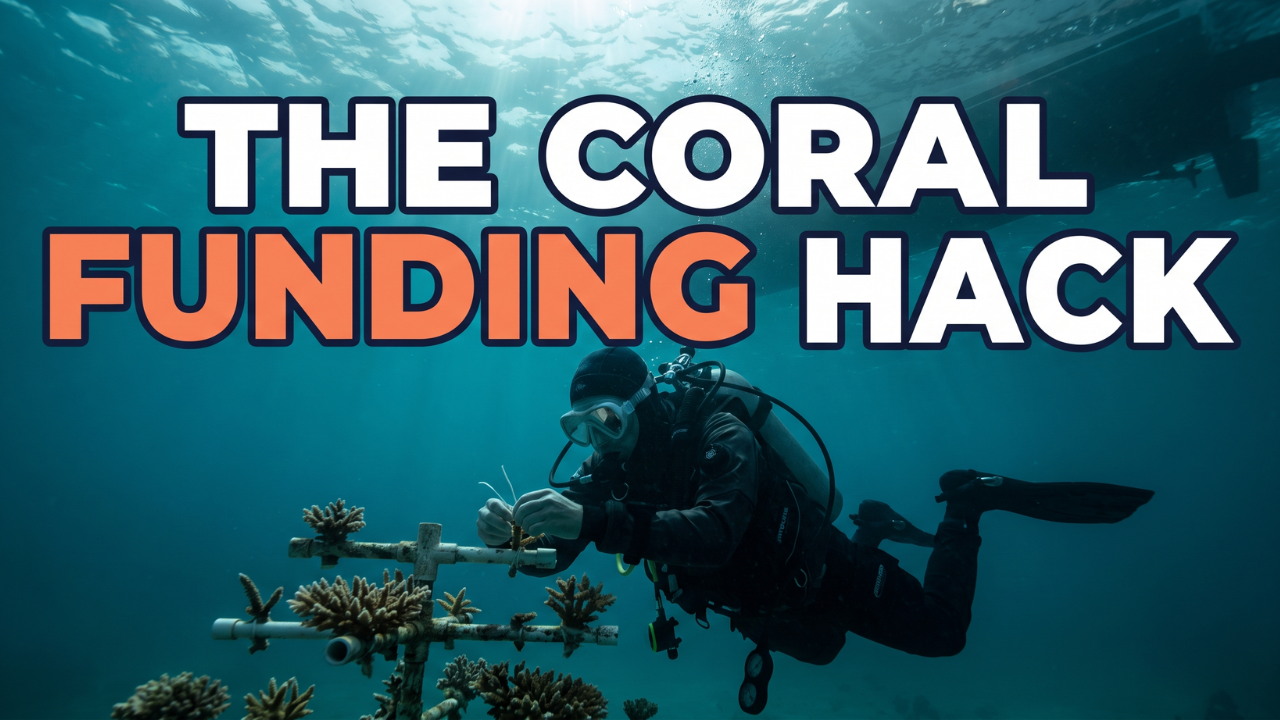
Coral nurseries need constant maintenance. That maintenance is expensive, and it never really stops. When Mike Goldberg, co-founder of the Florida Keys coral restoration nonprofit I.CARE, ran into that problem, his answer wasn't to hire more staff. It was to let paying customers do the work for the fun of it, and to build a funding model so small that in years of collecting it, close to nobody has ever complained.
None of that makes sense, though, until you understand what coral actually is.
What Coral Actually Is
A lot of people assume coral is a plant, or even a rock. It's an animal. It sits on a rock and barely moves, so it can look plantlike, but what looks like a single coral "head" is really a colony of thousands, sometimes millions, of individual tiny animals called polyps. Each polyp is a small sac-like body with a mouth ringed by tentacles, and neighboring polyps in a colony are physically connected by shared living tissue. Each one secretes calcium carbonate underneath itself, and it's the buildup of that limestone-like skeleton, generation after generation of polyps building on top of what came before, that forms the actual physical structure of a reef.
Most reef-building corals also host a second organism living inside their own tissue: a photosynthetic algae called zooxanthellae. It's a genuine partnership. The coral gives the algae a protected home plus carbon dioxide and waste compounds the algae need, and the algae photosynthesize and hand back the majority of the coral's food energy, plus its color. When a coral is badly stressed, heat being the main trigger, it expels the algae, exposing clear tissue over a white limestone skeleton. That's what bleaching actually looks like, and why a bleached coral isn't automatically dead: it's lost its main food source and its color, so it's vulnerable, but the animal itself may still be alive underneath. If conditions improve, the zooxanthellae can come back and the coral can recover. If the stress lasts too long, it won't.
Two Completely Different Ways to Make More Coral
Corals reproduce two completely different ways, and I.CARE's entire nursery operation is built on deliberately harnessing one of them.
The first is asexual reproduction, or fragmentation, and it's what coral gardening actually is. In nature, storms and wave action routinely break pieces off a coral colony. If a broken fragment lands somewhere stable, it can reattach and keep growing into a brand-new, fully independent colony, a genetic clone of the parent. Restoration practitioners deliberately recreate this: they cut a small fragment, typically about 5 to 10% of a healthy donor coral, which is why it doesn't harm the parent colony. A coral colony is made up of thousands of genetically identical polyps, so losing a small piece is a bit like taking a cutting from a large, healthy plant. That fragment gets mounted onto a substrate, a cement or ceramic plug, or tied onto a nursery line, usually fixed in place with a non-toxic, two-part marine epoxy, and it grows out before eventually being outplanted onto the reef. Fragments from the same original parent colony, placed close enough together, will even recognize each other as genetically identical and physically fuse into one larger, seamless colony rather than staying as separate pieces.
The second path is sexual reproduction, and it's the source of real genetic diversity, not clones. About 85% of reef-building coral species are broadcast spawners: entire colonies release eggs and sperm into the water at the same time, in a synchronized event cued by water temperature, the lunar cycle, and time of night, often just once a year. A fertilized egg develops into a free-swimming larva called a planula, which drifts, eventually settles somewhere, and starts a brand-new, genetically unique colony. The remaining species brood, fertilizing internally and releasing more developed larvae directly. This is the biological basis for larval propagation, the "coral IVF" technique covered earlier this week, a completely different restoration method from the fragment-based nursery work I.CARE relies on day to day.
Combine the two and you get something powerful: fragmenting genetic clones increases coverage fast, and as those colonies mature and reach sexual maturity, they add genuinely new, genetically diverse offspring back into the reef, not just more copies of themselves.
The Nursery Hack: Turning Paying Customers Into Restoration Crews
Offshore nursery maintenance, the day-to-day work of caring for growing coral fragments, is the most labor-intensive part of coral restoration, and it never stops. I.CARE's fix for that wasn't a science idea. It was a business idea.
I.CARE is installing nine offshore "pop-up" nurseries, one per restoration site, rather than running everything out of one central location. The concept originated with Ken Nedimyer, a Florida Keys coral restoration pioneer who piloted it in a couple of locations; Mike describes taking it to another level, giving every restoration site its own dedicated nursery. That matters because the further a restoration site is from a central headquarters, the more risk there is of a fragment not surviving the trip and the outplant. With pop-up nurseries, coral and sponges are nursed just feet away from where they'll actually be outplanted, so they never have to be removed from the water, boated somewhere else, and put back in, a stressor that's especially damaging for sponges. The nurseries are officially semi-temporary: regulatory approval is granted for five years to start, extendable, with the explicit long-term goal of not needing a nursery there at all once the reef stabilizes.
The paying-customer part is where the funding hack comes in. I.CARE's dive boats and partner boats in the Keys take paying scuba diving customers out daily anyway. Those divers can choose to dive the reef for fun, or make a left turn into the nursery and do restoration work instead. It's entirely their choice. On top of that, I.CARE's per-dive fee has been running for years, since before the very first coral was even planted: a $2 add-on for every $100 dive, started with two shops and now running across three. Mike says nobody has ever objected to it. He also personally donates 2% of all of his own dive revenue on top of that $2, by his own account a meaningful chunk of his own retirement savings, a way of signaling to customers that he has real skin in the game. Local divers who participate in I.CARE's restoration programs pay an additional membership-style fee on top, since, as Mike frames it, the organization has a fiduciary responsibility to everyone participating at any level, whether that's a $2 add-on or a large donation.
A Business Case Tied Directly to Conservation
Mike's dive shop, Key Dives, won first place in every category Scuba Diving Magazine judged for the U.S. and Canada region in the magazine's 2026 Readers Choice Awards, Best Overall, Best Quality of Staff, Best Quality of Dive Boats, and Best Attention to Safety, adding to a run that's made Key Dives a repeat first-place winner over the years. Mike's own framing ties that recognition directly back to the restoration work: the more people who come dive with him, the more he gets to donate.
That's the real shape of I.CARE's funding model. It isn't one big ask. It's several small, mandatory, low-friction fees layered together, a $2 dive add-on, Mike's personal 2%, a local-diver fee, each individually small enough that nobody pushes back, adding up to real, sustained funding for work that has to happen constantly.
This is episode three of a four-part week built around Andrew's full interview with Mike Goldberg, airing Friday. Friday's episode digs into exactly how that $2 add-on adds up over the years, and whether Mike's ever had a customer actually say no to it.
Takeaways:
- Cutting a fragment off a healthy coral doesn't hurt it, because a coral colony is really thousands of genetically identical animals, not a single organism the way a fish or a mammal is.
- Coral restoration nurseries are deliberately organized versions of something that already happens naturally when a storm breaks coral apart. The innovation is doing it on purpose, at scale, with a plan for where each fragment ends up.
- The most labor-intensive part of coral restoration, offshore nursery maintenance, got solved with a business idea, not a science one: make it something paying customers want to do anyway.
- I.CARE's funding model isn't one big ask. It's several small, mandatory, low-friction fees layered together, each small enough that nobody has pushed back.
- A conservation program can double as a competitive business advantage. Mike ties Key Dives' award recognition and its restoration work together as the same story.

CEO


