The Nursery Hack That Pays for Itself


 Apple Podcasts
 Spotify
 YouTube
 Amazon Music
 PocketCasts
 Overcast
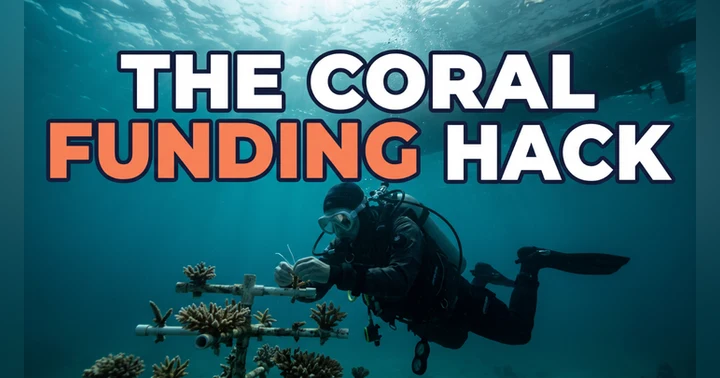
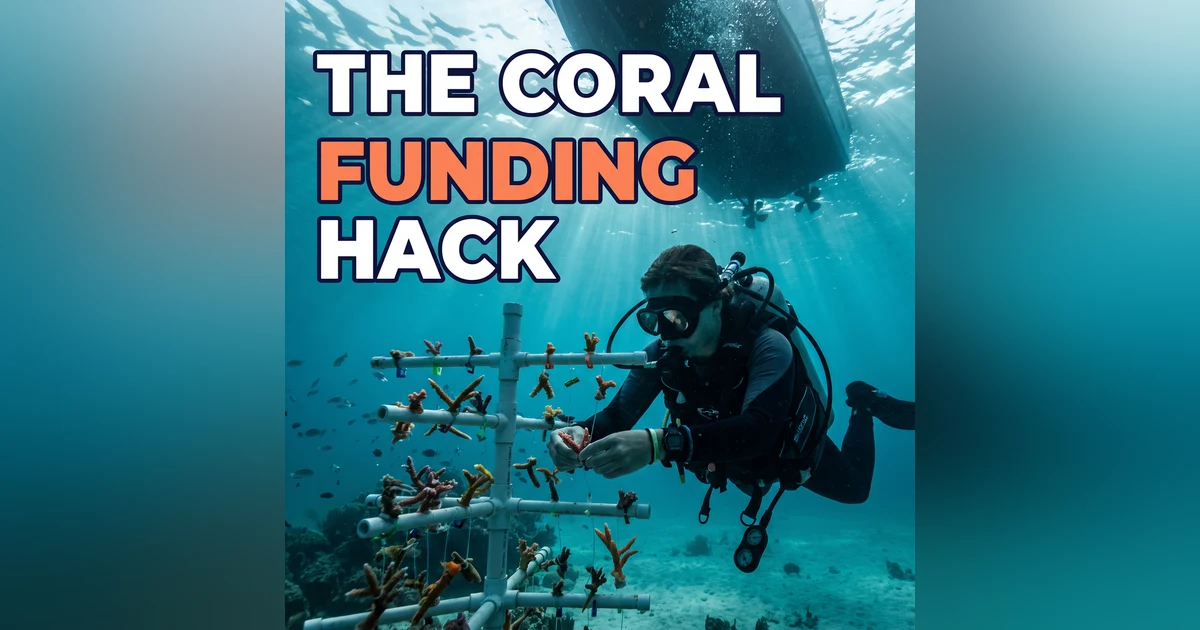
 Coral nurseries need constant maintenance, and that maintenance is expensive and relentless. When Andrew talked to Mike Goldberg, co-founder of I.CARE, his answer wasn't to hire more staff. It was to let paying customers do it for the fun of it. Mike owns a dive shop in the Florida Keys, so the paying customers are scuba divers, and over the years he's built a funding model so small that nobody has ever really complained about it.
None of that makes sense until you understand what coral actually is. It's an animal, not a plant or a rock: what looks like one coral "head" is really a colony of thousands, sometimes millions, of tiny individual animals called polyps, each one secreting a bit of limestone-like skeleton that builds up, generation after generation, into the physical structure of a reef. Most reef-building corals also host a photosynthetic algae, zooxanthellae, living in their own tissue, a genuine partnership that gives coral its color and most of its food energy, and whose loss under heat stress is what "bleaching" actually is. Corals also make more of themselves two completely different ways: asexual fragmentation, where a broken piece reattaches and grows into a genetic clone, which is exactly what coral gardening recreates on purpose, and sexual reproduction, where colonies release eggs and sperm in a synchronized event that produces genuinely new, genetically diverse offspring.
I.CARE's whole nursery operation is built on deliberately harnessing fragmentation, and this episode walks through how that biology turns into a funding model. The pop-up nursery concept, originated by Florida Keys restoration pioneer Ken Nedimyer, lets I.CARE keep coral and sponges just feet from where they'll actually be outplanted instead of stressfully hauling them from one central nursery. And the money behind it comes from small, mandatory, low-friction fees layered together: a $2 add-on on every $100 dive across three dive shops, Mike personally donating 2% of his own dive revenue on top of that, and a local-diver membership fee, all stacked so no single piece feels like a big ask. This is episode three of a four-part week built around Andrew's interview with Mike Goldberg, airing Friday.
Takeaways:
- Cutting a fragment off a healthy coral doesn't hurt it, because a coral colony is really thousands of genetically identical animals, not a single organism the way a fish or a mammal is.
- Coral restoration nurseries are deliberately organized versions of something that already happens naturally when a storm breaks coral apart. The innovation is doing it on purpose, at scale, with a plan for where each fragment ends up.
- The most labor-intensive part of coral restoration, offshore nursery maintenance, got solved with a business idea, not a science one: make it something paying customers want to do anyway.
- I.CARE's funding model isn't one big ask. It's several small, mandatory, low-friction fees layered together, each small enough that nobody has pushed back.
- A conservation program can double as a competitive business advantage. Mike ties Key Dives' award recognition and its restoration work together as the same story.
Website: https://icareaboutcoral.org/
Support Independent Podcasts: https://www.speakupforblue.com/patreon
Need help with your ocean non-profit, company, or project? Get the help you need with Pisces Oceans Inc.: https://www.piscesoceans.ca
Connect with Speak Up For Blue
Website: https://bit.ly/3fOF3Wf
Instagram: https://bit.ly/3rIaJSG
TikTok: https://www.tiktok.com/@speakupforblue
Twitter: https://bit.ly/3rHZxpc
YouTube: www.speakupforblue.com/youtube
0:00 This week we are focusing on coral reefs and coral reef restoration. And when you have coral reef restoration, you have coral nurseries. And coral nurseries need constant maintenance. They need constant attention. That maintenance is super expensive and is relentless. And when I talked to Mike Goldberg, which you're gonna hear the interview on Friday, his answer wasn't just to hire more staff. It was to let paying customers do it for the fun of it. Now, he owns a dive shop, so the paying customers are scuba divers, and he wants to build a funding model so small that in years of collecting it, not one person has ever really complained. But none of that makes sense until you understand what coral actually is and why cutting a piece off doesn't kill it.
0:43 We're gonna find out all about that on today's episode of the How to Protect the Ocean podcast. If you like to listen to this kind of stuff, where we're like talking about coral reef restoration, coral reef health, ocean news, ocean updates, stories about the ocean, this is the podcast for you. So hit that follow button right now if you haven't, and you've been listening for a while, don't worry, I'm not mad. But I'd love for you to hit that follow button so you don't miss any of the episodes, Monday to Friday. So this week it's all about corals. If you've missed Monday's and Tuesday's episode, you can go back and watch or listen to those. And if you wanna stay more in tuned, just hit that follow button. You'll get it all in your podcast feed. So this is what is fun. All right. Before we get into the whole restoration and how the funding model works, let's talk about what coral actually is.
1:24 Because a lot of people think coral's a plant, but it's an animal, not a plant or a rock, it's an animal. It sits on a rock. It kinda looks like a plant in some ways because it doesn't move very much, and sometimes it sways in the water, but it's an animal, right? It's a colony of animals. And what looks like one coral head is actually just a colony of thousands, sometimes even millions, of individual tiny animals called polyps. And each polyp has a small sac-like body with a mouth ringed by tentacles. And neighboring polyps in a colony are physically connected to a shared living tissue. So each polyp secretes calcium carbonate underneath itself, so right underneath. And it's the buildup of that limestone-like skeleton, generation after generation of polyps building on top of what came before, that forms the physical structure of a reef.
2:13 Now, most reef-building corals also host a second organism living inside their own tissue. It's a photosynthetic algae called zooxanthellae. It's a genuine partnership. The coral gives the algae a protected home, plus carbon dioxide and waste compounds the algae needs, and the algae photosynthesize, and hand back the majority of the coral's food energy, plus its color, the beautiful, beautiful colors of the reef. Now, when a coral is badly stressed, heat being the main trigger, it expels the algae, exposing clear tissue over a white limestone skeleton is what bleaching actually looks like, and why a bleached coral isn't automatically dead. It's lost its main food source and its color, so it's vulnerable, but the animal itself may still be alive underneath.
2:59 If the conditions that cause the bleaching subside, then the zooxanthellae will come back, or they'll get new zoo-xant-xanthellae in their system. So the algae will come back, it'll go into the corals, the corals will revitalize, and they'll be saved. But if it's a long period of time, they will go, it won't be good. Now, corals reproduce two completely different ways, and ICARE's whole nursery, ICARE about the coral, like, that's the one we're talking about with Michael, the whole nursery operation is built on deliberately harnessing one of them. That's asexual reproduction or fragmentation. And that is where coral gardening actually is. So in nature, storms and wave action routinely break pieces off of coral colony. If a broken fragment lands somewhere stable, it can reattach and keep growing into a brand-new, fully independent colony.
3:44 A genetic clone, per se, of the parent, so the genetic makeup is exactly the same. Now, restoration practitioners deliberately recreate this. They cut a small fragment, typically about 5 to 10% of a healthy donor coral, so like an adult coral, that's what we call, like, the parent coral, the colony, which is why it doesn't harm the parent, so you don't take off too much. The colony is made up of thousands of genetically identical polyps, so losing a small piece is a bit like taking a cutting from a large, healthy plant. That fragment is then mounted onto a substrate, a cement or ceramic plug, or tied onto a nursery line and it'll grow out before eventually being outplanted onto the reef. So usually fixed into place with a non-toxic two-part marine epoxy.
4:27 So as it is cut, it's placed on this, like, ceramic tile or some kind of ceramic plug or cement tile. And then it has, like, a little of epoxy. It solidifies there, and then it grows from there. Now, fragments from the same original parent colony placed close enough to another, will recognize each other as genetically identical and physically fuse into a larger seamless colony. So rather than staying a separate pieces. This is likely exactly what Mike means later in the interview when he talks about it, when he describes his own brain coral fragments, fusing eight to 10 months after being out planted. So what he does is he actually takes these brain corals, and he puts them up into different spots on a rock, and they're probably separated by a few centimeters.
5:08 Then the corals will recognize each other, and the colonies will start to grow on top of the rock and actually fuse together to make one big colony, which is insane, right? It's insane. I just think it's such a cool way that these animals can survive, like the wave actions and storms that hit shallow reefs. As they break off, maybe sexual reproduction doesn't always happen, which we'll talk about in a sec, but as they break off, they can continue to grow and grow out and cover the substrate with corals, wall-to-wall corals, which is what we want. That's a healthy coral reef. Now, sexual reproduction is the other path, and it's the source of real genetic diversity, not clones. These are like the asexual is genetically identical, sexual is genetically different. About 85% of reef-building corals species are broadcast spawners.
5:51 So they release eggs and sperm into the water at the same time in a synchronized event cued by water temperature, the lunar cycle, and time of night, often just once a year, and it's a beautiful sight. Like, people have taken videos of it. People just love when it happens. Now, a fertilized egg, any kind of fertilized eggs develop into free-swimming larvae called planulae, which drift, eventually settle somewhere, and start a brand-new genetically unique colony. The remaining species brood, fertilizing internally and releasing some developed larvae directly. This is the biological basis for larval propagation, like coral IVF technique covered in Monday's episode that we did. It's a completely different way to restoration method from the fragment-based nursery work that we're gonna describe in a second.
6:35 What's nice though is, like, you have these two different ways. One is genetically identical, which doesn't help the diversity of the reef from a genetic standpoint, but allows the coverage to happen in case it's breaking off. But it's easier to fragment. IVF is something that I would imagine is fairly new over the last decade or so, and we're get- learning more and more about it, and there's, there are pop-up… We're gonna actually talk to somebody later on in the next couple of months about coral IVF and what that takes, what it is, and how difficult it is. Like, what are the challenges and how they've overcome some of those challenges. It's quite interesting to be able to cover, so looking forward to that interview. Now, what's interesting is when you combine the fragging and the sexual reproduction, you kinda come into, like, a really good success for replanting reefs. So if you think about it, if you frag reefs, so going back to that brain coral example that Mike talks about in the interview on Friday, you have these brain corals that come up, and they're up on the rocks, and then they start to fuse together, and there's, like, one big brain coral.
7:29 But then it's healthy, so it says, "Hey, you know what? We can sexually reproduce." So the eggs and the fertile, and the sperm go up into the air, it gets fertilized, and then the eggs kinda drop down wherever the larvae starts to drop down wherever they need to. Now, that's genetic diversity. So by fragmenting genetic clones, you start to increase the potential down the road as they become healthy and become adults, you get sexual maturity, you'll get sexual reproduction, you'll get genetically different offspring. Not just the clones itself. So that's pretty cool. Now what's interesting is like now you can do this on a local level. This is very difficult to do on a global level, as we talked about on Monday's episode. So you have to do it on a local level. And ICARE, which is the organization that we're gonna be talking to, like Mike Goldberg from ICARE.
8:12 He's the president. He's installing, like the organization with Dr. Kylie Smith, they're installing nine offshore pop-up nurseries, one per restoration site. So they have nine restoration sites. And what's happened here is that the restoration sites, if you have like one headquarter, it's more challenging to bring them from like the central headquarter where you have the nurseries, where you're growing these frags, and bring them out to all the different sites. It's more stressful. There's more of a risk of these things not doing well because there's a distance there. The further the restoration site is from the headquarter, the more risk there is of that fragment not surviving, not only the journey, but the outplant and everything like that, right? When you actually go plant it in the reef. So what Mike wanted to do is say, "Hey, you know what we're gonna do," and ICARE wants to do, is they want to install these pop-up sites.
8:56 And so the concept itself originated from Ken Nedimyer, who piloted it in a couple of locations. So Mike describes it in the interview. He's talking it like taking it to another level, giving every restoration site its own dedicated nursery, which I think is pretty cool, 'cause then you can start looking at what that restoration site had in the first place, and you're trying to recreate that site with the frags that were there. So you're not just making all the same restoration site. You're not making all the same corals. It could be different corals in different areas 'cause that's what made it possible, right? Natural selection. Now this problem solves like the offshore nursery maintenance is, is intense. It's intense and it's constant. It never stops. So ICARE's dive boats and partner boats in the Keys take paying customers, paying scuba diving customers out daily, like anyway.
9:38 They're out there just doing the work, like just scuba diving, 'cause like I'm a scuba diver. I would go and I would pay Mike's dive shop to be like, "Hey, take me out. I wanna go see these reefs in the Keys." The Florida Keys are beautiful. I know they're not what they used to be, but I wanna go out there, I wanna see what they've done. And then I would actually… They-- He would say, "Hey, do you wanna participate in planting some coral?" Like, "Yes. Absolutely I wanna do that. Show me how. I will do it, and this will be amazing." So he's like, "Okay, cool. But a part of your dive, whether you do it or not, you're gonna pay an extra $2. You're gonna pay an extra $2 'cause this goes into the fund that helps us grow out each of these corals." Now it's not enough to have a whole program for ICARE. But it adds to the pot of funding that allows… 'Cause like I said, it's very expensive and it's tireless.
10:21 You've gotta be on there all the time. The divers can choose whether they wanna dive the reef for fun or make a left turn into the nursery and say, "Hey, Can we do restoration work instead?" You know, it's their choice. The financial logic is great. Like, you don't have to pay as a group every time you go out and do these reefs. Everybody's paying because everybody benefits from a healthy reef. Everybody benefits from a restored reef. And the more you restore, the more resilient that reef can get to all the other factors that are affecting it, climate change, nutrient loading, coastal development, all that kind of stuff. Now, coral and sponges are nursed just feet away, like from where they're actually gonna be outplanted because of these pop-up nurseries. So they never have to be removed from the water, boated somewhere else and put back in.
11:05 Like a stressor, like especially damaging for sponges if you take it out of the water. So they're actually in there. Like, they're actually in the site. They're in the ocean where they are, which I think is pretty cool. Now, they're semi-temporary. They need regulatory approval is granted, you know, for five years to start, and they're extendable of course with the explicit long-term goal of not needing a nursery, there once the reef stabilizes. So the goal is to build it up so much that they don't need it after. I think that's pretty cool. And like ICARE's per dive fee has been running for years, and since before the very first coral was even planted, a $2 add-on for every $100 dive started with two shops and now running across three shops. Nobody has ever objected to the $2, nobody.
11:47 'Cause it's minimal and you're a diver, you care about the ocean. That's what's the best part of it is. You can say, "I-- not only did I dive, but I contributed to this happening." Now, Mike personally donates 2% of all of his own dive revenue on top of the $2 that everybody pays per dive, per hundred dollar dive, which he uses deliberately to signal to customers that he has skin in the game. He's candid about this being a meaningful amount of his own retirement savings. He puts this in because he cares. It's not just about business to him. It's not just about continuing his business. This is bigger than that. He wants to restore this reef. He wants the next generation of divers, not only divers, but people, to benefit from the reef. So local divers that participate in ICARE's coral law plans pay an additional dollar as a kind of, like, user fee, not free participation, which is kinda cool.
12:37 Like ICARE, you know, has a fiduciary responsibility to everyone that's a participant at any level, whether it's $2 or a large donation. There is a thing that he does to make sure that everybody knows what's happening with the reef, and we're gonna talk about that in tomorrow's episode. We're gonna dive into that a little bit more. Now, one of the thing that Mike kinda bragged about and he's gonna brag about, which I think is kinda cool, is he says that The Key Dives, his, dive shop, was voted number one in North America across all seven categories in Scuba Diving's magazine's reader poll for 2025, and he expects hopefully to get the same result in 2026. It's gonna be announced in the first week of September, which is this week. I believe it'll be this week when you're hearing this.
13:18 So I think that's kinda cool to see that people are enjoying this because he cares. He cares about the reef. It's not just about scuba diving to him. He cares about the reef, and I think that's important. And he, like an award for him for this is it's like tying a business case directly back to conversation. Like, the more people that come here, the more he gets to donate. 2% of his funds go towards the reef. So it's bigger than just diving. It's bigger than just a business. This is a guy who has a business in the Keys. He cares about the Keys, and he cares about the reef, and he wants to see the reef, wall-to-wall reef again. So like when you look at this episode, what we cover is like cutting a fragment off a healthy coral, it doesn't hurt it because it could become a coral colony.
13:59 And it really is thousands of genetically identical animals, not a single organism, like the way a fish or a mammal is. Coral restoration nurseries are really just deliberately organized versions of something that already happens naturally when a storm breaks a coral apart. So the innovation is doing it on purpose, at scale, with a plan for each fragment that it ends up. That ends up being a coral. And like the most labor-intensive part of coral restoration is offshore nursery maintenance. He's got that solved, like, with a business idea, not a science one, making something paying customers want to do anyway. And the funding model for Icare isn't a big ask. It's very small, mandatory, low-friction fees layered together. And then it also, Mike puts on 2% as well to say, "Hey, look, you're putting in $2, I'm putting in 2% of my revenue." So a conservation program can double as a competitive business advantage.
14:46 Key Dives' award recognition and its restoration work are, in Mike's own framing, the same story. It's not just about diving, it's about taking care of the reef. I'm gonna ask Mike to walk you through exactly how that $2 add-on like adds up over the years, and whether he's ever had a customer who actually says no to it. And you're gonna hear that on Friday. It's a great episode. I want you to hit that follow button to be able to listen to it because it's something that I just love when we have somebody like Mike on who's so dedicated. It's just amazing. I only have to start doing these interviews on Monday instead of Friday, like publishing on Monday, and then we can just debrief afterwards Tuesday to Friday. But we'll have to maybe change that up next week. Who knows? But anyway, that's it for today's episode. I wanna thank you so much for joining. You learned a lot about coral restoration and about the corals, the animal itself.
15:29 Love to hear what you think. If you're on Spotify, leave me a comment. If you wanna just give me a DM on Instagram or TikTok or Facebook, please feel free to do so. Or LinkedIn, of course, I'm on LinkedIn. All the links are in the show notes, and, uh, I wanna thank you so much for joining me on today's episode of the How to Protect the Ocean podcast. Have a great day. We'll talk to you next time, and happy conservation.