Inside the System That Makes a Seafood Label Trustworthy
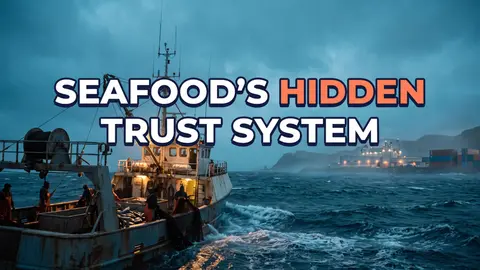
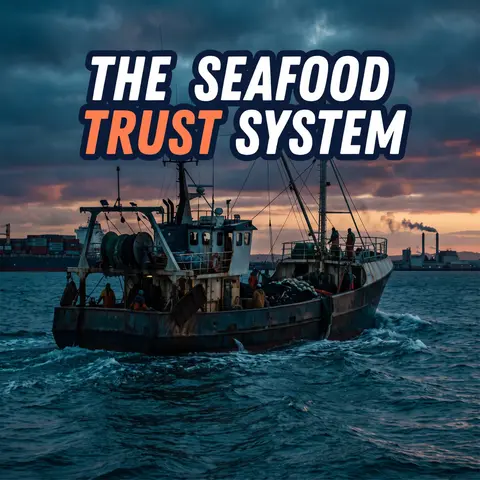
Somewhere between a fishing vessel out on the water and a can of tuna in your grocery cart, a complex, little-understood system works to verify whether you should trust what's on the label. It runs on audits, vessel registries, and compliance reports that almost nobody outside the industry ever reads. It's a large part of why a blue check mark on a package means anything at all.
What an RFMO Actually Is
The system starts with the RFMO, a regional fisheries management organization: a treaty-based body where countries with a stake in a fishery legally bind themselves to cooperate on how it's managed. One RFMO can oversee several different fisheries at once, and the countries involved can shift depending on which fishery is in question. These bodies exist because fish, unlike people, don't respect the borders humans draw. A tuna or a sea turtle can cross a dozen national jurisdictions in a single migration, so managing that species responsibly requires countries to manage it together. [VERIFY: some RFMOs are described as covering 45-plus member countries; confirm which RFMO and its current published membership count before publishing this figure again.]
Where does that cooperation actually happen? In windowless UN rooms in New York, at the FAO in Rome, and in what Andrew calls "boring ballrooms" in hotels around the world. Nearly the entire ocean falls under the jurisdiction of one RFMO or another. The skill that matters most in those rooms isn't legal expertise, it's listening: hearing what a country means behind what it's saying, since where a delegate stands often depends on where their country sits.
From a Negotiating Table to Your Dinner Table
Governance in these rooms isn't just paperwork. It's an agreed set of rules and somewhere to go when something goes wrong: a document that spells out what happens if a rule is broken, and what enforcement looks like when it is.
The payoff is that these governance decisions eventually reach your dinner table, through several complementary channels. The International Seafood Sustainability Foundation (ISSF) is one of them: a science and policy organization whose work spans research to improve tuna fishery management, advancing improved fishing practices on the water, transparency and verification tools like annual company audits and public vessel tracking, and direct engagement with RFMOs to push for science-based conservation measures.
Eco-labels are another channel, and a powerful one. The Marine Stewardship Council's (MSC) blue check mark isn't symbolic. It carries real financial weight, which is why losing it can force real change. MSC suspended the Maine lobster fishery's certification twice: first in August 2020, then again on December 15, 2022, both tied to concerns over North Atlantic right whale protection under the Marine Mammal Protection Act and the Endangered Species Act. Notably, MSC's own auditors found only limited evidence that the fishery itself was responsible for the entanglements in question, meaning the suspension was as much about legal compliance status as it was about on-the-water risk. That pressure is part of why ropeless and reduced-rope lobster and crab gear is now moving from experimental to mainstream.
It also flows to retailers. Chains like Costco and Walmart won't put a product on the shelf that doesn't meet their own sustainability commitments, so transparency at the vessel level ends up shaping what's available at the store, not just what's technically legal to catch.
Two Complementary Systems, Not One Pipeline
It's worth being precise about who does what, because ISSF and MSC are often talked about as if they're the same thing or as if one simply feeds the other.
ISSF's work is broader than any single tool: science-based fisheries management, improved fishing practices, transparency and verification, and RFMO policy engagement. Its transparency tools include independent third-party audits of participating companies (conducted by an outside auditor, MRAG Americas [VERIFY: confirm spelling], not by ISSF itself, so it isn't grading its own homework) and the ProActive Vessel Register (PVR), one of four public vessel lists ISSF maintains, which publishes vessel-by-vessel compliance with specific conservation measures using a plain color code: a green check for implemented, a red mark for not implemented, and a circle for pending verification. Seafood buyers are named as a primary user group for that list.
Per ISSF's 2025 audit-period report, 24 participating companies achieved 98.8% aggregate conformance across 32 conservation measures covering things like product traceability, catch data submitted to RFMOs, and shark-finning and bycatch policies, ISSF's tenth consecutive year above 90% conformance. Separately, PVR-registered vessels showed 75.6% aggregate compliance on vessel-specific conservation measures. These two figures cover different measures and different populations (companies versus individual vessels), so they aren't a direct before-and-after comparison. Both point to a system that keeps improving over time.
MSC is a separate certifying body. Fisheries pursuing MSC certification are assessed against the MSC standard by independent conformity assessment bodies, not by ISSF. ISSF's own broader transparency and science work supports the same overall goal, sustainable, well-verified seafood, without functioning as an evidence pipeline built specifically to feed MSC certification.
Neither organization replaces the other, and both matter for a shopper's trust. Compliance data buried in a PDF doesn't reassure anyone standing in a grocery store aisle. A label without credible, independently verified evidence behind it is just marketing.
An Honest Caveat
This system isn't perfect. Not every MSC-certified fishery is free of disagreement about whether it should be certified, and not every RFMO-managed fishery is in ideal shape. The tuna industry itself still has room to improve, particularly at the vessel level. What this episode argues is that it's a step-by-step process, and the tools now in place, observer coverage requirements, FAD management rules, public compliance reporting, are moving that needle faster than they were two decades ago.
Takeaways:
- A regional fisheries management organization (RFMO) is a treaty-based body that turns "we should manage this fishery responsibly" into an enforceable, multi-country agreement.
- Eco-labels like MSC certification carry real financial weight. Losing one can force a fishery to change its practices, even when the science on the underlying risk is still ambiguous.
- ISSF's work spans science-based fisheries management, improved fishing practices, transparency and verification, and RFMO policy engagement, not just company audits and vessel tracking.
- ISSF and MSC are complementary but distinct approaches. Independent conformity assessment bodies, not ISSF, assess fisheries against the MSC certification standard.
- Per ISSF's 2025 audit-period report, participating companies achieved 98.8% aggregate conformance across 32 conservation measures, and PVR-registered vessels showed 75.6% aggregate compliance on vessel-specific measures, two separate transparency metrics, not a gap between them.

CEO
The Biggest Mouthful: How Blue Whales Eat and Why Krill Matters