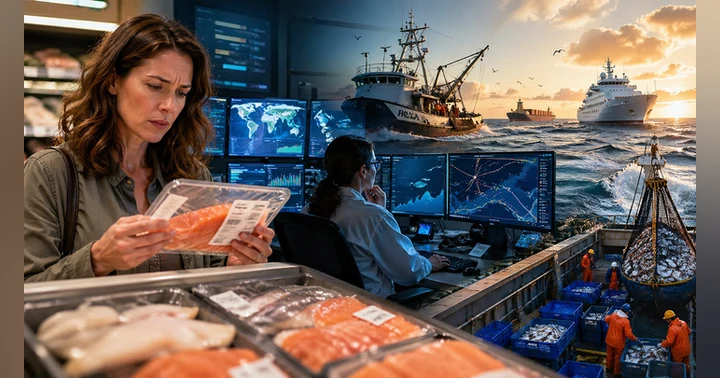
Why Your Seafood Depends on NOAA More Than You Think


 Apple Podcasts
 Spotify
 YouTube
 Amazon Music
 PocketCasts
 Overcast
 NOAA seafood safety affects more than most people realize. The seafood in your grocery store or on your restaurant plate may rely on NOAA science, inspections, fisheries data, and monitoring systems that help keep oceans productive and supply chains accountable. In this episode, we break down why this often-overlooked agency matters to everyday consumers.
Seafood traceability is not just about labels. It is about knowing where fish comes from, whether it was caught legally, and whether marine ecosystems are being managed responsibly. If those systems weaken, consumers, honest fishers, and ocean wildlife all feel the impact.
Ocean conservation often sounds distant, but this story is personal. One surprising truth: many people have never heard of NOAA, yet its work can influence the seafood they trust, the fisheries that survive, and the ocean protections that support future food security.
Support Independent Podcasts: https://www.speakupforblue.com/patreon
Help fund a new seagrass podcast: https://www.speakupforblue.com/seagrass
Connect with Speak Up For Blue
Website: https://bit.ly/3fOF3Wf
Instagram: https://bit.ly/3rIaJSG
TikTok: https://www.tiktok.com/@speakupforblue
Twitter: https://bit.ly/3rHZxpc
YouTube: www.speakupforblue.com/youtube
0:00 What if the seafood on your plate depended on the science you never see, rules you've never heard about and an agency that many people barely know exists? That is exactly what happens each and every day. This is the How to Protect the Ocean Podcast, your weekly Ocean Conservation Podcast. Follow the show right now if you want clear stories about what really keeps the Ocean healthy. Today we're gonna be talking about seafood, jobs and the hidden NOAA system, the National Oceanographic and Atmospheric Administration system behind sustainable fisheries. Listen. NOAA is under attack by the Trump administration. We've saw cuts over the last year that have devastated a lot of the programs and weakened a lot of the programs, and we're gonna talk about some of the services this week.
0:46 If you didn't get yesterday's episode on weather patterns and how it provides information that helps save people's lives, you can go check that out after this episode, but today we're talking about sustainable fisheries and the NOAA system that will be behind that, and it helps manage those sustainable fisheries. So here we go. Millions of people eat seafood each and every day. Millions more depend on fishing for their livelihoods, but fish are not unlimited. Without the proper management, fisheries can collapse. We have seen that happen in many parts of the world, including my home country in Canada. This is where NOAA comes in, not just in Canada, but it comes in in other places, of course. NOAA scientists assess fish populations, estimate abundance, study reproduction, monitor catches and help set harvest limits designed to keep stocks healthy over time.
1:35 That means the goal is not just fish today. It is fish next year and 10 years from now. Now look, responsible fishing and sustainable fisheries management is something that we need to talk about each and every day because there are a lot of times where that fails. And a lot of times it's the system that we put together. The science is usually on par. And it's just a matter of whether the funding and whether the politicians will allow that to happen on a regular basis. In Canada, we've seen Oceana Canada come on this podcast and talk about how a lot of the fishery stock assessments that are supposed to be done each and every year are not done each and every year. We only see some of the popular ones that we see and eat every day, but there are a lot of other fisheries that are supposed to be done.
2:16 The stock concession are supposed to be done and they're not done every, even though it's part of law. That's what we have nGOs and nonprofit organizations like Oceana Canada to make sure that their report that comes out every year holds the government of Canada accountable. And Oceana does that all over the world, including the US. And the US has seen major recoveries in fisheries, under a science-based management frameworks like the Magnuson Stevens Act, which this year celebrated its 50 years in existence. A huge, huge thing that has happened. The stocks that were once under pressure have been rebuilt in multiple regions through catch limits, monitoring, and adaptive management. A well-known example is Alaska Pollock, one of the largest managed fisheries in the world.
3:00 Strong oversight has helped keep the stock productive while avoiding the chaos seen in poorly managed systems elsewhere. So along the Gulf Coast, Red Snapper Management has been controversial, but the larger point remains. Management matters because people care deeply when a fishery supports jobs, recreation, and culture. On all West Coast, salmon seasons are adjusted based on changing environmental conditions and population trends. These decisions are difficult, but they exist to prevent deeper long-term damage. And look, we are in a system. We are in a planet that changes each and every day. And every year stocks will change based on what happens, not just the weather fishing pressure has increased or decreased, but it's also climate change, Ocean patterns, below the sea surface temperature, that's increasing as well.
3:47 We've seen differences in an Ocean chemistry that is causing the pH to lower, which is changing systems as well. Looking at, I think I mentioned, but currents, which is changing where animals end up settling, looking managed on Marine protected areas or Marine sanctuaries. Making sure that spawning sites and nursery areas are also protected. All these things change each and every year 'cause the world is changing, the Ocean is changing. Whether you think climate change is real or not, things change all the time. It's a fluid area. The Ocean is fluid. It is a water system that changes all the time and scientists there are there to detect those changes and they're there to say, Hey, you know what, this salmon population that came back this year is not as high as it was last year.
4:29 So we're gonna implement catch limits that were lower than they were last year because the population has just lowered. And sometimes we know, and sometimes we don't know. We may not know right away. We may find out later that has to do with something that happened out at sea or when they came back there was new dam that really affected more than we thought the population of salmon coming back. 'cause they come back in rivers to spawn. So there's a lot of things that go on in that. Making sure that these catch limits, making sure that everything is being assessed properly and is a representative of what is happening out there, that's an important aspect that NOAA provides. And a lot of times, unfortunately, stock assessments and that type of science, fishery science is cut. And people think we don't use it, but we're gonna be talking about jobs, we're gonna be talking about the work that it provides.
5:12 It helps sustain for a lot of people. We're not talking about just the fishermen that go and catch the boat. We're talking about the fish processors, the delivery trucks that bring the fish to from one place to another. The restaurants that depend on seafood, the grocery stores that depend on seafood. All this helps maintain jobs, maintains a part of the economy that is big, especially in coastal areas on fisheries, and that is something that we need to continue to support. NOAA also works on bycatch reduction, which is another part of fisheries that we have to be careful. Bycatch is anything that is caught, basically that is accidental capture of like sea turtles, Marine mammals, sharks, seabirds, and of course the non-target fish species. So if you're going after Alaskan Pollock, but you're catching a lot of arctic char, that's not what you wanna be catching, you wanna make sure that you're reducing that bycatch because one people may not buy it.
5:58 Or you're decreasing a population that you do not want to decrease because it could be sensitive to, as I mentioned, a lot of changes that are happening in the Ocean. Okay? Gear improvements, closures, observer programs, and better data can reduce waste and ecological harm. So you're probably wondering, well, Andrew, why is this actually mattering to people? How does this affect people? As I mentioned before, we're gonna be talking about seafood markets need predictability. Fish communities need stability. These fishing communities have been fishing for generations and generations. And we're not talking about the industrial complex of fisheries. We're talking about the artisanal fishers that depend on this to get their kids to school, making sure that their families are stable and living a life that you and I live as well.
6:40 And of course, like consumers want confidence that seafood was harvested responsibly. We don't wanna have to know that we're buying something that isn't great. We may not ask the right questions at times, but we just trust that the system is proper and that it's being managed properly. NOAA helps create that confidence. Without management, you often get a boom and bust type of cycle. So overfishing collapses, job losses, conflict, and long recoveries for a lot of these fisheries. And so that's what it matters to the people. Now, why this all matters to the oceans essentially is healthy fisheries are conservation. When fish populations remain abundant, ecosystems function better, predators have food and habitats face less pressure from desperate over exploitation.
7:22 And so when we have a diverse area, we have more stability within the system. And so that diversity stays, everything stays the same. We get a better economy, we get better fisheries, we get better seafood. And so if you enjoy seafood, there is a chance that science and management help put it there. And that's why we need to continue to help NOAA stay with the programs it does and get funded with the programs it does. And not just taking a cut across the board like we saw last year. It may not be perfect, it never will be, but unmanaged decline is worse in fisheries than anytime we think. So, when you talk about taking cuts or making cuts with NOAA, obviously there are some programs that could run a little bit more efficient, for sure.
8:04 I'm not saying that it's not, but cutting programs that affect the economy is not great. We don't talk a lot about the seafood economy. It provides a lot of money to the economy, and it may not be as big as tech or as big as fossil fuel or anything like that, but properly managed fisheries not only stabilize the country and the economy, but also stabilizes the ecosystems and the waters that surround the US, North America and elsewhere. When we look at seafood, it's not just along the coastal lines of the US. It's also worldwide too. NOAA helps a lot of worldwide because those populations don't always see borders. And having reports on shark species, Marine mammals, fisheries, all these things to make sure that the Ocean is in good shape and stable, that is something that is extremely important for us here in Canada, in the US, around the world, for every country to look at.
8:52 And NOAA has been a leader in a lot of the research that people have taken and moved around. So, having them in the right frame of mind, in the right funding agency, with the right amount of funds to do these studies and to continue to lead is really important. The US has been a leader in fisheries management for a long time. I'd like to keep it that way. To be honest, because we all benefit from it, the world benefit from it, from the methods, from the sharing. The scientists are fantastic and I'd love to see that continue. So, that's it for today's episode. If you have any questions or comments, you can hit me up online. You can go to our socials. There'll be in the show notes. You can also hit me up at speak up for blue.com/feedback. Let me know if you wanna leave a voicemail or text. You can do that anytime you want.
9:32 DM me on Instagram at How to Protect the Ocean. And, yeah, that's it for today's episode. Follow How to Protect the Ocean for more real stories behind Ocean Policy and Conservation. And thank you so much for joining me on today's episode of the How to Protect the Ocean Podcast. I'm your host, Andrew Lewin. Have a great day. We'll talk to you tomorrow and happy conservation.