
Saving Ghana's Guitarfish: Inside West Africa's First Shark Science Program


 Apple Podcasts
 Spotify
 YouTube
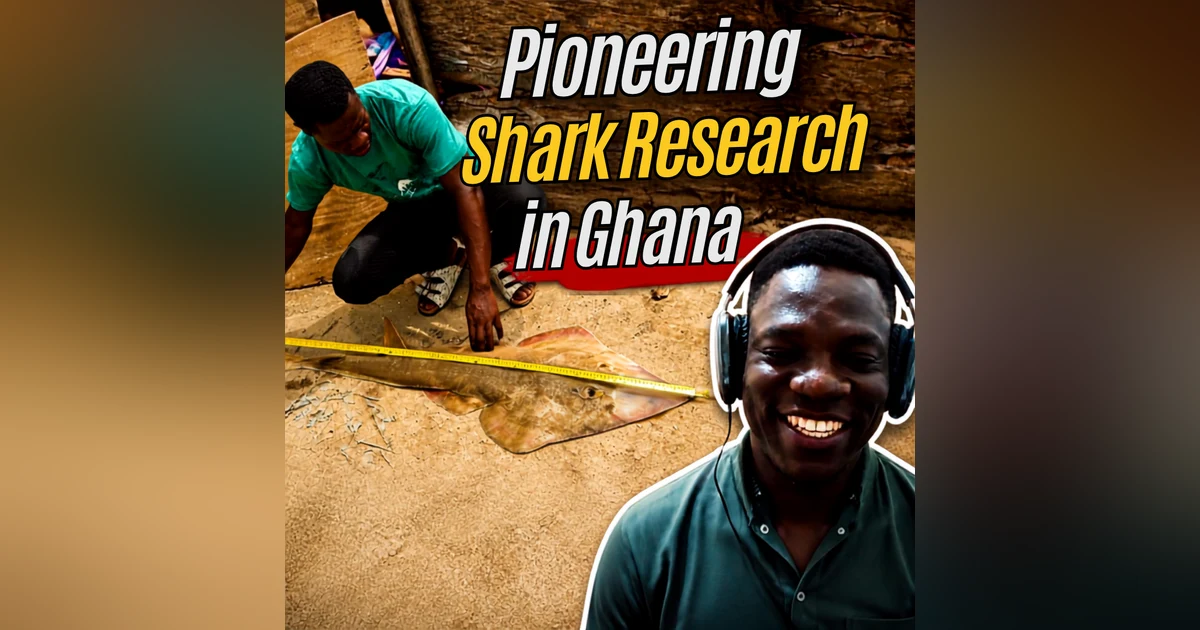
 Dr. Issah Seidu didn't set out to become West Africa's first dedicated shark and ray scientist. He started his career studying dragonflies, damselflies, amphibians, and even elephants and crocodiles as a terrestrial wildlife biologist in Ghana, a country whose university programs, like most in the region, simply didn't study marine species. That changed on a visit to his uncle, a fisherman in a coastal community, where he watched sharks and rays being landed and sold on the beach and realized nobody in Ghana, or almost anywhere in West Africa, was studying them at all. Today he's the founder and team leader of AquaLife Conservancy, a lecturer at Kwame Nkrumah University of Science and Technology, a Regional Vice-Chair for Africa on the IUCN Shark Specialist Group, and a 2026 Whitley Award winner, one of conservation's most prestigious honors, for his work protecting Ghana's guitarfish.
Andrew and Dave talk with Issah about what it actually takes to build a conservation program where none existed before: the funding that mostly has to come from outside the country, the near-total absence of local mentors in his field, and the years it took just to convince his first fishing partners that his research wasn't a threat to their livelihoods. Issah walks through the hard math behind his work, sawfish already functionally extinct in Ghanaian waters, wedgefish not seen since around 2010, and four species of guitarfish now at real risk of following them, and explains why Ghana's own high demand for shark and ray meat as a protein source makes this a food security question as much as a conservation one. He also shares how a broad early career studying insects and amphibians turned out to be the best possible training for pioneering an entirely new field, and what he tells young African conservationists who ask him how to get started with no roadmap at all.
This is a conversation about what it looks like to build shark science in a part of the world that the field has largely overlooked, told by someone doing it in real time, with real fishing communities, on a coastline most Western listeners have never heard mentioned in the same sentence as sharks.
Takeaways:
- Ghana has four documented guitarfish species (common, white-spotted, blackchin, and spineback), and Issah's research shows they're on the same extinction trajectory that already claimed the country's sawfish and wedgefish populations.
- Sawfish are functionally extinct in Ghana, with no confirmed sighting since the 1980s; wedgefish haven't been caught since around 2010.
- Building trust with fishing communities took years, not months. Issah's first two committed fishing partners took roughly six months of repeated visits and conversations to win over.
- Ghana's own high domestic demand for shark and ray meat as a protein source, not just export markets, is a central driver of the fishing pressure Issah is trying to manage.
- Issah's advice to young conservationists starting out with no local mentors or funding: be bold, be committed, and above all be persistent, since changing fishing behavior takes years of sustained relationship-building.
Connect with Issa Seidu:
Instagram: https://www.instagram.com/antwiseidu88/
Connect with us:
Website: https://bit.ly/37TMqeK
Instagram: https://bit.ly/3eorwXZ
YouTube: https://www.youtube.com/@beyondjawspodcast7591
Dave:
Website: https://www.lostsharkguy.com/
Instagram: https://bit.ly/3q1J9Q5
YouTube: https://www.youtube.com/@lostsharkguy
Andrew:
Website: https://www.speakupforblue.com/
Instagram: https://bit.ly/37g5WkG
YouTube: https://www.youtube.com/@SpeakUpForBlueTV
0:00 I think it's fair to say that we, Dave and I, get impressed by every guest that we have on. And this young man that is on the podcast today, Issah Seidu, is one of those people who continue to impress in how much dedication he has to his job and to knowing sharks. We're gonna find out what it's like to work in Ghana as a shark scientist, where shark science isn't really studied that much, and he's one of the first ones to do that, even in West Africa. So we're gonna talk all about shark science in West Africa and Ghana on this episode of the Beyond Jaws podcast. Let's start the show Hey, everybody. Welcome back to another exciting episode of the Beyond Jaws Podcast.
0:41 I'm your co-host Andrew Lewin, with my co-host, Dr. David Ebert. Dave, like, how impressed are you with this guest that we have on with Issah? I was- … real impressed w- with I- well, Issah, I mentioned as I, as I'll talk about in the show, uh, I met him at Sharks International. Our friend Andrew Chen introduced me to him, and he was so excited because he's a big fan of the show, and , who would've known in Ghana, in West Africa. Right. But I talked with him and he was just really an impressive guy, and I was just like, "I've gotta get this guy on the show." And so, um, uh, so I, I was … I in fact even texted Andrew that night from Colombo, Sri Lanka to- Yeah … Canada and said, "Dude, we gotta get this guy on the show.
1:22 He's great." Yeah. Yeah. so yeah, so we finally were able to work it out, the timing, to get him on here, and, uh, as you'll hear in the show, you know, he works in a part of the world that he really is a true pioneer, like in Ghana- Yeah … 'cause there's just, nobody's done anything on the sharks, and he's just literally blazing his own trail there, and that's It's great. I just, great getting people like that, just real impressive guy and just seeing what he's doing there- Yeah … in there. And you're gonna hear his story and about, hear his journey, which is pretty amazing, 'cause it's, you know, that part of the world- Yeah it's not easy. No. Not easy at all, and he's just, he's doing, he's making it happen. Well, and I think, like, even if we set the stage here, you know, he's a young man, and he'll tell you his story, but, learning and studying sharks in Ghana, where nobody else is really studying sharks, and I think when we think of Africa, a lot of us go to land animals, right?
2:14 The safaris- Mm-hmm … and, and so forth. Or the only time you really think about sharks is if it's South Africa, because that's- Mm … usually where we see the footage and everything. Yeah. We don't see it from Ghana. We don't really hear about it from Ghana or West Africa, or even other places in Africa, you know? And I think having … It's been really enlightening to me, and I'm sure to you as well, Dave. I don't wanna speak for you, but I'm sure you as well, where- We have these people who have, recently graduated find, that sharks haven't really been studied very well and go to a place where they can be that pioneer, which is challenging beyond means. You know what I mean? Because like- Mm-hmm … it sounds great to be a pioneer.
2:56 It sounds great to be the only one studying or one of the only ones studying and working with fishers and everything like that. But it takes so much time, it takes so much patience and trying to overcome these challenges to get people to understand why you're studying these things and why they need to protect them and to know more information on them. I'm just highly impressed with people who do that. That's not for the faint of heart by any means. No. It's a hard job and for them to just come on and talk about, like, he was pretty nonchalant. We've had other, like, Gofrey did the same thing, like, they're pretty nonchalant about it. But it's a huge, huge thing. They're contributing so much. And to think, like, we're in 2026 and people can still contribute such a great amount to- Mm-hmm … knowledge of sharks in different places in the world absolutely flabbergasts me and it's just, it impressed me so much.
3:42 So here's the interview with Issah Seidu talking about his work in pioneering in shark science in Ghana and West Africa. Enjoy the interview, and we'll talk to you after. Hey, Issah. Welcome to the Beyond Jaws podcast. Are you ready to talk about elasmobranchs? I am very ready to talk about sharks and rays in Ghana and across West Africa and Africa. All right. All right. I like that. Well, welcome to today's Beyond Jaws podcast, where we have a fabulous guest from a part of the world that we outsiders do not know, really know a lot about. However, before I introduce him, I want to acknowledge Andrew Chen, who introduced us at the recent Sharks International Conference in Colombo, Sri Lanka, saying he wanted to introduce me to a big fan.
4:25 Of course, I always want to hear it from fans. But I had really didn't realize just how popular we actually are in West Africa. So today, our guest is Dr. Issah Seidu, who's a young conservation leader from Ghana in West Africa, who has a special interest in both marine and freshwater biodiversity. Issah is a founder and team leader of Aqualife Conservancy, a Ghana-based not-for-profit, dedicated to research and conservation of marine and freshwater biodiversity. Issah's current, role at Aqualife and Conservation is to spearhead research and conservation of sharks and rays in Ghana and across Africa. He also serves as a vice chair for Africa for the IUCN Shark Specialist Group. He's leveraged his role to train many young volunteers, early career researchers, and conservationists to be champions of ocean conservation.
5:11 Issah is also a champion in research and conservation of marine megafauna, again, specifically sharks and rays, and guitarfishes, which I'm looking forward to talking about guitarfishes today, in Ghana and across West Africa. Issah holds a PhD and a master's degree in Wildlife Management, and a Bachelor of Science degree in Natural Resources from Kwame Nkrumah University, which I completely apologize I've mispronounced, but he'll correct me. University of Science and Technology. He has an impressive resume for someone so early in his career, and I could spend the next 30, 45 minutes just covering all that, but we'll touch on some of that during the interview. But some of the highlights are, he has a certificate in Tropical Ecology and Ecosystem Conservation from the Tropical Biological Association in the United Kingdom.
5:55 He's also a fellow of the Zoological Society of London Edge program, and he's currently also with the New England Aquarium MCAF Fellow. He's also a 2026 Whitley Award winner. Wow, that's really impressive. And is implementing a groundbreaking project aimed at garnering grassroots support for conservation of guitarfishes and other sharks and rays in Ghana. Issah has contributed to the IUCN Red List assessment to 28 endemic and near endemic West African sharks and rays. He's also an expert in reviewing for East Atlantic guitarfishes on CITES and Appendix II. He's also a member of the IUCN Freshwater Fish Specialist Group, and he's produced several technical reports and quality scientific papers that are recognized in internationally peer-reviewed journals.
6:39 He's received numerous awards, as I said. I could spend 30 minutes just going over all that stuff. He has over 30 publications to date, and he's contributed 28 IUCN Red List assessments. I've already mentioned his education background. He has a Bachelor's of Science, a Master's, and a PhD. He's currently a lecturer in the Department of Wildlife and Range Management, and he's also a co-founder and team leader, as I mentioned, at AquaLife. And with that, Issah, welcome to the show. Wow. Thank you for having me. I didn't, uh, know. That is real. I, I- Holy. I could have gone on. I'm serious, another 20 minutes with this young guy. I d- I just had no idea. I'm pretty familiar with Southern Africa and East Africa, but I'm not as up on West Africa, so it is a real privilege to have you today.
7:24 I didn't realize we had such a rock star to bring on the show today. you know, that he- Thank you, Dave. Thank you, Andrew, for having me on this show. You bet, dave. Oh, it's wonderful. It's wonderful. I wanna ask you, like we ask all of our guests when they come on, like, how did you get interested in marine science and sharks and just how did you get started in all this? Interested. That's a very interesting question, and I've been very, very fascinated any time I hear this question. Actually, I started my career as a terrestrial wildlife biologist, because in my university, Kwame Nkrumah University of Science and Technology in the Department of Wildlife and Range Management, we mostly focus on terrestrial species.
8:09 So I had little knowledge and little information on marine ecosystem. So for my BSc degree, I work on dragonflies and damselflies, and I was also working on so many terrestrial species such as amphibians, dragonflies, elephants, crocodiles. Wow. So after my master degree- What a range … yeah, after my master degree, I actually paid a visit to my uncle in one of the coastal fishing communities in Ghana called Dscove Community. And when I was there, early mornings, I usually go to the landing beaches to observe the fishermen. So one morning, I went to one of the landing beaches and I saw several sharks and rays being displayed for sale along these landing beaches.
9:00 I actually got fascinated about these species, and I wanted to dive and know more about the sharks, the rays, and the guitarfish in Ghana. And I found out that there was absolutely nobody working on the species, and no information on the species whatsoever in the country. on the species, especially in the country and even the West Africa. There were very little information on sharks and rays and guitarfish. So deep down, something actually pressed me, motivated me to start working on the species, at least to collect key baseline information that can be leveraged to develop management framework to safeguard the species. Because the fishermen, when I had interactions with them, the fishermen were even oblivious.
9:44 They were unaware that many of these species are on the verge of extinction, and that they need our to ensure they are still in the marine ecosystem. So this is what actually drove me into working on sharks, rays, and guitarfish. Yeah. Really, when you, as you got this interest there, there's really been nobody else that's ever, that I, I'm aware of from Ghana who've really gotten into the sharks and rays. You're a pioneer in this whole area. Is that correct? Yeah. I'm actually one of the pioneers in the sharks and rays conservation and research in Ghana, and even in West Africa. I can- Wow. I can, yeah, I can say that. Yeah. Yeah. how difficult is that?
10:25 We have the privilege here of a lot of the stuff has been found and, you know, there's an established, like, network of funding for specific species and specific types of species here in Canada and in the US. Not as if funding is, like, easy to get, but when you're the only one learning about sharks and rays in your country or even in West Africa, what are the challenges that you face when you have to be that person to advocate, not only to know more about them, so funding to get more about them, but also just the knowledge of it and getting that message out there? Yeah, it's quite challenging. I remember when I started conservation and research on sharks and rays- And I mentioned that out to my professors and my colleagues.
11:08 All of them actually advised me to focus on dragonfly and damselflies. Many of them actually. Because they know that I have already created a niche for myself. I was doing marvelously well in dragonfly and damselflies research. At that time, I had already published about three to four papers. Wow! And they didn't understand the reason why I'm moving from dragonfly to damselflies, and wanted to work on sharks and rays. So they told me that first and foremost, I have two challenges. Funding issue. You don't have funding in West Africa. In Ghana, government are mostly not interested in conservation Because the government want to channel its resources into developmental project that bring fruit, and they are not much interested in conservation.
11:54 So getting funding in this part of this world was very difficult for us. So we mostly live with, we mostly, we, we, we, we mostly attract funding from international organization, and that is quite challenging. Of course, we know what happens. We are always competing with big international organization, people who are already expert in the field. So it become difficult for us to get small funding to even support our project. That was the first thing they told me. Yeah. And the second one has to be with the expert. When I started, there were very few experts, and all the experts were coming from Western countries. Mm. The Western countries, yeah, to come to West Africa, Eastern Africa, and Central Africa to work on sharks, rays, and other megafauna. We did not have many, indigenous scientists from West Africa who were actually keen on working on sharks and rays, and this was quite challenging.
12:44 So I remember one of my professors told me I have to link up with some of the experts in the Western countries so that I can get the needed mentorship and support from them, and that was what I actually did and it's been working. Yeah. Yeah. For background for people listening to the show, I can, I speak a little bit to this is Southern Africa, South Africa, there's been a lot of stuff done. In East Africa, they have a history of some research having going back, 100 years or so. But West Africa, anywhere from Angola, Namibia, and up that whole coast there, Ghana, Benin, all the way up that, the Gulf of Guinea states, it's just nothing. There's just almost nothing in the literature in that.
13:24 So I say when you're kind of pioneering a whole area of the world, you really are. And again, a lot of people listening from, North America and Australia, you kinda have a bit of a roadmap and some sources to go to. But try to imagine yourself, in Issah's situation where there's-- he's basically gotta make it up as you go along and figure it out. so as you kinda went along, I think the first step is you recognized there was a problem, an issue here with the sharks and the rays, and particularly the guitarfishes. And so, as you started out seeking resources and everything, what were some of the other things like just going out to the villages and stuff to find out what they're catching? Yeah, I have been doing that for the past eight years.
14:08 I mostly spend 10 days out of the 30 days in a month with these coastal fishing communities to collect fishery data, to interview them, and also to also join them in their fishing expedition to map key areas where they are targeting, especially guitarfish. So I've been doing this, and in the last, I think 2022, we started focusing specifically on guitarfish. We found out that these species are on the verge of extinction When we talk about guitarfish, whalefish and sawfish, they are termed as shark-like rays. We all know that they are all termed as rhino rays or shark-like rays. In Ghana, the, the sawfish is currently functionally extinct.
14:53 And the last time a fisherman actually spotted the species was somewhere in the 1980s. And the whalefish, from our interview with the fishermen, the last time they caught the species was somewhere in 2010. So that means that the guitarfish is next to suffer local extinction if proper conservation measures are not put in place. That was the rationale, the reason why in 2022, from our interviews and our publication, it revealed to us that you must focus much attention on saving guitarfish as well, together with other threatened sharks and rays. So our focus, our conservation and awareness campaigns, and our conservation models is now channeling towards the conservation of guitarfish.
15:36 And we've been doing that using about four different models altogether, which if time permits, I would like to go through for you. When you started there, what kind of references did you use to just to identify all the different sharks and ray species that occur in Ghana? How'd you start? How'd you go about that? Yeah. Mostly for identification, I use the Sharks and Rays of the World. I have a copy of the book there. Okay. Oh, interesting. Well- Yeah … I didn't mean that as a setup for my book, but, but I was cur- because there's no, like, there's no real regional guides there. Yeah. So I So, so I use that. I, I have, I have- Thanks for the plug.
16:16 Yeah. , I have three books. I bought three. Actually, I bought three. I've given two to my local volunteers who are also studying them. Nice. Also keeping one copy. Nice. Yeah, so you mostly use the Sharks and Rays of the World a lot. And anytime we have found identification difficult, we also send it to expert, who happened to be Professor Skerritt. Yeah, he has also- Oh, Skerritt … been supporting us. Skerritt has been supporting us in identification. And we also collect DNA samples, and we have a couple of samples which we are still looking for potential collaborators for analysis. So that's, that's really what we've been doing with the identification. I know that being a young person, when I start out going to countries where you have like, there's just no reference guide at all really to start with, and you can use like a rays or sharks of the world book, but you're having to go through all the sharks and rays of the world to narrow it down to this one little part of the world where you're at.
17:12 And not having anything to really work off of, to start with. It can be challenging, let's say, put it that way. It could be challenging, on everything. You've gone and you set up like this, like a monitoring program now with all your, um, your different, uh- Yeah. We actually have a monitoring program, and we started this monitoring program in 2020, and then we ended in 2022 in, I remember in March. And then after March, we actually had a grant from the Save Our Seas Foundation to start. So we started in June 2022 till 2025. We also ended because our funding program actually ended.
17:54 So we have about, four or five years, monitoring program, and we've collected very holistic information, fishes information on these sharks and rays. Okay. Okay. That's good. Well, again, Save Our Seas has been a great organization for funding projects like yours and stuff that generally can be difficult to get any kind of funding in these different communities and stuff. Curious, how much coastline does Ghana have bordering on the Atlantic? Yeah. Basically, our coastline is demarcated into three different regions. You have the West Coast, the East Coast, and the Central Coast. Okay. So the… Yeah. So the West Coast is from Ghana, Côte d'Ivoire border to the Ankobra River estuary, which happens to be at, uh, Shama, and then, yeah, A- Ankobra Estuary.
18:44 And then from the Ankobra Estuary to the Tema is the Central Coast. And then from Tema to Ghana-Togo borderland is the Eastern Coast. Okay. Oh, wow. So we have the, yeah, three coastline. Okay. So, oh, so it's ac- so you got, you're basically divided up into three different regions? Yeah. Yeah. We started our conservation research work in the Western Coast, and then in 2022, we moved gradually to the Central Coast, and now we are covering the East Coast as well. So we are covering the entire coastline of Ghana, working with close to 15 different communities. You said 15 communities? Yeah, 15 communities. Yeah. Wow. Oh, good.
19:24 And do you have, monitors, people that are checking those, monitoring those areas all the constantly, or? Yeah. Those that are working with, we have local volunteers. We train them as our official biologists. So official biologists, what we do, we pick them, we select them, those who have actually attained high school education, and then we train them, and we give them the resources to help us collect fishery data on these species. And we also have about 20 fishery, fisher biologists who also go to the sea and collect the GPS coordinates of these species, of the sharks and rays. Are these volunteers that are doing this?
20:06 Yeah, they're volunteers, but of course, we give them some stipend, small stipend. Yeah. Yeah. Yeah. Just to motivate them to- Yeah, of course … do the work. Yeah. Because without that motivation, it become difficult for them to, to- Yeah … continue working with us. Yeah. Yeah. And what made them originally interested in participating in this program? Yeah. Initially- Were they just curious? Initially, when we wanted to recruit them, they were cur- somehow curious about our work. Most of them, they don't want to work with that because they were thinking that our work was going to be used against their fishing activities. So most of them were very reluctant. So what we did, what actually created the magic was that we started visiting most of them.
20:51 We organized series of meeting in small groups, like a group of five, four, three, and even up to maximum up to eight. So we did a lengthy presentation and then talked to them about the conservations of sharks and rays, and we also talked to them about our models, our work, how our work is going to help them conserve sharks and rays for their future generation as well. So our model, we wanted to let them know that our work is to strike a balance between conservation and utilization, because we cannot stop them from fishing. But our work is to strike that balance between conservation and utilization. And I think most of them actually bought into our conservation model, and they started working with us.
21:32 It takes some time. Of course, it takes some time. It take quite a lot of time. Yeah. Yeah. Because changing behavior doesn't come easily. And do you have, like, a lot of your guys now, you still have the same people you've had now for a while? You've been able to build people that stay with the project for a while, or do you have people come and they go, and you have to train new people all the time? Yeah. we have over 11 people, 11 fishermen who have worked with us since 2019, and they are still working with us. They're still working well. But some also come, and then they later move. Some too have also tended to be migrant fishers. They move from Ghana to other neighboring West Africa countries to work on to fish. So once they leave, then we have to bring in new faces.
22:16 Yeah. Do the guys take photographs of the different species they're catching so you can voucher or document specifically the types of the different species you're catching? Yeah. Every individual they record, they take a photograph of the individual. That's, that has always been the model. Mm-hmm. Every individual you record, you have to take a photograph of it for- Yeah … confirmation. Yeah, that's what we've been doing. But sometimes you go then you see several individuals of sharks that it become difficult for you to take all the individual- Yeah pictures of every individual. So at that time, we mostly ask them to take maybe two or three photographs of the several individuals- Mm-hmm … within the coastline. Yeah.
22:56 Are the sharks and rays, are they mostly consumed in Ghana or are they exported? Yeah, for sharks and ray, they are mostly consumed in Ghana. In West Africa, we are the highest consumers of sharks and rays. Oh, really? Wow. Wow. I didn't know that. We are the highest. Yeah, actually. You did? And to the extent that, yeah, fishermen from Ghana go to neighboring West Africa countries such as Mauritania, Senegal, Gambia, Liberia, Nigeria, Guinea, to target sharks, rays, and guitarfish. So once they get them, they process them to dry meat called- Mm … kakko in our local parlance, and then they import them back to the country on trucks to supplement the protein requirement of our people.
23:39 That has been the trend. Yeah. So we are, we are regarded the highest or the largest consumers of sharks and rays in this part of the world. How does that compare to other fisheries, like other fish? Are sharks and rays consumed more than any other commercial fisheries? Yeah, for now, for other commercial fisheries like, like tunas and that- Yeah … other bony fishes, I will not say that, that sharks and rays are highly consumed as compared to that. Okay. The issue is it's about survival. So when they don't have much like bony fish to depend on, then- Gotcha … they have to focus on other alternative, like the sharks, the rays, and the billfish, and that's exactly what they are doing.
24:20 Yeah. Just to emphasize to people listening to the show, you know, again, that haven't been to Africa, are not familiar, it's, you're working with people that they gotta catch stuff to eat, basically. And so it's- That's it … you gotta be very, trying to work that balance between, say, a, people, food security, and conservation, which is not easy to do at all. So some of the things when you see these different species, and guitarfish seem to be one of the primary species they catch quite a few of. Yeah. Guitarfish, you see, in Ghana, they mostly use three different gears in targeting sharks, rays, and guitarfish. We have the drift gillnet gear. The drift gillnet gears are mostly used in the oceanic habitats to target sharks and other large marine megafauna such as billfish.
25:08 Then the bottom set net gears are mostly used in the coastal habitat to target guitarfish and other ray species. So guitarfish, those who are using the bottom set net mostly catch the guitarfish at a very high number. Do they get wedge fish very often? Do you see- No, for the wedge fish, the last time the fishermen actually indicated to me that they've actually caught the species was somewhere in 2010s. Unfortunately- Wow. Yeah. Since 2019, we have done extensive survey, extensive, uh, landing site survey of sharks, rays, and guitarfish, and we've never spotted a wedge fish. , I had interaction with the fishermen. I've collected social science data on the wedge fish, and the last time a fisherman indicated that he actually caught the fish was somewhere in 2010s.
25:57 Wow. What about some of the other, like, things like sawfishes? Do they, they ever see those anymore? No, sawfish, sawfish is also functioning extinct in Ghana. Yeah. So the last time, for our social science interview data revealed to us that the last time fishermen caught or saw the sawfish was somewhere in the 1980s. Till now, nobody has even spotted the sawfish. nobody. Yeah. Nobody has. So it's functionally extinct. Is there any evidence, like say, I know in a lot of places, particularly in East Africa, there's places you can go, you'll see in some villages you'll see a lot of the rostra from the sawfishes, but they were all caught back in the 1960s and '70s, but they're just, they kept, people just have them around their places, curios.
26:43 Do you see that in any of the villages in Ghana? Yeah, I saw one rostra. I saw it in Busia community. That was the first time and I actually spotted that, uh, the rostra. Okay. Yeah, okay. So yeah, so again, the things are, yeah, it's not seen that frequently with some of those species. I'm just going down a list of a few different species and this is a little bit of my just curiosity because I West Africa is just an area I don't know. But how about the devil rays? Do you see those? They caught very frequently? Yeah, the devil rays, especially the mobula species. Yeah, the mobula species, they mostly cut them. The manta rays, they mostly cut them. They mostly- Okay. They- Especially the fishermen using the drift game gears, they mostly land them.
27:27 Okay. Okay. So they, they still catch those kinda regularly then, uh, with the- Yeah, it's very, very regular for that. Very, very regular. Yeah. If, two or three, if uh, say two or three canoes or boat actually lands sharks and rays, you definitely- Mm-hmm … see one, one or two mobula or devil rays. Yeah. Okay. Most of the fishery is all coastal, is that correct? Mostly coastal fishery? Yeah, mostly are, they are coastal fisheries. Yeah. Yeah. Yeah. Have you ever worked with the Norwegians and the Food and Agriculture Organization have their research vessel, uh, the Dr. Fridtjof Nansen, usually does surveys up and down the West Coast, East Coast, they alternate years. Have you ever been in contact with them to see what's kind of deep sea species are being caught?
28:10 No, I've never contacted them. I recently had a discussion with the industrial fisheries. Yeah. And I am actually planning to start my survey in the industrial fisheries as well. Mm-hmm. Especially Tema and Takoradi, yeah, in Ghana. Yeah. So our plan for next year is to start working with the industrial fisheries as well, because we've worked with artIssahnal fisheries, the semi-industrial fisheries. We've worked with the semi-industrial fisheries as well. Yeah. But the industrial fisheries is the only remaining sector where we need to start working on. And we are planning to work with them somewhere next year. Mm-hmm. Especially when we get funding from Save Our Seas Foundation.
28:53 Yeah. Yeah. When you started out, you obviously worked on a lot of different, you worked on like a lot of different groups and stuff from plants and insects and different things. Did you feel like that helped? A lot of it was around the overall biodiversity theme, right? You did a lot, you were mostly doing biodiversity, but you worked on different groups. Did that kinda help prepare you for when you moved over to doing elasmobranchs? Yeah, exactly. It really prepared me because most of the models I use in saving these terrestrial species were pushed to the marine ecosystem because you don't change much of the models, much of the activities. For example, when you talk about conservation awareness and education campaign, you can use the same models to also work on the marine species.
29:40 When we're also talking about, for example, collecting key baseline information, so the key baseline information can also model to marine species. So it really prepared me to be a champion of the marine ecosystem. Because you're involved with the IUCN freshwater fish group as well? Yeah, I was very, very much involved in the activities. I collected some key baseline information for them some couple of years ago. But now, it seems my focus has shifted a little, and, I'm now focusing specifically on sharks and rays. Yeah. Well, the reason I wanted, wanted that because I think-- because people, again, we highlight this because most people to get where you're like, you are now, you did a lot of different things.
30:21 You had a very broad background. And a thing I try to emphasize to young people is like, you don't have to be doing sharks and rays every day. - It's all about skills, but learning different groups, whether it's plants, insects, working with freshwater fishes. But all that stuff helped prepare you for when you went into a whole new area with the sharks and rays. I guess young people listening to this episode, don't dismiss, like if you can work on some other groups and learn some other skills, don't pass it. Very, very important because I believe all the models, all the activities, all the knowledge you gain from other groups can easily be transferable to the others as well. Yeah. Yeah.
31:01 Yeah. Do you mention you had a relative, was it an uncle or somebody, worked in wildlife as well? Early in your career you had a friend or a relative who worked in wildlife? No. My uncle was actually a fisher, a fisherman. Okay. Yeah. Okay. So I visited, I visited him, and he gave me the opportunity to see shark for the first time, and I got fascinated- Okay … and then started working on them. Yeah. Okay. Um, So your uncle has inspired you in a way, as a fisherman. Exactly. Exactly. Yeah. Let me ask you this, like, when you first saw a shark, like, in person, what were your thoughts? I couldn't believe that Ghana's waters actually contained sharks and rays. I couldn't believe it. Right. I've heard a lot about sharks, that sharks are actually man eaters when you - Yeah, that's how we all learn.
31:45 Yeah. Yeah. So when I, when I saw a shark for the first time, I was so fascinated about- Yeah yeah. And I, unfortunately for me, I w- I saw mako shark. You can see how- The mako shark … huge mako shark, yeah, mako shark was. Wow. So I got fascinated, I got fascinated about it, and then I decided to, yeah- How big was it? Yeah, it was, like, about 200 centimeters. Yeah. Wow. Okay. Yeah. It was a proper shark. Yeah. Yeah. It's a good shark. It's a good size shark. Yeah. Yeah. Yeah. I got a question for you. So when you went back and you told your mom and dad you're interested in sharks, what was their reaction? My mom, my colleagues, all of them actually, they were not happy. They thought I wa- They, they, they thought I was going to die because the sharks were going to eat me up.
32:34 So- So actually my mom was trying to discourage me. Some of my colleagues also were trying to discourage me. They were telling me, "No, you don't have to do that. You have to focus on your dragonflies and damselflies. You are doing marvelous work. Everybody is now seeing what you are doing. Why do you want to move to sharks and rays? that's n- really not going to help you." Yeah. Uh, so they were not happy at all. They were not happy at all. They, yeah, they weren't, they weren't happy about it. They ha- so now that you've gone on, you've done all that you've had… You're very accomplished now, what do they feel now? I actually asked one of my colleagues when I won the Whitley Award that, "How do you feel now?" And it's like a turn up to me. They are all so happy that I actually challenged myself. I did not listen to them.
33:15 I challenged myself, and I moved on to do what I actually, was actually born to do. And they are now happy. They are now happy. it's a great story because there was, like, no roadmap. You just had this passion and this direction to pursue the sharks and rays. I love talking to people like you, 'cause were just like, "I'm gonna do this." And even though there was no real- roadmap. There were no mentors in Ghana that you could really talk to directly, but you just, you saw something there, and you just pursued it. I love stories like that here and that different, different- Thank you … different types of stuff like that. And so, do you have a following of people now that are all eager to be the next to kind of follow in your footsteps? Yeah.
33:55 In my university, I'm mentoring students who are interested in marine megafauna such as sharks, ray, dolphins, billfish. And recently, I supported two master student, one actually work on dolphins and one also work on billfish, and I'm trying to inspire them. They are all ladies. Fortunately for me, they are all females, and I'm trying to push them, they are to be champion of conservation in this area as well. So I'm mentoring a lot of guys working on sharks and rays. Two of my undergraduate students are working on sharks, and one is also working on guitarfish, which is quite- Wow … yeah, quite inspiring. Oh, cool. Yeah. Good. Yeah. Okay, this is a science nerd question, but how many species of guitarfish do you have in Ghana?
34:38 Yeah. So far we have documented four species of guitarfish. Four? These are the s- yeah, spinebared guitarfish, whitespotted guitarfish, bluchin guitarfish, and the common guitarfish. These are the four- Oh, okay … main species I've documented so far. Okay. Wow, you got a pretty good number of species there. Very several different species to work on. That's pretty awesome. Most areas just have, like, one, but, seems like Africa seems to be a hotbed for guitarfish species. That's for sure. Are you a lecturer with the university and you run your NGO? Is that your situation? Yeah, that's correct. That is correct. Okay. Yeah. It's kinda nice 'cause you have students that you can mentor, bring through the university system, and then you got an easy source of volunteer helpers for your NGO.
35:20 Yeah. You don't have much funding. Yeah. So the little funding we are, we have, we channel most of the funding to these local volunteers who are mostly stationed in their various communities to support our conservation activities. So I'm working in the university because I withdraw salary from the university, yeah, which also supports me and other staff. As you're lecturing people and you're talking about your work, even with the volunteers that you're talking to, do you find there is more interest from students in studying sharks because there's something that you've established there, like a bit of a footprint to say, "Hey, you know what? There could be more studies of sharks"? Of course, I have been very inspirational to most of my students I actually mentor.
36:04 And it's so interesting to see that some of the students mostly come to you and tell you, "Hey, we've seen that you are doing this and doing that. You are working on sharks and rays, so we also want to follow your footstep." So yeah. So anytime I get that information from the student, I get very, very happy that at least… But when I started, I never got the opportunity to go to any lecturer, go to any person, especially in Ghana, in West Africa- Mm-hmm and ask the person, "Oh, I want to follow your footstep." But now, if students are coming to you that they want to follow your footstep, that's quite a blessing, and it gives me the energy to continue with the work- Yeah … and to continue mentoring them. Yeah. I can imagine. Yeah. Yeah. Yeah.
36:44 So obviously you're, inspiring like the next generation or the-- really the first generation after you of young shark researchers and rays and young conservationists. Have some of your students, do you have involved with doing like any kind of Red List assessments yet? Yeah. For the Red List assessment, I think the last time we did was in 2020. It was a workshop. REMAS sent us some key areas, some key species that we want to do the Red List on. So I have two of my master's students with whom I've talked to, and I asked them that they should start preparing their data, because very soon I'll be pushing some of these things to them for them to start sending information to the IUCN for the Re- Red List assessment.
37:32 Yeah. With all your students, sounds like you're build- you're building quite a program there. For your young student, particularly in Ghana or in West Africa, if you ha- were-- was asking you, like, for advice, what kind of advice would you give a young person starting out, like, how to get going, how to get started in this field? Yeah. So this is the advice I always tell them. The marine ecosystem provide a lot of opportunities for the young generation, but the opportunities come with so many challenges. So I always advise them, when they start their work in marine conservation, they need to be bold. That's the first thing. They need to be committed, and they also need to be persistent. Be persistent in the form that changing behavior, changing the behavior of people takes time.
38:16 So if you are not persistent, if you don't have the patience, there's no way you can win them. When I started, it took me more than six years to be able to win just two fishermen. Six months, it took me six months to win two fishermen to come and work with me. But I was always on them. I was persistent. I go to them, I talk to them, and they was like, "No, we don't want to work with you because we know your work is going to use against our work," and that stuff. Mm-hmm. But since I was persistent, at a point in time in our life, I was able to win them. So these are the three things I mostly convince students and the early career scientists.
38:56 When they start their conservation work, their conservation career in marine conservation, they need to be bold, committed, and persistent If they are able to get this trade, there's no way they can show as conservationists in the marine ecosystem. Yeah. Yeah. It's been a super fascinating, conversation. So here's a question for you. Where do you see your career going over the next 10, 20 years? You're such a young guy and you've done so much already. Where do you see yourself going? Actually, this is a question people ask me, I find it difficult to answer. That's okay. No, no pressure. Yeah. The next, the next 10 to 15 or 20 years, I still want to work in marine conservation, spear the con- still spearheading the conservation of sharks, rays, guitarfish, and other marine megafauna, such as dolphin, billfish.
39:52 And I also want to see myself train as many early career scientists as possible, who will also be champion of marine conservation in this part of the world. That's Western and Central Africa. When you talk about Western and Central Africa, we have very few people championing the conservation of sharks, rays, guitarfish, and other marine megafauna. And I, my, as part of my work, I want to see many people trooping into this, area. In the next 10, 20 years, I also want to support government, NGOs, all of us to come together to establish MPA.
40:32 I'm talking about MPA, not MP on paper. Effective MPA that can support- Mm-hmm … the management of these species. Because in Ghana, we started our MPA and which is currently on the paper, but we want something that is quite effective, that can support the management of these species, and that's what I want. In the next 10, 15, 20 years, I want to see that we have a regional framework, a regional framework that supports the management of these species as well. That's great. Well, we're definitely gonna have to have you come back here in the future and talk to us a bit more and update us what's going on. And now that we have you on tape with your plans for the future, we'll hold that, it'll live on the internet forever, hopefully.
41:13 Issah, it's been a wonderful time having you on there, and we're so glad, I'm so glad we connected at Sharks International. And if you're a young person out there, that's definitely the go-to conference where you meet wonderful people. For me, it was great meeting you and as many of the other young people up and coming. We'll definitely keep in touch with you and have you back on in the future to update us on what's happening in Ghana. Thank you so much for coming on the show. Absolutely. Thank you, Issah. We appreciate it. Yeah. Thank you, Dave and Andrew, for having me. And it's a pleasure having me to talk about my work and my conservation work in Africa. Absolutely. You bet. Absolutely. Thanks. Thank you. Thank you, Issah, for joining us on the Beyond Jaws podcast.
41:55 It was so great to have you on. Now, Dave, I know why you texted me from Sharks International right away, and you're like, "Yo, we have to have Issah Seidu on because this kid is…" I say, I call him a kid. He's obviously an adult, but for me- Yeah … like even now, I'm still- See, Dave, I've been hanging around you a lot of the time. Now he's the young people, But, uh- Yeah … just super impressive. Great to have him on. He, you know, loves the show. We love him. Can't wait to have him back on to talk more about what he's been up to in that part of the world. Uh- Yeah … what are your, what are your impressions, Dave? Like, you've- Uh … seen so many young people, students, things like that. Mm-hmm. Uh, you know- There- … he's heading up these shark science. Well, yeah, well, you know, as I, I think I mentioned, you know, in East Africa there's been a fair amount of work done over the years in East Africa.
42:36 I mean, there's a lot to be done. Right. But you have, you know, we've had people from certainly South Africa, Mozambique, Tanzania, Madagascar, and some of these areas there. But West Africa has really been way behind. There just has not been any kind of real research. We've had Ana Lucia, uh, Sorozan. Yeah. Furtado. She's been on a couple times, and she's been working in Angola, which again, I can tell you from my own experiences in Africa, that is not an easy place for her to be working. We had Goframe on, is working in Cameroon recently, and again, my hat's off to her. That's not an easy place. No. And now we have Issah and we have a few more people coming up working in different parts of Africa. These are not easy places to get around.
43:17 Right. Yeah, it's interesting. I mean, I, I guess, like, for me, I've never been to Africa before. You've seen the terrain, you've seen what it's like to go from fishing village to fishing village in certain parts of these countries. It's not easy. We were just in Madagascar not long ago, like, oh, was it last year? Last year? yeah, last year. Yeah. Yeah, last year. So not long ago. and you even said yourself, like, it was, it… Certain places were hard to reach. It's always interesting to me. I mean, I think you have to be there to really get the challenges and really understand what people are going through and why sharks aren't really being studied, but they're being caught on a regular basis. Mm-hmm. As Issah was saying, like, it's a sustenance thing. They need to eat. And so it becomes a complex issue when you're talking about not only science, but conservation of sharks.
44:01 You know, we obviously we wanna protect these sharks, but people need to eat, and they're gonna eat what they need to eat, you know- Yeah what they can. So it must be a difficult thing to work with them and just be like, "Hey, yeah, I understand where you're coming from. Let's see if we can catch something else." And, and sharks, like, how does that work? that's… And that's the thing I've talked about in other episodes, but this one really hits home, is that If you're there and you understand the situation there with people, but you get people coming in from overseas in Western countries that don't really understand it they're just focused on, say, a conservation aspect without really fully understanding, like these people don't catch stuff, they're not gonna eat. Yeah. And so you can't just go in there and especially myself going there, I never, I just provide information and tools for them to use, and I think that's the best- Yeah … that's the best approach you should be doing.
44:44 Yep. And then someone like Issah who's right there on the ground, he's Ghanan, so he's gonna have the best feel for stuff. He's gonna understand the situation and hopefully he can, and I expect he will, make some inroads with, uh, you know, on how best they could manage and conserve their shark and ray fauna. Yeah. No, absolutely. Yeah. You know? Um- Phenomenal episode. Phenomenal interview. Yep. You know, definitely have him back on the podcast- Yeah … at some point, to figure out what he's up to after this one. But it's so great. We'll, uh, put a link to his socials in the show notes. And Dave, if people wanna get ahold of you, how would they do so? The best two ways is Instagram, lostsharkguy. Yeah. And then also on, uh, YouTube, lostsharkguy, and please go and subscribe or like and follow.
45:25 And on the YouTube, follow the series that Andrew and I and Denise Sotomayor are producing. Yes. Searching for Lost Sharks: Extinct or Alive, and appreciate it if you watch it and subscribe, and it definitely helps us. So thank you very much. Yeah, absolutely. Absolutely. Plus, you get to see some pretty cool things that we have. Denise took some great footage. Yep. Uh, so it's a lot, it's a lot of fun. And of course, if you wanna subscribe, if you're watching this on YouTube or even if you're not, subscribe to the podcast on your favorite podcast app. Subscribe to the YouTube channel. And of course, you can follow us on Instagram at beyondjawspod. We wanna thank you for joining us on this episode of the Beyond Jaws podcast from Dave and I. Have a great night. We'll talk to you next time, and happy conservation.