Nearly 2,000 Volunteers Just Answered the Ocean's Biggest Question

 Apple Podcasts
 Spotify
 YouTube
 Amazon Music
 PocketCasts
 Overcast
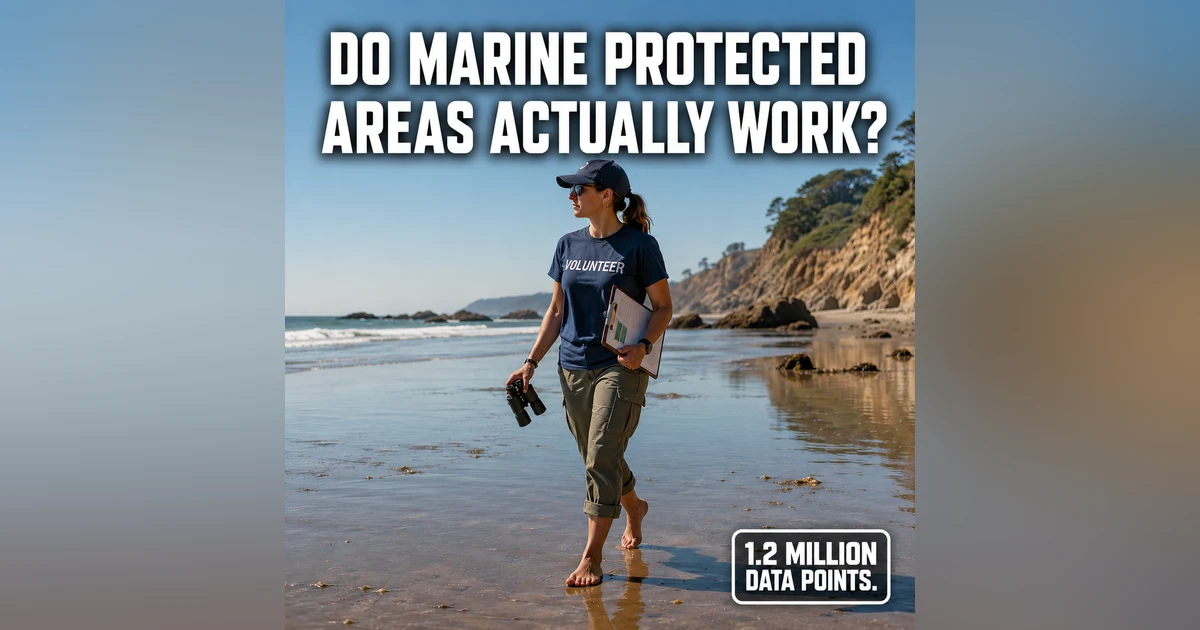
 For more than a decade, almost 2,000 volunteers have walked California's beaches with clipboards, counting every swimmer, surfer, angler, and boat they see. It sounds simple, maybe even a little strange. But that pile of data, more than a million tally marks collected between 2012 and 2020, just answered a question marine scientists have debated for years: do marine protected areas actually work in the real world, not just on paper?
In this episode, we walk through what researchers found when they finally pulled that decade of volunteer data together. We look at how the MPA Watch program trains everyday people to track human activity on the coast, how scientists stripped out the noise to find the real signal, and what the numbers say about compliance, recreation, and enforcement inside no-take zones. We also connect this human data to a separate decade of underwater fish surveys, and to the famous Cabo Pulmo recovery story, to show why watching people matters as much as watching fish.
The takeaway is simple but important. Ocean protection does not have to mean locking people out, and it does not happen by accident. It works when people believe in it, follow it, and watch over it, and this episode gives you a few concrete ways to be one of those people, whether that means joining MPA Watch yourself, learning your local rules, or just reporting what you see.
Support Independent Podcasts: https://www.speakupforblue.com/patreon
Need help with your ocean non-profit, company, or project? Get the help you need with Pisces Oceans Inc.: https://www.piscesoceans.ca
Connect with Speak Up For Blue
Website: https://bit.ly/3fOF3Wf
Instagram: https://bit.ly/3rIaJSG
TikTok: https://www.tiktok.com/@speakupforblue
Twitter: https://bit.ly/3rHZxpc
YouTube: www.speakupforblue.com/youtube
00:00:00,049 --> 00:00:03,939
For more than 10 years, almost
2,000 people have been walking
2
00:00:03,949 --> 00:00:06,079
California beaches with a clipboard.
3
00:00:06,343 --> 00:00:07,483
They're not looking for shells.
4
00:00:07,493 --> 00:00:09,153
They're not looking for lost dogs.
5
00:00:09,340 --> 00:00:10,970
They're counting strangers.
6
00:00:11,193 --> 00:00:14,853
Every surfer, every kid in a
tide pool, every person with a
7
00:00:14,853 --> 00:00:19,693
fishing rod, every kayak, all of it
tallied one beach walk at a time.
8
00:00:20,086 --> 00:00:21,536
And here's the strange part.
9
00:00:21,786 --> 00:00:26,140
The pile of clipboard data, more than
a million little tally marks, just
10
00:00:26,140 --> 00:00:29,170
answered a question that scientists
have argued about for decades.
11
00:00:29,343 --> 00:00:31,793
Do marine protected areas actually work?
12
00:00:31,883 --> 00:00:35,240
Not just on paper, in the
real world with real people.
13
00:00:35,780 --> 00:00:38,996
Today, we are going to walk one
of those beaches with them, and
14
00:00:38,996 --> 00:00:42,296
we're going to find out what
all of that counting revealed.
15
00:00:42,903 --> 00:00:45,773
You're listening to the How to Protect
the Ocean podcast, and I'm Andrew Lewin.
16
00:00:45,773 --> 00:00:49,963
This is the show where we take
one ocean story a day and turn it
17
00:00:49,973 --> 00:00:53,963
into something you can actually do
every weekday, Monday to Friday.
18
00:00:54,013 --> 00:00:57,013
If this is your thing, do me a favor,
hit that follow button right now
19
00:00:57,013 --> 00:00:58,573
wherever you're listening to this.
20
00:00:58,650 --> 00:01:02,710
And it is the single easiest
way to help this show keep going.
21
00:01:02,756 --> 00:01:04,636
Then come back, and let's get into it.
22
00:01:04,636 --> 00:01:07,033
And of course, if you wanna
support the show, you can go
23
00:01:07,033 --> 00:01:08,783
to speakupforblue.com/patreon.
24
00:01:10,613 --> 00:01:14,143
That's speakupforblue.com/patreon.
25
00:01:14,686 --> 00:01:17,536
So let's start with the question
underneath the whole episode.
26
00:01:18,246 --> 00:01:21,916
When you hear the words marine
protected area, what do you picture?
27
00:01:22,576 --> 00:01:26,510
Probably a line on a map, a stretch of
coast where the rules are different.
28
00:01:26,860 --> 00:01:29,680
Maybe no fishing, maybe
not taking anything at all.
29
00:01:30,210 --> 00:01:34,360
Okay, but a line on the map does
not protect anything by itself.
30
00:01:34,690 --> 00:01:38,170
A rule only matters if people
follow it, and that raises a
31
00:01:38,170 --> 00:01:40,110
question almost nobody asks.
32
00:01:40,450 --> 00:01:42,390
Who is actually checking?
33
00:01:42,893 --> 00:01:47,903
Who is standing on that beach day after
day, seeing whether people obey the line?
34
00:01:48,323 --> 00:01:50,863
And if we did check, what would we find?
35
00:01:51,283 --> 00:01:56,453
Would we find a quiet compliance, or would
we find that protected is just a word
36
00:01:56,453 --> 00:01:58,823
we put on a sign and hope for the best?
37
00:01:59,409 --> 00:02:02,319
For most of the California coast,
for most of history, the honest
38
00:02:02,319 --> 00:02:04,590
answer was nobody really knows.
39
00:02:04,619 --> 00:02:05,709
Nobody was counting.
40
00:02:06,046 --> 00:02:08,686
Until a group of volunteers
decided to change that.
41
00:02:09,287 --> 00:02:10,167
Here's the scene.
42
00:02:10,567 --> 00:02:13,037
It was a bright Friday morning
on the California coast.
43
00:02:13,237 --> 00:02:18,070
A volunteer parks, grabs a data sheet and
a pair of binoculars, and walks down to
44
00:02:18,070 --> 00:02:23,130
a fixed starting point on the sand, the
same starting point every single time.
45
00:02:23,850 --> 00:02:26,630
Then they begin to walk a
set path along the shore.
46
00:02:27,010 --> 00:02:28,570
As they go, they count.
47
00:02:28,770 --> 00:02:29,850
Not everything at once.
48
00:02:30,100 --> 00:02:34,747
They count in categories: people
swimming, people surfing, people walking
49
00:02:34,747 --> 00:02:39,877
dogs, people tide pooling, people
fishing from the rocks, boats offshore.
50
00:02:40,327 --> 00:02:41,347
They note the weather.
51
00:02:41,467 --> 00:02:42,567
They note the tide.
52
00:02:42,847 --> 00:02:44,467
They write down the time of day.
53
00:02:45,207 --> 00:02:46,417
It sounds pretty simple.
54
00:02:46,497 --> 00:02:48,637
It sounds almost too simple to matter.
55
00:02:49,297 --> 00:02:50,647
But now multiply it.
56
00:02:51,317 --> 00:02:54,477
This is a statewide
program called MPA Watch.
57
00:02:54,683 --> 00:02:58,610
It runs through a network of about
a dozen local organizations from
58
00:02:58,610 --> 00:03:01,750
near the Oregon border all the
way down to the Mexican border.
59
00:03:02,160 --> 00:03:05,340
And when researchers pulled the
archive together for this new
60
00:03:05,340 --> 00:03:08,060
study, the numbers were staggering.
61
00:03:08,610 --> 00:03:12,920
Almost two thousand volunteers, more
than thirty thousand separate beach
62
00:03:12,920 --> 00:03:17,440
surveys, over one hundred sites
up and down the coast, both inside
63
00:03:17,440 --> 00:03:19,380
protected areas and outside them.
64
00:03:19,757 --> 00:03:23,577
And more than 1.2 human individual
activities all counted by
65
00:03:23,587 --> 00:03:26,097
hand between 2012 and 2020.
66
00:03:26,517 --> 00:03:27,337
Let that sink in.
67
00:03:27,487 --> 00:03:33,167
1.2 million tally marks made by regular
people on their own time because they
68
00:03:33,167 --> 00:03:35,337
cared about the water in front of them.
69
00:03:35,772 --> 00:03:37,832
And it is not always calm work.
70
00:03:38,175 --> 00:03:41,369
A reporter recently joined one
of these teams on a boat survey
71
00:03:41,369 --> 00:03:42,959
off La Jolla near San Diego.
72
00:03:43,319 --> 00:03:46,729
On that single trip, the crew spotted
three vessels that appeared to be
73
00:03:46,729 --> 00:03:48,789
fishing illegally inside a no-take zone.
74
00:03:49,349 --> 00:03:51,909
They logged the locations by
radar and sent them straight
75
00:03:51,919 --> 00:03:53,379
to state wildlife authorities.
76
00:03:53,849 --> 00:03:57,849
The statewide coordinator put it plainly,
"This program is basically California's
77
00:03:57,869 --> 00:04:01,329
only way to know what human activity
is actually happening on the beach."
78
00:04:01,759 --> 00:04:03,689
Those are the eyes on the coast.
79
00:04:04,326 --> 00:04:06,246
Now, what did all those eyes see?
80
00:04:06,702 --> 00:04:07,985
Here's where it gets really good.
81
00:04:08,562 --> 00:04:11,222
The researchers did not
just add up the tally marks.
82
00:04:11,662 --> 00:04:13,562
Volunteer data is actually pretty messy.
83
00:04:14,232 --> 00:04:17,982
People survey at different times, in
different weather, with different skills.
84
00:04:18,455 --> 00:04:21,806
So the team used careful statistical
models to strip out the noise.
85
00:04:22,176 --> 00:04:25,466
They controlled for the tide, the
season, the day of the week, the
86
00:04:25,466 --> 00:04:27,356
weather, the type of beach, all of it.
87
00:04:27,816 --> 00:04:31,022
They wanted the real signal,
not just the busy weekends.
88
00:04:31,382 --> 00:04:34,262
And when the signal came
through, it told a clear story.
89
00:04:34,532 --> 00:04:35,282
Three parts.
90
00:04:35,642 --> 00:04:36,562
First finding.
91
00:04:36,926 --> 00:04:41,156
The first finding inside the strictest
protected areas, the no-take zones where
92
00:04:41,156 --> 00:04:44,336
you are not supposed to remove anything,
the amount of fishing and collecting
93
00:04:44,336 --> 00:04:46,166
was significantly lower than outside.
94
00:04:46,606 --> 00:04:48,706
Compliance, in other
words, was pretty high.
95
00:04:49,092 --> 00:04:51,812
Across the whole state, the vast
majority of what people were
96
00:04:51,812 --> 00:04:53,512
doing broke no rules at all.
97
00:04:53,822 --> 00:04:56,632
The line of the map was
mostly being respected.
98
00:04:57,229 --> 00:05:00,586
The second finding, and this one
matters just as much, protection
99
00:05:00,586 --> 00:05:02,416
did not ruin anyone's fun.
100
00:05:02,792 --> 00:05:06,872
People were swimming, surfing, diving, and
walking the beach inside protected areas
101
00:05:06,896 --> 00:05:08,846
at the same rate as everywhere else.
102
00:05:09,059 --> 00:05:11,049
There was no measurable
drop in recreation.
103
00:05:11,449 --> 00:05:14,629
So the fear you sometimes hear
that protecting the ocean means
104
00:05:14,649 --> 00:05:17,689
locking people out of it, the
data simply didn't support that.
105
00:05:17,982 --> 00:05:22,696
You protect the fish, and people still
get their beach day, both things at once.
106
00:05:23,196 --> 00:05:27,306
And the third finding, the coast
is overwhelmingly a place people
107
00:05:27,306 --> 00:05:29,299
go to enjoy, not to extract.
108
00:05:29,789 --> 00:05:32,332
Take one busy Southern California
beach the study modeled.
109
00:05:32,642 --> 00:05:35,332
On one nice day, the model
predicted around four hundred
110
00:05:35,332 --> 00:05:36,402
and fifty people out there.
111
00:05:36,402 --> 00:05:40,296
And of all those people, only a
small handful, fewer than five,
112
00:05:40,296 --> 00:05:41,956
were there to take anything at all.
113
00:05:42,136 --> 00:05:44,456
Everyone else was just living
their life next to the sea.
114
00:05:44,969 --> 00:05:46,639
So put those three things together.
115
00:05:46,739 --> 00:05:48,329
People are mostly following the rules.
116
00:05:48,606 --> 00:05:52,176
Protection is not costing our
recreation, and extraction is
117
00:05:52,176 --> 00:05:53,856
the exception, not the norm.
118
00:05:54,402 --> 00:05:59,512
That is a genuinely hopeful picture, and
we only know it because somebody counted.
119
00:06:00,276 --> 00:06:01,396
This is why a quick pause here.
120
00:06:01,396 --> 00:06:04,112
If you are finding this useful,
the best thing you can do right
121
00:06:04,112 --> 00:06:07,302
now is share this episode with
one person who loves the ocean.
122
00:06:07,422 --> 00:06:07,882
Just one.
123
00:06:08,049 --> 00:06:10,782
That is how this show grows,
and it costs you nothing.
124
00:06:11,492 --> 00:06:14,232
Okay, because there's one more
layer here, and it is the layer
125
00:06:14,232 --> 00:06:15,822
that ties everything together.
126
00:06:16,269 --> 00:06:19,309
You might be thinking, fine, but
counting people is not counting fish.
127
00:06:19,319 --> 00:06:21,816
How do we know the protection
actually is helping the
128
00:06:21,816 --> 00:06:23,619
ocean, not just the beachgoers?
129
00:06:23,859 --> 00:06:27,826
That's a fair question, and this is where
the human data meets the underwater data.
130
00:06:28,326 --> 00:06:31,396
For years, separate teams of scientists
have been diving California's
131
00:06:31,396 --> 00:06:33,726
protected reefs, measuring the fish.
132
00:06:33,956 --> 00:06:36,659
In twenty twenty-two, the
state pulled ten years of that
133
00:06:36,659 --> 00:06:38,239
work together in a big review.
134
00:06:38,539 --> 00:06:41,719
The result across the network,
fish inside the protected areas
135
00:06:41,729 --> 00:06:45,736
were more abundant, larger, and
greater in total mass than fish in
136
00:06:45,736 --> 00:06:47,556
comparable areas open to fishing.
137
00:06:47,912 --> 00:06:51,915
The effect was strongest exactly where
you would expect, in places under heavy
138
00:06:51,915 --> 00:06:56,256
fishing pressure and in the larger, older
reserves that had no time to recover.
139
00:06:56,788 --> 00:06:58,468
Now, why does that recovery happen?
140
00:06:58,898 --> 00:07:03,018
Because people leave fish alone, which
brings us right back to the clipboards.
141
00:07:03,484 --> 00:07:04,354
Think of it this way.
142
00:07:04,754 --> 00:07:07,664
The dive surveys tell you
what is happening underwater.
143
00:07:07,924 --> 00:07:09,574
The beach counts tell you why.
144
00:07:09,944 --> 00:07:12,714
And if the fish are coming back,
the human data can show you that
145
00:07:12,714 --> 00:07:15,664
it is because people are actually
honoring the no-take zones.
146
00:07:16,092 --> 00:07:19,272
One data set without the
other is only half the story.
147
00:07:19,525 --> 00:07:21,145
Together, they close the loop.
148
00:07:21,643 --> 00:07:25,985
And when protection is real and
enforced, the payoff can be spectacular.
149
00:07:26,685 --> 00:07:29,835
There's a famous example just
south of California in Mexico
150
00:07:29,835 --> 00:07:31,635
a place called Cabo Pulmo.
151
00:07:32,115 --> 00:07:34,795
Local families fought to turn
their overfished reef into a
152
00:07:34,795 --> 00:07:38,141
strictly protected no-take park
and then actually defended it.
153
00:07:38,861 --> 00:07:42,151
Within about a decade, the total mass
of fish on the reef grew more than
154
00:07:42,151 --> 00:07:46,031
four times over a jump of roughly
four hundred and sixty percent.
155
00:07:46,451 --> 00:07:49,871
Big predators, the sharks and
groupers, came roaring back.
156
00:07:50,115 --> 00:07:53,185
It became one of the most dramatic
ocean recoveries ever measured.
157
00:07:53,655 --> 00:07:55,265
The difference is not magic.
158
00:07:55,711 --> 00:07:57,838
It's enforcement and a
community that showed up.
159
00:07:58,337 --> 00:08:00,887
That is the thread running
through this entire episode.
160
00:08:01,367 --> 00:08:03,257
Protection on paper does nothing.
161
00:08:03,647 --> 00:08:06,687
Protection that people believe
in and follow and watch
162
00:08:06,687 --> 00:08:08,327
over brings the ocean back.
163
00:08:08,697 --> 00:08:12,517
And the only reason we can prove
people are following it at the scale
164
00:08:12,517 --> 00:08:15,827
of an entire coastline is that a
couple of thousand volunteers kept
165
00:08:15,827 --> 00:08:17,337
walking the beach and counting.
166
00:08:17,823 --> 00:08:20,313
So here is the big idea I
want you to walk away with.
167
00:08:20,763 --> 00:08:24,233
We tend to think ocean recovery is
something that happens far away, done by
168
00:08:24,243 --> 00:08:26,363
experts in wetsuits and research boats.
169
00:08:26,647 --> 00:08:28,777
And that work is real, and it does matter.
170
00:08:29,070 --> 00:08:31,940
But this study is a reminder that
a huge piece of it is because of
171
00:08:32,000 --> 00:08:36,363
just ordinary people, people with a
clipboard and a free morning doing
172
00:08:36,363 --> 00:08:39,463
something small over and over for years.
173
00:08:39,847 --> 00:08:43,367
That patience became one point two
million data points, and those
174
00:08:43,377 --> 00:08:47,790
data points became proof, proof that
California's ocean protections are
175
00:08:47,790 --> 00:08:51,393
working and that people are largely
respecting them, and that we did not
176
00:08:51,393 --> 00:08:53,323
have to give up the coast to protect it.
177
00:08:53,837 --> 00:08:57,637
The ocean is not only saved by heroes,
it is saved by people who just show
178
00:08:57,637 --> 00:09:00,023
up, which means you can be one of them.
179
00:09:00,437 --> 00:09:02,587
Let me give you a few real options here.
180
00:09:02,917 --> 00:09:05,693
Nothing here is going to
single-handedly save the ocean, and
181
00:09:05,693 --> 00:09:07,563
I am not gonna pretend otherwise.
182
00:09:07,827 --> 00:09:10,147
Each one is a genuine,
honest contribution.
183
00:09:10,527 --> 00:09:13,723
One, if you are anywhere near the
California coast, you can literally
184
00:09:13,723 --> 00:09:15,163
do what this episode is all about.
185
00:09:15,453 --> 00:09:18,943
MPA watch trains everyday
volunteers to walk these surveys.
186
00:09:19,247 --> 00:09:20,907
You do not need a science degree.
187
00:09:21,317 --> 00:09:24,880
Go to mpawatch.org and
find a program nearest you.
188
00:09:25,260 --> 00:09:28,860
A few surveys a month at your
own pace around the tides.
189
00:09:29,190 --> 00:09:30,300
That's the whole commitment.
190
00:09:30,810 --> 00:09:34,623
Two, wherever you live, learn
the local rules before you go.
191
00:09:34,813 --> 00:09:38,283
Find out where the nearest protected
area is and what it actually allows.
192
00:09:38,293 --> 00:09:41,070
Some zones let you fish,
some let you take nothing.
193
00:09:41,510 --> 00:09:45,540
Knowing the line and respecting it is one
of the most direct things that you can do.
194
00:09:46,083 --> 00:09:48,360
And third, the beach walk classic.
195
00:09:48,680 --> 00:09:51,400
Grab three pieces of trash
every time you leave the coast.
196
00:09:51,713 --> 00:09:55,133
Volunteers in this very program
call it the three of the sea.
197
00:09:55,477 --> 00:09:59,752
It is small, but it adds up Four,
if you see something that looks
198
00:09:59,752 --> 00:10:03,305
like poaching inside a protected
zone, you do not confront anyone.
199
00:10:03,489 --> 00:10:04,239
You report it.
200
00:10:04,419 --> 00:10:07,489
In California, that goes to the
Department of Fish and Wildlife tip line.
201
00:10:07,855 --> 00:10:11,475
Like those volunteers off La Jolla,
your job is just to be a witness.
202
00:10:11,645 --> 00:10:13,605
Collecting the observation is enough.
203
00:10:14,152 --> 00:10:16,562
And five, share what you learned today.
204
00:10:17,012 --> 00:10:20,742
The finding that protection works and
that it works without shutting people
205
00:10:20,742 --> 00:10:24,695
out is exactly the kind of thing
people need to hear about right now.
206
00:10:25,105 --> 00:10:25,895
So pass it on.
207
00:10:26,462 --> 00:10:27,682
That's it for today's episode.
208
00:10:27,682 --> 00:10:30,312
If you got something out of it, hit
that follow button so you don't miss
209
00:10:30,312 --> 00:10:34,215
tomorrow's story, and your feed
automatically downloads it and updates
210
00:10:34,215 --> 00:10:35,965
you on what's happening in the ocean.
211
00:10:36,172 --> 00:10:39,232
And to be honest, like, I really just
appreciate you listening each and
212
00:10:39,232 --> 00:10:42,022
every day, each and every weekday
that I publish, Monday to Friday.
213
00:10:42,139 --> 00:10:43,439
It's something that I really enjoy.
214
00:10:43,449 --> 00:10:44,849
It's kept me connected to the ocean.
215
00:10:45,019 --> 00:10:48,449
I'm a science communicator who works
for a company called Pisces Oceans, and
216
00:10:48,449 --> 00:10:49,859
I just love doing this kind of stuff.
217
00:10:49,879 --> 00:10:52,642
This is something that I will always
do, and this is episode 1978.
218
00:10:52,692 --> 00:10:57,292
1,978. It was actually the
year I was born, in 1978.
219
00:10:57,292 --> 00:10:57,912
Yeah, I'm old.
220
00:10:57,922 --> 00:10:58,442
It's okay.
221
00:10:58,525 --> 00:10:59,445
But I love this stuff.
222
00:10:59,455 --> 00:11:01,005
I really love the fact
that you're listening.
223
00:11:01,119 --> 00:11:03,609
If you have any suggestions on
this type of format that I'm
224
00:11:03,609 --> 00:11:05,689
doing, 'cause it's a little bit
different than I've done before, I
225
00:11:05,689 --> 00:11:07,375
would love to hear your thoughts.
226
00:11:07,482 --> 00:11:08,342
Please let me know.
227
00:11:08,342 --> 00:11:12,872
You can DM me on TikTok, on Facebook,
on Instagram, whichever one you prefer.
228
00:11:12,982 --> 00:11:16,572
Or you can go to
speakupforblue.com/patreon,
229
00:11:16,702 --> 00:11:19,682
and you can support the show if
you really love it that much.
230
00:11:19,812 --> 00:11:21,162
I appreciate you listening.
231
00:11:21,292 --> 00:11:24,492
This has been another exciting episode
of the How to Protect the Ocean podcast.
232
00:11:24,732 --> 00:11:25,782
I'm your host, Andrew Lewin.
233
00:11:25,792 --> 00:11:26,432
Have a great day.
234
00:11:26,432 --> 00:11:28,429
We'll talk to you next
time, and happy conservation.


