What Happens to Your Water Before the Coast Floods?

 Apple Podcasts
 Spotify
 YouTube
 Amazon Music
 PocketCasts
 Overcast
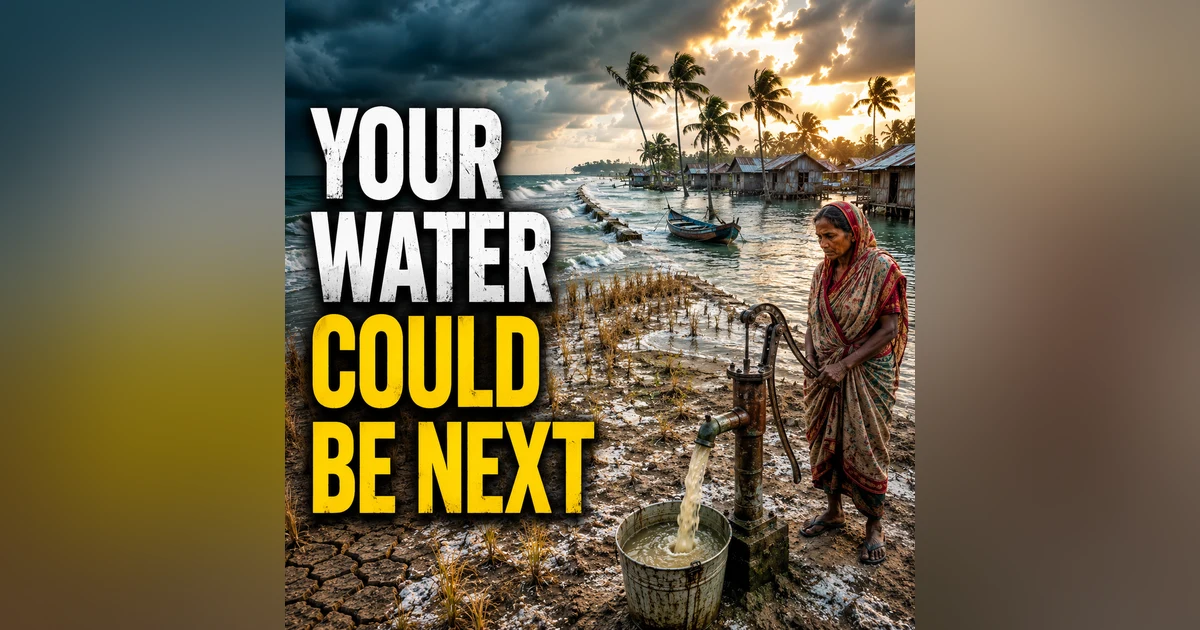
 Sea level rise isn’t always dramatic. Long before homes disappear beneath the waves, coastal communities can lose something even more essential: safe drinking water. In this episode, we explore how saltwater is quietly moving into freshwater supplies across coastal Bangladesh and why this hidden impact deserves far more attention.
Using a recent Mongabay commentary as a starting point, you’ll learn how rising seas, changing rivers, and human activities are combining to reshape one of the world’s largest river deltas. The consequences extend beyond drinking water to agriculture, public health, local economies, and the future of entire communities. It is a reminder that climate change often begins with changes we cannot immediately see.
This isn’t just Bangladesh’s story. Coastal communities around the world are becoming more vulnerable to saltwater intrusion as sea levels continue to rise. Understanding these early warning signs helps us better prepare for a future where protecting freshwater may become just as important as protecting our shorelines.
Support Independent Podcasts: https://www.speakupforblue.com/patreon
Need help with your ocean non-profit, company, or project? Get the help you need with Pisces Oceans Inc.: https://www.piscesoceans.ca
Connect with Speak Up For Blue
Website: https://bit.ly/3fOF3Wf
Instagram: https://bit.ly/3rIaJSG
TikTok: https://www.tiktok.com/@speakupforblue
Twitter: https://bit.ly/3rHZxpc
YouTube: www.speakupforblue.com/youtube
00:00:00,050 --> 00:00:03,290
What if climate change didn't flood
your home tomorrow, but made your
2
00:00:03,300 --> 00:00:06,040
drinking water undrinkable today?
3
00:00:06,603 --> 00:00:09,493
This is the How to Protect the Ocean
podcast, your weekday ocean news update.
4
00:00:09,513 --> 00:00:12,983
If you care about staying informed about
the ocean every single weekday, Monday to
5
00:00:12,983 --> 00:00:16,390
Friday, hit that follow button right now
on this podcast app that you're listening
6
00:00:16,390 --> 00:00:18,643
to, so you don't miss tomorrow's story.
7
00:00:19,386 --> 00:00:21,116
Today, we're answering
one important question.
8
00:00:21,396 --> 00:00:26,343
How is rising sea level quietly
transforming life in coastal Bangladesh?
9
00:00:26,473 --> 00:00:30,423
And why is this a warning for
coastlines around the world?
10
00:00:31,152 --> 00:00:34,598
Now, this episode is based off of
a story I found on Mongabay News.
11
00:00:34,648 --> 00:00:38,458
You can go to mongabay.com to
find out more about this article.
12
00:00:38,458 --> 00:00:41,548
I'll post the article in the show
notes so you have access to it.
13
00:00:41,705 --> 00:00:44,255
But today we're gonna be talking about
sea level rise in a country that we
14
00:00:44,255 --> 00:00:46,285
rarely talk about on this episode.
15
00:00:46,295 --> 00:00:49,005
But Bangladesh is a very
interesting country.
16
00:00:49,118 --> 00:00:52,282
I've covered it on Beyond Jaws
before with Dave Ebert where we talk
17
00:00:52,292 --> 00:00:54,005
about shark fisheries in Bangladesh.
18
00:00:54,005 --> 00:00:56,115
But today we're gonna be talking
about coastal communities that are
19
00:00:56,115 --> 00:00:59,125
getting more sea levels, getting
more salt in their drinking water,
20
00:00:59,125 --> 00:01:00,915
which is really difficult to imagine.
21
00:01:01,112 --> 00:01:03,148
'Cause when people talk about
sea level rise, they usually
22
00:01:03,148 --> 00:01:04,648
imagine dramatic images.
23
00:01:04,658 --> 00:01:08,638
Flooded streets, homes underwater,
storm surges crashing over sea walls.
24
00:01:08,728 --> 00:01:11,318
Those images are real,
and they actually happen.
25
00:01:11,441 --> 00:01:13,861
But they're not the first sign
that the ocean is changing.
26
00:01:13,901 --> 00:01:16,311
Sometimes the first sign
is something much quieter.
27
00:01:16,631 --> 00:01:20,711
You turn on the tap, the
water tastes slightly salty.
28
00:01:21,392 --> 00:01:22,711
Your crops stop growing.
29
00:01:22,855 --> 00:01:25,765
Your family starts getting sick
because fresh drinking water
30
00:01:25,765 --> 00:01:27,255
is becoming harder to find.
31
00:01:27,698 --> 00:01:31,608
That's the reality many people are living
along the coast of Bangladesh today.
32
00:01:31,885 --> 00:01:35,715
A new commentary published by Mongabay
argues that saltwater intrusion
33
00:01:35,715 --> 00:01:39,055
driven by rising seas and worsened
by human activities is already
34
00:01:39,055 --> 00:01:42,975
reshaping entire communities long
before permanent flooding arrives.
35
00:01:43,325 --> 00:01:46,205
This is not just a story that
centers around Bangladesh.
36
00:01:46,215 --> 00:01:48,855
Obviously, this is where the example is,
and this is where the commentary comes
37
00:01:48,855 --> 00:01:53,165
from, but this is really an ocean story
because one of the biggest impacts of sea
38
00:01:53,165 --> 00:01:55,445
level rise isn't the water we can see.
39
00:01:55,618 --> 00:01:57,118
It's the water beneath our feet.
40
00:01:57,536 --> 00:02:00,536
Bangladesh sits on one of the
largest river deltas in the world.
41
00:02:00,799 --> 00:02:04,916
Three major rivers, the Ganges,
the Brahmaputra, and the Manga
42
00:02:04,916 --> 00:02:06,396
empty into the Bay of Bengal.
43
00:02:06,779 --> 00:02:10,120
For centuries, these rivers have
carried fresh water and nutrient-rich
44
00:02:10,130 --> 00:02:13,610
sediment that supports farming,
fisheries, and millions of people.
45
00:02:13,773 --> 00:02:15,743
But today, that balance is changing.
46
00:02:16,113 --> 00:02:19,293
As sea level rise, saltwater
is pushing farther inland,
47
00:02:19,293 --> 00:02:20,693
pushing the freshwater back.
48
00:02:20,883 --> 00:02:23,903
It doesn't simply just flood
fields, it moves into rivers.
49
00:02:24,076 --> 00:02:25,406
It seeps into groundwater.
50
00:02:26,043 --> 00:02:30,803
It contaminates ponds and wells that
families have relied on for generations.
51
00:02:31,056 --> 00:02:33,909
The result is something called
saltwater intrusion, and it's
52
00:02:33,910 --> 00:02:35,460
exactly what it sounds like.
53
00:02:35,559 --> 00:02:38,209
Saltwater moves into places
where freshwater used to exist.
54
00:02:38,349 --> 00:02:40,773
I've covered an article where the
saltwater intrusion is happening
55
00:02:40,773 --> 00:02:43,593
in Florida, where we're starting to
see flooding that's happening not
56
00:02:43,593 --> 00:02:46,963
only on top of the land, but in the
groundwater and underneath the land.
57
00:02:46,963 --> 00:02:50,626
So when floods happen, it actually comes
from the soil first and goes through the
58
00:02:50,626 --> 00:02:52,516
pores of the soil and up onto the land.
59
00:02:52,943 --> 00:02:55,979
Once that happens, drinking
water becomes scarce.
60
00:02:56,169 --> 00:02:58,529
Agricultural soils become less productive.
61
00:02:58,706 --> 00:03:01,869
Even trees and freshwater
wetlands begin to struggle.
62
00:03:02,313 --> 00:03:06,073
The commentary points out that sea
level rise is only part of the problem.
63
00:03:06,310 --> 00:03:10,476
Reduced river flow, upstream water
management, coastal development, shrimp
64
00:03:10,476 --> 00:03:14,846
farming, and stronger cyclones all make
it easier for saltwater to move inland.
65
00:03:14,886 --> 00:03:18,546
Just think about, like, stronger
cyclones pushing that water further
66
00:03:18,546 --> 00:03:22,786
and further inland into groundwater and
allowing that saltwater to stay there.
67
00:03:23,046 --> 00:03:25,406
So in other words, it's
not just one single issue.
68
00:03:25,416 --> 00:03:28,926
It's several pressures
combining into a growing crisis.
69
00:03:29,286 --> 00:03:32,840
And because the changes happen
gradually, they often receive far less
70
00:03:32,840 --> 00:03:34,750
attention than floods or hurricanes.
71
00:03:35,276 --> 00:03:38,276
And here's why this story deserves
even more of our attention.
72
00:03:38,546 --> 00:03:42,136
Fresh water is one of the most
basic resources any community needs.
73
00:03:42,336 --> 00:03:46,373
Without it, everything becomes harder:
growing food, raising livestock,
74
00:03:46,423 --> 00:03:49,653
running businesses, maintaining
just public health in general.
75
00:03:50,073 --> 00:03:53,123
When fresh water becomes salty,
families often have to travel
76
00:03:53,133 --> 00:03:55,243
further to collect clean water.
77
00:03:55,663 --> 00:03:59,013
Now, if you think about it, like I
remember going back to my elementary
78
00:03:59,013 --> 00:04:00,583
school days, even my high school days.
79
00:04:00,643 --> 00:04:01,913
You know, in Canada, we
talk about fresh water.
80
00:04:01,913 --> 00:04:05,020
We hold twenty percent of the
world's fresh water, and we share
81
00:04:05,020 --> 00:04:06,480
that with the US through a border.
82
00:04:06,680 --> 00:04:09,150
And I remember, especially with the
amount of fresh water lakes that we
83
00:04:09,150 --> 00:04:10,840
have in Canada too, like we have a lot.
84
00:04:11,013 --> 00:04:13,763
And I remember a teacher telling
me one day that that's gonna become
85
00:04:13,763 --> 00:04:14,973
what wars are gonna be about.
86
00:04:15,180 --> 00:04:18,710
It's gonna be about the very
basic resource of fresh water
87
00:04:18,710 --> 00:04:22,090
because fresh water powers what
I just talked about everything.
88
00:04:22,333 --> 00:04:25,213
And without fresh water, you just
don't have healthy populations,
89
00:04:25,233 --> 00:04:28,333
or you have to adapt to make sure
that you have healthy populations.
90
00:04:28,503 --> 00:04:32,703
And because the salt water's intruding,
on our fresh water resources, we
91
00:04:32,703 --> 00:04:34,153
are having more and more problems.
92
00:04:34,300 --> 00:04:38,170
We have government bodies that are
dedicated to making sure that our
93
00:04:38,170 --> 00:04:42,096
source water for our drinking water
is clean, not just from salt, but
94
00:04:42,096 --> 00:04:45,556
from just chemicals and nitrates
and ammonia and all these other
95
00:04:45,556 --> 00:04:47,066
nutrients that are around in the water.
96
00:04:47,576 --> 00:04:48,716
So just think about that.
97
00:04:49,036 --> 00:04:51,640
Think about how important salt water has.
98
00:04:51,650 --> 00:04:54,350
Like farmers may actually lose
harvests because many of the
99
00:04:54,350 --> 00:04:58,340
crops can't tolerate increased
salinity in these Bengal regions.
100
00:04:58,583 --> 00:05:02,083
Some communities switch from growing
rice to farming shrimp because salt
101
00:05:02,083 --> 00:05:03,763
water now dominates their landscape.
102
00:05:04,176 --> 00:05:07,316
That may provide income for some
people, but it actually changes
103
00:05:07,316 --> 00:05:09,006
local ecosystems and food production.
104
00:05:09,366 --> 00:05:12,453
There's another consequence we
don't talk about either: migration.
105
00:05:12,863 --> 00:05:15,703
When farmland becomes less
productive and fresh water
106
00:05:15,703 --> 00:05:17,810
disappears, people begin to leave.
107
00:05:18,263 --> 00:05:21,313
Some move to nearby cities,
others relocate farther inland.
108
00:05:21,720 --> 00:05:24,720
Climate migration is often described
as something that will happen in
109
00:05:24,720 --> 00:05:27,830
the future, but many communities in
Bangladesh, it's already happening.
110
00:05:28,020 --> 00:05:31,873
We've seen it happen because of sea level
rise on small island communities as well.
111
00:05:32,250 --> 00:05:34,170
And this isn't unique to one country.
112
00:05:34,430 --> 00:05:37,860
Saltwater intrusion is becoming a
concern in coastal aquifers around
113
00:05:37,860 --> 00:05:40,750
the world, including, like I said,
Florida, like in the United States.
114
00:05:41,090 --> 00:05:44,510
Recent research has found declining
groundwater levels and increasing risk of
115
00:05:44,510 --> 00:05:49,110
seawater contamination across many coastal
regions from Asia to North America.
116
00:05:49,610 --> 00:05:52,220
That's what makes Bangladesh
such an important case study.
117
00:05:52,383 --> 00:05:56,953
The country itself is experiencing one
of the earliest and clear examples of
118
00:05:56,953 --> 00:05:58,803
what a saltier future could look like.
119
00:05:59,312 --> 00:06:02,052
So the question really is, like, is
there anything that communities can do?
120
00:06:02,336 --> 00:06:03,916
The answer is yes, believe it or not.
121
00:06:03,916 --> 00:06:05,646
But there isn't just one single solution.
122
00:06:06,072 --> 00:06:09,882
So protecting and restoring mangrove
forests can help reduce storm surges
123
00:06:09,882 --> 00:06:11,552
impacts and slow coastal erosion.
124
00:06:11,849 --> 00:06:16,449
So just keeping the coast green
essentially, like keeping it
125
00:06:16,449 --> 00:06:18,069
natural, naturalizing coast.
126
00:06:18,286 --> 00:06:19,506
I remember being at a
127
00:06:19,506 --> 00:06:21,436
Coastal Zone Canada conference.
128
00:06:21,536 --> 00:06:23,646
And it's a lot of engineers
and a lot of people who are
129
00:06:23,646 --> 00:06:24,976
doing things along the coast.
130
00:06:25,156 --> 00:06:28,016
The one study that I was listening
to was a study from an engineering
131
00:06:28,026 --> 00:06:31,842
firm where they talked about how they
were re-naturalizing the coastlines
132
00:06:31,852 --> 00:06:33,182
along the Mississippi Delta.
133
00:06:33,416 --> 00:06:36,236
And they were doing that because at one
point they hardened those coastlines
134
00:06:36,236 --> 00:06:37,966
because they were eroding away.
135
00:06:38,026 --> 00:06:40,206
Some parts were eroding and
some parts were building.
136
00:06:40,356 --> 00:06:43,539
But what they didn't realize is that
when something was eroding away, it
137
00:06:43,539 --> 00:06:46,269
was building another coastline
that was very, very important.
138
00:06:46,269 --> 00:06:49,012
And when they hardened the coastline
that was eroding away, there was
139
00:06:49,012 --> 00:06:52,212
no other sand or dirt or sediment
to build up the other coastlines.
140
00:06:52,212 --> 00:06:55,912
And we started to lose other coastlines,
changing, permanently changing the
141
00:06:55,912 --> 00:07:00,452
shape of the Mississippi Delta, which
affected a lot of indigenous people who
142
00:07:00,452 --> 00:07:04,152
lived there and had their lands there
and had their people, their ancestors
143
00:07:04,162 --> 00:07:08,892
buried there for many, many, many, many
years, like generations and generations.
144
00:07:09,219 --> 00:07:11,719
So they went back to
naturalizing those areas.
145
00:07:12,139 --> 00:07:16,099
So, you know, a lot of times in Bangladesh
and other places where you start to take
146
00:07:16,099 --> 00:07:21,189
away mangrove forests for shrimp farming
or coastal development, you start to
147
00:07:21,199 --> 00:07:26,286
lose that security system, and that
could stop sea level rise from actually
148
00:07:26,286 --> 00:07:29,446
intruding and saltwater intrusion from
actually happening at a better rate
149
00:07:29,456 --> 00:07:31,136
than you would if you took it all away.
150
00:07:31,396 --> 00:07:34,766
The biggest thing really, the point of
this part here is that, you know, we need
151
00:07:34,766 --> 00:07:36,556
to protect our coastal systems, right?
152
00:07:36,556 --> 00:07:39,482
You also, need to look into,
like, improving freshwater storage
153
00:07:39,482 --> 00:07:42,392
systems, which allows communities
to capture rainwater before
154
00:07:42,392 --> 00:07:44,722
saltwater reaches local supplies.
155
00:07:45,106 --> 00:07:48,326
Better groundwater management can
reduce over-pumping, which makes
156
00:07:48,326 --> 00:07:50,206
saltwater intrusion even worse.
157
00:07:50,616 --> 00:07:53,656
Engineers are also exploring
improved embankments, river
158
00:07:53,656 --> 00:07:56,206
management, and nature-based
solutions that work with coastal
159
00:07:56,206 --> 00:07:57,906
ecosystems instead of against them.
160
00:07:58,202 --> 00:08:01,322
And at the same time, the biggest
driver remains global climate change.
161
00:08:01,689 --> 00:08:04,749
The faster sea levels rise, the
harder it becomes for communities
162
00:08:04,749 --> 00:08:05,909
to stay ahead of the problem.
163
00:08:06,172 --> 00:08:09,902
And that's why this story
matters far beyond Bangladesh.
164
00:08:10,222 --> 00:08:14,312
Whether you live in Florida, Atlantic
Canada, the Netherlands, here in
165
00:08:14,332 --> 00:08:18,232
Ontario, small island nations in the
Pacific, or anywhere else along the
166
00:08:18,232 --> 00:08:20,206
coast, the same process is unfolding.
167
00:08:20,462 --> 00:08:24,832
The timing may be different, the severity
may vary, but the physics are the same.
168
00:08:25,292 --> 00:08:29,612
As oceans rise, saltwater moves
inland, and once freshwater resources
169
00:08:29,612 --> 00:08:33,062
become contaminated, recovering
them may be extremely difficult.
170
00:08:33,539 --> 00:08:36,639
One thing I appreciate about this
Mongabay commentary is that it reminds
171
00:08:36,639 --> 00:08:40,129
us climate change isn't only measured
in centimeters of sea level rise.
172
00:08:40,392 --> 00:08:44,559
It's measured in everyday decisions,
like, "Can I drink this water?" Not
173
00:08:44,559 --> 00:08:48,529
to say, "Hey, sea level's gonna rise
one centimeter in the next generation
174
00:08:48,529 --> 00:08:52,232
or the next, like, 50 years." That
number doesn't equate to people.
175
00:08:52,232 --> 00:08:55,702
But the fact is, like, can I drink
this water, or can I grow food
176
00:08:55,712 --> 00:08:58,276
here, or can my family even stay?
177
00:08:58,616 --> 00:09:01,652
Those are the questions people
are increasingly asking, and
178
00:09:01,652 --> 00:09:02,722
they have to answer for them.
179
00:09:03,026 --> 00:09:05,526
And those are the questions
that most coastal communities
180
00:09:05,526 --> 00:09:07,156
may face in the decades ahead.
181
00:09:07,679 --> 00:09:10,149
So sea level rise isn't
just about losing land.
182
00:09:10,149 --> 00:09:11,849
It's about losing fresh water.
183
00:09:12,236 --> 00:09:15,576
When the ocean changes, it's
flowing beneath our feet.
184
00:09:15,846 --> 00:09:18,536
It changes how people
live, work, and survive.
185
00:09:18,839 --> 00:09:21,199
The ocean is always a people story.
186
00:09:21,362 --> 00:09:22,282
I want you to remember that.
187
00:09:22,666 --> 00:09:25,816
The way we manage climate change,
the way we conserve the ocean, is
188
00:09:25,816 --> 00:09:27,586
we manage the people around it.
189
00:09:28,136 --> 00:09:31,529
That's how we help not only the
people who depend on it, but the
190
00:09:31,529 --> 00:09:33,239
people who are affecting it as well.
191
00:09:33,686 --> 00:09:34,786
That's the episode for today.
192
00:09:34,786 --> 00:09:35,946
I would love to hear what you think.
193
00:09:35,956 --> 00:09:37,096
You can hit me up my socials.
194
00:09:37,252 --> 00:09:38,592
Links are in the show notes.
195
00:09:38,732 --> 00:09:42,506
And of course, if you wanna support this
podcast or the YouTube channel that I have
196
00:09:42,602 --> 00:09:45,942
or any of the efforts that I have to make
your ability to understand the ocean a
197
00:09:45,942 --> 00:09:50,319
little bit better every single weekday,
please feel free to support me on Patreon.
198
00:09:50,329 --> 00:09:53,079
Go to speakupforblue.com/patreon.
199
00:09:53,316 --> 00:09:57,886
That's speakupforblue.com/patreon
to help support the show.
200
00:09:58,126 --> 00:10:00,656
Thank you so much for joining
me on today's episode of the How
201
00:10:00,656 --> 00:10:01,805
to Protect the Ocean podcast.
202
00:10:02,019 --> 00:10:02,619
Have a great day.
203
00:10:02,619 --> 00:10:04,702
We'll talk to you next
time, and happy conservation.


