Fossil Fuel Companies Knew They Were Destroying Coral Reefs Decades Ago
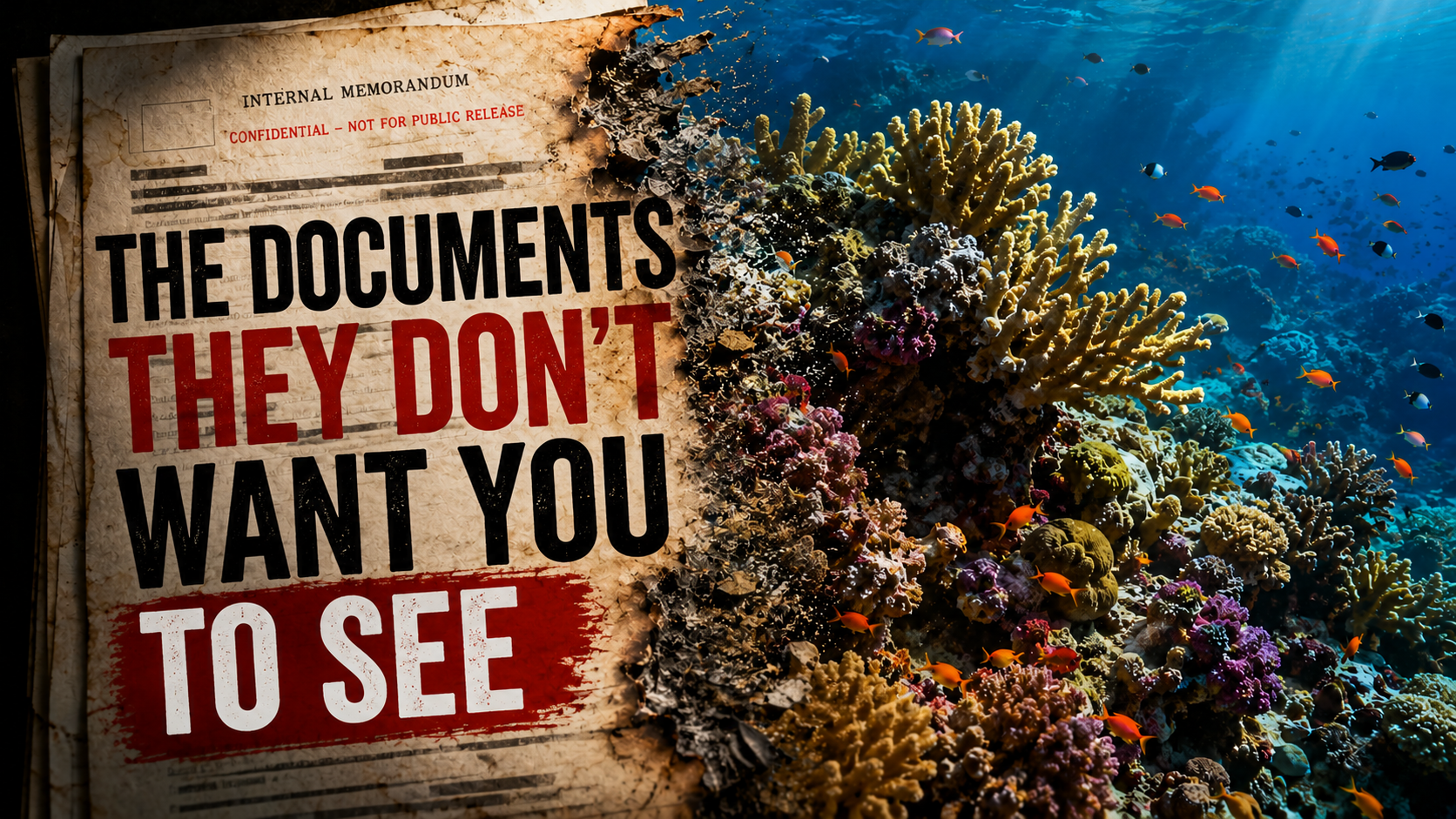
In 1978, an Exxon scientist stood in front of company management with a list of research questions. One was written in capital letters: were shallow water carbonates dissolving? In plain language, one of the biggest oil companies on Earth was asking, on the record, whether burning its own product would dissolve the world's coral reefs.
Over the following decade, Exxon got its answer. Then it spent years paying people to say the opposite.
That's the finding at the center of a new study from the University of Oxford's Climate Litigation Lab, published in the journal NPJ Ocean Sustainability in June 2026. Researchers reviewed more than fourteen thousand pages of internal fossil fuel industry documents and found that the world's largest oil and gas companies, often called the carbon majors, understood by the 1980s that their products threatened coral reefs in multiple, well-documented ways.
The chemistry, and what the industry wrote about it
A coral reef looks like rock but it's built by tiny animals. Coral polyps pull calcium and carbonate out of seawater and lay down a skeleton made of aragonite, a form of calcium carbonate. Burning fossil fuels releases CO2, and the ocean absorbs much of it. When CO2 dissolves into seawater, it makes the water more acidic and reduces the carbonate available for corals to build with. Take enough of it away and coral skeletons grow thinner and weaker, easier to snap in a storm and easier for boring organisms to damage.
Exxon's 1978 internal question was an early flag of this exact mechanism. By 1982, the company's scientists went further while evaluating a CO2-heavy natural gas field near Indonesia's Natuna Islands. Internal modeling concluded that injecting the field's CO2 into the deep ocean would spike acidity across roughly 1,000 square kilometers and dissolve aragonite and calcite structures, in other words, coral. The documents describe the chemistry of CO2 and seawater as "well understood" as early as 1982.
Shell's internal greenhouse effect working group reached a similar conclusion in a 1986 confidential report, warning that nearshore corals exposed to high-CO2, low-pH water could face what it called "not unrealistic" massive deaths of organisms, and that entire coral islands could disappear as a socioeconomic consequence of warming. By 1988, a Washington conference co-sponsored by fossil fuel interests, including Texaco and the American Petroleum Institute, heard NASA scientist James Hansen and others lay out that Caribbean corals could not survive water above 30 degrees Celsius, and that warming would intensify storms.
By the end of the 1980s, the industry had internal knowledge of all three major threats we watch destroy coral reefs today: acidification, heat-driven bleaching, and stronger storms, in some cases years before the world's climate scientists said the same things publicly through the IPCC.
Knowledge, then denial
The Oxford researchers describe what happened next as worse than silence. In 2012, the Cato Institute, a think tank funded over the years by ExxonMobil, the American Petroleum Institute, and Koch family foundations among others, published a 200-page report designed to closely resemble an official US government climate assessment. On coral reefs specifically, it argued the science did not support "alarming statements about losing reefs" and suggested bleached corals were simply adapting to warmer water.
That reassurance arrived five years after the IPCC's fourth assessment had already warned that all coral reefs would bleach below two degrees of warming, with extinction of remaining reef ecosystems likely around three degrees. The word "coral" appeared in that report's impact volume more than 700 times. Researchers call this pattern knowledge, denial, delay: learn the risk early, deny it publicly, and delay any response for as long as possible.
Where reefs stand now
Between January 2023 and mid-2025, the world experienced the fourth global coral bleaching event, and the largest ever recorded. According to NOAA, bleaching-level heat stress hit roughly 84 percent of the world's coral reef area across at least 83 countries and territories, compared to about 21 percent during the first recorded global bleaching event in 1998. NOAA's Coral Reef Watch had to add three new alert levels to its bleaching scale because the existing top level no longer captured the severity. When NOAA announced the event had likely ended in 2025, its coordinator noted that reefs are now bleaching on a near-annual basis, without the multi-year recovery windows corals need.
The paper trail is becoming legal evidence
The Oxford study wasn't written only to document history. Internal memos and funded disinformation campaigns are exactly the kind of evidence courts have started to act on. In January 2026, a court in The Hague ruled in a case brought by Greenpeace Netherlands and residents of Bonaire, whose reefs are bleaching and whose coastline could be up to one-fifth underwater by the end of the century. The court found the Dutch government was violating human rights by failing to do its fair share to limit warming to 1.5 degrees, and ordered the state to adopt a real climate adaptation plan by 2030. Dying coral reefs were part of the evidence the court accepted, and the ruling was declared enforceable even pending appeal.
For decades, the story was that industry knew and nothing happened. That's starting to change: the knowing is becoming evidence, and evidence is leverage.
What you can actually do
Roughly one billion people depend on coral reefs for food, income, and coastal protection, and reefs shelter more than a quarter of all named marine species. This isn't only an aesthetic loss. Four concrete steps from the episode:
- Know the story well enough to tell it. Being able to calmly and accurately explain that this was foreseen and hidden shifts how people understand the cause, which is what makes policy and litigation politically possible.
- Support the accountability work. Groups like the Climate Litigation Lab at Oxford and organizations tracking climate cases are turning documents into legal pressure.
- Push your emissions lever at the scale you have. For most people that means contacting elected representatives and checking where pension or investment money sits, not just individual consumer choices.
- Get in the water respectfully. Snorkeling a reef, supporting local reef organizations, or following restoration-focused marine biologists builds the kind of connection that sustains long-term action.
Cutting emissions is the single most powerful lever for buying reefs the time and cooler water they need to recover. Everything else, restoration projects and marine protected areas, buys time. Emissions cuts buy the future.

CEO


