Do Marine Protected Areas Actually Work? Here's What 2,000 Volunteers Found Out
The Question Nobody Was Answering
When you hear "marine protected area," you probably picture a line on a map. A stretch of coast where the rules are different, where fishing might be limited or banned outright. But a line on a map does not protect anything by itself. A rule only matters if people follow it, and for most of California's history, nobody was really checking whether they did.
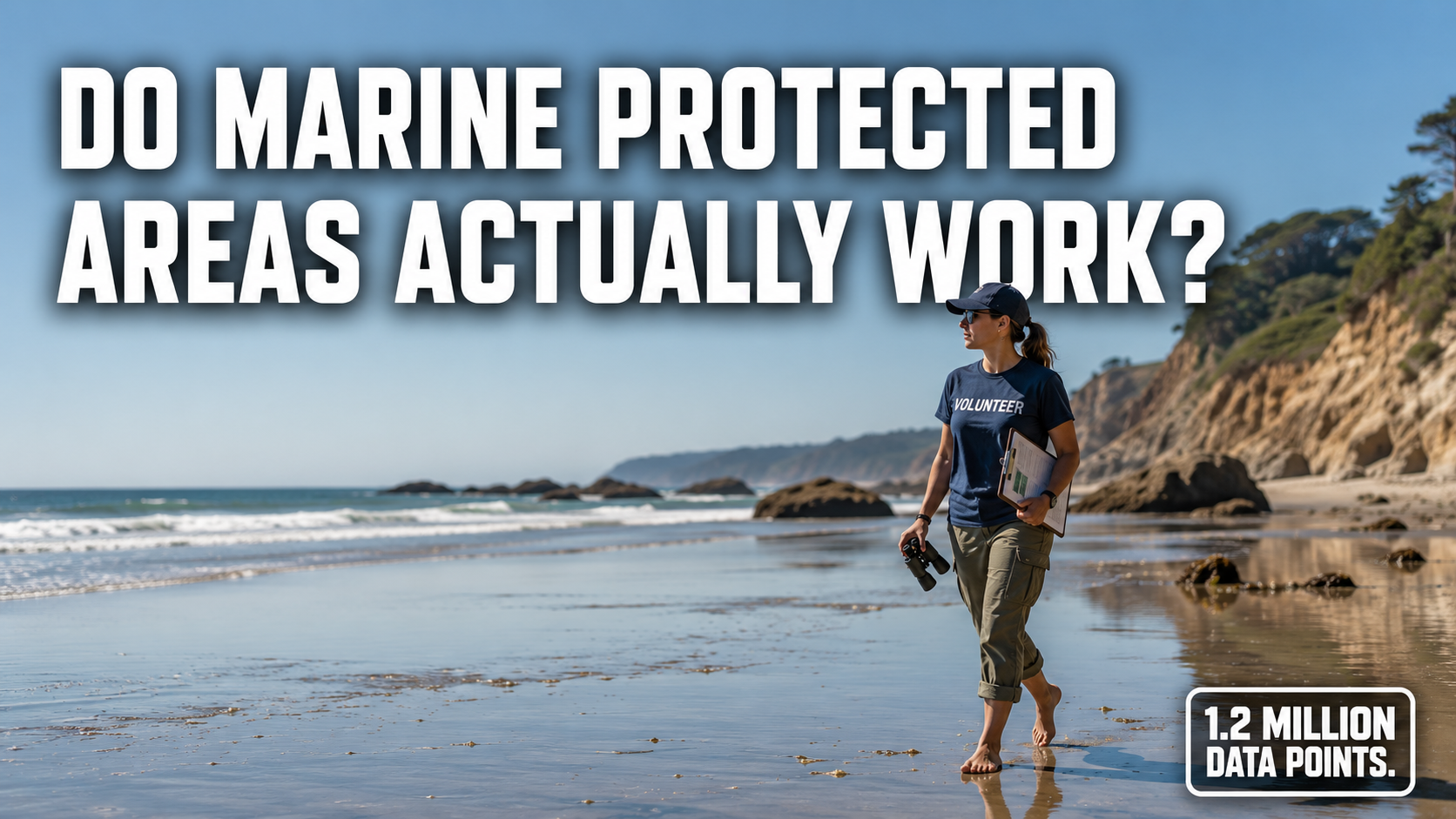
That changed with a program called MPA Watch. For more than ten years, volunteers have walked fixed routes along California beaches, counting every category of human activity they see: swimmers, surfers, anglers, tide poolers, dog walkers, boats offshore. They log the weather, the tide, and the time of day, then repeat the same walk again and again.
The Scale of the Data
MPA Watch runs through a network of roughly a dozen local organizations stretching from the Oregon border to the Mexican border. When researchers pulled the program's archive together for a new study, the totals were striking: almost 2,000 volunteers, more than 30,000 separate beach surveys, over 100 sites both inside and outside protected areas, and more than 1.2 million individual human activities tallied by hand between 2012 and 2020.
The work is not always uneventful. On one boat survey off La Jolla near San Diego, a volunteer crew spotted three vessels that appeared to be fishing illegally inside a no-take zone and reported the locations directly to state wildlife authorities. As the program's statewide coordinator put it, this is essentially California's only way to know what human activity is actually happening on the beach.
What the Numbers Actually Show
Raw tally marks are messy. People survey at different times, in different weather, with different levels of experience. So researchers used statistical models to control for tide, season, day of week, weather, and beach type, isolating the real signal from the noise. Three findings stood out.
First, inside the strictest no-take zones, fishing and collecting were significantly lower than outside them. Compliance was high. Second, protection did not reduce recreation. People swam, surfed, dove, and walked the beach inside protected areas at the same rate as everywhere else, so there was no measurable trade-off between conservation and access. Third, extraction was rare overall. In one modeled scenario on a busy Southern California beach, out of roughly 450 people on a nice day, fewer than five were there to take anything at all.
Connecting Human Behavior to Ocean Recovery
Counting people is not the same as counting fish, so researchers connected this human behavior data to a separate body of underwater science. A 2022 statewide review compiled a decade of diver surveys and found that fish within protected areas were more abundant, larger, and had greater total mass than fish in comparable areas open to fishing, with the strongest effects in reserves under heavy fishing pressure.
The two data sets close the loop on each other. The dive surveys show what is happening underwater. The beach counts show why: people are largely honoring the no-take zones. It is the same pattern behind one of the most dramatic ocean recoveries ever recorded, at Cabo Pulmo in Mexico, where local families turned an overfished reef into a strictly protected, strictly enforced no-take park. Within about a decade, the total fish biomass on that reef grew by roughly 460 percent, with large predators like sharks and groupers returning in force.
What This Means, and What You Can Do
Protection on paper does nothing on its own. Protection that people believe in, follow, and watch over is what brings the ocean back, and the only reason anyone can prove that at the scale of an entire coastline is that thousands of ordinary volunteers kept showing up with a clipboard.
If you live near the California coast, you can join MPA Watch directly at mpawatch.org. Wherever you live, learn the rules of your nearest protected area before you visit. Pick up three pieces of trash every time you leave the coast. If you see what looks like poaching in a protected zone, do not confront anyone, just report it, in California to the Department of Fish and Wildlife tip line. And if this episode changed how you think about ocean protection, share it with someone who loves the ocean too.

CEO


