New Deep Sea Species Found Off Brazil, Including a Giant Ghost Octopus
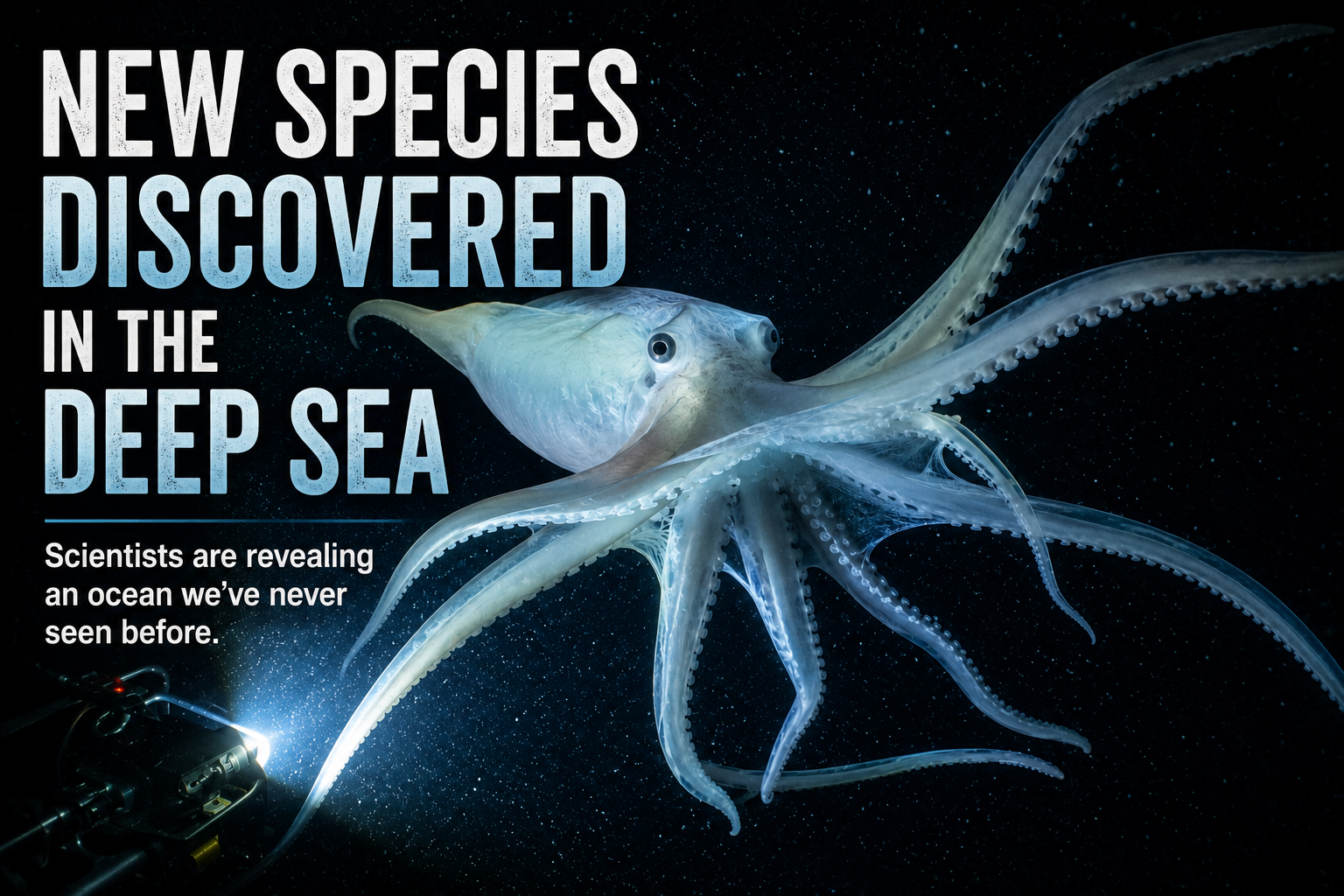
Picture a control room on a ship far off the coast of Brazil. Below, a robot the size of a small car sinks through black water a thousand meters down, its lights cutting a narrow tunnel through the dark. Then something drifts into frame: big, pale arms unfurling like a parachute. It's a giant open ocean octopus, an animal almost no one has ever seen alive, calmly eating a jellyfish.
That moment happened recently during an expedition run by the Schmidt Ocean Institute, using the research vessel Falkor (too) and the ROV SuBastian. The team wasn't diving to the seafloor. They were exploring the midwater, the open water between the sunlit surface and the bottom, sometimes called the ocean's middle. What they found there was a parade of animals, more than two dozen of them new to science: shimmering comb jellies, chain-like siphonophores, tadpole-shaped larvaceans, a glowing worm, a transparent glass squid, and a dinner-plate jellyfish caught mid-hunt.
Then there was the octopus. Scientifically named Haliphron atlanticus, she's unusual because most octopuses live on the seafloor, while this species lives out in the open water column. The animal filmed had a body about the length of a forearm, but the species can grow to roughly four meters from arm tip to arm tip and weigh close to 75 kilograms. Almost everything scientists know about this animal comes from dead specimens hauled up in nets, so watching one alive and feeding at depth offered a rare window into real behavior. The team used non-invasive tools, including a 3D laser scanner developed at the Monterey Bay Aquarium Research Institute, to study these fragile animals without touching them.
The bigger story here is scale. The expedition's chief scientist, Karen Osborn of the Smithsonian, has called the midwater the largest habitat on Earth, and by volume that's accurate. Yet a 2025 study in the journal Science Advances found that humans have visually observed less than 0.001% of the deep seafloor, an area smaller than Rhode Island, across nearly seventy years of exploration, with most of that limited effort clustered near just three countries. The midwater above it is even less studied.
That matters beyond curiosity. Midwater animals are central to what's called the biological carbon pump: plankton at the surface absorb carbon dioxide, get eaten, and sink as waste and dead material, while midwater animals capture, process, and carry that carbon deeper, some by migrating up to feed at night and back down by day. Estimates suggest this pump moves somewhere between 5 and 12 million tons of carbon from the surface toward the deep ocean every year, much of it locked away for a century or more.
That same midwater now sits at the center of a decision about deep sea mining. Companies want to extract metal-rich nodules containing cobalt, nickel, copper, and manganese from the seafloor, but the process kicks up sediment plumes that drift through the midwater above. Lab research on a deep sea jellyfish, published in Nature Communications, found its stress response to mining-like sediment was more severe than its response to a four-degree jump in water temperature. Because the midwater functions as one connected, moving system, scientists warn these plumes could spread for tens of thousands of kilometers.
The rulebook that would allow full commercial deep sea mining hasn't been finished by the International Seabed Authority, and as of 2026, around 40 countries, including Canada and Brazil, have called for a pause until the science catches up. The decision is still open, which means public pressure still matters.
What you can do this week:
- Watch the Schmidt Ocean Institute's free dive footage on YouTube to see the octopus and the midwater for yourself.
- Find out where your country stands on deep sea mining and send a short note to your representative, whether that's a thank-you for backing a pause or a request to support one.
- Follow and share the work of groups like the Schmidt Ocean Institute, the Monterey Bay Aquarium Research Institute, and the Ocean Discovery League.
- Support electronics and battery recycling, since demand for deep sea metals is tied heavily to battery production.

CEO


