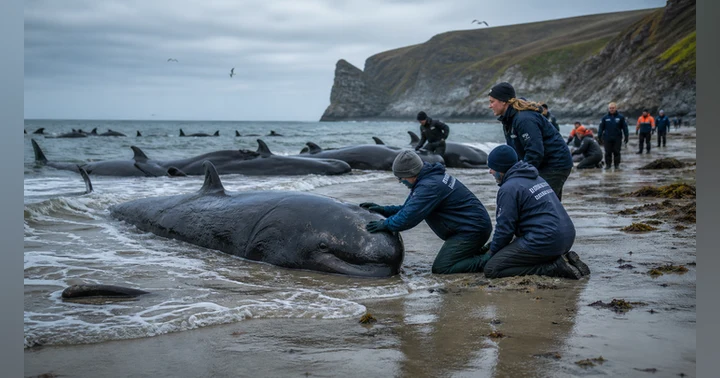
Why Healthy Whales Are Suddenly Ending Up on Beaches


 Apple Podcasts
 Spotify
 YouTube
 Amazon Music
 PocketCasts
 Overcast
 Whale strandings are heartbreaking, but what happens when the whales are not sick? In this episode of How to Protect the Ocean, we look at a recent mass pilot whale stranding in Scotland, where many of the animals appeared to be healthy before they ended up on shore.
Pilot whales are highly social animals, which means one wrong turn can become a disaster for the entire pod. As prey shifts closer to shallow coastal waters, whales may follow their food into places where navigation becomes harder and the risk of stranding increases.
Ocean change is the bigger story. These strandings may not just be random events. They may be signals that prey, currents, temperatures, and ecosystems are shifting in real time.
Support Independent Podcasts: https://www.speakupforblue.com/patreon
Help fund a new seagrass podcast: https://www.speakupforblue.com/seagrass
Connect with Speak Up For Blue
Website: https://bit.ly/3fOF3Wf
Instagram: https://bit.ly/3rIaJSG
TikTok: https://www.tiktok.com/@speakupforblue
Twitter: https://bit.ly/3rHZxpc
YouTube: www.speakupforblue.com/youtube
00:00:00,050 --> 00:00:02,470
The whales we're gonna talk
about today, they weren't sick.
2
00:00:02,730 --> 00:00:06,316
They were just in the wrong
place at the wrong time.
3
00:00:06,853 --> 00:00:11,193
This is the How to Protect the Ocean
podcast, and if you are interested in
4
00:00:11,193 --> 00:00:14,523
knowing more about the ocean, need a
resource to find out more about the
5
00:00:14,523 --> 00:00:17,976
ocean, what's happening, the good, the
bad, maybe the ugly at some point, I
6
00:00:17,976 --> 00:00:22,206
want you to hit that follow button right
now because this is the podcast for you.
7
00:00:22,356 --> 00:00:25,876
You're gonna learn everything
five days a week on this podcast.
8
00:00:25,876 --> 00:00:30,623
Normally, we do a solo show Monday through
Thursday, and then we'll do an interview.
9
00:00:30,643 --> 00:00:34,463
This week, we're gonna be doing
five randomized podcasts, solo
10
00:00:34,463 --> 00:00:36,443
podcasts, Monday to Friday.
11
00:00:36,573 --> 00:00:37,543
Normally, there's a theme.
12
00:00:37,703 --> 00:00:40,553
Today we're just gonna randomize, gonna
go back to the old school How to Protect
13
00:00:40,553 --> 00:00:43,193
the Ocean podcast, and I can't wait
to get into it 'cause we're gonna talk
14
00:00:43,193 --> 00:00:45,610
about these whales, these pilot whales.
15
00:00:45,800 --> 00:00:49,600
Why are healthy whales ending
up stranded on beaches?
16
00:00:49,690 --> 00:00:53,153
Every time you see a stranding
or news of a stranding... I've
17
00:00:53,153 --> 00:00:54,063
never seen a stranding live.
18
00:00:54,063 --> 00:00:55,523
I don't know if I can
handle it emotionally.
19
00:00:55,620 --> 00:00:57,133
You have people who react to them.
20
00:00:57,133 --> 00:00:59,043
You have whale stranding networks.
21
00:00:59,183 --> 00:01:00,533
There's some in the UK.
22
00:01:00,533 --> 00:01:01,723
There's some in North America.
23
00:01:01,723 --> 00:01:04,813
There are some all over the world,
and these are a lot of times
24
00:01:04,813 --> 00:01:08,103
volunteers that will patrol or go out.
25
00:01:08,103 --> 00:01:13,123
They're trained to specifically handle
beached whales situations or any kind
26
00:01:13,123 --> 00:01:16,333
of beaching of any type of animal, and
they go out, and they make sure the right
27
00:01:16,333 --> 00:01:19,413
authorities know what to do, or they
can come out to these whale strandings.
28
00:01:19,573 --> 00:01:21,633
But it's really difficult to go out there.
29
00:01:21,663 --> 00:01:24,253
You have these whales that a lot
of the times they don't make it.
30
00:01:24,516 --> 00:01:26,029
They come onto the beach.
31
00:01:26,029 --> 00:01:28,329
We don't really know why
they're coming onto the beach.
32
00:01:28,499 --> 00:01:31,689
A lot of times, if it's like pilot
whales, they tend to follow the leader.
33
00:01:31,689 --> 00:01:34,546
And if the leader's sick or it
ends up beaching itself, the entire
34
00:01:34,546 --> 00:01:36,096
pod will beach itself as well.
35
00:01:36,096 --> 00:01:38,386
So it's a difficult situation to look at.
36
00:01:38,556 --> 00:01:43,356
In this latest or recent study that was
reported by phys.org, which is a great
37
00:01:43,356 --> 00:01:47,693
site as well, looked at a major pilot
whale stranding in Scotland, where
38
00:01:47,693 --> 00:01:51,263
more than 50 whales were stranded.
39
00:01:51,629 --> 00:01:53,873
That is insane amount.
40
00:01:53,873 --> 00:01:56,513
Now, like I said, pilot whales,
they come in large pods.
41
00:01:56,793 --> 00:01:59,813
We don't know why they really beach
themselves, but they're known to beach.
42
00:01:59,813 --> 00:02:02,200
They beach in New Zealand, up in the UK.
43
00:02:02,380 --> 00:02:05,440
This is not necessarily a rare occasion.
44
00:02:05,520 --> 00:02:07,650
It's just one that we've seen a lot.
45
00:02:07,700 --> 00:02:10,440
And the ones that were stranded,
these 50, many of them were in good
46
00:02:10,440 --> 00:02:12,310
health before it actually happened.
47
00:02:12,536 --> 00:02:14,786
That's what makes this one different.
48
00:02:15,083 --> 00:02:20,073
The detail that really changes this story
is that most of the animals were healthy.
49
00:02:20,313 --> 00:02:23,293
They weren't sick, they weren't
disoriented, they didn't
50
00:02:23,293 --> 00:02:24,323
have any problems with them.
51
00:02:24,353 --> 00:02:28,833
All the animals that stranded and ended
up dying, they were actually healthy.
52
00:02:29,060 --> 00:02:32,043
This wasn't a disease, and
it wasn't an obvious injury.
53
00:02:32,336 --> 00:02:35,586
Instead, researchers found
something else, and this is
54
00:02:35,586 --> 00:02:37,736
where it really comes into play.
55
00:02:37,860 --> 00:02:40,140
Like the mysteries of the
ocean, everything that comes on.
56
00:02:40,313 --> 00:02:44,823
These whales had been feeding in areas
that were closer to the continental shelf,
57
00:02:45,163 --> 00:02:49,363
right near shallow coastal zones, which
these pilot whales aren't really there.
58
00:02:49,660 --> 00:02:52,870
Now, these places are productive,
but they can be dangerous because
59
00:02:52,900 --> 00:02:55,120
of the shallowness of the area.
60
00:02:55,410 --> 00:02:56,470
Whales follow food.
61
00:02:57,030 --> 00:02:58,380
That's how the ocean works.
62
00:02:58,730 --> 00:03:01,550
But when food shifts, so do whales, right?
63
00:03:01,550 --> 00:03:03,550
That happens with a lot of these animals.
64
00:03:03,550 --> 00:03:05,030
They gotta go where their food is.
65
00:03:05,060 --> 00:03:09,010
And now, these days, with everything
going on in the world, you have climate
66
00:03:09,010 --> 00:03:13,523
change that is shifting where these
fish are going, where whales are going to
67
00:03:13,523 --> 00:03:15,783
follow the fish, where upwellings happen.
68
00:03:15,783 --> 00:03:18,630
And if you don't know what an upwelling
is, essentially It's a place like, on
69
00:03:18,630 --> 00:03:22,540
the ocean where cold, nutrient-rich
waters come from deep in the ocean,
70
00:03:22,540 --> 00:03:26,630
they come up to the surface, and it
brings fish around 'cause you get a
71
00:03:26,630 --> 00:03:28,340
lot of plankton in those upwellings.
72
00:03:28,590 --> 00:03:30,250
The fish will come to
feed on the plankton.
73
00:03:30,620 --> 00:03:34,820
The larger fish and marine mammals and sea
turtles and everything will come in and
74
00:03:34,820 --> 00:03:36,710
feed on everything else that's coming in.
75
00:03:36,896 --> 00:03:39,546
Seabirds will dive in, and it's
actually quite a productive area.
76
00:03:39,723 --> 00:03:42,703
You have a lot of these different areas
around the ocean that are being shifted
77
00:03:42,703 --> 00:03:45,413
around because currents are shifting,
'cause wind patterns are shifting,
78
00:03:45,450 --> 00:03:48,590
because the climate is changing,
and that's what we have to go with.
79
00:03:48,590 --> 00:03:52,620
And so it becomes really difficult
to track where these new areas are.
80
00:03:52,620 --> 00:03:55,970
Like, let's go back to marine
mammals that were being killed, like
81
00:03:55,970 --> 00:03:58,793
the North Atlantic right whale on
the East Coast of North America.
82
00:03:59,003 --> 00:04:00,693
They were normally in the US.
83
00:04:00,723 --> 00:04:03,403
They would go from Jacksonville,
Florida, in the winter all
84
00:04:03,403 --> 00:04:06,653
the way up to, say, like, New
England and Maine in the summers.
85
00:04:06,933 --> 00:04:09,483
Then, all of a sudden, they
started to go into the Gulf of
86
00:04:09,483 --> 00:04:10,813
St. Lawrence and up in Canada.
87
00:04:11,020 --> 00:04:12,000
Why are they up there?
88
00:04:12,090 --> 00:04:13,030
It's warmer waters.
89
00:04:13,030 --> 00:04:15,890
They can extend their range because it's
warmer waters, and they ended up being
90
00:04:15,890 --> 00:04:19,030
there, and 17 of them that summer that
we found them there ended up dying
91
00:04:19,030 --> 00:04:20,630
because the ships weren't ready for them.
92
00:04:20,630 --> 00:04:21,710
The ships ran into them.
93
00:04:21,816 --> 00:04:24,266
They got entangled from fishing
gear, and they ended up dying.
94
00:04:24,416 --> 00:04:25,606
A lot of the shifts had to change.
95
00:04:25,606 --> 00:04:29,496
Not only are we seeing a shift in
ecology, but we have to get into a
96
00:04:29,496 --> 00:04:33,086
shift of how we conduct ourselves
in the ocean during that time.
97
00:04:33,406 --> 00:04:35,436
So that's essentially
what's been happening.
98
00:04:35,640 --> 00:04:39,066
The shifts of animals coming into
closer to shore can bring these
99
00:04:39,066 --> 00:04:42,166
marine mammals that follow the
prey into risky environments,
100
00:04:42,206 --> 00:04:44,036
which is essentially shallow water.
101
00:04:44,266 --> 00:04:46,416
That's probably their biggest crux.
102
00:04:46,466 --> 00:04:48,146
As my daughter would say, the biggest op.
103
00:04:49,346 --> 00:04:49,676
I know.
104
00:04:49,736 --> 00:04:50,296
I'm older.
105
00:04:50,366 --> 00:04:51,766
I, I don't... I- it doesn't work.
106
00:04:51,889 --> 00:04:53,489
It doesn't feel good coming off my lips.
107
00:04:53,529 --> 00:04:54,039
But whatever.
108
00:04:54,156 --> 00:04:54,806
Yeah, yeah, I said it.
109
00:04:54,896 --> 00:04:55,516
I said it there.
110
00:04:55,516 --> 00:04:57,506
I said I'm not editing
that out regardless.
111
00:04:57,846 --> 00:04:59,876
But, you know, shallow waters
have complex coastlines.
112
00:04:59,986 --> 00:05:02,366
Places where navigation can become harder.
113
00:05:02,636 --> 00:05:05,573
It's difficult for pilot whales to go in.
114
00:05:05,623 --> 00:05:08,123
You add one more layer that
pilot whales are highly social.
115
00:05:08,353 --> 00:05:10,833
If one individual gets into trouble,
like I mentioned earlier, the
116
00:05:10,833 --> 00:05:13,113
entire group will actually follow.
117
00:05:13,461 --> 00:05:17,141
And when you have an entire group that's
following one animal or a couple of
118
00:05:17,141 --> 00:05:22,218
animals that are going through, this
social behavior amplifies the risk of
119
00:05:22,218 --> 00:05:23,818
what is gonna happen to these animals.
120
00:05:23,958 --> 00:05:25,201
They're in coastal waters.
121
00:05:25,201 --> 00:05:27,848
They're close to coastal waters,
where navigation can be difficult.
122
00:05:27,848 --> 00:05:29,618
They navigate using echolocation.
123
00:05:29,761 --> 00:05:34,211
That shallow water compared to deep water,
the sound reverberations that they use
124
00:05:34,211 --> 00:05:38,081
to look for the way they're going, their
navigation, can really throw them off and
125
00:05:38,081 --> 00:05:40,281
disorientate them in these shallow areas.
126
00:05:40,491 --> 00:05:43,291
So as they're going through the
shallow areas, they get disoriented,
127
00:05:43,291 --> 00:05:46,281
they lose their navigation, they
end up getting beached, and then
128
00:05:46,431 --> 00:05:49,091
because they're so social, a lot of
the other animals will just follow
129
00:05:49,091 --> 00:05:50,261
them even though they're healthy.
130
00:05:50,541 --> 00:05:55,415
So one mistake becomes a mass stranding,
and this is the key insight here.
131
00:05:55,605 --> 00:05:57,525
Strandings are not just random.
132
00:05:57,665 --> 00:06:01,155
They are signals telling us
that the ocean is changing.
133
00:06:01,548 --> 00:06:05,028
And so when we have a changing ocean,
we have a lot of stuff going on.
134
00:06:05,178 --> 00:06:08,798
And to keep updated on finding out
what's going on in this changing ocean,
135
00:06:08,931 --> 00:06:11,871
I want you to hit that follow button
right now on this podcast so you make
136
00:06:11,871 --> 00:06:15,111
sure you don't miss any of the episodes
where we talk about the different
137
00:06:15,111 --> 00:06:16,791
things that are changing in the ocean.
138
00:06:16,791 --> 00:06:19,841
Yesterday, we talked about sea cucumbers
decreasing and how because of fisheries,
139
00:06:19,841 --> 00:06:22,621
because how important that is and how
important they are to the ecosystem.
140
00:06:22,781 --> 00:06:25,731
Now, we're talking about pilot whale
stranding and how healthy ones will
141
00:06:25,731 --> 00:06:28,745
strand because they are very curious.
142
00:06:28,745 --> 00:06:29,695
They're social animals.
143
00:06:29,695 --> 00:06:32,768
They wanna stay with their
pods, and they will go until
144
00:06:32,768 --> 00:06:34,248
they are very much in trouble.
145
00:06:34,278 --> 00:06:36,988
So hit that follow button so you
make sure you know everything that's
146
00:06:36,988 --> 00:06:41,498
going on because we're gonna get
down into what needs to happen next.
147
00:06:41,548 --> 00:06:44,398
If we don't wanna see this, 'cause we're
gonna see more of this, we're likely
148
00:06:44,398 --> 00:06:47,748
gonna see more of these pilot whales
stranding, not because the whales are
149
00:06:47,748 --> 00:06:50,368
failing, because the ocean is shifting.
150
00:06:50,718 --> 00:06:51,998
Prey is moving.
151
00:06:52,038 --> 00:06:55,835
Conditions are changing, and
species are adapting in real time.
152
00:06:55,835 --> 00:06:57,495
They're adapting 'cause they need to.
153
00:06:57,685 --> 00:07:00,904
A lot of the times, people will look at
climate change and look at everything
154
00:07:00,904 --> 00:07:03,035
that's happening, and they'll tell me,
"Andrew, like, why do we need to change?
155
00:07:03,035 --> 00:07:04,055
I love the hot weather.
156
00:07:04,265 --> 00:07:07,745
It's great when we get a shorter
winter and a hotter summer or a
157
00:07:07,745 --> 00:07:10,805
longer spring, summer, fall because
those are the seasons I like.
158
00:07:10,805 --> 00:07:15,408
I don't wanna be in Canada in the
snow for long." As winter ends here
159
00:07:15,408 --> 00:07:18,518
in Canada, here in Ontario, people
are like, "When's spring coming?
160
00:07:18,518 --> 00:07:21,498
When's spring coming?" So much
so that we look to a groundhog
161
00:07:21,498 --> 00:07:23,338
to tell us when spring is coming.
162
00:07:23,408 --> 00:07:26,025
That's how much we don't like
it by the end of the winter.
163
00:07:26,025 --> 00:07:29,125
We love winter for a little bit, but
after a few weeks of really cold, people
164
00:07:29,125 --> 00:07:33,521
are like, "When's summer coming?" And so,
people are not ready to change to that.
165
00:07:33,521 --> 00:07:35,235
And a lot of times they
don't see the change.
166
00:07:35,235 --> 00:07:37,715
They don't see that they need to change
because they haven't been affected
167
00:07:37,785 --> 00:07:39,385
too much yet or personally yet.
168
00:07:39,435 --> 00:07:41,938
Although many people around
the world are being impacted.
169
00:07:41,938 --> 00:07:45,741
Now, that has been a buildup, and
we're starting to see what is happening.
170
00:07:45,771 --> 00:07:48,991
But the animals that are in the ocean have
to change because they need their food.
171
00:07:48,991 --> 00:07:50,938
And when their food moves,
they need to move too.
172
00:07:51,205 --> 00:07:54,215
So the question now is whether
we can track those shifts, like
173
00:07:54,215 --> 00:07:57,868
these ocean shifts, fast enough
to understand and respond.
174
00:07:57,868 --> 00:07:59,788
Like, how can we do this?
175
00:07:59,891 --> 00:08:04,145
So there's modeling and then monitoring
of these fisheries and where they're gonna
176
00:08:04,145 --> 00:08:08,348
go, doing stock assessments, why they're
shifting, what are the major components?
177
00:08:08,415 --> 00:08:09,225
Is it temperature?
178
00:08:09,225 --> 00:08:12,138
Is it because their prey is shifting
'cause currents are shifting?
179
00:08:12,255 --> 00:08:15,901
And what's gonna happen when these
marine mammals come close to the
180
00:08:15,901 --> 00:08:17,451
shore or close to coastal areas?
181
00:08:17,661 --> 00:08:20,621
Again, are we gonna go out there
and try and divert them outwards?
182
00:08:20,811 --> 00:08:22,001
What happens to their food?
183
00:08:22,001 --> 00:08:23,391
Are they gonna be emaciated?
184
00:08:23,391 --> 00:08:25,675
Who knows what's gonna
happen in the future?
185
00:08:25,675 --> 00:08:29,915
But this is where the call to action
is, where we need more funding of
186
00:08:29,915 --> 00:08:33,708
just fundamental science, fundamental
ocean research, that will actually
187
00:08:33,708 --> 00:08:38,098
have applications to the real world
problems that we see each and every day.
188
00:08:38,205 --> 00:08:40,815
So that is teaming up with
coastal communities, like, so
189
00:08:40,815 --> 00:08:42,895
the science community teaming up
with coastal communities and be
190
00:08:42,895 --> 00:08:44,715
like, "What are you looking for?
191
00:08:45,015 --> 00:08:49,375
What are you seeing out there along
your coastline that you have seen for
192
00:08:49,375 --> 00:08:53,175
generations?" Whether it's indigenous
communities or non-indigenous, anybody
193
00:08:53,175 --> 00:08:56,945
who has been there for a long time can
tell you what's been happening to the
194
00:08:56,945 --> 00:08:59,385
fisheries, what's been happening to
the coastline, what's been happening
195
00:08:59,385 --> 00:09:04,424
to sea level rise, temperature, shifts
in wind, shift in currents, shifts in
196
00:09:04,424 --> 00:09:06,875
prey, anything, they are able to tell it.
197
00:09:06,904 --> 00:09:10,618
And allow the scientists to come
in and collaborate with those local
198
00:09:10,618 --> 00:09:14,658
communities to be able to find out
solutions on how they can actually, just
199
00:09:14,658 --> 00:09:17,608
sit there and be like, "Hey, you know
what? We can actually adapt to this."
200
00:09:17,748 --> 00:09:19,808
These whales didn't make a mistake.
201
00:09:20,078 --> 00:09:22,298
They followed the ocean as it changed.
202
00:09:22,538 --> 00:09:24,158
We're gonna see that a lot more.
203
00:09:24,248 --> 00:09:27,468
And that is something that is scary
to see because these are healthy
204
00:09:27,468 --> 00:09:31,084
whales and we're gonna see more of
these whales do this, but their prey
205
00:09:31,084 --> 00:09:33,314
is shifting closer to the coastline.
206
00:09:33,531 --> 00:09:37,391
This may not be a problem if the prey
shifted like further away from the
207
00:09:37,391 --> 00:09:38,934
coastline, but they're coming in.
208
00:09:38,964 --> 00:09:43,091
And so now it's a problem, and now we need
to have better monitoring in the future.
209
00:09:43,321 --> 00:09:45,631
I would love to hear what you
think, 'cause this podcast, this
210
00:09:45,631 --> 00:09:48,441
whole thing, is the start of a
conversation, not just this episode.
211
00:09:48,441 --> 00:09:50,941
But this is why I started
this podcast 11 years ago.
212
00:09:51,051 --> 00:09:52,091
I wanna hear from you.
213
00:09:52,091 --> 00:09:53,271
I wanna have that conversation.
214
00:09:53,271 --> 00:09:55,061
Reach out to me on my socials.
215
00:09:55,061 --> 00:09:56,501
You can see it in the description.
216
00:09:56,564 --> 00:10:00,824
You can subscribe to my newsletter,
speakupforblue.com/newsletter, that
217
00:10:00,861 --> 00:10:02,751
I send out every Monday to Friday.
218
00:10:02,954 --> 00:10:07,504
And of course, you can always hit me
up at speakupforblue.com/feedback.
219
00:10:07,668 --> 00:10:10,068
Leave a voicemail or you
can type in your feedback.
220
00:10:10,068 --> 00:10:12,088
I would love to hear from you.
221
00:10:12,088 --> 00:10:15,058
If you listen to this podcast more than
once a day or even this is your first
222
00:10:15,058 --> 00:10:19,798
time, I'd love to hear your thoughts,
your comments, anything, criticisms even.
223
00:10:20,048 --> 00:10:21,478
I would love to hear from you.
224
00:10:21,741 --> 00:10:24,281
I wanna thank you so much for
joining me on this episode of the
225
00:10:24,281 --> 00:10:25,511
How to Protect the Ocean podcast.
226
00:10:25,511 --> 00:10:26,091
Have a great day.
227
00:10:26,091 --> 00:10:28,291
We'll talk to you next time,
and happy conservation.