Deep Sea Mining Exposed: Inside the Fight to Save the Ocean's Last Frontier
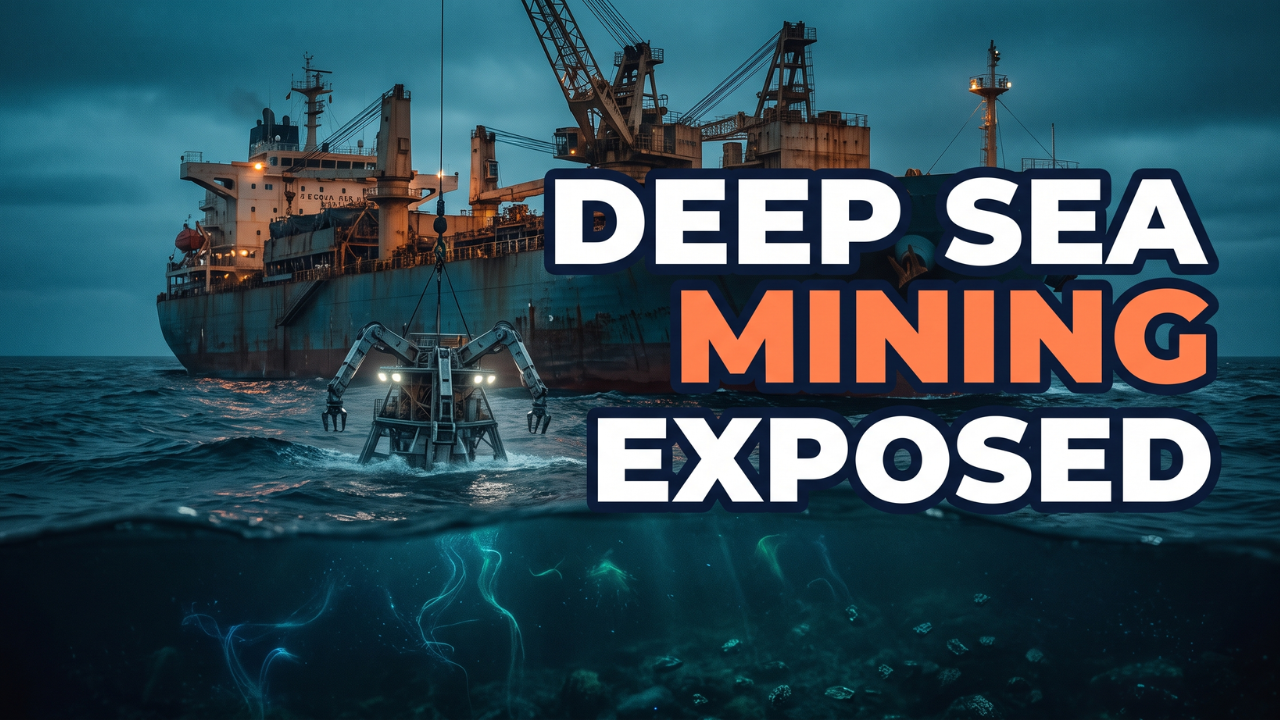
For decades, the deep sea was treated as an afterthought in conversations about ocean conservation, a dark, distant place assumed to be mostly empty. That assumption is now being tested in real time, as mining companies push to extract polymetallic nodules from the seafloor and regulators scramble to decide whether, and how, to let them.
On this episode of How to Protect the Ocean, Andrew talks with Matthew Gianni, co-founder and Political and Policy Advisor of the Deep Sea Conservation Coalition (DSCC). Matthew's path into ocean advocacy started on the water itself. He spent ten years as a commercial fisherman, five of them as a deep sea trawlerman working the Central California coast down to roughly a thousand meters. What came up in the nets, glass sponges, corals, starfish, crabs, much of it not commercially useful and simply shoveled back overboard, planted the question that would define his career: what are we destroying that we don't even understand yet?
That question led him to Greenpeace International, where he ran the organization's ocean program, and eventually to co-founding the DSCC to fight deep water bottom trawling on seamount ecosystems through a UN General Assembly process. Seamounts, it turns out, are hotspots of biodiversity, and the evidence has been consistent for decades. Research on Tasmanian seamounts found that once heavy bottom trawling began, coral cover on the affected peaks was devastated compared to untrawled seamounts nearby, a pattern documented by fisheries scientists and referenced repeatedly in policy debates since.
That history of destruction is now colliding with a new frontier: deep seabed mining for polymetallic nodules, potato-sized rocks scattered across the abyssal plains of the Clarion-Clipperton Zone in the eastern Pacific, roughly 1.7 million square miles of ocean floor sitting five to seven thousand meters down. Mining companies, led by The Metals Company (TMC) and its CEO Gerard Barron, argue this area is sparse and commercially unimportant to protect. Matthew and the broader scientific community disagree, and the evidence keeps mounting in their favor.
In 2023, researchers associated with the Natural History Museum in London catalogued more than 5,500 organisms collected from the Clarion-Clipperton Zone over past decades, of which only around 500 had been formally identified. That means roughly 90 percent of what's already been collected from the mining zone remains scientifically unnamed, to say nothing of species not yet collected at all. Then, in 2024, came an even more startling finding: researcher Andrew Sweetman and colleagues reported that the manganese nodules themselves may be producing oxygen in complete darkness, a process not yet fully understood and still being independently verified. If confirmed, it raises the question of what role that oxygen plays in deep sea ecosystems, and what mining could disrupt before scientists even know to look for it.
The regulatory fight over all of this runs through the International Seabed Authority (ISA), the UN-affiliated body that governs mining in international waters, an area covering roughly half to two-thirds of the world's seabed. Under the Law of the Sea Convention, the ISA is legally obligated to act "for the benefit of humankind as a whole," not for individual companies or countries. That obligation is at the center of the current standoff. Regulations for commercial mining still haven't been finalized after years of negotiation, missed deadlines, and hundreds of pages of unresolved draft text. Matthew points to a leadership change as one sign of where sentiment is heading: in 2024, Leticia Carvalho, an oceanographer from Brazil, defeated incumbent Secretary-General Michael Lodge, whom critics had accused of being too closely aligned with mining interests, in an election widely seen as a rebuke of the previous administration's approach.
Meanwhile, The Metals Company has pursued a different path entirely: applying for a US mining license through NOAA, bypassing ISA authority altogether under the argument that the United States, having never ratified the Law of the Sea Convention, isn't bound by its seabed mining provisions. Matthew calls this "unilateral mining," and argues it risks undermining the entire international maritime legal order, particularly since many of TMC's corporate partners are based in countries that have ratified the treaty and are legally obligated to prevent exactly this kind of activity.
Underneath all of it sits a question that gets less attention than the legal fights: does deep sea mining even make economic sense? By Matthew's own calculations, drawn from ISA and industry figures, mining three million tons of nodules a year, the volume the industry says it needs to be profitable, would yield metal quantities representing a small fraction of a percent to roughly two percent of current global terrestrial production, depending on the metal. Combine that with rising recycling rates for copper, nickel, and cobalt, and a battery technology landscape rapidly moving away from some of these metals altogether, and the case for urgency looks weaker than the industry's public messaging suggests.
Matthew remains clear-eyed about the pressure building on the industry side of this fight. Money, he says, tends to win out over regulation once an industry gets moving. Whether that happens here may depend on decisions being made in the next few years, at meetings like the one that just wrapped up in Kingston, Jamaica, and in the courts, congressional hearings, and boardrooms where the future of the deep ocean is quietly being decided.
Takeaways:
- Matthew Gianni's path from commercial fisherman to Deep Sea Conservation Coalition co-founder shapes his firsthand perspective on what deep sea trawling and mining actually destroy.
- Tasmanian seamount trawling research documented major coral loss on heavily trawled peaks compared to untrawled ones, though exact figures need verification before republishing.
- Roughly 90 percent of organisms already collected from the Clarion-Clipperton Zone remain scientifically unnamed, per Natural History Museum research.
- The 2024 "dark oxygen" discovery raises unresolved questions about what deep seabed mining could disrupt before science understands it.
- The International Seabed Authority is legally required to act for the benefit of humankind as a whole, a standard now central to the mining regulation debate.
- The Metals Company is seeking a US mining license through NOAA to bypass ISA authority, a move critics call unilateral mining.
- Even by industry-friendly estimates, nodule mining would contribute a small fraction of current global metal supply, raising real questions about whether the economic case holds up.
FAQs
Will the ISA finish its Mining Code, and should it right now?
Not yet, and that's the center of the whole debate. The Mining Code is the full rulebook that would let companies move from exploration to commercial mining, and after years of negotiation it's still missing major pieces on environmental protection, financial terms, and enforcement. A number of countries and scientists argue that finalizing the code before those pieces are settled would lock in rules for an industry nobody yet fully understands.
Could a company start deep sea mining before the ISA finishes its rules?
Under the ISA's own position, no. Commercial mining in international waters isn't supposed to happen until the Mining Code is adopted. The real worry raised at the meeting is that a company, or a country that hasn't signed onto the Law of the Sea Convention, could try to mine outside the ISA's system entirely. That's exactly what's playing out with The Metals Company's push for a U.S. permit through NOAA.
How is the ISA supposed to respond to the U.S. issuing its own deep sea mining permits?
This was one of the most contentious issues at the meeting. Companies tied to existing ISA contractors have been pursuing permits through NOAA instead of the ISA, and member states are wrestling with whether that amounts to a breach of the Law of the Sea Convention, and what leverage the ISA actually has over a company operating outside its authority.
Is there support for a moratorium on deep sea mining?
Yes, and it's growing. By the close of the meeting, 46 countries had come out against allowing commercial mining to start for now. This isn't a binding rule yet. It's a signal of where a meaningful bloc of ISA members currently stands.
Do scientists actually know enough about the environmental risks of deep sea mining?
Not fully, and that gap is at the center of the scientific debate. Delegates raised open questions about how mining impacts would add up across an entire mining zone, how long deep sea ecosystems would take to recover, whether proposed mitigation measures would actually work, and whether there's enough baseline data to know what "acceptable harm" would even mean.
Who would be financially responsible if deep sea mining causes damage?
That's still being negotiated. The discussion covers whether the mining company itself, its parent company, or both should be liable, who could actually file a claim (including coastal states and Indigenous Peoples), and a harder question underneath all of it: whether money can meaningfully compensate for the loss of an ecosystem in the first place.
What rights would coastal states and Indigenous Peoples have if mining moves forward?
Participants pushed for clearer rules on consultation and participation in decisions that could affect fisheries and cultural interests, along with a real path to compensation if mining harms their waters or livelihoods. Those protections aren't clearly spelled out in ISA rules today.
Is the ISA itself equipped to oversee a commercial mining industry?
-
That's an open question raised repeatedly by civil society groups at the meeting. Concerns included closed-door negotiating sessions, limited NGO access, and whether the ISA has the budget, staff, and auditing capacity to monitor compliance once mining actually begins.

CEO
Whales Are Sprinters: What a Blue Whale's Heart Does When It Lunge Feeds