Greenwashing Exposed: Why 400+ Companies Got Caught Lying About Sustainability in 2026
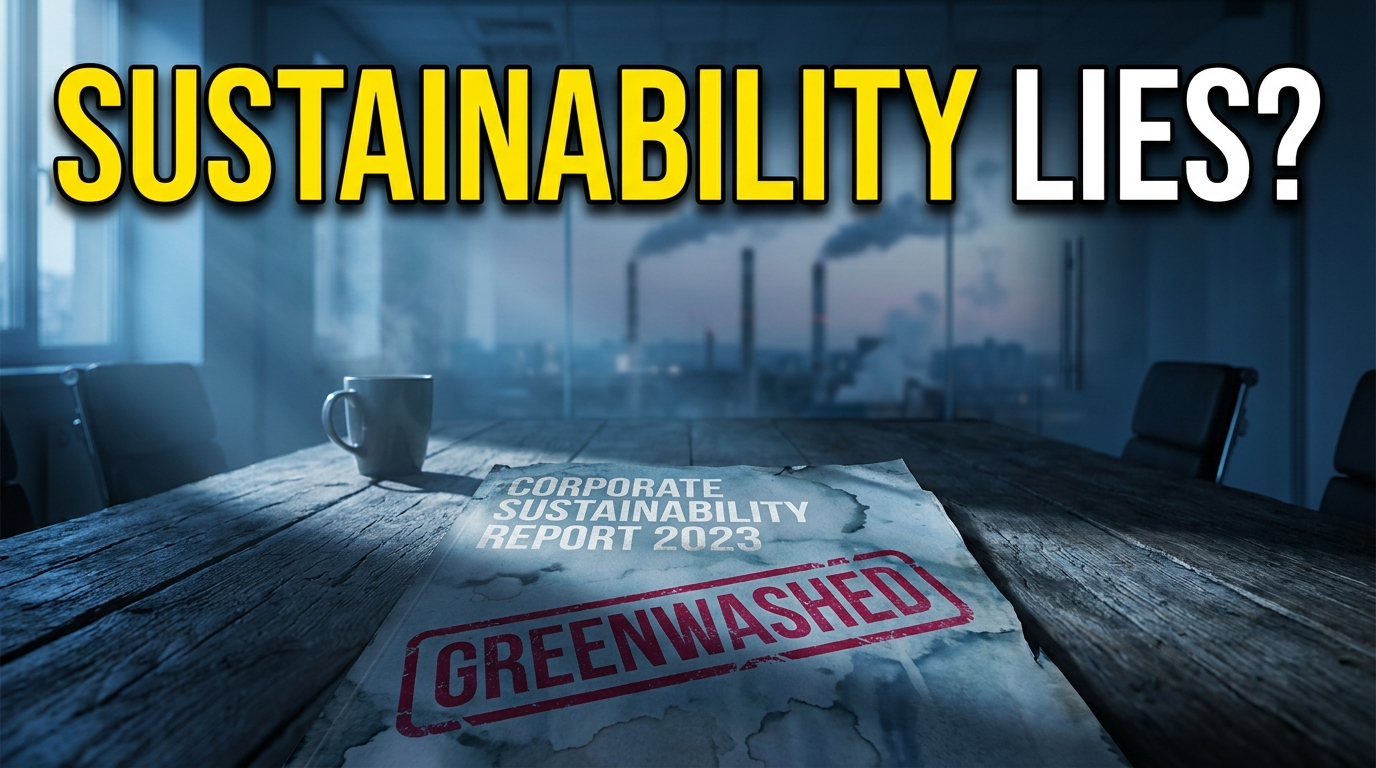
Businesses talk about sustainability constantly. The harder question is whether they are actually doing what they claim. In 2026, regulators around the world decided to find out, and the answer for a lot of companies was no.
More than 400 greenwashing related enforcement actions have already been recorded this year across the United States, the United Kingdom, the European Union, Canada, Australia, and India. The EU's updated consumer protection regulation, which entered into force in 2026, now requires companies to back up marketing claims with proof. Generic language like sustainable or eco is prohibited without evidence.
Andrew compares this to food labeling rules he studied years ago at the University of Guelph. In Canada, a product labeled fat free can legally contain up to 1.5 percent fat. The category technically fits, even though the number on the package does not match reality. Sustainability claims have worked the same way for decades. Companies could show a beautiful commercial of rolling hills and clean skies, while the actual site featured pollution, chemical-runoff ponds, and fractured land that blocked migratory animals. That gap between the image and the reality is greenwashing.
The financial consequences are now real. The SEC has fined Goldman Sachs and DWS multiple millions of dollars for misrepresenting ESG processes, and fined WisdomTree Asset Management 4 million dollars for ESG-related misstatements. State attorneys general in New York, California, and Washington, D.C. have filed greenwashing suits under consumer protection and false advertising laws. In Canada, new penalties tied to environmental claims substantiation have pushed some companies toward what is now being called green hushing, where businesses quietly stop making public ESG statements rather than risk litigation over claims they cannot prove.
The regulatory approach differs by region. The EU and UK are enforcing ad standards aggressively. The US is relying more on state attorneys general and SEC litigation. Canada has introduced a private right of action. All three are aimed at the same problem: businesses saying they are doing good for the environment when they are not, which drowns out companies actually investing in sustainability and circularity.
For listeners, Andrew's advice is straightforward. Be skeptical of vague claims like eco-friendly, green, or carbon neutral when there is no evidence behind them. Ask companies where they publish their emissions reports. Trust third-party verification over a company's own marketing copy, since a neutral verifier has no stake in making the company look good.
Tomorrow's episode features a conversation with Zena Harris, a sustainability consultant who works with Hollywood production companies to make entertainment industry operations genuinely sustainable rather than just labeled that way.
Takeaways
- Over 400 greenwashing enforcement actions were recorded globally in 2026
- The EU's updated consumer protection regulation requires companies to substantiate environmental claims
- The SEC fined Goldman Sachs, DWS, and WisdomTree Asset Management for ESG-related misstatements
- State attorneys general in New York, California, and Washington, DC have filed greenwashing lawsuits
- Canada is seeing a rise in green hushing as companies scale back ESG statements to avoid litigation
- Vague terms like eco-friendly, green, and carbon neutral require evidence, not marketing language
- Third-party verification is more reliable than a company's own sustainability claims
- Tomorrow's episode features sustainability consultant Zena Harris on the entertainment industry

CEO

Who Pays for Plastic? Inside the Law Quietly Shifting the Bill to Producers