The Gerard Barron Pattern: What One CEO's History Tells Us About Deep-Sea Mining's Future
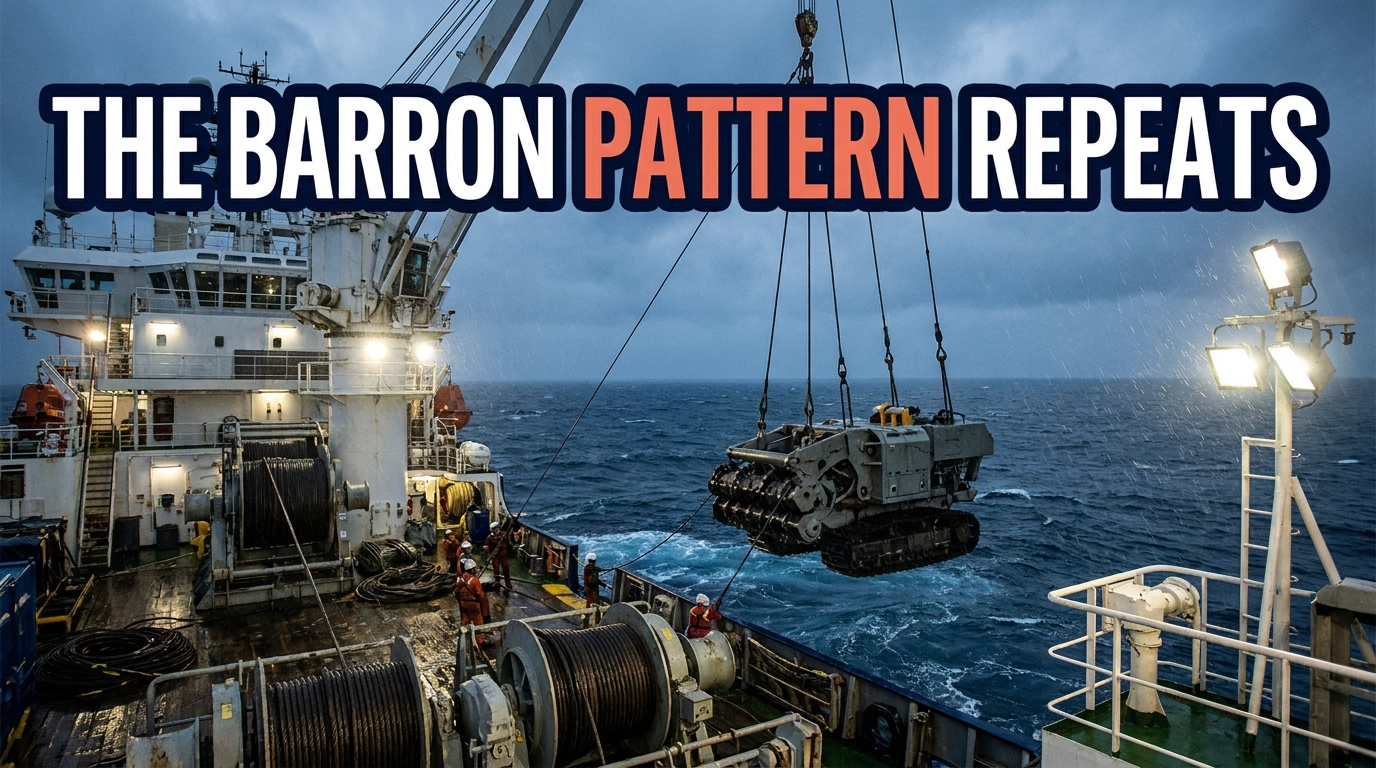
Why would someone who watched a deep-sea mining company collapse go back and try it again? For Gerard Barron, CEO of The Metals Company (TMC), that's not a hypothetical question. It's already happened once, with the same industry, some of the same licenses, and several of the same people involved. This piece isn't an accusation against Barron as an individual. It's a look at a documented sequence of decisions, laid out so you can weigh the motive for yourself.
From advertising to the ocean floor
Barron's path to deep-sea mining didn't start in the ocean. He built his career at Adstream, an ad-tech company founded in Sydney in 2000 that delivered TV commercials and ad materials to broadcasters. Barron became CEO as the company needed formal leadership and investment, and under him Adstream grew from a single office to more than 40 offices in 30 countries, reportedly pulling in over $100 million a year before he left in December 2013.
Around 2001, a friend and geologist, David Hayden, pitched Barron on a new venture: Nautilus Minerals, an underwater mining company. By Barron's own account, given to NPR, he knew very little about the ocean and very little about mining. He was drawn in by curiosity about a new frontier, and by his own description, fascinated to learn the ocean was full of metal.
Nautilus: profit for Barron, losses for Papua New Guinea
Nautilus pursued seafloor massive sulfide deposits off Papua New Guinea, rich in copper, gold, silver, and zinc. The company eventually raised hundreds of millions of dollars from investors, including PNG's own government. Barron was an early investor and promoter rather than the company's CEO or manager; Hayden held that role from 2002 to 2008. By Barron's own account, he had largely sold out of his position by the time PNG's government invested, and he exited with a reported return as high as $30 million.
The company didn't survive. Nautilus's projected operating costs of about $70 per ton reportedly spiraled to around $192 per ton, triggering its delisting from the Toronto Stock Exchange and a 2019 bankruptcy filing in Canadian court. PNG's prime minister said the country spent nearly 300 million Kina, roughly $72 million USD, calling the project a total failure. A shipyard building the company's specialized vessel canceled its contract after Nautilus missed an $18 million payment. Along the way, the project reportedly damaged seabed habitat in PNG's waters, and the government was left facing both financial and environmental costs.
Barron has named the reasons he believes Nautilus failed: the wrong technology, the difficulty of operating in a developing nation, and not finding as much of the target resource as expected. He's described himself and his colleagues as unashamed pioneers who took the arrows so the wider industry could follow. Notably, the reasons he lists are technical and financial. He hasn't pointed to the environmental damage as a factor in the collapse.
A familiar shape, in a new zone
In 2011, people connected to Nautilus, including Hayden, started a new company, Deep Green. Barron became involved early and took over as chairman and CEO in 2018. Deep Green became The Metals Company, which now holds an exploration license in the Clarion Clipperton Zone that once belonged to Nautilus.
TMC has been the company driving much of the current urgency around commercial deep-sea mining. It triggered the International Seabed Authority's "two-year rule" through partner nation Nauru, a move that reportedly coincided with a rise in TMC's stock price. More recently, TMC has pursued a permitting path through NOAA and the Trump administration, outside the ISA process entirely, since the US has not ratified the UN Convention on the Law of the Sea and isn't part of the ISA's member process. A recent announcement points to a new leasing area near the Commonwealth of the Northern Mariana Islands.
Barron's public argument hasn't changed much across years of interviews: he consistently compares seabed mining favorably to mining on land, at one point describing the Clarion Clipperton Zone as having essentially no plant life and a very low biomass figure compared to the rainforests where land-based nickel mining occurs. That specific comparison is disputed in this episode as an inaccurate lowball of the zone's actual biomass. When Greenpeace, an advocacy organization, published a report critical of the industry, TMC's response was that Greenpeace had misunderstood the industry rather than that its concerns had merit. For contrast, the Wall Street Journal, a mainstream financial publication rather than an advocacy outlet, has summarized TMC's own arc bluntly: the company lost roughly half a billion dollars, got crosswise with a South Pacific government, destroyed sensitive seabed habitat, and went broke, before Barron tried again.
Why this matters
Independent research on deep-sea mining's aftermath is still limited, but what exists is not encouraging. Some studies indicate biodiversity in mined areas hadn't recovered three to four years after mining activity occurred. The Clarion Clipperton Zone is largely unmapped and unsurveyed. The pattern this episode traces isn't unique to Barron. It's a shape that shows up across natural resource industries: business leaders who see the operational upside clearly and the downstream environmental risk much less clearly, or who frame that risk in comparative terms ("less bad than the alternative") rather than addressing it directly. Whether that's a good enough basis for opening a new, poorly understood frontier of the ocean to industrial extraction is the question this episode leaves open for listeners to answer.
Takeaways
- Gerard Barron, now CEO of The Metals Company, was an early investor and promoter behind Nautilus Minerals, a deep-sea mining company that went bankrupt in 2019.
- Barron reportedly exited Nautilus with a return as high as $30 million, years before the company's collapse.
- Papua New Guinea's government invested heavily in Nautilus and, per its prime minister, lost roughly $72 million USD on a project called a total failure.
- The Metals Company now holds a Clarion Clipperton Zone exploration license that once belonged to Nautilus, and Barron leads it as chairman and CEO.
- TMC is pursuing a US permitting path outside the International Seabed Authority process, through NOAA and the Trump administration.
- A biomass figure Barron has cited to compare seabed mining favorably to land mining is disputed in this episode as inaccurate.
- Peer-reviewed recovery studies, mainstream financial reporting (e.g. the Wall Street Journal), and advocacy reports (e.g. Greenpeace) are distinct categories of evidence and are treated separately throughout this piece.
FAQs: Gerard Barron, The Metals Company, and Deep-Sea Mining
1. Who is Gerard Barron?
Gerard Barron is an Australian businessman who serves as chairman and CEO of The Metals Company (TMC), one of the most prominent companies pushing to start commercial deep-sea mining. He built his earlier career in advertising technology as CEO of Adstream, then became an early investor and promoter in Nautilus Minerals, a deep-sea mining venture that went bankrupt in 2019, before helping build what became TMC.
2. What is The Metals Company?
The Metals Company (TMC), formerly known as Deep Green, is a mining company pursuing commercial extraction of polymetallic nodules from the Clarion Clipperton Zone in the Pacific Ocean. It holds exploration rights once belonging to Nautilus Minerals and is publicly traded on the Nasdaq under the ticker symbol TMC.
3. Is deep-sea mining environmentally safe?
No independent body has established deep-sea mining as environmentally safe, and the available science points the other way. Studies have found that biodiversity in test-mined areas had not recovered years after mining activity, and much of the Clarion Clipperton Zone remains unmapped and poorly understood. Industry proponents argue it's less damaging than land-based mining, but that's a comparative claim, not a safety assurance, and some independent analyses put deep-sea biodiversity damage at many times that of land mining.
4. Why do scientists oppose deep-sea mining?
Scientists point to the lack of baseline data on largely unmapped deep-sea ecosystems, evidence that disturbed seafloor habitats show little to no recovery years after mining activity, and the risk of permanently losing slow-growing, poorly understood species before they're even identified. Many argue the industry and its regulators are moving faster than the science needed to responsibly assess and manage the impacts.
5. What are Gerard Barron's arguments in favor of deep-sea mining?
Barron's central argument, repeated across years of interviews, is that mining the seabed does less environmental damage than mining on land, at times citing the Clarion Clipperton Zone's low biomass compared to rainforests where land-based nickel mining occurs (a specific figure he's cited has been publicly disputed as inaccurate). He also frames deep-sea mining as necessary to supply critical minerals for batteries and the broader energy transition, and describes himself and earlier colleagues as pioneers willing to take on the risk of a new industry.
Other Common Questions
Is Gerard Barron a scientist?
No. Barron's background is in advertising and business, not science or mining. By his own account, given to NPR, he knew very little about the ocean or about mining when he first got involved in the industry.
How much money could deep-sea mining generate?
Estimates vary widely depending on the source. One industry-favorable analysis values global polymetallic nodule reserves between $8 trillion and over $16 trillion, with projected capital investment in the sector reaching $115 billion by 2043. A separate financial risk assessment reached a very different conclusion, projecting the industry could destroy $30 billion to $132 billion in value overall and post a negative 2% return on invested capital, and noted that several major banks (including Credit Suisse, Lloyds, NatWest, and Standard Chartered) have adopted policies excluding deep-sea mining from funding.
What is the International Seabed Authority?
The International Seabed Authority (ISA) is an autonomous international organization established under the 1982 UN Convention on the Law of the Sea (UNCLOS) to regulate mineral-related activity in international seabed areas, roughly 54% of the world's ocean, on behalf of all nations, while also being required to protect the marine environment from harm. It's headquartered in Kingston, Jamaica, and has 172 members (171 states plus the European Union).
Which countries support or oppose deep-sea mining?
At least 46 countries, including Mauritius, Mozambique, Kenya, Madagascar, Malawi, and the Republic of the Congo, currently back a moratorium or precautionary pause on deep-sea mining. On the other side, several Pacific island nations, including Nauru, Kiribati, and Tonga, have sponsored or explored mining partnerships with companies like TMC, and the United States under the Trump administration has pursued a permitting path for deep-sea mining outside the ISA process entirely.
Is The Metals Company publicly traded?
Yes. TMC trades on the Nasdaq under the ticker symbol TMC.

CEO
The Pollution That Breeds: How the Great Lakes Stopped Invaders