The Deep Sea Isn’t Barren, Here’s Why That Changes Everything

 Apple Podcasts
 Spotify
 YouTube
 Amazon Music
 PocketCasts
 Overcast
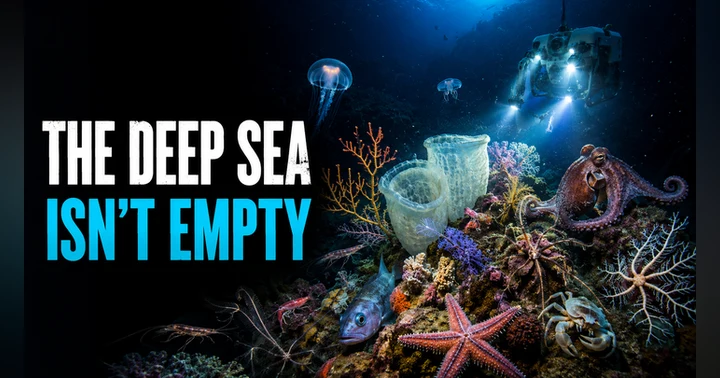
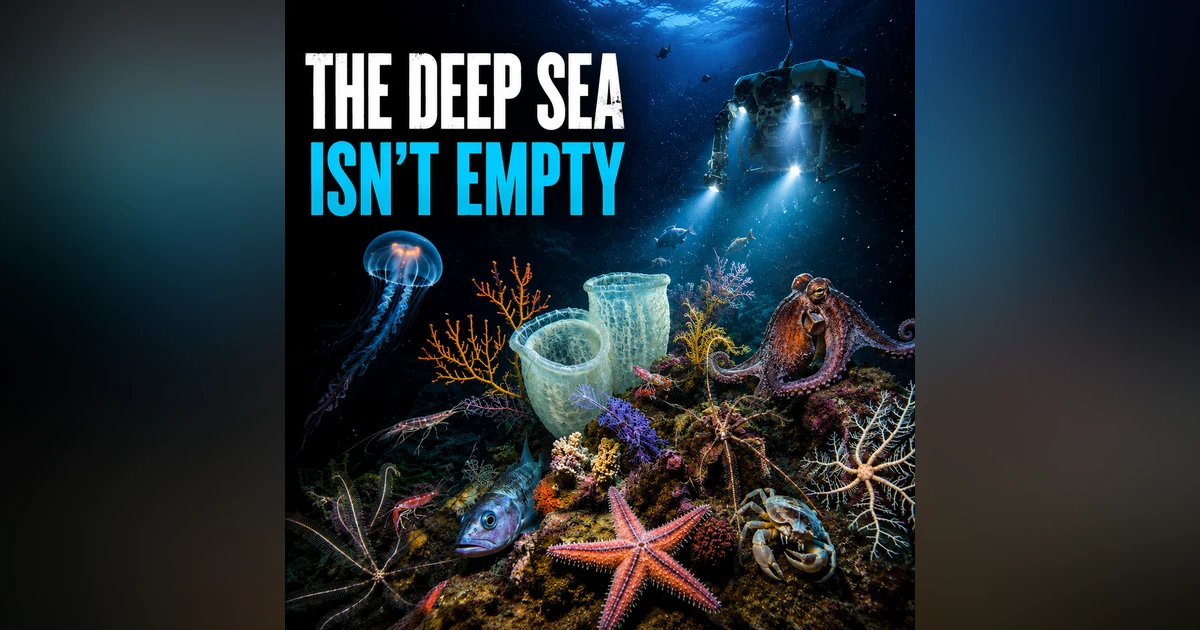
 Most people picture the deep sea as a dark, empty place where almost nothing can survive. The truth is far more surprising. Thousands of meters below the surface lives an extraordinary world filled with ancient corals, giant sponges, glowing jellyfish, strange fish, and species that scientists are still discovering today.
In this episode, you’ll learn how life has adapted to crushing pressure, freezing temperatures, and complete darkness. You’ll also discover why deep-sea ecosystems are some of the most important habitats on Earth, supporting biodiversity, fisheries, and even helping us better understand how life itself can evolve under extreme conditions.
The more scientists explore the deep sea, the more they realize how much remains unknown. That mystery is exciting, but it also makes protecting these fragile ecosystems more important than ever. If you’ve ever wondered what really lives in the deepest parts of our ocean, this episode will change the way you think about the world beneath the waves.
Support Independent Podcasts: https://www.speakupforblue.com/patreon
Need help with your ocean non-profit, company, or project? Get the help you need with Pisces Oceans Inc.: https://www.piscesoceans.ca
Connect with Speak Up For Blue
Website: https://bit.ly/3fOF3Wf
Instagram: https://bit.ly/3rIaJSG
TikTok: https://www.tiktok.com/@speakupforblue
Twitter: https://bit.ly/3rHZxpc
YouTube: www.speakupforblue.com/youtube
00:00:01,772 --> 00:00:04,497
Hey Michelle, back again, doing another episode.
2
00:00:04,497 --> 00:00:06,551
This one's on deep sea biodiversity.
3
00:00:06,551 --> 00:00:08,584
And um yeah, we're gonna get into it.
4
00:00:10,252 --> 00:00:18,565
When most people picture the deep ocean, when most when most people, you know what's
throwing me off is it the script keeps putting deep ocean, it's supposed to be deep sea.
5
00:00:18,565 --> 00:00:19,435
And that's throwing me off.
6
00:00:19,435 --> 00:00:20,365
So I apologize.
7
00:00:20,365 --> 00:00:21,405
Here we go.
8
00:00:22,146 --> 00:00:28,127
When most people picture the deep ocean, they imagine darkness, cold water, and almost no
life.
9
00:00:28,127 --> 00:00:30,728
I'm gonna do that again because I meant to say deep sea.
10
00:00:31,128 --> 00:00:36,130
When most people picture the deep sea, they imagine darkness, cold water, and almost no
life.
11
00:00:36,130 --> 00:00:37,580
But the reality
12
00:00:37,814 --> 00:00:44,440
Some of the strangest, oldest, and most remarkable animals on earth are living thousands
of meters below the surface.
13
00:00:44,440 --> 00:00:49,803
The problem isn't that life doesn't exist down there, is that we've only just begun to
discover it.
14
00:00:49,804 --> 00:00:52,886
This is the How to Protect the Ocean Podcast, your weekday ocean news update.
15
00:00:52,886 --> 00:01:01,984
If you care about staying informed about the ocean every single weekday, Monday to Friday,
hit that follow button right now on your favorite podcast app so you don't miss tomorrow's
16
00:01:01,984 --> 00:01:02,814
story.
17
00:01:02,988 --> 00:01:13,570
Welcome back to part two of our four-part series leading up to Friday's interview with a
DFO scientist, Department of Fisheries Oceans Canada scientist, and an educator involved
18
00:01:13,570 --> 00:01:17,971
in one of the Canada's largest deep sea exploration projects and education projects.
19
00:01:17,971 --> 00:01:20,585
It's gonna be a lot of fun, so do not miss out.
20
00:01:20,585 --> 00:01:23,416
But here we're gonna be talking about the deep sea.
21
00:01:23,416 --> 00:01:27,028
Yesterday we talked about how little we've explored of the deep sea.
22
00:01:27,028 --> 00:01:29,909
And today we're gonna be answering another question.
23
00:01:29,989 --> 00:01:32,630
If the deep sea is so dark and so cold,
24
00:01:32,630 --> 00:01:36,652
And under so much pressure, how can anything survive there?
25
00:01:36,652 --> 00:01:40,693
The answer changes the way you think about life on Earth, to be honest.
26
00:01:40,693 --> 00:01:43,674
Imagine being dropped in complete darkness.
27
00:01:43,674 --> 00:01:45,942
The temperature is only a few degrees above freezing.
28
00:01:45,942 --> 00:01:47,075
It's gonna be super cold.
29
00:01:47,075 --> 00:01:48,276
You probably wouldn't survive much.
30
00:01:48,276 --> 00:01:53,438
And of course, the pressure is hundreds of times greater than what you've experienced,
what you're experiencing now.
31
00:01:53,438 --> 00:01:59,320
Food is scarce, there are no plants, there's no sunlight, no sunrise, no sunset.
32
00:01:59,900 --> 00:02:02,481
Which means there's no sunrise and no sunset.
33
00:02:02,645 --> 00:02:07,969
And if someone is describing those conditions to you, you might assume that nothing could
survive there.
34
00:02:07,989 --> 00:02:12,533
But instead, the deep ocean but instead the deep sea is filled with life.
35
00:02:12,533 --> 00:02:17,557
Scientists have discovered giant glass sponges that can live for thousands of years.
36
00:02:17,557 --> 00:02:22,841
Deep sea corals that create underwater forests without even seeing sunlight.
37
00:02:22,982 --> 00:02:26,704
Octopuses that brood their eggs for years before they hatch.
38
00:02:26,865 --> 00:02:28,866
Fish with transparent heads.
39
00:02:28,866 --> 00:02:32,661
Jellyfish that glow in brilliant blues and reds.
40
00:02:32,661 --> 00:02:36,863
Sea cucumbers that drift through the water like floating balloons.
41
00:02:36,964 --> 00:02:40,186
Some animals create their own light through bioluminescence.
42
00:02:40,186 --> 00:02:44,868
Others have enormous eyes designed to detect any of the faintest glow.
43
00:02:45,269 --> 00:02:50,472
Some don't even have eyes at all because they simply can't, because they simply don't need
them.
44
00:02:50,632 --> 00:02:57,616
Life has evolved in extraordinary ways because the deep sea plays by completely different
rules.
45
00:02:58,997 --> 00:03:03,859
And every expedition seems to reveal another species scientists have never seen before.
46
00:03:03,859 --> 00:03:04,949
Think about that for a moment.
47
00:03:04,949 --> 00:03:14,303
In 2026, on the planet with billions of people, scientists are still discovering animals
that have existed for millions of years without ever knowing that they were there.
48
00:03:14,303 --> 00:03:15,904
That's incredible.
49
00:03:16,324 --> 00:03:18,915
It's easy to focus on weird-looking animals.
50
00:03:18,915 --> 00:03:21,506
And honestly, like they're fascinating.
51
00:03:21,506 --> 00:03:24,167
Some of them, some people say they're like alien-like.
52
00:03:24,167 --> 00:03:28,799
But the real story isn't just about bizarre creatures, it's about the ecosystems.
53
00:03:28,855 --> 00:03:33,966
Deep sea corals provide habitat for fish, crabs, shrimp, and countless other species.
54
00:03:33,966 --> 00:03:40,948
The massive sponge reefs filter enormous amounts of seawater every day, improving water
quality and creating a home for marine life.
55
00:03:40,948 --> 00:03:52,141
Hydrothermal vents, which are even crazier of an environment or of a habitat, support
entire communities powered not by sunlight, but by chemicals coming from inside the earth
56
00:03:52,141 --> 00:03:54,092
that would be toxic to us.
57
00:03:54,312 --> 00:03:57,930
Scientists once believed sunlight was essential for all ecosystems.
58
00:03:57,930 --> 00:04:06,273
Then they discovered life thriving through these vents, through these hydrothermal vents,
rewriting biology textbooks around the world.
59
00:04:06,273 --> 00:04:11,375
Here in Canada, where I live, the Pacific Ocean is home to globally significant sponge
reefs.
60
00:04:11,375 --> 00:04:18,518
Some of these reefs began forming thousands of years ago and provide habitat for
commercially important species like rockfish.
61
00:04:18,958 --> 00:04:26,327
Researchers have also discovered deep sea coral, deep-sea coral communities growing along
underwater mountains.
62
00:04:26,327 --> 00:04:31,681
Growing along underwater mountains and canyons off British Columbia, many of these
habitats are fragile.
63
00:04:31,681 --> 00:04:34,362
Some corals only grow millimeters a year.
64
00:04:34,543 --> 00:04:37,665
Some corals only grow millimeters each year.
65
00:04:37,665 --> 00:04:43,929
That means damage caused in minutes could take centuries to recover if it recovers at all.
66
00:04:43,969 --> 00:04:47,812
This is why scientists spend so much time documenting what's down there.
67
00:04:47,812 --> 00:04:54,807
They're building a baseline, and that's expensive, and it takes time because we know where
these ecosystems are.
68
00:04:54,807 --> 00:04:59,973
'Cause once we know where these ecosystems are, we can take bet we can make better
decisions about protecting them.
69
00:05:01,933 --> 00:05:10,486
Now, if you think about how this is all done, the baseline data, how we need to collect
all this information, how long it takes to collect all this information, and even how
70
00:05:10,486 --> 00:05:11,206
expensive it is.
71
00:05:11,206 --> 00:05:12,377
It requires funding.
72
00:05:12,377 --> 00:05:16,338
It requires people to be like, hey, like I really believe in this.
73
00:05:16,338 --> 00:05:21,340
We need to support this through either government funding or extra external funding
somehow, right?
74
00:05:21,340 --> 00:05:23,499
Well, this is like what this podcast does.
75
00:05:23,499 --> 00:05:23,809
Right.
76
00:05:23,809 --> 00:05:33,496
If you get value from listening to this podcast each and every weekday that we produce an
episode to help you understand the ocean just a little bit more, I would love for you not
77
00:05:33,496 --> 00:05:38,079
only to follow this podcast, but help support our work on Patreon.
78
00:05:38,079 --> 00:05:48,147
Go speakupforblue.com forward slash Patreon and you can support our work so that you know
we can pay our pay my editor a little better because I pay out of pocket, support the
79
00:05:48,147 --> 00:05:51,382
editor, support the the effort that I put in here.
80
00:05:51,382 --> 00:05:55,145
And you know, allow me to have a little wiggle room when I decide to do new things.
81
00:05:55,145 --> 00:06:05,832
I put up all my stuff on various social media platforms, on you know, on um on Patreon, on
he on this podcast platform, on YouTube, all that kind of stuff.
82
00:06:05,832 --> 00:06:06,793
It's a lot of work.
83
00:06:06,793 --> 00:06:09,795
And if you want to support me, you're more than welcome to do so.
84
00:06:09,795 --> 00:06:13,437
Go to speakupforblue.com forward slash Patreon.
85
00:06:13,617 --> 00:06:19,711
Now, one of my favorite things about ocean exploration is that nobody knows exactly what
they're going to find.
86
00:06:19,711 --> 00:06:28,847
Researchers head out with the maps, they have hypotheses, they know where interesting
habitats might exist, but they also expect surprises.
87
00:06:28,847 --> 00:06:32,429
Sometimes they discover species completely new to science.
88
00:06:32,429 --> 00:06:37,553
Other times they observe behaviors that have never been seen been even recorded before.
89
00:06:37,553 --> 00:06:45,055
A few years ago, researchers found what looked like an octopus nursery, where dozens of
octopus mothers gathered to care for their eggs.
90
00:06:45,055 --> 00:06:49,578
Another expedition revealed deep sea coral gardens stretching farther than anyone has ever
expected.
91
00:06:49,578 --> 00:06:55,172
These discoveries remind us that exploration isn't just about filling in blank spaces on a
map.
92
00:06:55,172 --> 00:06:59,295
It's about changing our understanding of how our planet works.
93
00:06:59,295 --> 00:07:01,456
And there's something worth remembering.
94
00:07:01,456 --> 00:07:03,408
Every species has a story.
95
00:07:03,408 --> 00:07:07,961
And as someone who communicates storytelling and using storytelling, that's important.
96
00:07:07,961 --> 00:07:10,402
Every ecosystem has a role.
97
00:07:10,402 --> 00:07:14,605
The more we explore, the more we realize how connected everything really is.
98
00:07:15,169 --> 00:07:18,292
Healthy deep sea habitats support healthier oceans.
99
00:07:18,292 --> 00:07:21,454
Healthier oceans support fisheries, biodiversity.
100
00:07:21,655 --> 00:07:22,555
Sorry, I can do that again.
101
00:07:22,555 --> 00:07:28,841
Healthier oceans support fisheries, biodiversity, climate regulation, and ultimately us
people.
102
00:07:28,841 --> 00:07:36,648
So when someone says the deep sea is empty, you know that's one of the biggest myths in
marine science, or just in in human knowledge.
103
00:07:36,648 --> 00:07:39,690
It's not empty, it's alive, it's diverse.
104
00:07:39,690 --> 00:07:42,733
And in many ways, it's still introducing itself to us.
105
00:07:42,733 --> 00:07:43,563
So when
106
00:07:43,569 --> 00:07:47,632
A deep sea mining executive says, hey, that all that's down there is just a bunch of
worms.
107
00:07:47,632 --> 00:07:50,645
Well, first of all, there's a diversity of worms, and those worms can be very important.
108
00:07:50,645 --> 00:07:55,558
We just don't know what their function is or many other functions are, but a lot of times
they're really important.
109
00:07:55,558 --> 00:07:57,690
But that doesn't mean that this that's all that's out there.
110
00:07:57,690 --> 00:08:01,402
There's so many other species that are out there that we just haven't figured out yet.
111
00:08:01,543 --> 00:08:06,727
Tomorrow we're going to tackle another fainting tomorrow, we're going to tackle another
fascinating question.
112
00:08:06,727 --> 00:08:09,783
If humans can't survive thousands of meters underwater,
113
00:08:09,783 --> 00:08:11,234
How do science actually explore?
114
00:08:11,234 --> 00:08:14,675
How do scientists actually explore these incredible places?
115
00:08:15,116 --> 00:08:16,677
If humans can't, I'm gonna do that again.
116
00:08:16,677 --> 00:08:22,980
If humans can't survive thousands of meters underwater, how do scientists actually explore
these incredible places?
117
00:08:23,160 --> 00:08:29,163
The answer involves technology that feels like someone is out of a science fiction.
118
00:08:29,304 --> 00:08:33,986
The answer involves technology that feels like something out of a science fiction movie.
119
00:08:34,306 --> 00:08:39,211
The deep sea isn't a lifeless abyss, it's one of the Earth's richest ecosystems.
120
00:08:39,211 --> 00:08:43,683
And we're only beginning to understand the incredible life it supports.
121
00:08:44,384 --> 00:08:46,761
I want to thank you for joining me on today's episode.
122
00:08:46,761 --> 00:08:48,966
I really appreciate you listening to this.
123
00:08:48,966 --> 00:08:59,082
I feel like this she this week is all about hope and all about curiosity, like
understanding our curiosity and filling, fulfilling that curiosity to really get to know a
124
00:08:59,082 --> 00:09:03,154
part of the ocean that we haven't been able to explore because we haven't had that
technology.
125
00:09:03,154 --> 00:09:08,107
Tomorrow we're going to talk about what that technology is and how it's helped us explore
the deep sea.
126
00:09:08,107 --> 00:09:11,598
But if you want, if and if you don't want to miss that episode, please follow.
127
00:09:11,598 --> 00:09:15,859
And of course, support us on Patreon if you like what I've been doing for the last 11
years.
128
00:09:15,859 --> 00:09:18,640
Go to speakupforblue.com forward slash Patreon.
129
00:09:18,640 --> 00:09:22,881
I want to thank you so much for joining me on today's episode of the How to Protect the
Ocean podcast.
130
00:09:22,881 --> 00:09:25,202
Check out the show notes for all of our social links.
131
00:09:25,202 --> 00:09:26,622
And thank you so much for joining us.
132
00:09:26,622 --> 00:09:27,253
Have a great day.
133
00:09:27,253 --> 00:09:29,963
We'll talk to you next time and happy conservation.
134
00:09:31,184 --> 00:09:31,824
Okay, Michelle.
135
00:09:31,824 --> 00:09:32,600
That one was a quick one.
136
00:09:32,600 --> 00:09:34,725
We're gonna have some quick ones this week.
137
00:09:34,765 --> 00:09:35,645
Here we go.