How Do Scientists Explore a Place Humans Can’t Survive?

 Apple Podcasts
 Spotify
 YouTube
 Amazon Music
 PocketCasts
 Overcast
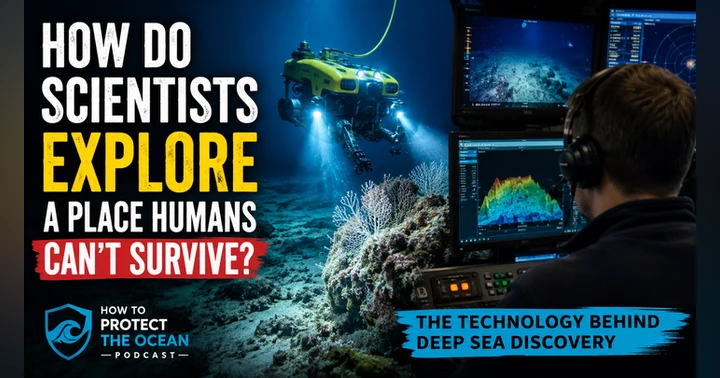
 The deep ocean is one of the most extreme places on Earth. Crushing pressure, freezing temperatures, and total darkness make it impossible for humans to explore for long, yet scientists continue to make incredible discoveries thousands of meters below the surface. So how do they do it?
In this episode, you’ll discover the remarkable technology that makes deep sea exploration possible. From remotely operated vehicles and autonomous underwater robots to multibeam sonar, artificial intelligence, and environmental DNA, these tools are transforming how we study one of the least explored parts of our planet. You’ll also learn why mapping the ocean often leads to discoveries scientists never expected to find.
This episode is part three of our four-part series leading up to Friday’s interview with experts from Ocean Networks Canada and Fisheries and Oceans Canada. By the end, you’ll understand why technology is helping scientists ask bigger questions, make new discoveries, and build the knowledge needed to better protect Canada’s deep ocean and the rest of our blue planet.
Map the Gaps: https://www.mapthegaps.org/
Support Independent Podcasts: https://www.speakupforblue.com/patreon
Need help with your ocean non-profit, company, or project? Get the help you need with Pisces Oceans Inc.: https://www.piscesoceans.ca
Connect with Speak Up For Blue
Website: https://bit.ly/3fOF3Wf
Instagram: https://bit.ly/3rIaJSG
TikTok: https://www.tiktok.com/@speakupforblue
Twitter: https://bit.ly/3rHZxpc
YouTube: www.speakupforblue.com/youtube
00:00:00,050 --> 00:00:03,519
Imagine trying to explore Mount Everest
without even setting foot on the mountain.
2
00:00:03,810 --> 00:00:07,580
That's essentially what ocean scientists
do every time they study the deep sea.
3
00:00:07,930 --> 00:00:08,839
The only difference?
4
00:00:09,140 --> 00:00:12,653
Instead of climbing nearly nine kilometers
up, they're exploring thousands of
5
00:00:12,653 --> 00:00:17,553
meters down into a place where a human
couldn't survive more than a few moments.
6
00:00:17,963 --> 00:00:20,103
Probably less than that, if
you really think about it.
7
00:00:20,586 --> 00:00:24,046
This is the How to Protect the Ocean
podcast, your weekday ocean news update.
8
00:00:24,153 --> 00:00:28,183
If you care about staying informed on
the ocean every single weekday, Monday
9
00:00:28,183 --> 00:00:32,006
to Friday, hit that follow button right
now so you don't miss tomorrow's story.
10
00:00:32,026 --> 00:00:35,336
And if you wanna support the show
because you love all the stuff that
11
00:00:35,336 --> 00:00:39,143
I do on this podcast, on YouTube,
on Instagram, on TikTok, and on
12
00:00:39,143 --> 00:00:43,243
Facebook, of course, you can do so by
going to speakupforblue.com/patreon.
13
00:00:43,510 --> 00:00:46,025
That's speakupforblue.com/patreon.
14
00:00:46,980 --> 00:00:50,719
Welcome to part three of our four-part
series leading up to Friday's
15
00:00:50,720 --> 00:00:55,569
interview with DFO scientist and
an Ocean Networks Canada educator,
16
00:00:55,569 --> 00:00:57,660
all on exploring Canada's deep sea.
17
00:00:58,040 --> 00:01:02,653
On Monday, we learned that we've only
explored a small fraction of the deep sea.
18
00:01:02,897 --> 00:01:05,637
Yesterday, we discovered that
the mysterious world is actually
19
00:01:05,637 --> 00:01:07,557
filled with incredible marine life.
20
00:01:07,774 --> 00:01:10,084
Today we're answering perhaps
the biggest question yet.
21
00:01:10,297 --> 00:01:13,837
How in the heck do scientists
actually explore a place
22
00:01:13,847 --> 00:01:16,327
humans can't even safely visit?
23
00:01:16,564 --> 00:01:19,143
The answer is one of the greatest
technological success stories
24
00:01:19,143 --> 00:01:20,723
you've probably never heard about.
25
00:01:21,100 --> 00:01:21,940
Let's be honest.
26
00:01:22,020 --> 00:01:25,520
Humans weren't built for
the deep sea ocean at all.
27
00:01:25,773 --> 00:01:29,044
By the time you reach 1,000 meters
below the surface, the pressure
28
00:01:29,053 --> 00:01:32,014
is around 100 times greater than
that you're experiencing right now.
29
00:01:32,043 --> 00:01:35,264
So you go deeper, and that
pressure continues to increase.
30
00:01:35,507 --> 00:01:38,587
At the deepest part of the ocean,
it's enough to crush an ordinary
31
00:01:38,587 --> 00:01:40,597
submarine like an empty soda can.
32
00:01:40,737 --> 00:01:41,810
It's completely dark.
33
00:01:41,860 --> 00:01:43,600
The water hovers just above freezing.
34
00:01:43,767 --> 00:01:45,097
There's no GPS.
35
00:01:45,264 --> 00:01:47,237
Radio signals don't work underwater.
36
00:01:47,454 --> 00:01:50,324
Even communicating with equipment
becomes incredibly difficult.
37
00:01:50,574 --> 00:01:53,624
So instead of sending people,
scientists send robots.
38
00:01:53,814 --> 00:01:57,914
The workhorse of deep sea exploration
is something called an ROV.
39
00:01:57,944 --> 00:02:00,294
That stands for remotely operated vehicle.
40
00:02:00,574 --> 00:02:03,344
Think of it as an underwater
robot that's connected to a ship
41
00:02:03,344 --> 00:02:05,314
on the surface by a long cable.
42
00:02:05,724 --> 00:02:09,144
Operators on board use joysticks,
cameras, and sensors to guide
43
00:02:09,144 --> 00:02:10,814
the vehicle across the sea floor.
44
00:02:11,030 --> 00:02:14,460
Modern ROVs aren't just cameras,
they're floating laboratories.
45
00:02:14,727 --> 00:02:18,284
They can collect rocks, take water
samples, measure temperature,
46
00:02:18,520 --> 00:02:22,740
capture high-definition video, pick
up delicate corals, even retrieve
47
00:02:22,740 --> 00:02:24,790
tiny animals for scientific study.
48
00:02:25,014 --> 00:02:28,394
It's like having a marine biologist,
a geologist, a photographer, and
49
00:02:28,394 --> 00:02:31,664
a robotic engineer all working
together through one machine.
50
00:02:31,937 --> 00:02:36,387
And because they're operated from the
ship, scientists can spend hours exploring
51
00:02:36,447 --> 00:02:38,197
places no diver could ever reach.
52
00:02:38,330 --> 00:02:40,460
Even if you dive at 100 feet.
53
00:02:40,760 --> 00:02:42,650
I go diving at 100 feet often.
54
00:02:42,660 --> 00:02:44,680
I'm not a big fan of it
because it's really deep.
55
00:02:44,690 --> 00:02:46,060
I don't love it to be that deep.
56
00:02:46,257 --> 00:02:48,637
But what I do when I've gone
down there, I spend like maybe
57
00:02:48,637 --> 00:02:50,187
15 minutes at the bottom time.
58
00:02:50,400 --> 00:02:54,347
Imagine being able to spend hours
looking through a monitor and seeing
59
00:02:54,377 --> 00:02:55,910
all this wonderful, amazing stuff.
60
00:02:56,034 --> 00:03:01,044
In fact, if you've even seen any of
the deep sea stuff that Schmidt Ocean
61
00:03:01,074 --> 00:03:04,754
Institute has put out, or Monterey Bay
has put out, or even Ocean Networks
62
00:03:04,754 --> 00:03:08,497
Canada put out, they have amazing
footage of the deep sea that you
63
00:03:08,497 --> 00:03:10,507
could even see from any social media.
64
00:03:10,507 --> 00:03:12,864
If you've ever go on any of their
social media, you get to see that
65
00:03:12,864 --> 00:03:15,234
stuff, and it's absolutely amazing.
66
00:03:15,690 --> 00:03:19,720
Now, before an ROV ever enters the water,
scientists need to know where to send it.
67
00:03:19,900 --> 00:03:24,510
That's where another incredible
technology comes in, the multi-beam sonar.
68
00:03:24,684 --> 00:03:28,087
I have to admit, I always
wanted a multi-beam sonar.
69
00:03:28,314 --> 00:03:29,550
It's a weird thing, I know.
70
00:03:29,620 --> 00:03:30,960
I've always wanted one, though.
71
00:03:31,094 --> 00:03:32,974
I've always wanted one to put on my boat.
72
00:03:33,154 --> 00:03:34,850
Did I say I wanted a boat as well?
73
00:03:35,130 --> 00:03:36,440
I always wanted one to put on my boat.
74
00:03:36,557 --> 00:03:40,417
In fact, when I did my master's, I
was doing my GIS analyst diploma at
75
00:03:40,417 --> 00:03:43,600
the same time at COGS, the Centre
of Geographic Science in Nova
76
00:03:43,600 --> 00:03:44,804
Scotia, it was a great program.
77
00:03:44,804 --> 00:03:48,954
But I remember driving an hour and a half
each way to school and back to my home
78
00:03:48,954 --> 00:03:53,014
in Halifax, and I would pick up some
people on the way and bring some people
79
00:03:53,014 --> 00:03:54,184
home on the weekend and stuff like that.
80
00:03:54,184 --> 00:03:56,964
And I had a friend, Chris, and
we actually discussed starting a
81
00:03:56,964 --> 00:03:59,224
multi-beam sonar company at one point.
82
00:03:59,224 --> 00:04:01,504
We were gonna buy multi-beam sonars, we
were gonna have a boat, we were gonna
83
00:04:01,514 --> 00:04:04,827
do all this mapping of the ocean, of
the deep sea, and everything like that.
84
00:04:04,910 --> 00:04:07,890
Never happened, of course, but
multi-beam sonars are amazing.
85
00:04:08,100 --> 00:04:11,270
Instead of using light, ships send
sound waves towards the sea floor.
86
00:04:11,464 --> 00:04:14,574
Those sound waves bounce back,
allowing computers to create detailed
87
00:04:14,574 --> 00:04:16,024
maps of underwater landscapes.
88
00:04:16,214 --> 00:04:17,544
So imagine mowing your lawn.
89
00:04:17,844 --> 00:04:19,404
You don't just walk randomly.
90
00:04:19,414 --> 00:04:24,064
You move back and forth in organized lines
until you've covered every single section.
91
00:04:24,317 --> 00:04:26,017
Ocean mapping works much the same way.
92
00:04:26,017 --> 00:04:29,114
Research vessels carefully track
back and forth across the ocean,
93
00:04:29,114 --> 00:04:32,244
collecting millions of sound
measurements as they go along.
94
00:04:32,254 --> 00:04:35,284
Now, if you picture it like a lawn,
like mowing your lawn, for me, I
95
00:04:35,314 --> 00:04:37,644
go back and forth, back and forth
to make sure I don't miss anything.
96
00:04:37,644 --> 00:04:39,214
It takes me a little bit
longer, but I do that.
97
00:04:39,367 --> 00:04:41,317
But a lot of times if you're just
going forward, you're going one
98
00:04:41,317 --> 00:04:42,517
track, you go around another track.
99
00:04:42,580 --> 00:04:44,760
But the lines are incredibly
thin 'cause the multi-beam
100
00:04:44,770 --> 00:04:46,570
only goes a certain range down.
101
00:04:46,570 --> 00:04:49,770
So as it comes down, it's like a cone
shape from the bottom of the boat all
102
00:04:49,770 --> 00:04:51,340
the way down to the surface of the ocean.
103
00:04:51,504 --> 00:04:54,244
You get this cone shape, and
it only covers a certain swath.
104
00:04:54,414 --> 00:04:57,894
So the lines are gonna try and overlap
that swath to make sure you get all
105
00:04:57,894 --> 00:04:59,664
the data in this specific section.
106
00:04:59,847 --> 00:05:02,337
You're not able to do a
lot depending on the swath.
107
00:05:02,534 --> 00:05:06,427
So you're not covering a lot of area, but
it is kind of interesting, in that way.
108
00:05:06,614 --> 00:05:10,024
But eventually, like, the measurements
become detailed maps, and scientists
109
00:05:10,054 --> 00:05:13,394
can identify underwater mountains
called seamounts, which are really cool.
110
00:05:13,394 --> 00:05:17,204
They're deep canyons, steep cliffs,
ancient landslides, potential coral
111
00:05:17,204 --> 00:05:21,517
habitats, places where currents bring
nutrients that attract marine life.
112
00:05:21,787 --> 00:05:25,137
And those maps become the
guidebook for future exploration.
113
00:05:25,137 --> 00:05:27,747
And to be honest, if you wanna really
look for exploration, there's an
114
00:05:27,747 --> 00:05:29,307
organization called Map the Gaps.
115
00:05:29,327 --> 00:05:33,267
It's a client of ours at piscesoceans.ca
if you wanna go to our website.
116
00:05:33,407 --> 00:05:35,727
But Map the Gaps is an organization.
117
00:05:35,727 --> 00:05:37,037
I'll put the link in the show notes.
118
00:05:37,207 --> 00:05:40,077
It's an organization that's out to map
the bottom of the ocean, and actually
119
00:05:40,077 --> 00:05:43,867
has a really cool plan where you can
basically purchase a hex to get it
120
00:05:43,867 --> 00:05:46,937
actually mapped out, and they'll go
out and map it out and stuff like that.
121
00:05:46,947 --> 00:05:48,197
It's really kind of a cool program.
122
00:05:48,197 --> 00:05:49,324
Check it out, Map the Gaps.
123
00:05:49,487 --> 00:05:51,397
I'm gonna put the link in the
show notes so you can check
124
00:05:51,397 --> 00:05:52,507
that out, but it's pretty cool.
125
00:05:52,680 --> 00:05:53,680
Now here's the exciting part.
126
00:05:53,780 --> 00:05:57,607
Every new map often revealed
something nobody expected: a ridge
127
00:05:57,607 --> 00:06:00,700
that wasn't there before, a canyon
that was much deeper than scientists
128
00:06:00,700 --> 00:06:03,800
had thought, or a habitat that
deserves a bit of a closer look.
129
00:06:03,904 --> 00:06:07,034
Sometimes the map itself
becomes the discovery.
130
00:06:07,174 --> 00:06:09,850
And that's a really kind of a cool thing,
'cause you've probably discovered this
131
00:06:09,860 --> 00:06:11,810
podcast just by searching out ocean.
132
00:06:11,810 --> 00:06:12,880
You're trying to search a keyword.
133
00:06:12,880 --> 00:06:17,490
Imagine doing it using a multi-beam sonar
and being able to discover something
134
00:06:17,490 --> 00:06:19,630
that's really cool, like a seamount.
135
00:06:19,630 --> 00:06:21,470
A seamount is basically
these mountains, right?
136
00:06:21,500 --> 00:06:24,810
Mountains that are in the ocean, and
they have incredible biodiversity
137
00:06:24,810 --> 00:06:26,210
at the top of that seamount.
138
00:06:26,344 --> 00:06:27,294
And so it's a really cool thing.
139
00:06:27,294 --> 00:06:30,634
But it's a very unique thing that people,
when they pass by, they kinda discover.
140
00:06:30,634 --> 00:06:33,170
Just like you were probably searching
for something in the ocean, and you
141
00:06:33,170 --> 00:06:36,100
passed by and you got to my podcast
about how to protect the ocean.
142
00:06:36,100 --> 00:06:38,494
You're like, "I need to check this
out." And now you're addicted
143
00:06:38,494 --> 00:06:40,077
because this is such great material.
144
00:06:40,180 --> 00:06:42,920
But if you've just discovered this
and you wanna come back to it, and
145
00:06:42,920 --> 00:06:45,697
you may not remember the name or
whatever that might be, hit the follow
146
00:06:45,697 --> 00:06:49,140
button so you don't miss any other
episode, and you can always get this
147
00:06:49,150 --> 00:06:52,880
rich, rich information, biodiverse
information, or diverse information.
148
00:06:52,880 --> 00:06:55,000
Not biodiverse, I guess,
but it's diverse for sure.
149
00:06:55,150 --> 00:06:57,734
We definitely cover a lot of
things on ocean conservation.
150
00:06:57,910 --> 00:07:01,073
But the technology in the deep
sea ocean keeps getting better.
151
00:07:01,073 --> 00:07:04,613
Scientists are now combining underwater
robots with artificial intelligence, AI,
152
00:07:05,013 --> 00:07:07,603
to analyze thousands of hours of video.
153
00:07:07,604 --> 00:07:11,273
So think about this, like, if you think
about the effort that it takes to go on
154
00:07:11,273 --> 00:07:15,880
out on a boat, gather all the data, and
then be able to bring all that back.
155
00:07:15,943 --> 00:07:18,933
Even Ocean Networks Canada, the
amount of data that they pump
156
00:07:18,934 --> 00:07:20,363
through, it's, like, by the minute.
157
00:07:20,364 --> 00:07:22,303
They can even do it by the
second if they really wanted to.
158
00:07:22,303 --> 00:07:25,563
That all has to be analyzed because
you can't understand the ocean without
159
00:07:25,584 --> 00:07:28,714
analyzing the data that you actually
spent millions upon millions upon
160
00:07:28,723 --> 00:07:30,393
millions of dollars to gather, right?
161
00:07:30,393 --> 00:07:30,804
To collect.
162
00:07:30,804 --> 00:07:34,997
So you gotta use AI and machine
learning to actually process the data.
163
00:07:34,997 --> 00:07:37,837
And that's gonna become a bigger
and bigger part of actually
164
00:07:37,867 --> 00:07:41,517
understanding what data's coming
in and really identifying trends.
165
00:07:41,717 --> 00:07:45,197
So instead of watching every minute
of a video themselves, the AI can help
166
00:07:45,197 --> 00:07:49,467
identify corals, sponges, fish, and
other animals much more quickly.
167
00:07:49,663 --> 00:07:53,193
Researchers are also using
DNA, environmental DNA to be
168
00:07:53,193 --> 00:07:54,613
specific, what we call eDNA.
169
00:07:55,373 --> 00:07:59,167
Every animal leaves tiny traces of
their genetic material in the water.
170
00:07:59,330 --> 00:08:02,730
By collecting the seawater, scientists
can often determine which species
171
00:08:02,740 --> 00:08:04,720
are nearby without even seeing them.
172
00:08:04,720 --> 00:08:08,300
Now, it does require that we have
a genetic makeup of that species.
173
00:08:08,300 --> 00:08:11,580
So species that we haven't discovered
yet, we may have that eDNA in
174
00:08:11,580 --> 00:08:15,117
there, but we just don't know what
that DNA is or who it belongs to.
175
00:08:15,160 --> 00:08:19,200
So until we start discovering species
and get that makeup of that genome,
176
00:08:19,300 --> 00:08:22,740
we won't really know new species in
there 'cause we don't have their DNA.
177
00:08:22,780 --> 00:08:26,420
As we get better in that respect,
we'll get more and more of that DNA,
178
00:08:26,420 --> 00:08:27,590
and we'll be able to identify it.
179
00:08:27,707 --> 00:08:31,117
It's a little like walking into a
room after someone has left and still
180
00:08:31,117 --> 00:08:32,537
being able to tell that who was there.
181
00:08:32,547 --> 00:08:34,093
Like a smell, I guess, in a way.
182
00:08:34,203 --> 00:08:37,133
Sometimes that's good, sometimes it's
not so good when, when you're walking
183
00:08:37,133 --> 00:08:40,127
in a room and you hear, and you smell
something that you know that person wears.
184
00:08:40,193 --> 00:08:43,203
That smell of a cologne of some
sort or a natural smell or whatever.
185
00:08:43,277 --> 00:08:44,447
Sometimes it's not that great.
186
00:08:44,447 --> 00:08:46,627
It's BO, but we're not gonna get
into that because that's gross and
187
00:08:46,627 --> 00:08:47,667
we're not gonna talk about that.
188
00:08:47,823 --> 00:08:51,193
But autonomous underwater vehicles,
we are gonna talk about, or AUVs,
189
00:08:51,277 --> 00:08:53,027
they take exploration even further.
190
00:08:53,027 --> 00:08:56,533
So unlike ROVs, they don't need a
cable to connect them to a ship.
191
00:08:56,680 --> 00:09:00,290
They're programmed with a mission, they're
like an underwater drone, and explore
192
00:09:00,290 --> 00:09:02,200
on their own before returning the data.
193
00:09:02,560 --> 00:09:06,040
So when you put all these technologies
together, something remarkable happens.
194
00:09:06,183 --> 00:09:11,073
We begin to see ocean in ways that
simply weren't possible 20 years ago.
195
00:09:11,277 --> 00:09:15,777
Scientists can explore deeper, stay
underwater longer, collect more
196
00:09:15,777 --> 00:09:18,207
information, and answer bigger questions.
197
00:09:18,287 --> 00:09:20,797
But here's what I find the most inspiring.
198
00:09:21,117 --> 00:09:23,577
Technology doesn't replace the scientists.
199
00:09:23,753 --> 00:09:27,463
It gives scientists just better
tools to ask better questions.
200
00:09:27,513 --> 00:09:30,563
Every piece of data still needs
a scientist to interpret it.
201
00:09:30,723 --> 00:09:34,887
And every video still needs someone to
notice something unusual, because AI and
202
00:09:34,897 --> 00:09:38,837
machine learning and all that can still
miss something that the naked eye can see.
203
00:09:39,187 --> 00:09:42,007
Every discovery begins with curiosity.
204
00:09:42,140 --> 00:09:45,400
And that's exactly what you're gonna
hear about in Friday's interview, because
205
00:09:45,410 --> 00:09:49,480
we're gonna be feeding people's curiosity
by talking about this educational
206
00:09:49,480 --> 00:09:53,470
project where these researchers, using
these incredible technologies can
207
00:09:53,470 --> 00:09:57,990
answer questions about Canada's deep
Pacific Ocean and then share that live
208
00:09:57,990 --> 00:10:02,900
sometimes as they're doing these deep sea
exploration surveys with people watching
209
00:10:02,900 --> 00:10:04,610
it live, like students and so forth.
210
00:10:04,763 --> 00:10:06,833
Now tomorrow we're gonna finish
up our series, our four-part
211
00:10:06,833 --> 00:10:09,563
series, by looking at perhaps the
most important question of all.
212
00:10:09,760 --> 00:10:11,680
Why does exploration matter?
213
00:10:12,053 --> 00:10:16,053
We spend the time, the money,
the effort exploring places
214
00:10:16,093 --> 00:10:17,583
most people will never visit.
215
00:10:17,660 --> 00:10:19,470
Because exploration isn't the goal.
216
00:10:19,490 --> 00:10:20,310
Protection is.
217
00:10:20,437 --> 00:10:21,617
And understanding is.
218
00:10:21,657 --> 00:10:22,737
That's why we protect it.
219
00:10:22,943 --> 00:10:25,693
And that's where the story
becomes even more important.
220
00:10:26,120 --> 00:10:30,060
The deep sea is too extreme for humans
to explore directly, but technology is
221
00:10:30,060 --> 00:10:34,510
allowing us to discover new ecosystems
and understanding our planet in ways that
222
00:10:34,510 --> 00:10:37,080
weren't possible just a generation ago.
223
00:10:37,520 --> 00:10:39,950
It's an incredible time to be a scientist.
224
00:10:39,960 --> 00:10:41,770
It's an incredible time to be an engineer.
225
00:10:41,853 --> 00:10:44,303
It's an incredible time to be curious
about the ocean 'cause we're actually
226
00:10:44,313 --> 00:10:47,743
able to see, just regular people,
not scientists, just people that are
227
00:10:47,743 --> 00:10:50,053
going, minding their own business,
you can actually see what's in the
228
00:10:50,053 --> 00:10:53,590
deep sea by going on Ocean Networks
Canada and looking at their live feeds.
229
00:10:53,680 --> 00:10:58,020
You can go on Smith Ocean Institute on
their live feeds or their videos that
230
00:10:58,020 --> 00:10:59,690
they have from their deep sea exploration.
231
00:10:59,783 --> 00:11:03,033
There are so many videos being shared,
it's actually quite incredible.
232
00:11:03,043 --> 00:11:05,643
Some of the videos that we've been
able to see have been able to point
233
00:11:05,643 --> 00:11:10,263
out and get, sometimes for the first
time, deep sea squid, giant squid on
234
00:11:10,263 --> 00:11:14,283
camera, which is absolutely incredible,
and we continue to find more and more
235
00:11:14,283 --> 00:11:16,103
things as we continue to explore.
236
00:11:16,250 --> 00:11:19,683
By using these amazing technologies that
cost money and, had to go through a
237
00:11:19,683 --> 00:11:24,653
lot of trial and error to get into the
deep sea and be able to do what they do
238
00:11:24,703 --> 00:11:26,363
right, just as what we talked about today.
239
00:11:26,433 --> 00:11:29,073
And I'm so excited that I was
able to bring that to you.
240
00:11:29,227 --> 00:11:30,687
But I would love to hear what you think.
241
00:11:30,697 --> 00:11:33,417
Hit me up on Instagram
or on TikTok in my DMs.
242
00:11:33,560 --> 00:11:38,540
Let me know how you feel about these
episodes and what you're learning.
243
00:11:38,620 --> 00:11:41,163
I always like to know what
you'd wanna learn as well.
244
00:11:41,273 --> 00:11:45,003
You can hit me up on those DMs or
on the social platforms by going
245
00:11:45,003 --> 00:11:48,290
to the show notes, where I'm also
gonna put in Map the Gap's website.
246
00:11:48,340 --> 00:11:50,543
And of course, if you would like
to support the show, you can go
247
00:11:50,543 --> 00:11:53,233
to speakupforblue.com/patreon.
248
00:11:53,233 --> 00:11:55,733
Thank you so much for joining
me on today's episode of the How
249
00:11:55,733 --> 00:11:56,873
to Protect the Ocean podcast.
250
00:11:57,083 --> 00:11:58,073
I am your host, Andrew Lewin.
251
00:11:58,093 --> 00:11:58,873
Have a great day.
252
00:11:58,893 --> 00:12:01,093
We'll talk to you next time,
and happy conservation.