How Scientists Explore the Deep Ocean Without Diving
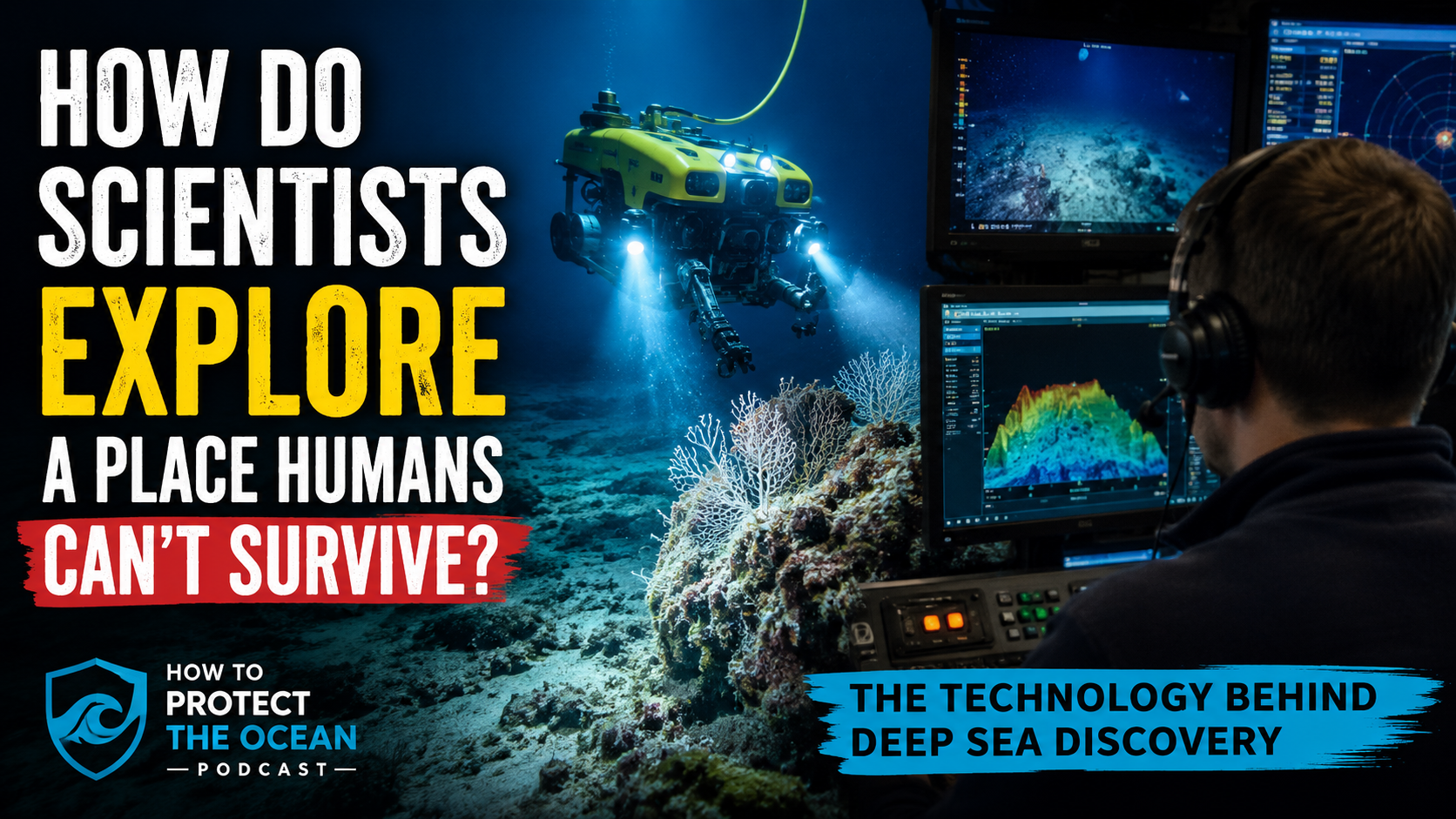
More than 80% of our ocean remains unmapped and largely unexplored. Yet scientists continue to make incredible discoveries thousands of meters below the surface, in places where no human could survive for more than a few moments. The obvious question is: how do they do it? The answer involves some of the most advanced technology ever built for scientific discovery.
In this episode of How to Protect the Ocean, we explore the incredible tools that are allowing researchers to unlock the mysteries of the deep sea. These technologies are changing how we understand marine ecosystems, discover new species, and protect some of Earth’s most fragile environments.
Why Humans Can’t Explore the Deep Ocean
The deeper you go into the ocean, the more challenging the environment becomes. Sunlight disappears, temperatures approach freezing, and pressure increases dramatically. At depths of several thousand meters, the pressure is hundreds of times greater than what we experience at sea level, enough to crush equipment that isn’t specifically designed for those conditions.
Although human-operated submersibles exist, they are expensive, limited in duration, and used only for specialized missions. Most scientific exploration today relies on technologies that can stay underwater longer, travel farther, and gather much more data than people ever could.
Meet the Robots Exploring Our Ocean
One of the most important tools in ocean science is the remotely operated vehicle, or ROV. These underwater robots remain connected to a research vessel by a long cable that provides power while transmitting high-definition video and scientific measurements back to scientists on the ship. Operators can control robotic arms to collect samples, photograph marine life, and inspect underwater landscapes in real time.
Scientists also use autonomous underwater vehicles, known as AUVs. Unlike ROVs, these robots operate without a tether and follow pre-programmed missions. They can map vast areas of the seafloor, collect environmental data, and reach locations that would be difficult or impossible for larger research vessels.
Mapping the Ocean Floor
Before scientists can study an area, they first need to know what it looks like. That is where multibeam sonar comes in. Instead of relying on light, which cannot travel very far underwater, sonar uses sound waves to create incredibly detailed maps of the ocean floor.
These maps reveal underwater mountains, deep canyons, hydrothermal vents, and habitats that had never been seen before. Many scientific expeditions begin with sonar mapping because it helps researchers identify the most interesting places to investigate in greater detail.
Finding Life Without Seeing It
One of the newest breakthroughs in marine science is environmental DNA, often called eDNA. Every organism leaves behind tiny traces of genetic material in the water through skin cells, mucus, waste, or scales. Scientists can collect a simple water sample and analyze it to determine which species have recently been in the area.
This approach allows researchers to detect rare, elusive, or endangered species without capturing or disturbing them. As eDNA techniques continue to improve, scientists are gaining an entirely new way to monitor biodiversity across the world’s oceans.
Artificial Intelligence Is Changing Ocean Science
Modern ocean expeditions generate enormous amounts of information. High-definition video, sonar imagery, water chemistry, biological observations, and environmental measurements quickly produce more data than humans can analyze efficiently. Artificial intelligence is becoming an essential tool for processing these massive datasets.
AI systems can identify marine species, detect unusual patterns, classify habitats, and even help guide future research missions. Rather than replacing scientists, artificial intelligence allows them to spend more time interpreting discoveries and asking new scientific questions.
Why This Technology Matters
Deep sea exploration is about much more than satisfying human curiosity. The information collected helps governments make better conservation decisions, supports sustainable fisheries, improves climate research, and identifies ecosystems that deserve protection before industrial activities expand into previously unexplored areas.
Every new expedition reminds us how little we truly know about our own planet. The more we discover about the deep ocean, the better equipped we are to protect it for future generations.
Final Thoughts
Technology has become our eyes, ears, and hands in one of the most extreme environments on Earth. From underwater robots and sonar mapping to eDNA and artificial intelligence, these innovations are allowing scientists to explore places humans simply cannot reach.
The deep ocean remains one of the last great frontiers of exploration. With every mission, we uncover new species, better understand Earth’s largest ecosystem, and take another step toward protecting our blue planet.

CEO
How Did Humpback Whales End Up in New York Harbor?