We’ve Explored Space Better Than Our Own Ocean, How Is That Possible?

 Apple Podcasts
 Spotify
 YouTube
 Amazon Music
 PocketCasts
 Overcast
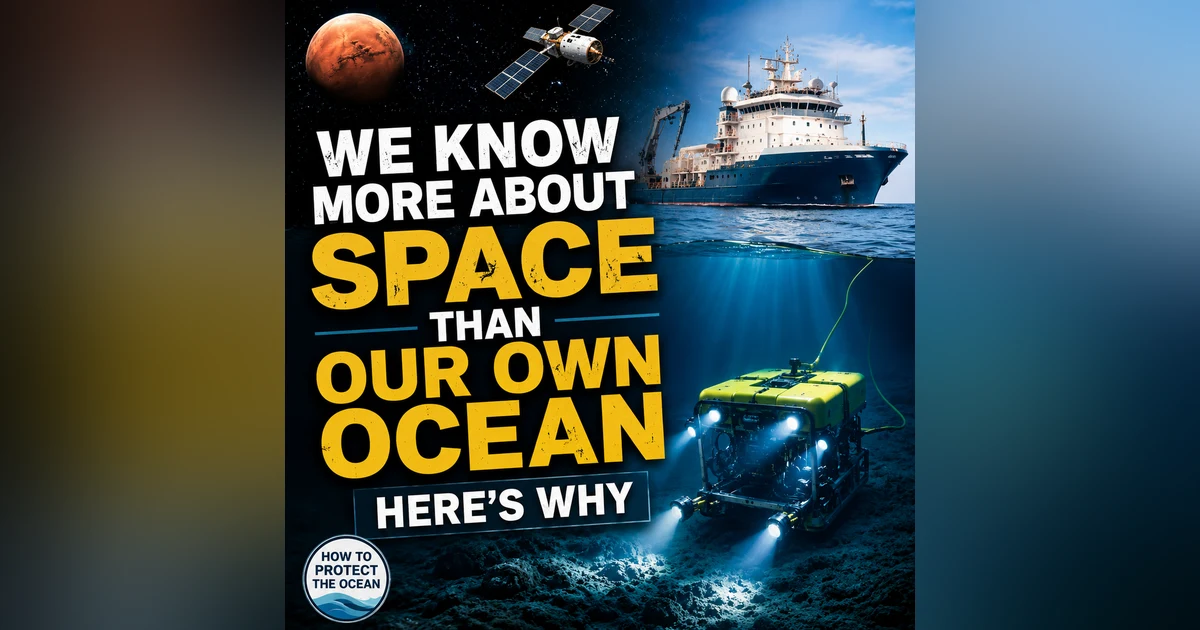
 How can we know more about the Moon and Mars than the bottom of our own ocean? It sounds impossible, but it is true. In this episode, we begin a special series on deep ocean exploration by uncovering why so much of our planet remains a mystery and why that matters more than ever.
The deep ocean plays a critical role in regulating Earth’s climate, supporting marine life, and helping sustain the ecosystems we depend on every day. Yet scientists have only explored a tiny fraction of it because of crushing pressure, complete darkness, and the enormous scale of the seafloor. You’ll discover why exploring the deep sea is far more than an adventure; it is essential for making better decisions about conservation.
This episode sets the stage for an upcoming interview with experts from Oceans Network Canada and the Department of Fisheries and Oceans Canada who are helping reveal Canada’s hidden underwater world. Before we can protect the ocean, we first have to understand it. And that journey begins here.
Support Independent Podcasts: https://www.speakupforblue.com/patreon
Need help with your ocean non-profit, company, or project? Get the help you need with Pisces Oceans Inc.: https://www.piscesoceans.ca
Connect with Speak Up For Blue
Website: https://bit.ly/3fOF3Wf
Instagram: https://bit.ly/3rIaJSG
TikTok: https://www.tiktok.com/@speakupforblue
Twitter: https://bit.ly/3rHZxpc
YouTube: www.speakupforblue.com/youtube
00:00:00,998 --> 00:00:03,959
Okay, Michelle, Andrew here.
2
00:00:04,560 --> 00:00:07,111
We're gonna be doing uh four episodes.
3
00:00:07,111 --> 00:00:15,364
I've got an interview this week with Ontario on Oceans Networks Canada, Ocean Networks
Canada, and so we're gonna be talking about that.
4
00:00:15,505 --> 00:00:18,496
well on Friday, and then so these are four that will go with that.
5
00:00:18,496 --> 00:00:24,889
So I am away uh Monday, Tuesday, Wednesday, Thursday, or Monday, Tuesday.
6
00:00:24,889 --> 00:00:25,349
I'm away.
7
00:00:25,349 --> 00:00:26,689
I'm back on Tuesday night.
8
00:00:26,689 --> 00:00:28,110
Um
9
00:00:28,130 --> 00:00:33,450
The Monday episode, what I'm gonna do, I'm gonna do all the show notes and stuff from the
transcript here.
10
00:00:33,450 --> 00:00:37,436
ah and then so I'll have it all uploaded and ready to go.
11
00:00:37,557 --> 00:00:46,774
And then all you have to do is just put I'm gonna have it and I'm actually gonna have for
the first two actually, Monday and Tuesday, I'm gonna have the everything done on Libsyn.
12
00:00:46,774 --> 00:00:54,069
All you to do is just upload the um upload the the thing to the right to the right title.
13
00:00:54,069 --> 00:00:55,244
Um
14
00:00:55,244 --> 00:01:02,780
And then that'll help me because I'm up at a cottage and I don't have a lot of um access
to internet and stuff like that.
15
00:01:02,780 --> 00:01:04,391
So I'm gonna have that done.
16
00:01:04,391 --> 00:01:10,026
If you can just upload it, it'll be scheduled for Monday at 3 a.m.
17
00:01:10,026 --> 00:01:11,086
my time.
18
00:01:11,337 --> 00:01:13,609
so if you can just upload it before that, that would be great.
19
00:01:13,609 --> 00:01:14,700
Let me know when it's uploaded.
20
00:01:14,700 --> 00:01:15,781
Same with the Tuesday.
21
00:01:15,781 --> 00:01:20,995
If you can get that uploaded, you can do that on Monday, your time, um, and then have it
uploaded.
22
00:01:20,995 --> 00:01:22,506
The show notes will be ready for you.
23
00:01:22,506 --> 00:01:23,994
Okay, I'll do those tonight.
24
00:01:23,994 --> 00:01:24,812
Okay.
25
00:01:24,812 --> 00:01:25,293
Here we go.
26
00:01:25,293 --> 00:01:26,213
I always do last minute.
27
00:01:26,213 --> 00:01:29,208
I don't know why I always do a last minute, but always do last minute on these.
28
00:01:29,208 --> 00:01:31,791
So I almost didn't do it this week, but I wanted to get some done.
29
00:01:31,791 --> 00:01:32,711
Okay, here we go.
30
00:01:32,711 --> 00:01:34,474
Start off July hot.
31
00:01:37,802 --> 00:01:42,043
Imagine standing out on a beach and looking out at the ocean.
32
00:01:42,084 --> 00:01:46,585
Now imagine almost everything beneath the surface is still a mystery.
33
00:01:46,585 --> 00:01:53,748
In fact, we've met more of the moon and Mars than we've actually seen in detail on our
very own seafloor.
34
00:01:53,748 --> 00:01:56,349
How is that possible?
35
00:01:57,109 --> 00:02:00,170
This is the How to Protect the Ocean podcast, your weekday ocean news update.
36
00:02:00,170 --> 00:02:07,425
If you care about staying informed on the ocean every single weekday, hit that follow
button right now on the podcast app that you're listening to.
37
00:02:07,425 --> 00:02:10,088
So you do not miss tomorrow's story.
38
00:02:10,209 --> 00:02:21,395
Welcome to part one of a four-part series leading up to a very special interview later on
this week with scientists and educational people from the Ontario Networks Canada from
39
00:02:21,395 --> 00:02:22,987
Oceans Networks Canada.
40
00:02:22,987 --> 00:02:24,469
What are Canada's most
41
00:02:34,349 --> 00:02:35,319
I'm gonna try that one again.
42
00:02:35,319 --> 00:02:46,972
Welcome to part one of a four-part series leading up to a special interview later this
week with a scientist from Department of Fisheries Notions as in Canada, as well as uh an
43
00:02:46,972 --> 00:02:49,929
educator from Oceans Network Canada.
44
00:02:49,929 --> 00:02:59,836
Uh it's it's behind it's it's it's basically about the Canada's most ambitious deep sea,
not only exploration projects, but educational projects as well.
45
00:02:59,836 --> 00:03:04,045
So today we are starting with one simple question: how
46
00:03:04,045 --> 00:03:09,469
Can there's how can there still be so much of our own planet that we've never explored?
47
00:03:09,469 --> 00:03:11,341
It's a strange thing to think about.
48
00:03:11,341 --> 00:03:23,020
You know, we live in an age where satellites can show us our neighborhood from space,
rovers can rovers have driven across Mars, and telescopes can detect planets orbiting
49
00:03:23,020 --> 00:03:24,381
distant stars.
50
00:03:24,381 --> 00:03:29,105
Yet the largest habitat on Earth remains unknown.
51
00:03:30,006 --> 00:03:32,148
Remains mostly unknown.
52
00:03:32,148 --> 00:03:34,279
And that's the deep ocean.
53
00:03:35,202 --> 00:03:44,717
When people hear that we've explored on when people hear that we've explored only a tiny
when people hear that we've only when people hear that we've explored only a tiny fraction
54
00:03:44,717 --> 00:03:51,831
of the deep ocean, they s they often imagine scientists they often imagine scientists
haven't bothered looking.
55
00:03:51,831 --> 00:03:52,811
But that's not the case.
56
00:03:52,811 --> 00:04:00,314
The challenge is that the deep sea ocean that the the challenge is that the deep sea is
one of the most difficult places on earth to reach.
57
00:04:00,335 --> 00:04:05,067
Sunlight appears after about sunlight disappears after about 200 meters.
58
00:04:05,143 --> 00:04:07,494
Sunlight disappears after 200 meters.
59
00:04:07,494 --> 00:04:10,976
As you descend farther, the pressure increases dramatically.
60
00:04:10,976 --> 00:04:17,820
At a depth of a thousand meters, the pressure is roughly one hundred times greater than
what we experience at sea level.
61
00:04:17,820 --> 00:04:25,344
Go even deeper than that and the pressure begins to and the and the go even deeper than
that and the pressure becomes crushing.
62
00:04:25,344 --> 00:04:27,586
Most submarines can't survive it.
63
00:04:27,586 --> 00:04:31,788
We've even saw a submarine implode because it wasn't built properly.
64
00:04:31,828 --> 00:04:34,037
Humans can't as humans
65
00:04:34,037 --> 00:04:36,940
And humans certainly can't survive that on their own.
66
00:04:37,061 --> 00:04:43,449
Even sending cameras thousands of meters below the sea the surface requires incredibly
specialized equipment.
67
00:04:43,650 --> 00:04:48,016
The ocean only covers the ocean also covers more than 70% of our planet.
68
00:04:48,016 --> 00:04:52,071
That means scientists aren't exploring a single cave or canyon.
69
00:04:53,591 --> 00:04:56,422
They're trying to that they're trying to understand.
70
00:04:56,422 --> 00:04:59,443
That means scientists aren't exploring a single cave or canyon.
71
00:04:59,443 --> 00:05:06,286
They're trying to understand an enormous three-dimensional world that stretches across
millions of square kilometers.
72
00:05:06,286 --> 00:05:08,707
It's easy to forget the ocean isn't just wide.
73
00:05:08,707 --> 00:05:09,908
It's deep.
74
00:05:10,028 --> 00:05:11,228
Really deep.
75
00:05:11,228 --> 00:05:18,631
And if you stacked Mount Everest inside the deepest part of the Pacific Ocean, its summit
wouldn't its summit would still be underwater.
76
00:05:18,631 --> 00:05:21,112
That's the scale that we're talking about here.
77
00:05:21,133 --> 00:05:22,635
Scientists estimate
78
00:05:22,635 --> 00:05:27,768
Scientists estimate that we've visually explored only a tiny percentage of the deep sea
floor.
79
00:05:28,128 --> 00:05:31,410
Of the deep sea floor, of the ocean seafloor.
80
00:05:31,670 --> 00:05:38,834
That means that there are mountains we've never seen, canyons we've never mapped, species
we haven't even discovered yet.
81
00:05:38,834 --> 00:05:42,255
Entire ecosystems remain hidden beneath the waves.
82
00:05:42,296 --> 00:05:47,658
And that should make one of and that should make every one of us curious.
83
00:05:47,939 --> 00:05:49,880
It's time to put our science hat on, folks.
84
00:05:49,880 --> 00:05:51,958
Because if we don't know what's there,
85
00:05:51,958 --> 00:05:56,540
How do we know what we're protecting or not protecting in in certain cases?
86
00:05:57,021 --> 00:05:58,752
Now you're probably wondering, like who cares?
87
00:05:58,752 --> 00:05:59,602
So what?
88
00:05:59,602 --> 00:06:02,884
If everybody lives, if nobody lives down there, why does it matter?
89
00:06:02,884 --> 00:06:04,685
And that's a fair question, to be honest.
90
00:06:04,685 --> 00:06:08,347
The answer is that the deep ocean isn't separate from our lives.
91
00:06:08,347 --> 00:06:11,188
It's connected in almost everything.
92
00:06:11,188 --> 00:06:13,549
It's connected to almost everything.
93
00:06:13,549 --> 00:06:18,192
The deep ocean stores enormous amounts of carbon, helping regulate Earth's climate.
94
00:06:18,192 --> 00:06:21,173
It plays a major role in nutrient cycling.
95
00:06:21,173 --> 00:06:23,894
That supports life throughout the ocean.
96
00:06:23,994 --> 00:06:34,737
Many commercial import many commercially important fish spend most many commercially
important fish spend part of their time many commercially open sorry, Michelle.
97
00:06:34,737 --> 00:06:42,979
Many commercially open fish, many commercially open fish spend part of their lives
connected to deep habitats, to deep sea habitats.
98
00:06:43,119 --> 00:06:47,940
Scientists continue discovering organisms that produce scientists continue.
99
00:06:48,230 --> 00:06:49,521
man, I'm having trouble here.
100
00:06:49,521 --> 00:06:51,071
Scientists continue.
101
00:06:51,137 --> 00:06:53,378
Scientists continue discovering organisms.
102
00:06:53,378 --> 00:06:59,782
Science scientists continue to discover species that produce compounds with potential
medical applications.
103
00:06:59,782 --> 00:07:04,645
And the deep sea helps support the ocean systems that produce much of the ocean we
breathe.
104
00:07:04,645 --> 00:07:17,692
In other words, if you're not in other words, if you'll in other words, if you ah in other
words, even if you're in other words, even if you'll never visit the deep sea, you benefit
105
00:07:17,692 --> 00:07:19,433
from it every single day.
106
00:07:20,343 --> 00:07:22,035
There's another reason why this matters.
107
00:07:22,035 --> 00:07:24,797
Human activity is expanding farther offshore.
108
00:07:24,797 --> 00:07:34,866
Deep sea fishing, underwater cables, potential seabed mining, energy development, climate
change, all these activities can affect places we barely studied.
109
00:07:34,866 --> 00:07:38,288
Imagine someone proposing to log a forest before everyone.
110
00:07:38,349 --> 00:07:47,113
Imagine imagine someone proposing to log a forest before anyone had even identified trees
or counted the wildlife that living there.
111
00:07:47,113 --> 00:07:48,817
I'm going to do that one again.
112
00:07:49,149 --> 00:07:56,131
Imagine someone proposing to log a forest before anyone had even identified the trees or
counted the wildlife living there.
113
00:07:57,849 --> 00:07:59,692
It would seem backwards.
114
00:07:59,692 --> 00:08:05,112
And that's exact yet that's exactly the situation scientists are trying to avoid in parts
of the deep sea.
115
00:08:05,112 --> 00:08:08,014
Before we make decisions, we need knowledge.
116
00:08:08,014 --> 00:08:10,675
And knowledge begins with exploration.
117
00:08:10,675 --> 00:08:17,136
If you're getting value from this quick ocean update, follow this show so you never miss
another episode.
118
00:08:18,496 --> 00:08:22,879
The good news is that we're entering an exciting period for ocean exploration.
119
00:08:22,879 --> 00:08:26,081
Technology has improved dramatically over the last decade.
120
00:08:26,081 --> 00:08:31,424
Scientists can now create incredibly detailed maps of the seafloor using multi-beam sonar.
121
00:08:31,424 --> 00:08:39,249
Remotely operated vehicles or ROVs can dive thousands of meters while sending live video
back to researchers on the ships above.
122
00:08:39,249 --> 00:08:44,602
High-definition cameras reveal animals that no human has ever seen alive.
123
00:08:44,906 --> 00:08:52,140
And environmental DNA, and also known as e-DNA, allows scientists to detect species simply
by analyzing seawater.
124
00:08:52,420 --> 00:09:02,326
Artificial intelligence is helping researchers pr artificial intelligence is also helping
researchers pro process enormous amounts of video and imagery much faster than ever
125
00:09:02,326 --> 00:09:03,286
before.
126
00:09:03,426 --> 00:09:06,988
In many ways, we're experiencing a modern age of discovery.
127
00:09:06,988 --> 00:09:09,049
And Canada has an important poll.
128
00:09:09,049 --> 00:09:11,131
And Canada has an important role to play.
129
00:09:11,131 --> 00:09:14,004
Our Pacific Coast is home of submarine canyons.
130
00:09:14,004 --> 00:09:22,908
Underwater mountains, underwater mountains called seamounts, deep coral gardens, sponge
reefs, and habitats that scientists are only beginning to understand.
131
00:09:23,008 --> 00:09:27,250
Every expedition has the seafloor to discover something new.
132
00:09:27,351 --> 00:09:30,992
Sometimes it's a species, sometimes it's a habitat.
133
00:09:30,992 --> 00:09:36,595
And sometimes it eats and sometimes it's better understanding of how our planet works.
134
00:09:36,595 --> 00:09:39,036
That's why exploration isn't about
135
00:09:39,201 --> 00:09:42,102
That's why exploration isn't about satisfying curiosity alone.
136
00:09:42,102 --> 00:09:50,205
It's about making smarter decisions, better fisheries management, better marine protected
areas, better conservation, better climate science.
137
00:09:50,205 --> 00:09:52,926
You can't protect what you don't understand.
138
00:09:53,707 --> 00:10:00,069
And that's exactly why scientists continue exploring places that most of us will never see
with our own eyes.
139
00:10:00,389 --> 00:10:07,892
Later this week, you're going to hear from people leading one of Canada's deep ocean
exploration efforts and educational efforts.
140
00:10:07,894 --> 00:10:11,185
But before we get there, there's another question that we need to answer.
141
00:10:11,266 --> 00:10:18,809
If the deep ocean is so dark, so cold, and under so much pressure, how can anything
possibly live there?
142
00:10:18,809 --> 00:10:23,731
The answer is far more incredible than people imagine, and we're going to explore that
tomorrow.
143
00:10:24,291 --> 00:10:28,073
The deep sea may be out of sight, but it should never be out of mind.
144
00:10:28,073 --> 00:10:35,786
Understanding what's beneath the surface is the st is the first step toward protecting one
of the Earth's most important ecosystems.
145
00:10:37,366 --> 00:10:39,938
I want to thank you so much for joining us on today's episode.
146
00:10:39,938 --> 00:10:47,915
This is just a these are just quick hit episodes where we talk about what we're going to
be talking about, where we talk about some of the topics that we talk about in Friday's
147
00:10:47,915 --> 00:10:55,411
episode when we're going to be interviewing some people from Department of Fisheries and
Oceans, a person from Department of Fisheries Oceans in Canada, and we're also going to be
148
00:10:55,411 --> 00:10:58,595
talking to an educator from Ocean Networks Canada.
149
00:10:58,595 --> 00:10:59,895
You're going to want to stay tuned to that.
150
00:10:59,895 --> 00:11:06,476
So follow this episode right now so that you do not miss out on Friday's episode and of
course tomorrow's episode.
151
00:11:06,476 --> 00:11:11,019
we're going to be discovering why it's so important that of the deep sea why the deep sea
is so important.
152
00:11:11,019 --> 00:11:14,522
Thank you so much for joining me on today's episode of the How to Protect the Ocean
podcast.
153
00:11:14,522 --> 00:11:15,763
I'm your host Andrew Lewin.
154
00:11:15,763 --> 00:11:23,908
If you want to no sorry before we do that if you want to support this podcast and support
all the effort that I do I'm a basically a one person show.
155
00:11:23,908 --> 00:11:28,292
I have a team member who helps me edit that I pay to edit and she does an amazing job.
156
00:11:28,292 --> 00:11:34,856
Her and her husband do amazing jobs in editing all of my my clips, my podcasts, my YouTube
videos.
157
00:11:34,856 --> 00:11:42,378
And soon more clips that we're going to be doing or more short form videos that we're
going to be doing for Instagram and uh and TikTok.
158
00:11:42,378 --> 00:11:49,780
I just want if you want to so if you want to support all that effort that we do, you can
go to speakupforblue.com forward slash Patreon.
159
00:11:49,780 --> 00:11:54,681
That's speakeupforblue.com forward spot forward slash Patreon.
160
00:11:54,681 --> 00:11:58,863
The link is in the show notes as well as how to get a hold of me on Instagram or on
TikTok.
161
00:11:58,863 --> 00:12:02,654
Thank you so much for joining me on today's episode of the How to Protect the Ocean
podcast.
162
00:12:02,654 --> 00:12:03,234
Have a great day.
163
00:12:03,234 --> 00:12:04,619
We'll talk to you next time.
164
00:12:04,619 --> 00:12:05,560
and happy conservation.
165
00:12:05,560 --> 00:12:07,030
I'm gonna do that one more time.
166
00:12:07,030 --> 00:12:10,272
Thank you so much for joining me on today's episode of the How to Protect the Ocean
Podcast.
167
00:12:10,272 --> 00:12:11,493
I'm your host, Andrew Lewin.
168
00:12:11,493 --> 00:12:12,163
Have a great day.
169
00:12:12,163 --> 00:12:14,894
We'll talk to you next time in happy conservation.
170
00:12:15,369 --> 00:12:18,847
All right, Michelle, that was a little dirty, but hopefully we can clean that up.
171
00:12:18,847 --> 00:12:19,957
Sorry about that.