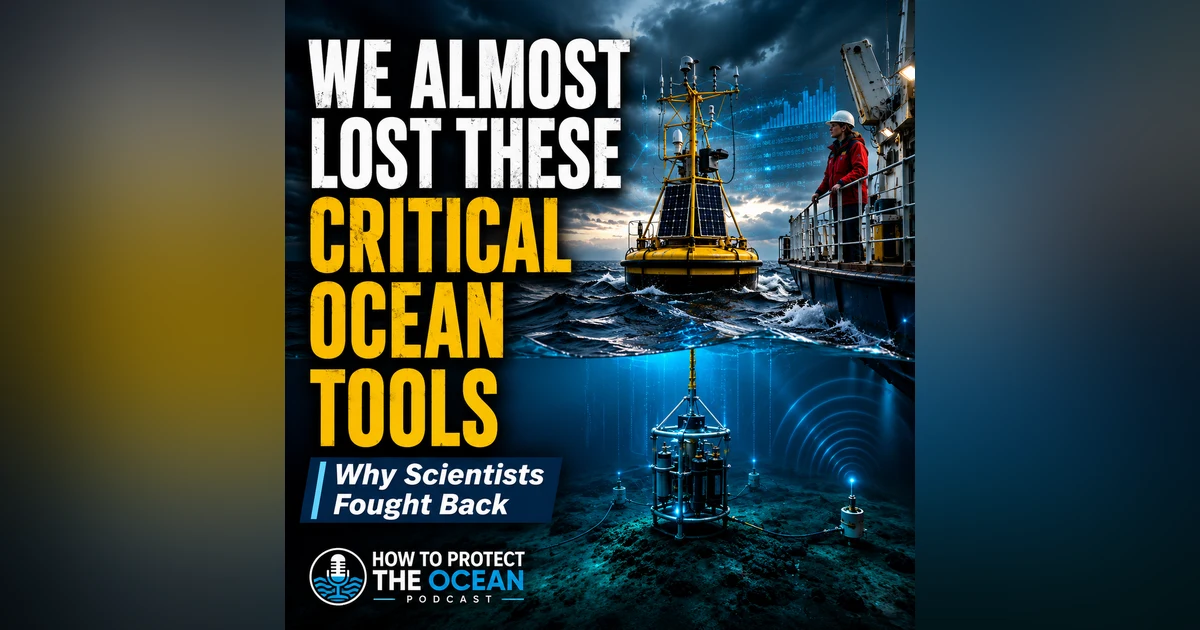
The Ocean Sensors We Almost Lost

 Apple Podcasts
 Spotify
 YouTube
 Amazon Music
 PocketCasts
 Overcast
 What happens when one of the world’s most important ocean monitoring systems is nearly shut down?
The Ocean Observatories Initiative (OOI) collects critical data on ocean temperatures, oxygen levels, currents, marine ecosystems, and climate change. Earlier this year, parts of the program faced significant cuts, raising concerns among scientists, policymakers, and ocean advocates.
In this episode, we explore why researchers fought so hard to save the OOI, how the National Academies challenged the justification for the cuts, and why long-term ocean observations are essential for understanding climate change, marine ecosystems, and the future of ocean conservation.
If we stop watching the ocean, what might we miss?
Support Independent Podcasts: https://www.speakupforblue.com/patreon
Need help with your ocean non-profit, company, or project? Get the help you need with Pisces Oceans Inc.: https://www.piscesoceans.ca
Connect with Speak Up For Blue
Website: https://bit.ly/3fOF3Wf
Instagram: https://bit.ly/3rIaJSG
TikTok: https://www.tiktok.com/@speakupforblue
Twitter: https://bit.ly/3rHZxpc
YouTube: www.speakupforblue.com/youtube
00:00:00,049 --> 00:00:03,079
One of the most important ocean
monitoring systems in the world was
2
00:00:03,089 --> 00:00:07,686
nearly pulled out of the ocean and most
people had no idea it was happening.
3
00:00:07,986 --> 00:00:09,946
Then something unexpected happened.
4
00:00:10,226 --> 00:00:11,486
Scientists pushed back.
5
00:00:11,696 --> 00:00:15,216
The National Academy stepped in
and the decision was reversed.
6
00:00:15,416 --> 00:00:16,476
So what happened?
7
00:00:16,766 --> 00:00:20,996
And why does it matter far
beyond one scientific program?
8
00:00:21,346 --> 00:00:24,340
This is the How to Protect the Ocean
podcast, your weekday ocean news update.
9
00:00:24,543 --> 00:00:28,726
If you care about staying informed on
the ocean every weekday, hit that follow
10
00:00:28,726 --> 00:00:32,556
button right now on your podcast app
so you don't miss tomorrow's story.
11
00:00:33,156 --> 00:00:35,126
Today, we're answering
one simple question.
12
00:00:35,386 --> 00:00:39,396
Why was the Ocean Observatories
Initiative almost dismantled, and
13
00:00:39,396 --> 00:00:43,296
what does its survival tell us
about the future of ocean science?
14
00:00:43,733 --> 00:00:45,523
So let's just talk about the basics.
15
00:00:45,533 --> 00:00:46,363
What happened?
16
00:00:46,613 --> 00:00:50,720
The Ocean Observatories Initiative,
or OOI, is essentially a giant
17
00:00:50,760 --> 00:00:53,870
network of scientific instruments
spread throughout the ocean.
18
00:00:54,126 --> 00:00:56,266
Think of it like a collection
of weather stations.
19
00:00:56,446 --> 00:00:59,113
Instead of monitoring conditions
on land, these stations
20
00:00:59,113 --> 00:01:01,199
continuously monitor the ocean.
21
00:01:01,429 --> 00:01:06,530
They measure things like temperature,
oxygen, currents, ocean chemistry, marine
22
00:01:06,530 --> 00:01:08,683
life, and climate-related changes.
23
00:01:08,683 --> 00:01:10,363
Really, really important stuff.
24
00:01:10,733 --> 00:01:15,433
The system operates around the clock
collecting data every day of the year.
25
00:01:15,676 --> 00:01:18,376
Researchers use the information to
understand everything from marine
26
00:01:18,386 --> 00:01:21,849
heatwaves to ecosystem changes
and long-term climate trends.
27
00:01:22,059 --> 00:01:25,809
And if you think about it, with a super
El Niño knocking on our door, this
28
00:01:25,809 --> 00:01:27,969
information is gonna be more than ever.
29
00:01:28,226 --> 00:01:30,946
Earlier this year, the US National
Science Foundation announced plans
30
00:01:30,946 --> 00:01:35,036
to significantly reduce parts of
the OOI, of the observation system.
31
00:01:35,316 --> 00:01:37,626
The proposal included
removing infrastructure from
32
00:01:37,626 --> 00:01:39,366
several observing arrays.
33
00:01:39,546 --> 00:01:43,006
As a scientist, not that I use the
data, which is freely available,
34
00:01:43,119 --> 00:01:44,989
this was an alarming situation.
35
00:01:45,403 --> 00:01:48,256
Not because a single instrument would
disappear, but because long-term
36
00:01:48,256 --> 00:01:50,123
data records would be interrupted.
37
00:01:50,329 --> 00:01:53,370
Here's the thing you have to realize
when we talk about long-term data.
38
00:01:53,770 --> 00:01:56,790
Long-term data, it's important to keep
it consistent, to make sure that you
39
00:01:56,790 --> 00:02:00,679
are getting the data that comes in on
a regular basis, whether that's every
40
00:02:00,679 --> 00:02:03,696
minute, whether it's every hour, whether
it's every day, it does not matter.
41
00:02:03,876 --> 00:02:04,976
You wanna make it consistent.
42
00:02:04,976 --> 00:02:08,619
Unfortunately, with these long-term
data systems, we get interruptions.
43
00:02:08,769 --> 00:02:11,190
We get interruptions, gaps
in data, usually because a
44
00:02:11,190 --> 00:02:12,699
government body gets involved.
45
00:02:12,899 --> 00:02:13,860
They say, "Hey, you know what?
46
00:02:13,860 --> 00:02:16,760
This actually costs too much money
to cut." It's an easy thing to cut
47
00:02:16,760 --> 00:02:19,623
because, like, they can say, "Well,
we have all this data already.
48
00:02:19,796 --> 00:02:23,283
We don't have to worry about it." But
the problem is, is when you have a
49
00:02:23,313 --> 00:02:27,473
consistent data set, you end up having
something that's really important.
50
00:02:27,483 --> 00:02:31,233
Because once a continuous data set
is broken, you can never go back
51
00:02:31,253 --> 00:02:33,133
and recreate the missing years.
52
00:02:33,379 --> 00:02:36,479
Imagine deleting several chapters
from a book and then trying to
53
00:02:36,479 --> 00:02:37,629
understand the entire story.
54
00:02:37,629 --> 00:02:38,979
That's really what it comes down to.
55
00:02:39,083 --> 00:02:41,503
That's what losing long-term
monitoring data can feel like.
56
00:02:41,853 --> 00:02:45,043
The ocean doesn't just stop
changing while we're not watching.
57
00:02:45,416 --> 00:02:46,196
That just doesn't happen.
58
00:02:46,216 --> 00:02:47,516
The ocean is constantly changing.
59
00:02:47,600 --> 00:02:50,850
And to understand, especially in
today's world, especially when we're
60
00:02:50,850 --> 00:02:54,129
gonna see big changes this year, it's
really important to be able to predict
61
00:02:54,129 --> 00:02:57,499
those what's gonna happen after those
changes, but monitor those changes.
62
00:02:58,019 --> 00:03:01,833
And here's why the story became much
bigger than a funding discussion.
63
00:03:02,149 --> 00:03:05,406
Ocean observations are the
foundation of ocean management.
64
00:03:05,546 --> 00:03:09,946
We often hear about protecting fisheries,
protecting marine heatwaves, understanding
65
00:03:09,946 --> 00:03:13,333
climate change, forecasting extreme
weather, managing coastal systems.
66
00:03:13,503 --> 00:03:15,753
All those decisions depend on data.
67
00:03:16,076 --> 00:03:20,189
Without observations, we're making
decisions with less information.
68
00:03:20,429 --> 00:03:23,299
That's why ocean scientists
reacted strongly to this news.
69
00:03:23,609 --> 00:03:26,299
But the biggest turning point
came when the National Academies
70
00:03:26,299 --> 00:03:27,869
released a public statement.
71
00:03:28,239 --> 00:03:31,809
According to the statement, the National
Science Foundation had inaccurately
72
00:03:31,809 --> 00:03:35,713
cited a National Academies report when
explaining the proposed reductions.
73
00:03:35,976 --> 00:03:37,466
That is huge.
74
00:03:37,716 --> 00:03:41,546
The National Academies are one of the
most respected scientific advisory
75
00:03:41,546 --> 00:03:43,696
organizations in the United States.
76
00:03:43,886 --> 00:03:46,626
When they publicly clarify
that their findings are being
77
00:03:46,636 --> 00:03:48,966
misinterpreted, people pay attention.
78
00:03:49,246 --> 00:03:50,986
Suddenly, it wasn't about budgets.
79
00:03:51,186 --> 00:03:55,626
It became a decision about scientific
evidence and how decisions are justified.
80
00:03:56,086 --> 00:03:57,576
Scientists began speaking out.
81
00:03:57,586 --> 00:03:59,056
Universities raised concern.
82
00:03:59,256 --> 00:04:00,799
Ocean stakeholders got involved.
83
00:04:00,949 --> 00:04:04,459
Lawmakers from both political
parties started asking questions.
84
00:04:04,693 --> 00:04:06,363
And momentum built quickly.
85
00:04:06,759 --> 00:04:10,939
Just like momentum's building on this
podcast, if you are getting value from
86
00:04:10,939 --> 00:04:15,512
these quick ocean news updates, follow
this show so you never miss an episode.
87
00:04:15,889 --> 00:04:16,909
Let's get back to the story.
88
00:04:17,045 --> 00:04:19,869
Now, what makes this story particularly
interesting is that it demonstrates
89
00:04:19,879 --> 00:04:21,902
how invisible ocean science can be.
90
00:04:22,049 --> 00:04:24,059
Most people will never
see these instruments.
91
00:04:24,059 --> 00:04:27,269
Like, let's be honest, we're never gonna
know what these observatories look like
92
00:04:27,399 --> 00:04:28,839
unless you go out and see a picture.
93
00:04:28,839 --> 00:04:30,169
You actually have to seek this out.
94
00:04:30,435 --> 00:04:32,092
But they're not for tourist attractions.
95
00:04:32,252 --> 00:04:33,242
They're not famous.
96
00:04:33,399 --> 00:04:36,332
They're quietly sitting there in
the ocean collecting information
97
00:04:36,372 --> 00:04:38,162
every second of every day.
98
00:04:38,479 --> 00:04:40,999
And let's be honest, like, a lot
of the times, like, this baseline
99
00:04:40,999 --> 00:04:42,885
data is boring to a lot of people.
100
00:04:43,062 --> 00:04:47,162
But when you put it in a database and
you start analyzing it from day shifts
101
00:04:47,182 --> 00:04:50,912
to hourly shifts, to whatever that
might that data, whatever that timescale
102
00:04:50,912 --> 00:04:54,812
is, it becomes really important in
protecting people, in protecting
103
00:04:54,832 --> 00:04:59,272
our coastlines, in protecting all
of our assets that we build on land.
104
00:04:59,532 --> 00:05:03,162
Because we see with the powerful
storms that can come in, how to predict
105
00:05:03,172 --> 00:05:07,052
those, and what it does to saving
lives and saving just infrastructure.
106
00:05:07,436 --> 00:05:08,446
So here's what happens.
107
00:05:08,546 --> 00:05:10,196
Here's the situation with
what's happening next.
108
00:05:10,196 --> 00:05:13,412
The good news is that the National
Science Foundation ultimately
109
00:05:13,412 --> 00:05:14,862
reversed course, which is great.
110
00:05:15,122 --> 00:05:18,212
The agency announced it would halt
further equipment removal, but
111
00:05:18,212 --> 00:05:20,532
it had already started, so some
of the damage was already done.
112
00:05:20,682 --> 00:05:22,212
Just off a misinterpretation.
113
00:05:22,242 --> 00:05:23,412
Just think about that.
114
00:05:23,619 --> 00:05:25,979
It would continue operations
and maintenance of everything.
115
00:05:25,979 --> 00:05:29,169
It would redeploy equipment that had
already been removed, which cost even more
116
00:05:29,169 --> 00:05:33,269
money, and it would gather additional
stakeholder input before moving forward.
117
00:05:33,619 --> 00:05:35,662
For now, the OOI remains operational,
118
00:05:35,742 --> 00:05:38,422
but the larger conversation
is far from over.
119
00:05:38,762 --> 00:05:40,872
Ocean observing systems are expensive.
120
00:05:41,222 --> 00:05:42,722
Budgets are always under pressure.
121
00:05:42,722 --> 00:05:46,835
For the last two years, it got… or
even before this, '24 and '25, it got
122
00:05:46,835 --> 00:05:49,905
approved by Congress, but we just don't
know what's gonna happen in the future.
123
00:05:50,052 --> 00:05:54,352
And let's be honest, we know in
Project 2025 it was slated to be cut.
124
00:05:54,699 --> 00:05:57,349
And many scientific programs
face similar challenges.
125
00:05:57,639 --> 00:05:59,999
What this episode highlights is
the importance of understanding
126
00:05:59,999 --> 00:06:01,489
what these systems actually do.
127
00:06:01,692 --> 00:06:04,372
It's easy to support protecting
whales because we love whales.
128
00:06:04,372 --> 00:06:06,662
It's easy to support protecting
coral reefs 'cause we all
129
00:06:06,662 --> 00:06:07,695
know what coral reefs are.
130
00:06:07,785 --> 00:06:11,565
It's often hard to explain why we
should invest in a network of sensors
131
00:06:11,565 --> 00:06:14,845
sitting hundreds of kilometers offshore
that we don't get to see or we
132
00:06:14,846 --> 00:06:16,996
don't understand how it benefits us.
133
00:06:17,215 --> 00:06:21,396
But without those sensors, our ability to
understand ocean change becomes weaker.
134
00:06:21,772 --> 00:06:24,552
And if we don't understand what's
happening in the ocean, it becomes
135
00:06:24,602 --> 00:06:26,862
much harder to protect it effectively.
136
00:06:27,132 --> 00:06:28,332
That's the lesson here.
137
00:06:28,442 --> 00:06:32,912
The observatory was saved, which is great,
but the broader challenge of maintaining
138
00:06:32,912 --> 00:06:35,232
long-term ocean science remains.
139
00:06:35,599 --> 00:06:38,319
Protecting the ocean isn't
about protecting species.
140
00:06:38,489 --> 00:06:41,969
It's about protecting the scientific
systems that help us understand
141
00:06:42,079 --> 00:06:43,935
what's happening beneath the surface.
142
00:06:44,112 --> 00:06:46,689
Because if we don't have that
information, there's nothing to
143
00:06:46,689 --> 00:06:50,119
protect because we don't know what's
trending downward until it's too late.
144
00:06:50,579 --> 00:06:54,759
And if we stop understanding it,
protecting it becomes much harder.
145
00:06:55,141 --> 00:06:56,221
That's it for today's episode.
146
00:06:56,221 --> 00:06:57,021
I want to bring you this news.
147
00:06:57,041 --> 00:06:59,515
It is good news, but it
doesn't mean that we are done.
148
00:06:59,525 --> 00:07:01,305
We still have to push.
149
00:07:01,408 --> 00:07:05,501
We still have to speak up, because
if we don't speak up for the ocean,
150
00:07:05,578 --> 00:07:07,128
the ocean will just disappear on us.
151
00:07:07,138 --> 00:07:10,061
Not disappear in terms of just
disappear and evaporate.
152
00:07:10,218 --> 00:07:13,278
What I'm saying is the data will
disappear, the protections will
153
00:07:13,278 --> 00:07:16,858
disappear, and we are gonna be in a
lot more trouble if we don't stand up
154
00:07:16,858 --> 00:07:20,945
to these cuts, these unnecessary cuts
that are done on misinterpretation
155
00:07:21,061 --> 00:07:23,701
and lack of understanding of
how important the ocean is
156
00:07:23,751 --> 00:07:27,791
in the face of, like, development and
trying to build a better America or
157
00:07:27,791 --> 00:07:29,715
whatever you wanna call it in the future.
158
00:07:29,938 --> 00:07:33,378
We have to protect the ocean, and
to protect the ocean, we have
159
00:07:33,378 --> 00:07:36,205
to understand it, and we have
to gather the baseline data.
160
00:07:36,291 --> 00:07:39,811
And we need to fund it, and that's what
the US has been amazing at doing in the
161
00:07:39,811 --> 00:07:41,988
past, is funding these ocean systems.
162
00:07:42,185 --> 00:07:45,045
This program started in 2016,
and it's still going strong.
163
00:07:45,191 --> 00:07:48,851
We need to make sure that we can help each
other and help the people in the States,
164
00:07:48,935 --> 00:07:52,625
and the people in the United States, you
need to speak up when this stuff happens,
165
00:07:52,625 --> 00:07:54,435
'cause we see that it becomes reversed.
166
00:07:54,575 --> 00:07:57,441
We see that even though it was
misinterpreted, when people speak
167
00:07:57,451 --> 00:07:59,741
up and people put pressure, whether
they're scientists, whether they're
168
00:07:59,741 --> 00:08:02,541
policymakers, whether they're
citizens, people get to know.
169
00:08:02,542 --> 00:08:06,885
And the way you get to know is
you get to know on this podcast.
170
00:08:06,905 --> 00:08:08,262
You follow creators.
171
00:08:08,372 --> 00:08:09,432
You follow this podcast.
172
00:08:09,442 --> 00:08:13,395
You follow creators like Carissa
Cabrera, who is always on top of this
173
00:08:13,405 --> 00:08:17,138
type of stuff, and others who are going
around and make sure that you are up to
174
00:08:17,138 --> 00:08:19,018
date on what's happening in the ocean.
175
00:08:19,155 --> 00:08:20,605
So follow this podcast.
176
00:08:20,775 --> 00:08:22,495
Make sure you're up to
date on what's happening.
177
00:08:22,495 --> 00:08:26,525
I'll try and bring you as much
information as I can when we move forward.
178
00:08:26,748 --> 00:08:27,868
That's it for today's episode.
179
00:08:27,868 --> 00:08:31,765
If you wanna get ahold of me, you
can do so by going into the socials,
180
00:08:31,775 --> 00:08:34,095
looking at my social links, DM
me, whatever you might wanna do.
181
00:08:34,095 --> 00:08:38,318
And if you wanna support the show, you
can go to speakupforblue.com/patreon.
182
00:08:38,318 --> 00:08:42,288
That's speakupforblue.com/patreon.
183
00:08:42,528 --> 00:08:45,498
Any contributions, it allows
me to continue to do the
184
00:08:45,498 --> 00:08:46,741
stuff that I want to do.
185
00:08:46,898 --> 00:08:48,725
Not only do I bring you this podcast.
186
00:08:48,725 --> 00:08:50,485
I help bring you the Beyond
Jaws podcast, of course.
187
00:08:50,495 --> 00:08:52,658
I bring you newsletters,
I bring you social posts.
188
00:08:52,778 --> 00:08:54,848
I bring you a YouTube channel material.
189
00:08:54,998 --> 00:08:58,711
I do this all for you and because
I love it, and your support helps.
190
00:08:58,711 --> 00:09:02,648
So go to speakupforblue.com/patreon,
and I wanna thank you so much for
191
00:09:02,648 --> 00:09:05,328
joining me on today's episode of the
How to Protect the Ocean podcast.
192
00:09:05,548 --> 00:09:06,558
I'm your host, Andrew Lewin.
193
00:09:06,568 --> 00:09:07,148
Have a great day.
194
00:09:07,148 --> 00:09:09,125
We'll talk to you next
time, and happy conservation.