What Happens to Ocean Science During a War?
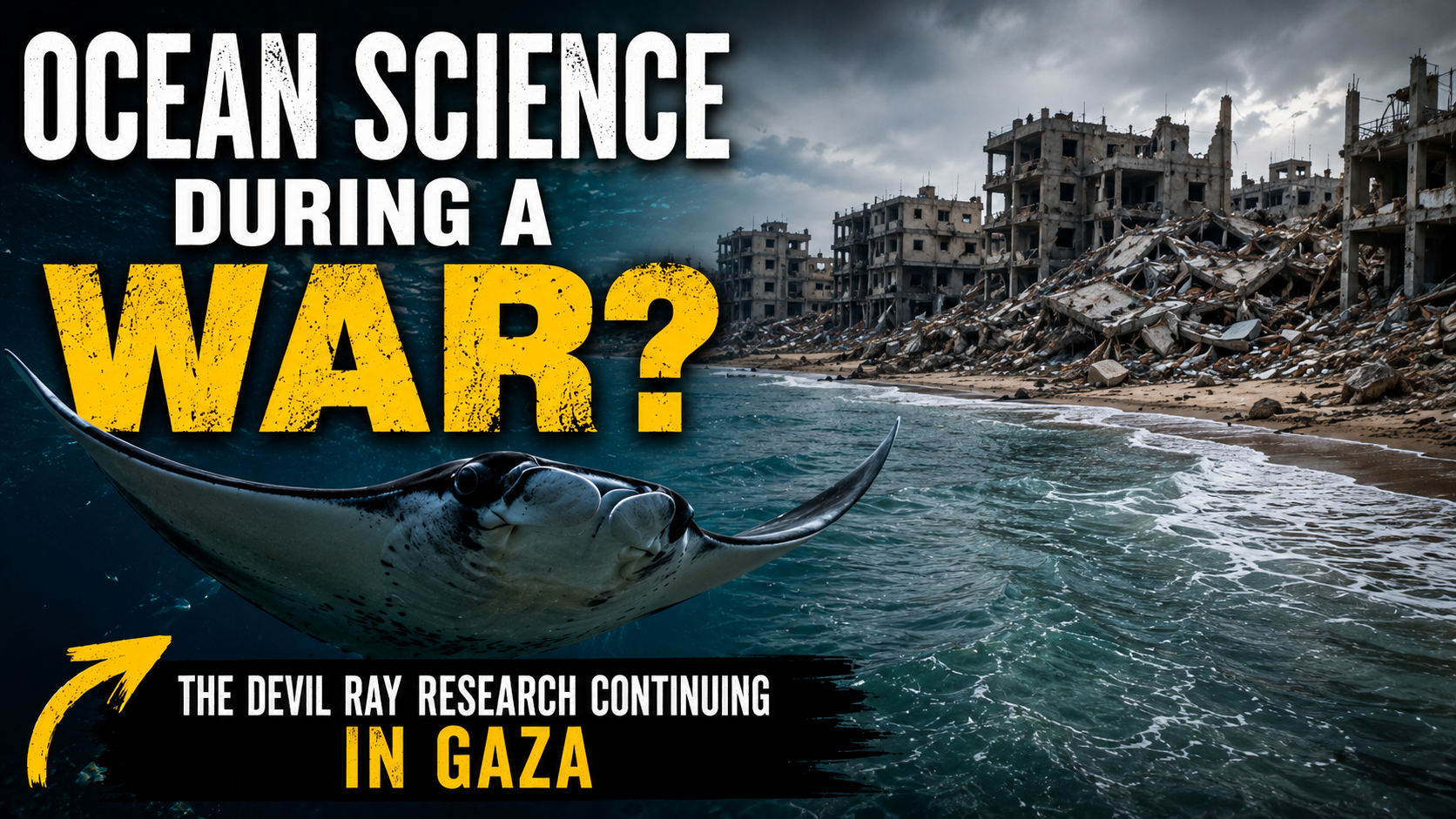
When most people think about ocean conservation, they imagine marine protected areas, scientific expeditions, or researchers tagging sharks and whales. They rarely think about scientists trying to continue their work while living through war. Yet that is exactly the reality for one marine ecologist studying endangered giant devil rays along the coast of Gaza.
His story reminds us that protecting the ocean isn’t only about wildlife. It is also about the people who dedicate their lives to understanding it, even under extraordinary circumstances. Sometimes, the greatest conservation story isn’t about the species being studied, but about the scientist refusing to give up.
Meet the Giant Devil Ray
Giant devil rays are among the largest rays in the world and are close relatives of manta rays. They glide through the open waters of the Mediterranean with wing-like fins and can grow several meters across. Despite their impressive size, scientists still know surprisingly little about how these animals migrate, reproduce, or how many remain in the wild.
That lack of information makes conservation difficult. Giant devil rays reproduce slowly, with females giving birth to very few young over their lifetime. When populations decline because of fishing or accidental capture, recovery can take decades.
Science in One of the World’s Most Difficult Places
Marine ecologist Mohammed Abu Daya has spent years studying these remarkable animals along Gaza’s coastline. His work helped reveal that what many people believed was a mysterious mass stranding of giant devil rays was actually a targeted fishery. That discovery changed how scientists understood both the species and the pressures it faces.
Since the outbreak of war, conducting research has become incredibly challenging. Fieldwork has been interrupted, equipment has become difficult to access, and everyday safety cannot be taken for granted. Despite these obstacles, Abu Daya has continued contributing to marine science whenever opportunities arise.
Why This Story Matters
Conservation depends on people. Scientists collect data that governments use to develop policies. Researchers work alongside fishing communities to understand marine ecosystems. Without those partnerships, protecting endangered species becomes far more difficult.
Many of the world’s most biodiverse marine ecosystems exist in regions facing political instability or humanitarian crises. Fish continue migrating. Marine mammals continue feeding. Endangered species continue struggling to survive. Nature does not pause because humans are experiencing conflict.
This story reminds us that local scientists often become the most important source of information for protecting marine life. Their work creates the foundation for future conservation decisions, even if the world isn’t paying attention.
Communities Are Essential to Conservation
One of the strongest messages from this story is the importance of working with local communities. Fishers spend countless hours on the water and often notice changes in wildlife long before scientific studies begin. Their observations can become valuable pieces of conservation research.
When local knowledge and scientific research come together, everyone benefits. Researchers gain information they could never collect alone, while communities become active partners in protecting the species they depend on. That collaboration creates stronger conservation outcomes than either group could achieve independently.
Hope for Giant Devil Rays
The future of giant devil rays remains uncertain, but there is reason for optimism. Scientists throughout the Mediterranean are sharing data, improving monitoring efforts, and learning more about these mysterious animals every year. Each new observation helps build a clearer picture of how to protect the species.
Perhaps the most inspiring part of this story is not the research itself. It is the determination of scientists who continue collecting knowledge despite overwhelming challenges. Their work reminds us that conservation is ultimately an investment in both people and wildlife.
Final Thoughts
The ocean story is always a people story.
Behind every scientific paper, every conservation success, and every new discovery is someone willing to dedicate their life to understanding our planet. Mohammed Abu Daya’s work studying giant devil rays demonstrates that even during humanity’s most difficult moments, the pursuit of knowledge and the desire to protect nature can continue.
If we want to build a healthier ocean, we must also support the people doing the work to understand and protect it.

CEO
The Blob Hit California's Kelp. Protected Kelp Came Back Faster.