What Happens When Canada’s Tiny Fish Disappear?
Forage fish are easy to overlook.
They are small. They move in schools. Most people do not think about them unless they are used as bait, turned into fish meal, or seen washing ashore during a capelin roll.
But these fish are not minor characters in the ocean. They are the foundation.
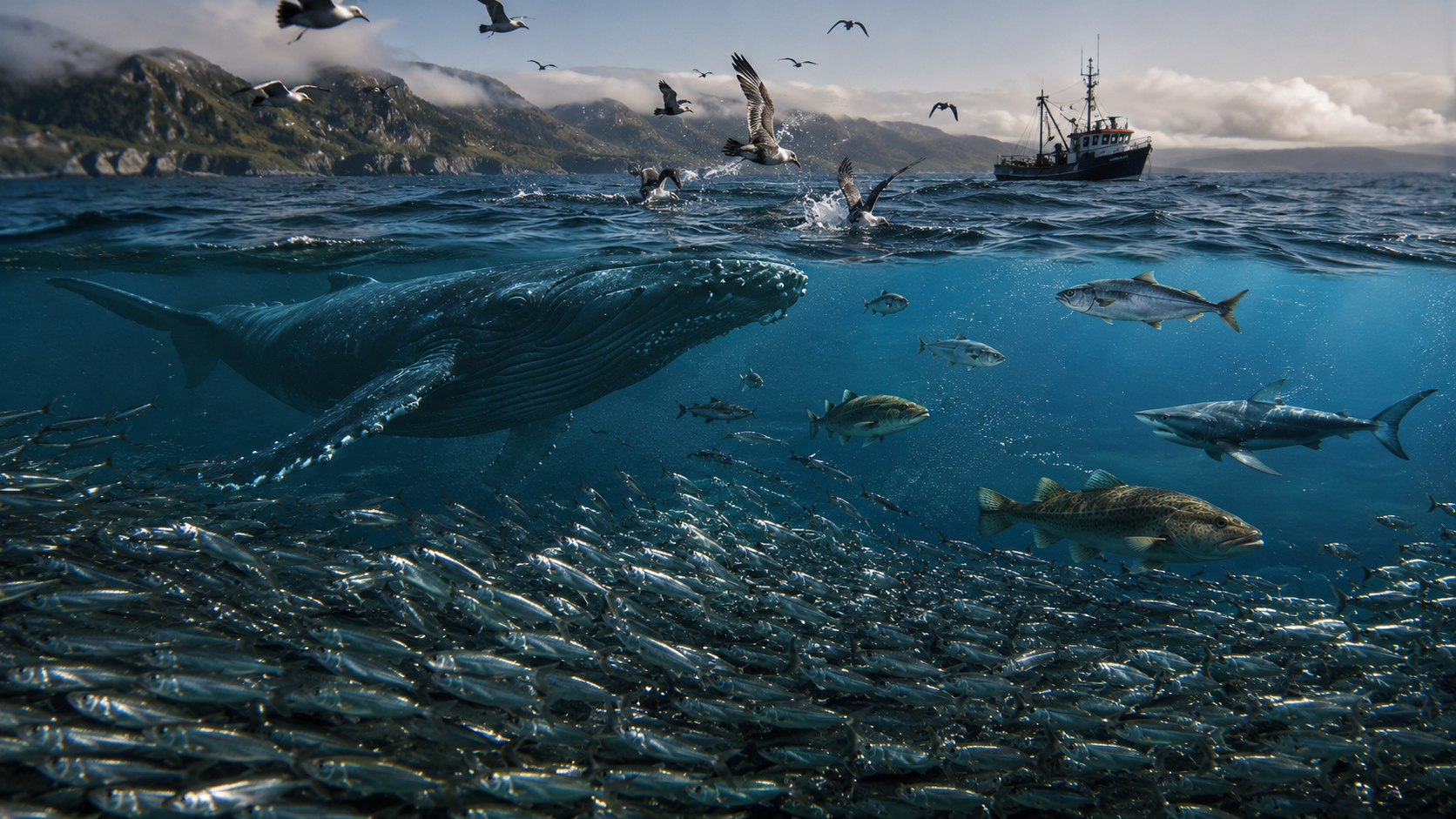
Capelin, herring, mackerel, sardines, anchovies, and other forage fish feed whales, seabirds, salmon, cod, sharks, and many other species. They transfer energy from plankton up through the food web. Without them, the ocean becomes less abundant, less stable, and less able to support the wildlife and fisheries people care about.
In this episode of How to Protect the Ocean, I speak with Jack Daly, marine scientist at Oceana Canada, about the organization’s report Little Fish, Big Foundation. The report looks at the state of Canada’s forage fish and asks a simple but important question: are we protecting the fish that hold the ocean together?
The Small Fish With a Big Job
Forage fish are often described as the glue of the ocean food web.
That may sound like a simple metaphor, but it is accurate. These fish connect the base of the food web to the predators people recognize most: whales, seabirds, cod, salmon, tuna, sharks, and marine mammals.
When forage fish decline, the effects do not stay with one species. They can ripple across the ecosystem.
A lack of forage fish can mean less food for seabirds raising chicks. It can mean fewer feeding opportunities for whales. It can affect fish species that support commercial and recreational fisheries. It can also affect coastal tourism, local fishers, and communities that depend on a healthy ocean.
Canada Has a Forage Fish Problem
The Oceana Canada report highlights a troubling issue: many forage fish stocks are not in good shape, and some do not have enough information available to clearly assess their health.
That matters because you cannot manage what you do not understand.
If a stock is heavily fished but poorly assessed, managers may not know whether catch levels are sustainable. If decisions are made year by year without a long-term plan, fisheries can become trapped in crisis management instead of rebuilding.
Jack Daly explains that some forage fish have the potential to recover, but only if action happens early enough. Once a stock becomes severely depleted, recovery becomes much harder.
In some cases, there may be no clear timeline for rebuilding.
The Problem With Waiting Too Long
One of the most important points in the episode is that not every fish stock can simply bounce back.
Forage fish often have short life cycles, which can make people assume they will recover quickly. But that assumption can be dangerous.
If too many fish are removed, if spawning is disrupted, or if environmental changes add pressure, a stock can fall to levels where rebuilding becomes uncertain.
That is where the stakes become clear.
This is not just about whether people can catch forage fish next year. It is about whether the ocean will have enough food to support the species and communities that rely on them over the long term.
Why This Is About More Than Fishing
Forage fish are used in many ways.
Some are eaten directly by people. Some are used as bait. Some are reduced into fish meal and fish oil for aquaculture or other industries.
That raises a difficult question: if these fish are so important to the ocean food web, how much should humans take?
This is where fisheries management becomes more than a numbers issue. It becomes an ecosystem issue.
A quota may look acceptable on paper, but if it does not account for whales, seabirds, cod, salmon, and other predators that need those fish, then the ocean is paying a hidden cost.
The Solution Starts With Better Protection
The good news is that the solutions are not impossible.
Oceana Canada is calling for stronger science-based management, better stock assessments, long-term rebuilding plans, and the protection of forage fish under Canada’s Fisheries Act.
That may sound technical, but the idea is simple.
Protect the fish that feed everything else.
If Canada wants healthier fisheries, stronger coastal economies, and more abundant oceans, forage fish need to be treated as a priority, not an afterthought.
Final Thought
Forage fish may be small, but their role is massive.
They are not just bait. They are not just fish meal. They are not just background species in the ocean.
They are the foundation of abundance.
And if we want whales, seabirds, salmon, cod, and healthy coastal communities to thrive, we need to pay attention to the tiny fish that make all of that possible.

CEO
The Biggest Mouthful: How Blue Whales Eat and Why Krill Matters