Who Actually Owns the Ocean?
Almost half of the planet belongs to no country at all.
That may sound impossible at first, but once you move beyond the waters controlled by individual coastal nations, you enter the high seas. These are the vast areas of ocean beyond national jurisdiction, often called international waters.
For decades, much of this space has been treated like a global free-for-all.
What Are the High Seas?
Every coastal country controls waters close to its shoreline through what is called an exclusive economic zone, or EEZ. This area usually extends about 200 nautical miles from the coast.
Inside that zone, countries can manage fishing, energy development, conservation rules, and other ocean activities.
Beyond that boundary, the rules become much more complicated.
That is where the high seas begin.
Why This Matters
The high seas make up nearly half of Earth’s surface.
That means the largest ecosystem on the planet exists mostly outside the direct control of any one country.
For a long time, the ocean was viewed as too big to damage. People believed it could absorb almost anything we threw at it and provide almost anything we wanted from it.
That belief no longer matches reality.
Industrial fishing fleets now operate thousands of kilometres from shore. Global shipping routes cross every major ocean basin. Deep-sea mining companies are interested in ecosystems we barely understand. Climate change is affecting marine life everywhere at once.
The ocean may still look endless, but it is no longer beyond human impact.
The High Seas Are Not Empty
One of the biggest mistakes people make is thinking of the high seas as empty water.
They are not.
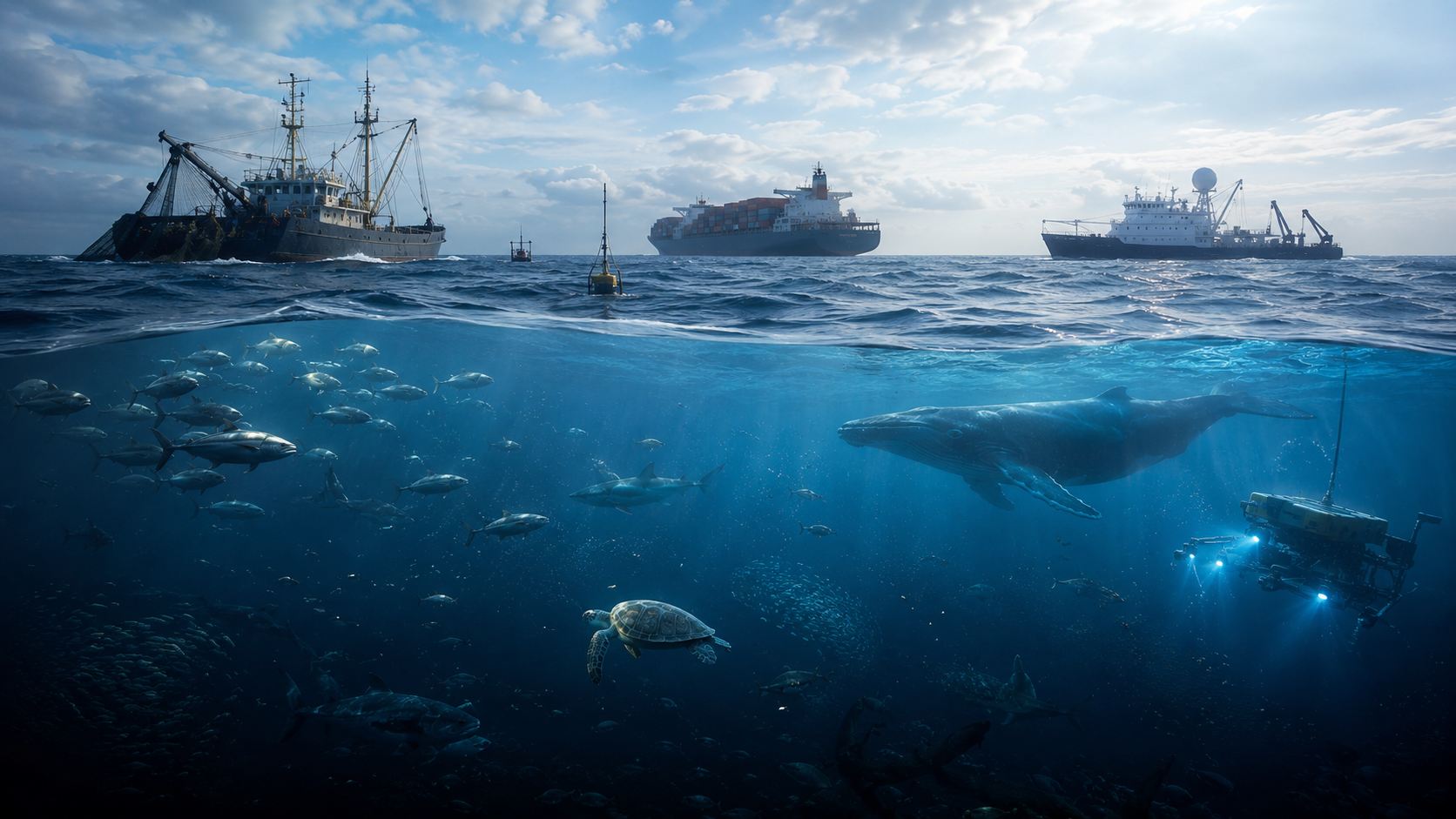
The high seas support tuna, sharks, whales, sea turtles, seabirds, plankton, deep-sea organisms, and countless species that move across ocean basins.
They also help regulate the climate.
What happens in the high seas does not stay in the high seas. If tuna populations collapse offshore, coastal fisheries can suffer. If deep-sea biodiversity disappears, we may lose species before we even discover them.
The Visibility Problem
A major challenge with the high seas is that most people never see what happens there.
We can see plastic on beaches. We can see coral bleaching in photographs. We can see coastal pollution near communities.
But industrial activity far offshore often happens out of sight.
That makes accountability harder.
When fishing, shipping, transshipment, and other activities happen far from public view, it becomes easier for harmful practices to continue without enough scrutiny.
The High Seas Treaty
For the first time, the world is trying to build a stronger collective system to protect biodiversity in areas beyond national jurisdiction.
That is the purpose of the High Seas Treaty.
The treaty is designed to help countries create marine protected areas in the high seas, strengthen environmental impact assessments, share marine genetic resources more fairly, and improve cooperation on ocean protection.
But signing a treaty is not the same as protecting the ocean.
The real test is implementation.
Protection Has to Be Real
Ocean protection only works when it becomes real in the water.
That means rules need enforcement. Protected areas need monitoring. Countries need to cooperate. Industries need accountability. And the public needs to understand why this part of the ocean matters.
The high seas are not some distant place disconnected from our lives.
They help stabilize the climate. They support marine life. They influence food systems. They connect ecosystems across the planet.
The ocean does not belong to one country.
But protecting it is everyone’s responsibility.

CEO
The Biggest Mouthful: How Blue Whales Eat and Why Krill Matters